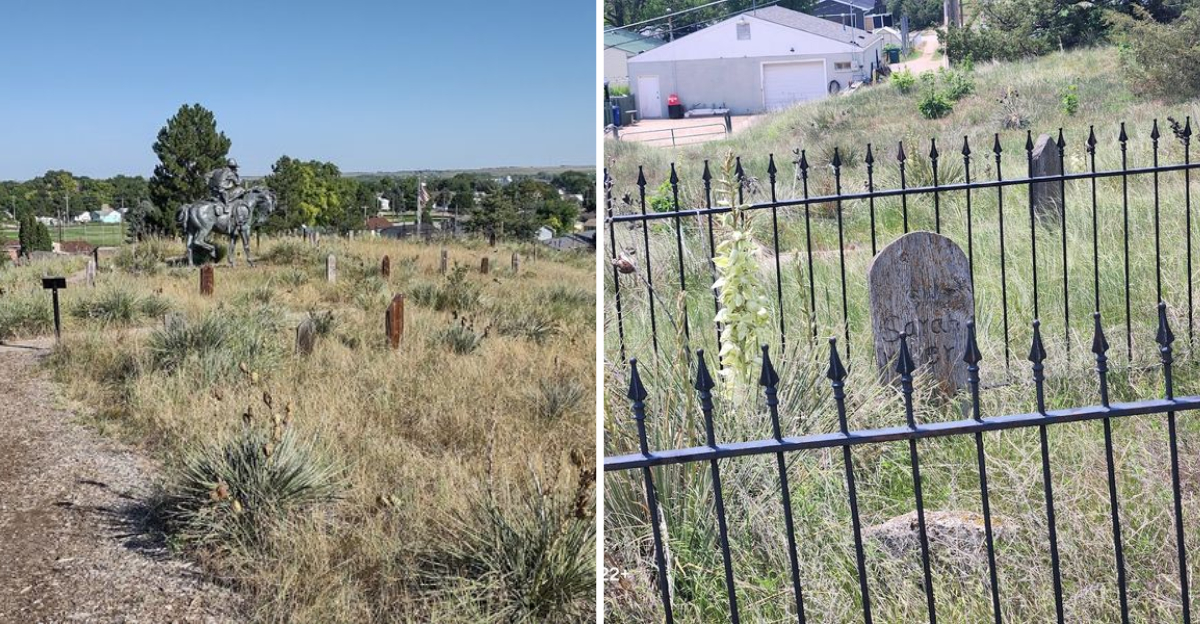
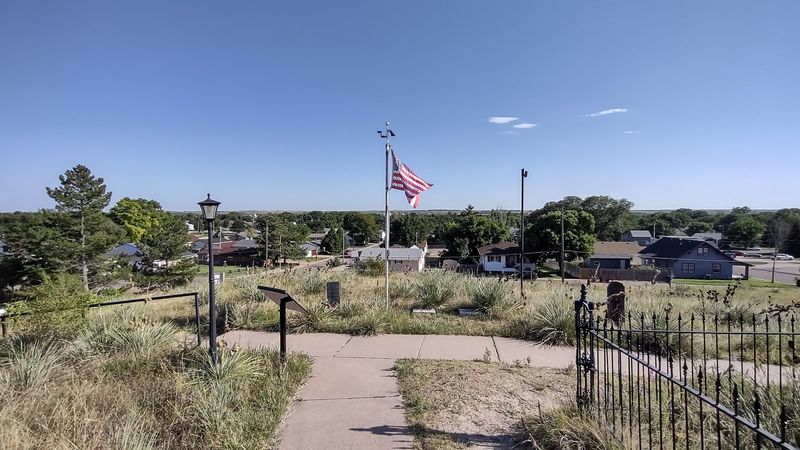
Cracked and weathered stones on a hill in Nebraska. A quiet residential neighborhood surrounds it, but this place carries the weight of the Old West in every marker.
I stumbled across it almost by accident, following a small roadside sign off the interstate. Half expecting a tourist trap, I found something far more haunting. Cowboys, drifters, and strangers who passed through the cattle trails and never made it home.
Some have names. Some have dates.
Some have nothing at all except a patch of earth and a marker that barely survived the decades. You walk among them and feel the silence pressing in. The wind moves through the grass, and for a moment you forget you are standing in the middle of a modern town.
History does not feel like a lesson here. It feels like a mystery still waiting to be solved.
The Unknown Cowboy: A Marker Without a Memory
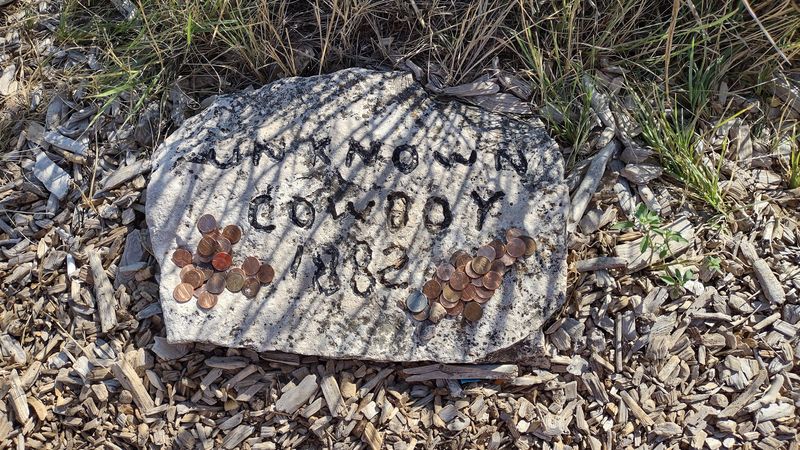
Out in the far northwest corner of Boot Hill Cemetery, there is a grave marker that says just two words: Unknown Cowboy. No birth year, no death year, no hometown scratched into the stone.
Just those two words, standing there like a question that nobody ever got around to answering.
It is one of those moments that stops you mid-step. You look at it and realize this person had a life, maybe a family somewhere, maybe a name people called out across a campfire, and all of that is just gone.
The cattle drives that passed through Ogallala during the 1870s and 1880s brought thousands of men through town, many of them young, many of them far from home.
Cowboys who died broke or unidentified were often wrapped in canvas and buried quickly, with whatever rough marker someone could put together. Wood rotted, stones shifted, and names disappeared.
The original markers at Boot Hill were crude at best, carved planks or simple posts that the Nebraska weather slowly erased over the years.
What makes this particular grave so striking is that someone still chose to mark it. They did not leave the ground bare.
They gave this person a title, even without a name, and that small act of acknowledgment feels surprisingly moving when you are standing right in front of it.
The Unknown Cowboy represents every nameless soul buried on this hill, and honestly, that weight is hard to shake once you feel it.
You stand there and try to imagine his face, his voice, the boots he wore. You wonder if anyone ever came looking for him, or if the cattle trail simply swallowed him up without a trace.
The prairie wind keeps blowing, and the marker stays silent. That is the whole point.
Pedro: A Man With One Name and No Past
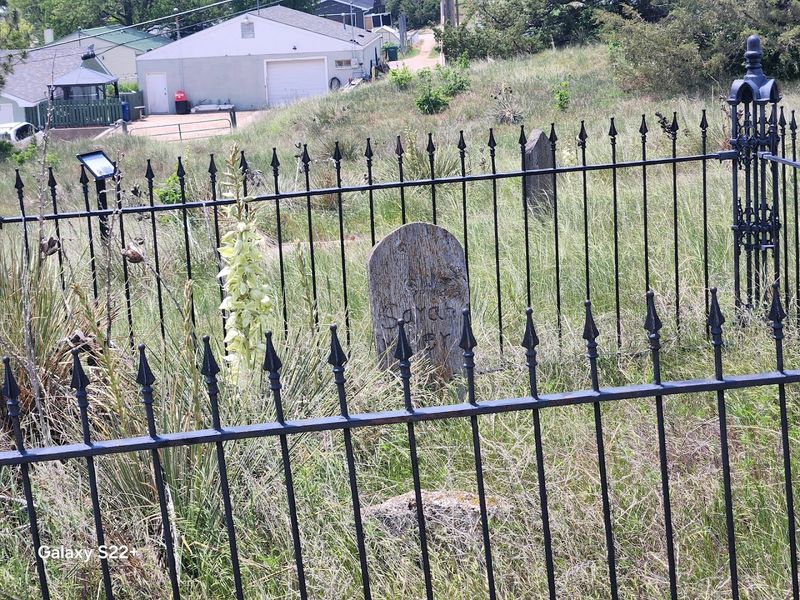
One of the more quietly heartbreaking graves at Boot Hill belongs to a man known only as Pedro. He died on September 13, 1876, and the details surrounding his life are almost entirely lost to history.
What is known is that he worked as a hired hand with a cattle outfit based out of Sidney, Nebraska, which means he was likely a ranch worker drifting through the region during the busiest years of the cattle trade.
The name Pedro suggests he may have come from Mexico or had Hispanic roots, but beyond that, the record goes silent. No surname was ever recorded.
No family came forward. He was given a name on his marker, which puts him a step ahead of some of his neighbors on this hill, but the story behind that name remains completely out of reach.
There is something specific about knowing the exact date someone died and still knowing almost nothing else about them. September 13, 1876, is a real day, a Tuesday, and somewhere on that day Pedro’s story ended in Ogallala, far from wherever he started.
The cattle trail era brought men of many backgrounds through Nebraska, and laborers like Pedro often worked the hardest jobs for the least recognition. His grave is a small reminder that the Old West was far more diverse than popular stories tend to suggest.
Pausing at his marker, even briefly, feels like the least anyone can do for a man history forgot to remember properly.
You kneel down to read the worn letters, and for a moment, the wind goes quiet. His name is still here, even if his story is not.
The Fifth Grave: Discovered by Accident in 1978
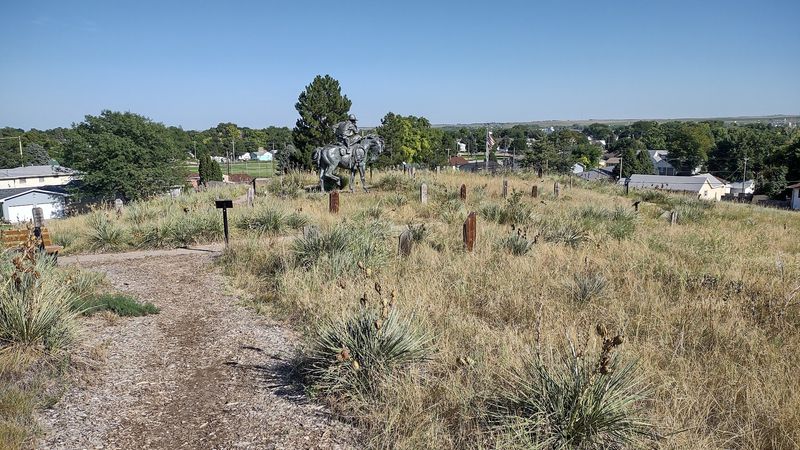
Most people who visit Boot Hill know about the four graves believed to be connected to an 1879 gunfight. They are grouped together, and their story has been told enough times that it has become part of the cemetery’s identity.
But there is a fifth grave nearby that almost nobody talks about, and its discovery was entirely unplanned.
In August 1978, workers accidentally uncovered human remains close to those four gunfight graves. The find was significant enough that anthropologists from the University of Nebraska-Lincoln were brought in to examine the site.
After careful study, they were unable to determine who the person was or even how they died.
No identity. No cause of death.
Just bones in the ground near a cluster of other unmarked or barely marked burials. The proximity to the gunfight graves raises obvious questions, but none of them have answers.
Was this person connected to that 1879 violence? Were they buried there at the same time, or years earlier or later?
Nobody knows.
That uncertainty is part of what makes Boot Hill feel different from a typical historic site. The ground here has not given up all of its secrets, and a discovery made less than fifty years ago proves that there may still be more waiting beneath the surface.
History tends to feel finished when it is written in a book. At Boot Hill, it still feels unfinished, like a chapter someone started and then set down without ever picking back up again.
Sarah Miller: The Grave That Refused to Decay
Sarah Miller’s story is the kind that makes you stop and reread the information sign twice just to make sure you understood it correctly. She was a young wife who died in childbirth and was buried at Boot Hill, which was not unusual for the time.
What happened when her grave was reopened in 1891 is the part that is genuinely difficult to explain.
When her body was exhumed for reburial in Ogallala’s newer cemetery, the gravedigger reportedly found her remains in a startling state. According to a 1935 newspaper account based on local memory, her body appeared petrified and showed no signs of decay, even after years underground.
Her child’s remains, buried alongside her, had reduced to bones, as would be expected. Hers had not.
The body was reportedly so heavy that a derrick had to be used to lift it from the ground. Whether this account is fully accurate, partially exaggerated, or somewhere in between is impossible to say now.
But it was documented, and local memory carried it forward for decades.
Petrification of human remains is an extremely rare phenomenon, sometimes associated with specific soil conditions or mineral content. Whether that explains what the gravedigger found in 1891 is a question no one can fully answer today.
Sarah Miller’s name is known, which sets her apart from many here. But the mystery wrapped around her burial makes her story feel just as unresolved as the graves that carry no name at all.
A Hill Full of Shallow Graves and Fading Markers
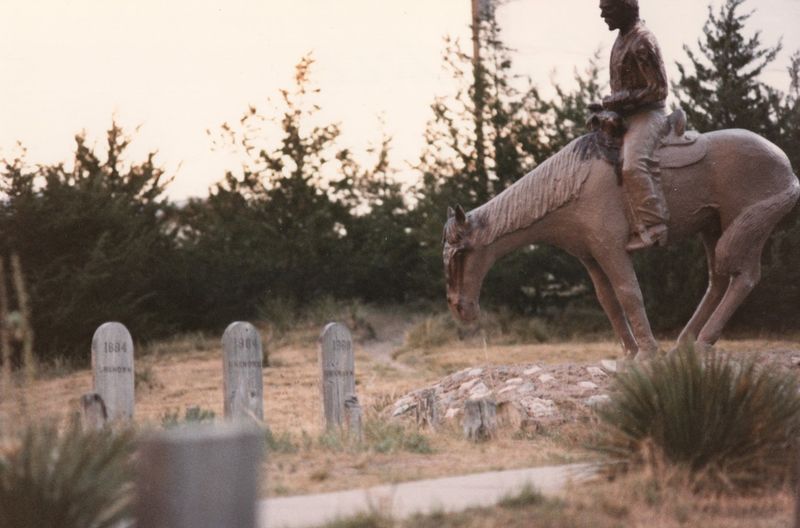
Boot Hill Cemetery is not a large place. It sits on a modest hill right in the middle of a neighborhood, and you can walk the whole grounds in under twenty minutes.
But the smallness of the space does not match the size of what it holds. This little patch of earth contains some of the most genuinely forgotten people in Nebraska history.
Most of the dead buried here during the cattle drive era were interred quickly and cheaply. Canvas instead of coffins, shallow holes instead of proper plots, rough-cut wood or fieldstones instead of engraved markers.
The Nebraska weather did the rest. Wind, frost, and decades of sun bleached and crumbled whatever identification had been left behind.
Getting to the cemetery requires climbing a flight of stairs, and parking on the surrounding residential streets can be tight. It is worth the few extra minutes it takes to get settled.
A brochure available at the site gives helpful background on the key graves and the history of the location, which adds real context to what you are looking at.
The cemetery is open around the clock, every day of the week, so there is no rush. Early morning visits have a particular kind of stillness to them, the kind that feels appropriate for a place like this.
Boot Hill is rated 4.6 out of 5 stars by visitors, and the consistent theme in their reactions is simple: the place feels genuinely real. Not staged, not polished, just honest and quietly powerful.
Address: Ogallala, NE 69153
