Six hours later I was still there, slightly damp from a water exhibit and completely fine with it. That is how a gray, drizzly morning in Ohio turned into an unexpected full-day adventure.
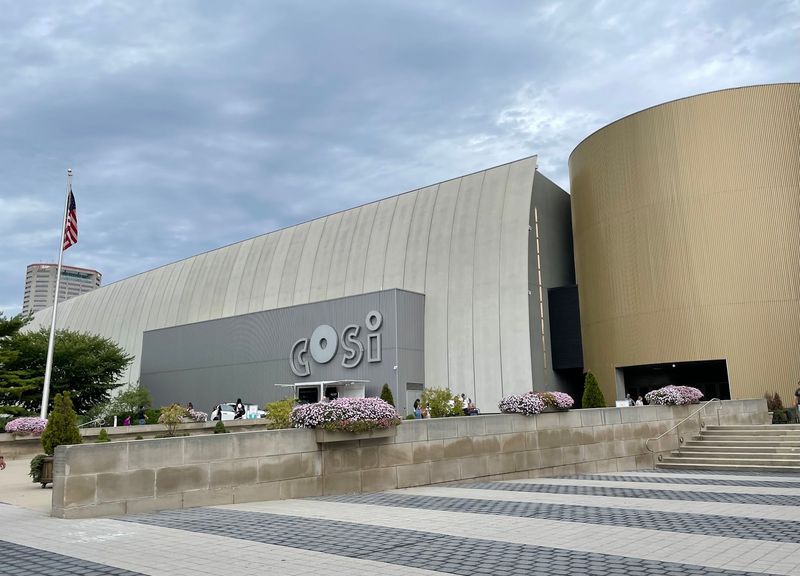
A friend had told me to just go to the science museum, and I showed up with no real plan. The building itself is enormous, a curved white sweep of concrete near the river, and inside there are hundreds of thousands of square feet of galleries, live shows, and a planetarium that happens to be the largest in the state.
What surprised me most was how much of it you actually touch, spin, launch, or build with your own hands. I watched grandparents crouching next to toddlers over the same marble run, and nobody looked bored.
The water exhibit had me laughing at myself while trying to redirect a stream with a plastic dam. The planetarium show made me tilt my head back and forget about the drizzly day outside.
If you think science museums are for kids only, this Ohio spot quietly proves otherwise.
The AMNH Dinosaur Gallery and Its Very Convincing T. rex
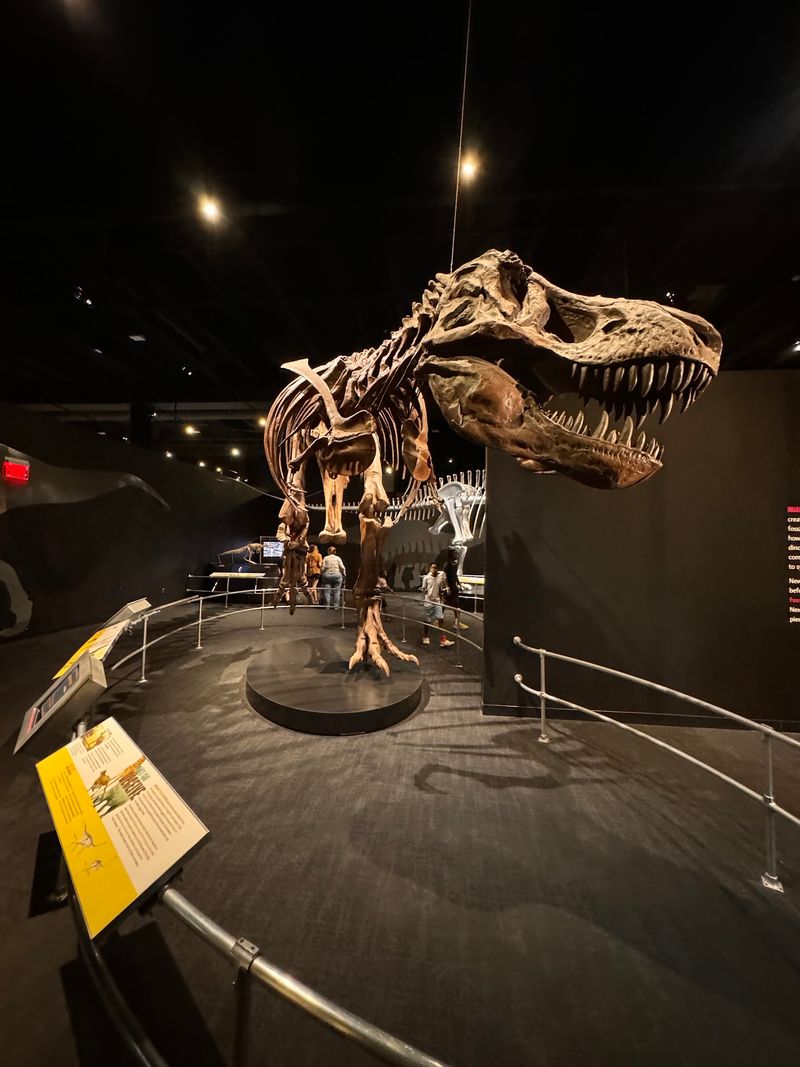
My first stop was the dinosaur gallery, mostly because I could see a giant skull from the hallway and had no self-control about it. Created with the American Museum of Natural History and opened in 2017, it is smaller than you might picture but packed tight with good stuff.
The T. rex is the obvious star. What kept me there longer, though, was a six-foot mechanical T. rex model that shows how the animal actually moved its legs, built from biomechanical research rather than movie guesswork.
Casts of a three-horned Triceratops and a dome-headed Pachycephalosaurus sit nearby, each with panels explaining current thinking about why those horns, frills, crests, and domes existed in the first place. Some of the theories are still debated, and I liked that the signs admit it.
The piece I hadn’t expected is a 15-by-10-foot re-creation of the Davenport Ranch Trackway, a set of sauropod and theropod footprints originally dug up in Texas back in the 1930s and 1940s.
Standing beside it, you get a strange sense of animals simply walking somewhere, which hits differently than a mounted skeleton does.
There is also a cast of a T. rex furcula, the wishbone, which upended the old assumption that wishbones belonged only to birds and the origins of flight. Small bone, big idea.
Give this gallery at least thirty unhurried minutes, and read the labels.
Gadgets, Circuits, and Chain Reactions in the Engineering Zones
Nobody at COSI hands you a lab coat, but the engineering play is everywhere once you start looking. The Gadgets exhibit is basically a room full of puzzles built to make you fiddle, fail, and try again.
I lost a solid twenty minutes there and I am a grown adult with a phone in my pocket.
Over in Energy Explorers, the centerpiece is a build-your-own chain reaction machine known as the Super Awesome Mini-Machine, or S.A.M.M. You arrange ramps, levers, and blocks, then release a ball and watch your careful plan either work beautifully or collapse in the first two seconds.
Potential energy becomes kinetic energy right in front of you, which beats reading about it in a textbook.
Electric Avenue sits in the same area, where you snap together circuits to get lights and buzzers going. It is simple enough for a first grader and still oddly satisfying at any age.
Project: Ripple Effect takes a different angle, letting visitors see how everyday choices affect water quality and the animals downstream. That one sneaks in systems thinking without feeling like a lecture.
Practical advice from someone who learned the hard way: come on a weekday if you can, because these stations are the ones kids camp out at longest. Tuesday mornings were noticeably calmer than the weekend.
And expect a wait at the popular builds without getting grumpy about it.
Ocean, Poseidon, and the Water Play You Will Get Slightly Soaked In
Ask around and half the visitors will tell you the Ocean exhibit is their favorite corner of the building. I get it now.
There is a mini-submarine you can climb into, a control station for driving a remotely operated underwater vehicle, and a tunnel walkthrough lit in that deep aquarium blue.
The water play section is where things get gloriously messy. Pipes, channels, valves, and floating bits let you redirect the flow however you want, and I watched two kids build a working aqueduct while arguing about it the whole time.
Roll your sleeves up before you start. Aprons are usually available, but sleeves stay soggy for a while regardless.
Driving the ROV takes a bit of patience since the controls don’t respond quite the way a video game would. That is sort of the point, because real underwater vehicles are awkward to steer too.
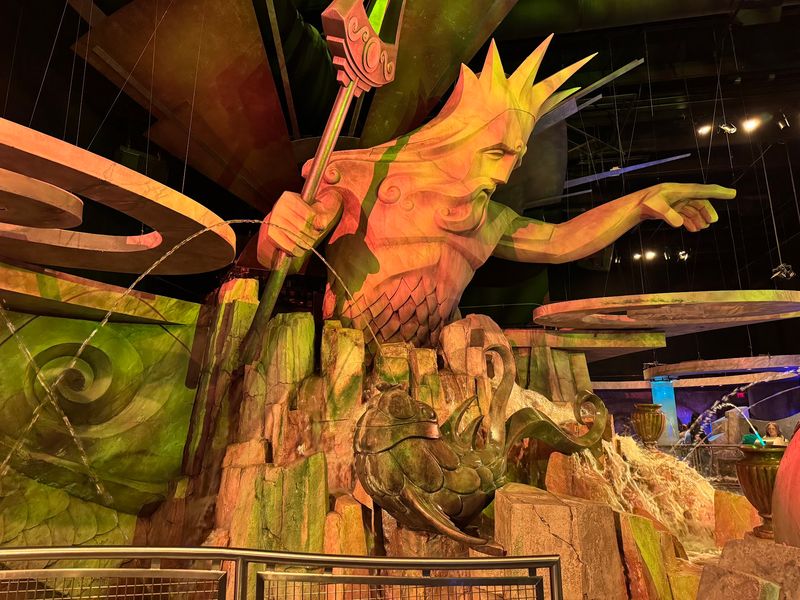
The Poseidon area nearby carries the same theme, and it tends to draw a crowd at midday. I circled back around three in the afternoon and had far more room to experiment.
Something worth knowing: interactive exhibits in heavy rotation occasionally go offline for maintenance, so if one station is roped off, another usually isn’t. Staff walking the floor were genuinely helpful when I asked what was running.
Bring a small towel for younger kids. Future you will be grateful during the car ride home.
Under the Dome, Ohio’s Largest Planetarium
The planetarium is the part of COSI I would build an entire visit around, and I say that as someone who usually skips theaters at museums.
It is the biggest planetarium in Ohio, running on modern digital projection, and the dome swallows your whole field of vision the moment the lights drop.
Shows rotate through different subjects. Some journey out past the planets, others stay closer to home and explore things like coral reefs or Earth science, so the topic you get depends entirely on when you walk in.
Here is my one piece of real advice: check the daily show schedule the moment you arrive, or look it up online before you leave the house. I have talked to people who wandered in expecting a tour of the solar system and got something completely different.
Neither show is bad, but going in knowing what you picked makes a difference.
Seats recline, which sounds minor until you spend twenty-five minutes with your head tilted back. Arrive a few minutes early so you can grab a spot nearer the center of the dome where the projection looks least distorted.
Little ones sometimes find the darkness and the swooping motion overwhelming, so sitting on an aisle gives you an easy exit if needed.
Afterward, I sat in the hallway for a minute just letting my eyes adjust. Nice pause in the middle of a loud, busy day.
Progress, A Whole Town Frozen Between 1898 and 1962
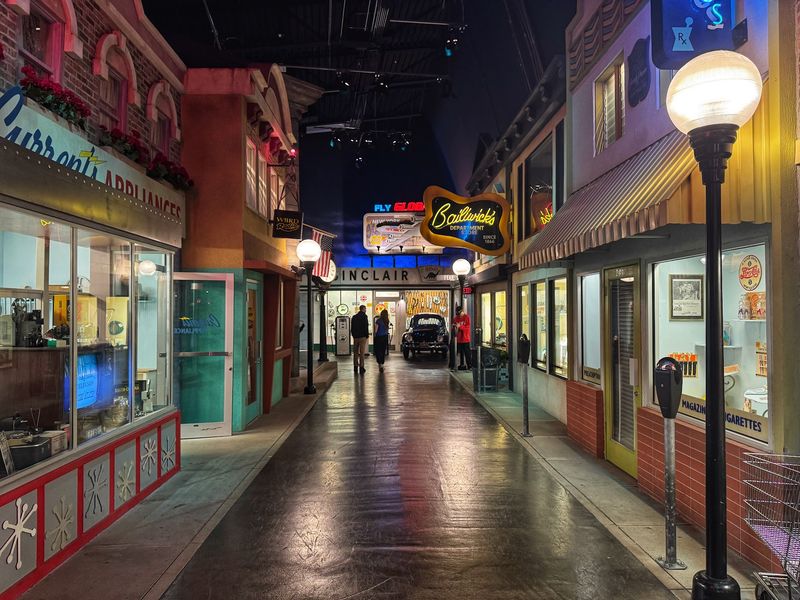
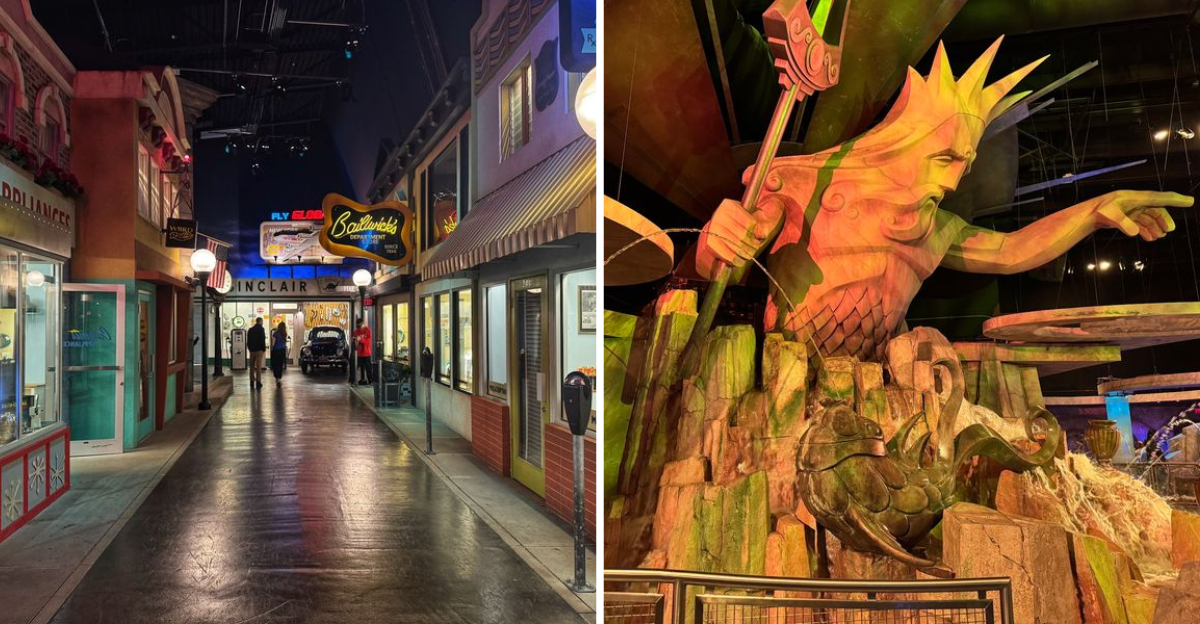
Of everything at COSI, Progress is the exhibit I keep describing badly to friends. It is a full walk-through street, built like a small town, and as you move along it you travel from 1898 toward 1962.
Storefronts, machines, household objects, and technology from each era sit right there for you to look at and often handle.
Older visitors seem to slow down the most in here. There is a real hush to it compared to the shrieking energy of the water exhibit two floors away, and the details are specific enough that you notice tiny things like the shape of a telephone or how a shop counter was arranged.
Even reviewers who weren’t sold on the rest of the museum tend to single this one out as genuinely interesting.
Kids get something different from it. Mine was less interested in the history and more amazed that people once had to crank things by hand.
Take your time on the transition points, where one decade becomes the next. Watching a kitchen or a workshop change piece by piece across sixty years tells a story about invention that no display case really can.
If you visit with teenagers who claim science museums are too young for them, start here. It reframes the whole place as something more layered than a playground, and it usually earns a grudging nod of approval before they wander off toward the rat basketball.
Live Shows, Big Science Park, and the Famous Rat Basketball
Rat basketball. That is not a typo, and it may be the single most talked-about thing at COSI.
Live shows run throughout the day, and alongside the rats you’ll find an electrostatic generator demonstration where hair stands straight up and everyone laughs at each other. The COSI Classics area gathers the old favorites that longtime visitors come back for, usually with a staff member on hand doing something loud.
Outside, Big Science Park turns physics into playground equipment. There is a huge granite sphere resting on a thin film of water that you can spin with one hand, and a car rigged to a pulley system so you can hoist it yourself and feel how leverage works.
Both are the kind of thing you understand in your muscles rather than your head.
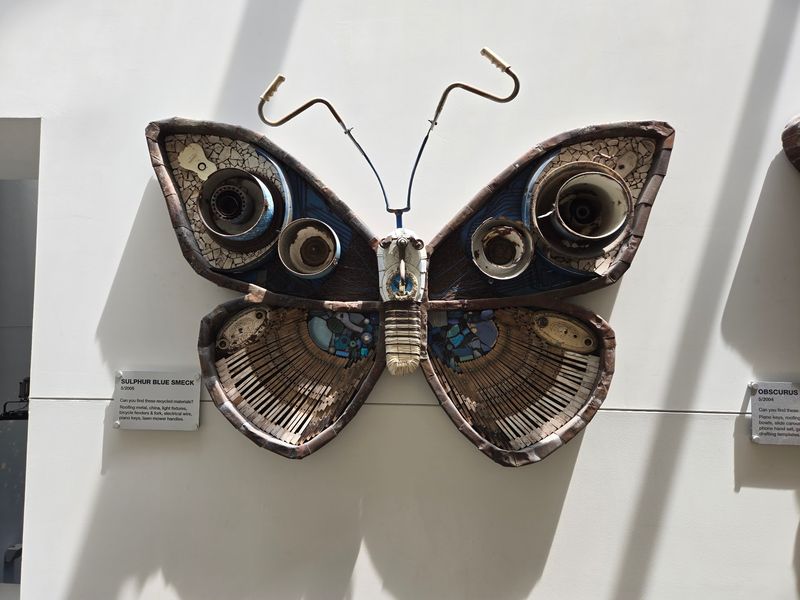
Indoors, don’t skip the hallways. Displays wedged between the main galleries include nanotechnology exhibits, sculptures, photography, and Rube Goldberg style contraptions, plus an interactive piece called Memory Machine that uses recycled materials and motion sensing to play sounds from famous places around the world.
For a bigger jolt, the Immersive Voyager VR simulator pairs virtual scenery with motion-powered seats.
Two logistics notes I wish I’d known sooner: lockers are cheap and roomy but need cash, and some attractions close their lines before the museum shuts at five. Check the schedule board when you arrive.
Address: 333 W Broad St, Columbus, Ohio
