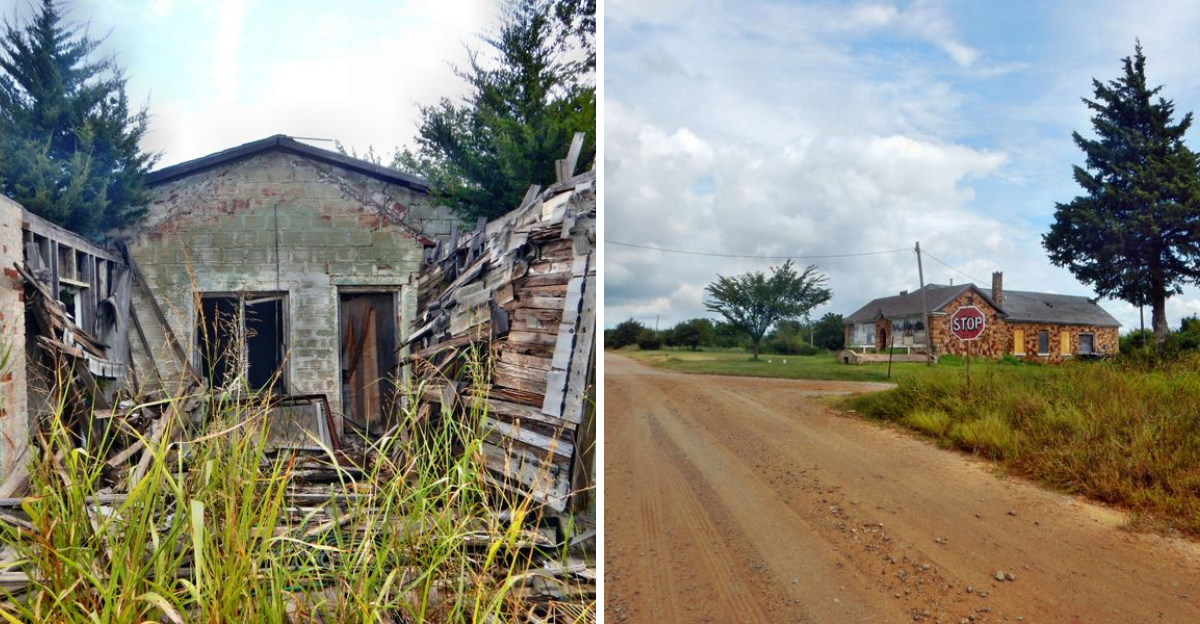
I stood on a dusty stretch of Oklahoma prairie where Avery once thrived, and honestly, it felt like stepping into a place that time simply forgot.
This ghost town in Lincoln County started life with big dreams as Mound City, got renamed for a railroad worker, and then watched everything fall apart when the trains stopped coming.
The story of Avery is one of those quintessentially American tales where a community rises on the promise of progress, only to fade when that promise moves elsewhere.
What makes this place so fascinating is how quickly it went from a bustling stop on the Eastern Oklahoma Railway to a collection of memories scattered across the prairie, and I wanted to understand exactly what happened here and why it matters today.
A Railroad Worker’s Unexpected Legacy
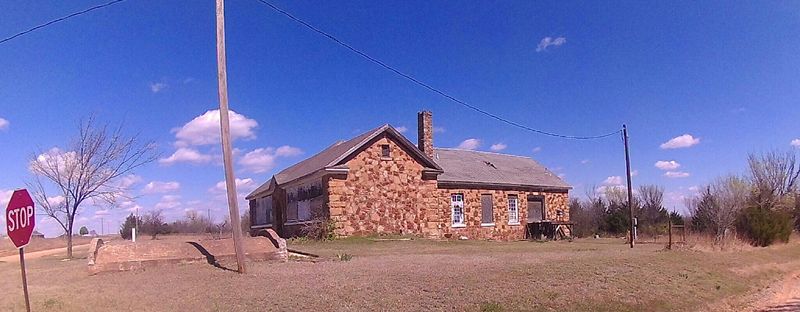
Avery Turner probably never imagined his name would outlive him on maps and in history books. He was just doing his job with the Eastern Oklahoma Railway when the town that started as Mound City decided to honor him with a name change.
Walking through what remains of Avery today, I tried to picture what Turner must have thought about this tribute. Did he feel proud, or maybe a little embarrassed that an entire community bore his name?
The renaming happened during that era when railroads were everything to small towns, and workers like Turner represented the lifeline that connected rural Oklahoma to the rest of the world. His legacy became intertwined with the town’s fate in ways nobody could have predicted.
I found it poignant that while Turner’s name stuck around longer than most of the buildings, even that eventually faded from common use. The post office that served Avery from 1902 to 1957 carried his namesake through fifty-five years of mail delivery.
Standing where the railway once cut through, I realized that sometimes our legacies are fragile things, dependent on infrastructure and economic forces beyond our control.
When Mound City Became Something Else Entirely
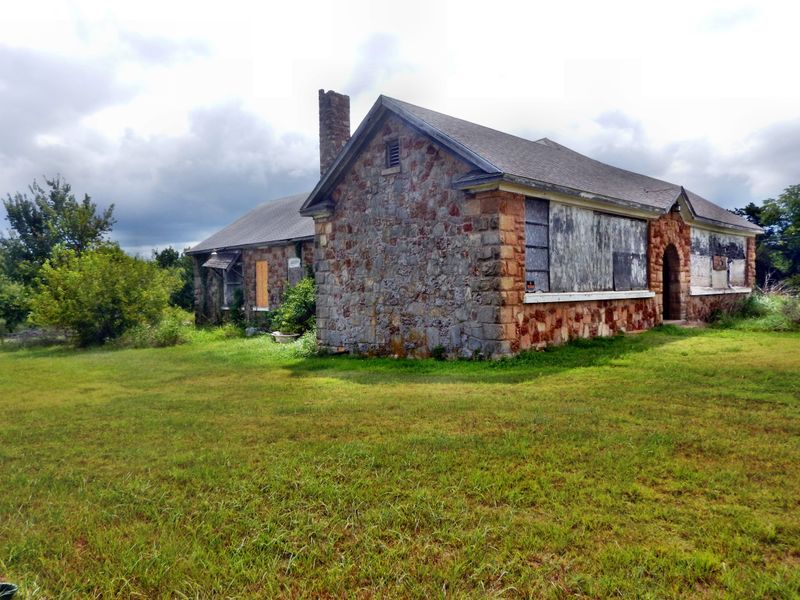
Every town starts with a name that means something to its founders, and Mound City clearly referenced the landscape features that early settlers noticed. But names change, and with them, identities shift in ways that echo through generations.
The transformation from Mound City to Avery marked more than just a administrative change. It signaled the community’s pivot from being defined by its natural geography to being defined by its connection to modern transportation.
I walked the area trying to spot the mounds that might have inspired the original name, and while the terrain does roll and rise in places, nothing particularly dramatic stands out today. Maybe a century of farming and weather smoothed things over, or perhaps the mounds were never that impressive to begin with.
What struck me most was how completely the Mound City identity vanished. Unlike some places that keep their old names alive through neighborhoods or local landmarks, Avery seemed to erase its past entirely when it embraced its railroad future.
That complete transformation makes the eventual abandonment feel even more ironic, as if the town bet everything on one identity and lost. Ghost towns fascinate us partly because we expect to see picturesque ruins, but Avery disappoints those expectations spectacularly.
Almost nothing remains standing, and what physical evidence exists requires a trained eye to recognize. I walked the townsite with a metal detector enthusiast who showed me where buildings once stood based on nail concentrations and foundation remnants.
The general store was here, the depot there, and houses scattered along what was once a proper street grid. Oklahoma’s climate is harsh on abandoned structures.
Wood rots quickly in humid summers, while winter freezes and spring storms accelerate deterioration. Without maintenance, buildings collapse within decades, and then scavengers salvage anything useful, and finally, farmers plow the debris under or burn what remains.
The complete absence of structures makes Avery feel more forgotten than most ghost towns. Places with standing buildings at least offer something tangible to photograph and explore, but here, you’re left with landscape and imagination.
I found that absence strangely powerful, though. It forced me to really consider how thoroughly a community can disappear, how little trace we leave when economic forces move on and nature reclaims its territory without sentiment or hesitation.
Lincoln County’s Forgotten Corner
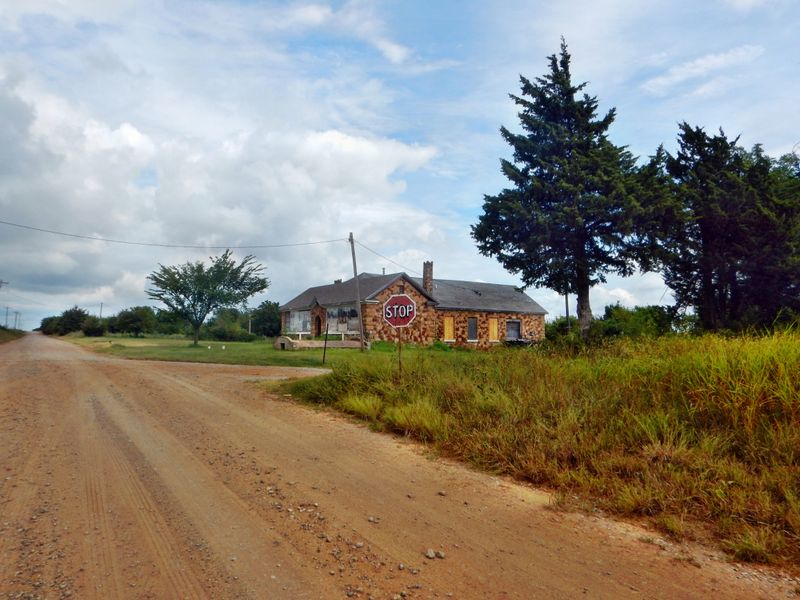
Lincoln County sprawls across central Oklahoma, and Avery sits in what feels like its most remote corner. Getting there requires intentional navigation because no major highways pass nearby anymore.
The county itself was named after President Abraham Lincoln, which gives it a certain historical weight that towns like Avery helped build through their agricultural and railroad contributions.
During Avery’s peak years, Lincoln County was dotted with similar small communities, each one serving farmers and ranchers in their immediate vicinity.
I drove through several other barely-there towns on my way to Avery, and the pattern became clear. Lincoln County once supported dozens of these railroad stops, but as transportation evolved and farming mechanized, the need for such closely-spaced communities evaporated.
What remains today is a landscape that looks much like it did before settlement, except for the occasional foundation or road that hints at former human presence. The county continues on, of course, with its seat in Chandler, but places like Avery became expendable in the modern economy.
Standing in Avery, I felt the isolation that must have gradually convinced residents to leave, especially after the trains stopped making their town a priority destination.
The Eastern Oklahoma Railway’s Rise and Routes
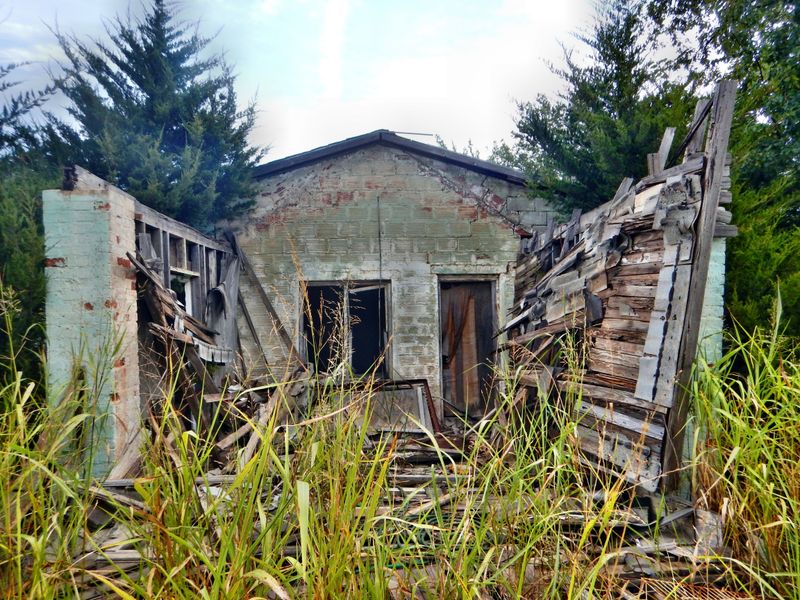
Railroad companies in the early twentieth century wielded enormous power over which communities thrived and which withered. The Eastern Oklahoma Railway made those life-or-death decisions for towns like Avery every time it adjusted schedules or routes.
This railway line connected Oklahoma’s agricultural interior to larger markets, and for a while, Avery represented an important stop where farmers could ship grain and livestock while receiving manufactured goods and supplies.
The symbiotic relationship seemed permanent to residents who built homes and businesses around the depot.
I researched the railway’s history and found that it eventually merged into larger systems, as most small regional railroads did. Those mergers inevitably led to route consolidations and efficiency measures that eliminated stops in towns like Avery.
The physical act of trains bypassing Avery probably happened gradually rather than all at once. Maybe freight trains stopped first, then passenger service became less frequent, until finally the tracks themselves were removed or simply abandoned to rust.
Walking along where the railway bed once ran, I could still detect the slightly elevated grade and the unusually straight path through otherwise rolling terrain. Those traces are all that remain of the iron road that gave Avery its brief moment of prosperity.
Agriculture’s Broken Promise on the Prairie
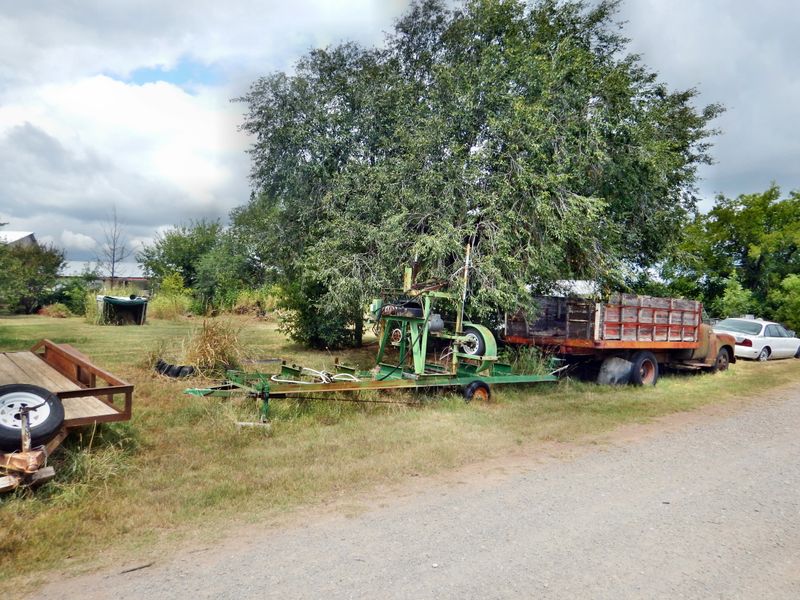
Farming brought settlers to this part of Oklahoma in the first place, and for decades, agriculture sustained communities like Avery through good years and bad. The prairie soil could be productive when rainfall cooperated, and the railway made shipping crops economically viable.
But agricultural economics changed dramatically through the twentieth century, and small towns paid the price. I spoke with historians who explained how mechanization meant farmers needed less help and fewer nearby services, while consolidation meant fewer family farms and more corporate operations.
The Dust Bowl years hit Oklahoma particularly hard, though Avery’s location in Lincoln County meant it fared slightly better than western parts of the state. Still, the ecological disaster and economic depression of the 1930s convinced many families that farming this land wasn’t worth the struggle.
Those who stayed and adapted found they could drive to larger towns for supplies and services, making places like Avery redundant. The very improvements in transportation that once made Avery necessary eventually made it obsolete.
I stood in what were probably once productive fields and saw how nature had reclaimed everything. Without constant human intervention, the prairie simply takes back what was temporarily borrowed.
Getting to Avery today requires determination because it’s not on the way to anywhere else. I drove from Chandler, the Lincoln County seat, following increasingly smaller roads until pavement gave way to gravel and I started questioning my navigation.
There are no tourist amenities, no historical markers, and no acknowledgment that you’ve arrived at a significant location. Visiting means parking alongside a county road and walking into prairie grass, hoping you’re in approximately the right spot.
I recommend bringing a metal detector if you’re serious about finding artifacts, though legally you shouldn’t remove anything you discover. The thrill comes from detecting evidence of human habitation beneath the grass: nails, glass fragments, pottery shards, and occasional larger pieces that hint at daily life.
Respect private property boundaries, as much of the townsite probably sits on land that farmers currently use or own. I encountered one landowner who was friendly and knowledgeable about Avery’s history, sharing family stories about when a few buildings still stood in the 1970s.
The visit won’t take long because there’s simply not much to see, but something about standing where a community once thrived and then completely vanished creates a contemplative mood that I found surprisingly moving and thought-provoking.
The Population That Vanished Into Memory
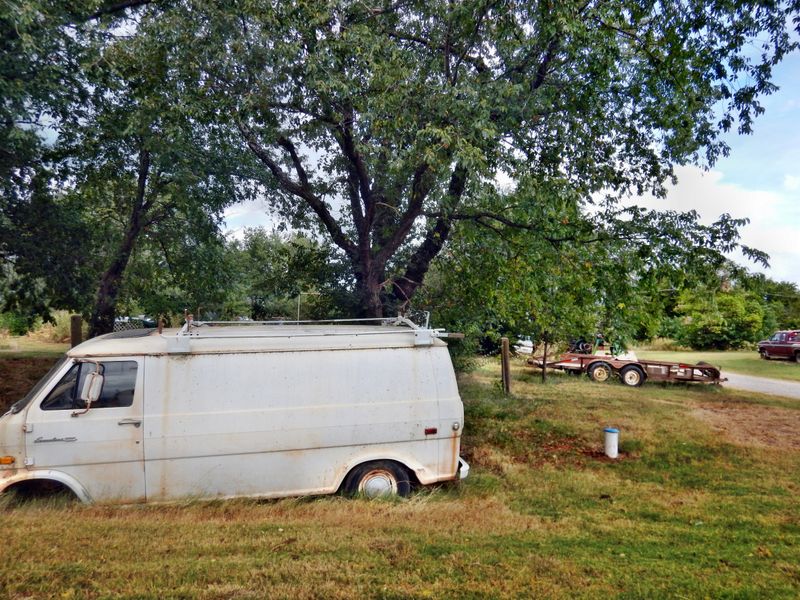
Nobody seems to know exactly how many people called Avery home at its peak, which itself tells you something about the town’s modest scale. Small prairie communities often went uncounted in official records, existing in that space between too small to matter and just big enough to have a post office.
I searched through census records and historical documents, finding only scattered references that suggested Avery never grew beyond a few dozen families at most.
That’s typical for railway stops in rural Oklahoma, where the town existed primarily to serve surrounding farms rather than as a population center itself.
The decline probably started slowly, with young people leaving for opportunities in places like Tulsa or Oklahoma City. Then families followed when schools consolidated or when breadwinners found work elsewhere, and suddenly the critical mass needed to sustain community institutions simply wasn’t there anymore.
By the time the post office closed in 1957, Avery’s population had likely dwindled to single digits. The last residents probably hung on out of stubbornness or lack of options, watching their neighbors depart one by one.
Today, the population stands at zero, and even finding people who remember when Avery was inhabited requires searching through Oklahoma and other states where descendants relocated. Figuratively, Avery lost its narrative thread when the railroad stopped making it part of Oklahoma’s development story.
The town went from being a character in the state’s growth saga to being completely written out of the script within a few decades. I found something darkly humorous about how thoroughly Avery failed at permanence.
The founders who named it Mound City, the railroad that renamed it for Avery Turner, the families who built homes expecting to raise generations there, everyone got it wrong about this location’s future. That failure isn’t unique to Avery, of course.
Oklahoma is littered with similar ghost towns, each one representing someone’s dashed hopes and abandoned investments. But Avery’s complete disappearance makes it a particularly pure example of how fragile our communities really are when separated from economic necessity.
Standing in the empty prairie, I couldn’t help but wonder which of today’s small towns will be tomorrow’s Averys, forgotten coordinates where future visitors will struggle to imagine that people once called this place home and believed it would last forever.
Dear Reader: This page may contain affiliate links which may earn a commission if you click through and make a purchase. Our independent journalism is not influenced by any advertiser or commercial initiative unless it is clearly marked as sponsored content. As travel products change, please be sure to reconfirm all details and stay up to date with current events to ensure a safe and successful trip.
