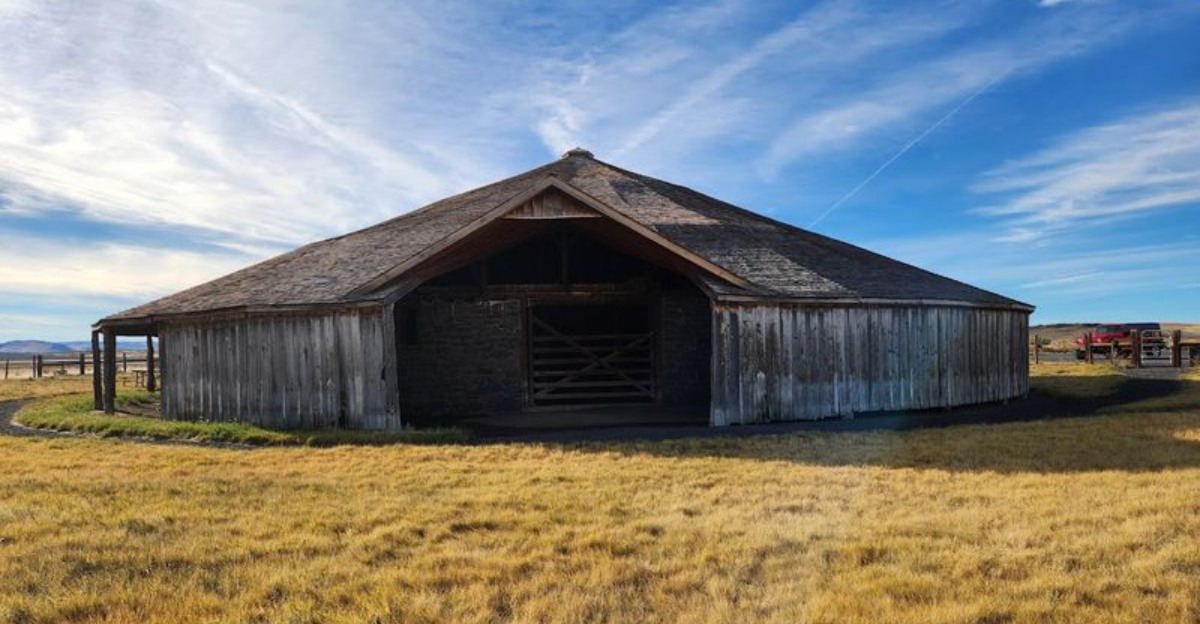
You have seen square barns, red barns, and falling down barns, but nothing quite prepares you for this. A massive wooden circle rising from the high desert, built not for hay, but for something far wilder.
This 100 foot round structure was designed to break the spirits of untamed horses during Oregon’s booming cattle empire days. The design is genius, a circular raceway where handlers could work with horses without corners to trap or spook them.
You can almost hear the thunder of hooves echoing off those curved walls, a sound that has not faded with time. The building stands today as a rare relic of a rugged era, preserved for visitors to walk through and marvel at the craftsmanship.
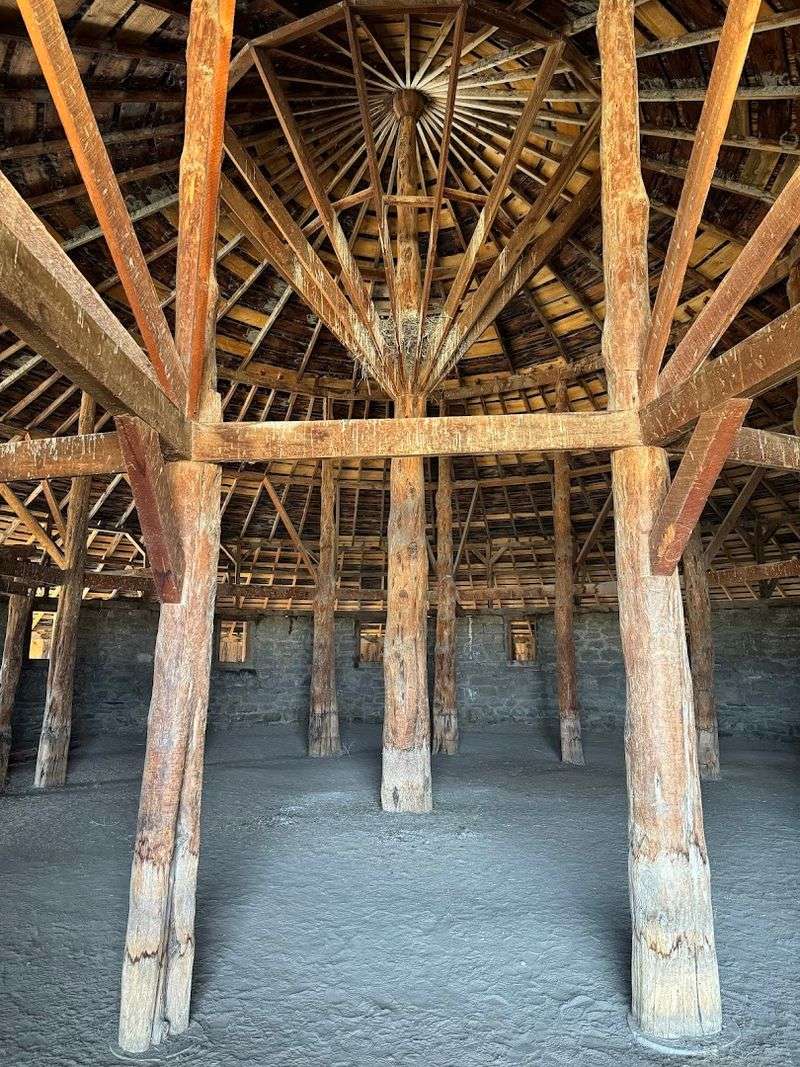
Sunlight streams through gaps in the wooden slats, casting stripes across the dusty floor like old fashioned stage lighting. A small museum nearby tells the story of the man behind it all, a cattle baron who left a lasting mark on the landscape.
Oregon is filled with quirky roadside history, but this round barn is in a class all its own.
Pete French and His Cattle Empire Story
Peter French arrived in Oregon as a young man with big ambitions and very little land. He worked his way up through the cattle trade, eventually controlling somewhere between 160,000 and 200,000 acres of high desert rangeland.
That number is staggering even by today’s standards.
He used every legal tool available, and sometimes pushed those tools well past their limits. The Swamp and Overflow Act allowed marshland purchases at low prices, and French reportedly built dams to flood areas he then bought cheaply.
His tactics made him powerful, but also earned him serious enemies among neighboring settlers.
French was known for being fiercely loyal to the men who worked for him. He paid well, kept his cowboys fed, and ran one of the most organized ranching operations in the Pacific Northwest.
His story is messy and complicated, full of ambition, conflict, and a violent end that Oregon history has never quite stopped talking about.
The Wild Horse Breaking Purpose Behind the Barn
Most barns store hay and house livestock through cold seasons. This one was built with a completely different goal in mind.
The round shape created a continuous indoor track where cowboys could work with wild horses all winter long without weather interruptions.
Breaking horses to harness was serious and dangerous work on any ranch. At the P Ranch operation, mule teams needed to pull heavy freight wagons across rough terrain.
Training them required patience, repetition, and a controlled space that kept both animal and rider safer than open ground.
The inner circle of the barn was also used for foaling mares, adding another layer of purpose to the clever layout. Every inch of this structure was thought through with the realities of frontier ranching in mind.
Spending time inside, you start to picture the noise and movement that once filled this space. The silence now feels almost theatrical compared to what it must have sounded like.
The Juniper and Stone Construction That Has Lasted Over 140 Years
There is something deeply satisfying about a building that refuses to fall down. The Pete French Round Barn has been standing since the 1880s, and the materials used explain a lot of that staying power.
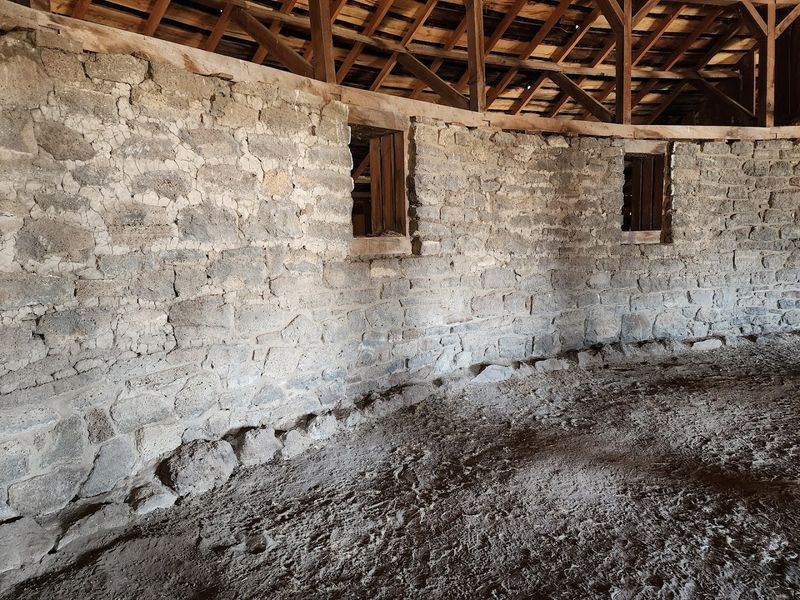
Local stone was stacked carefully to form the outer walls, thick enough to hold out wind and cold.
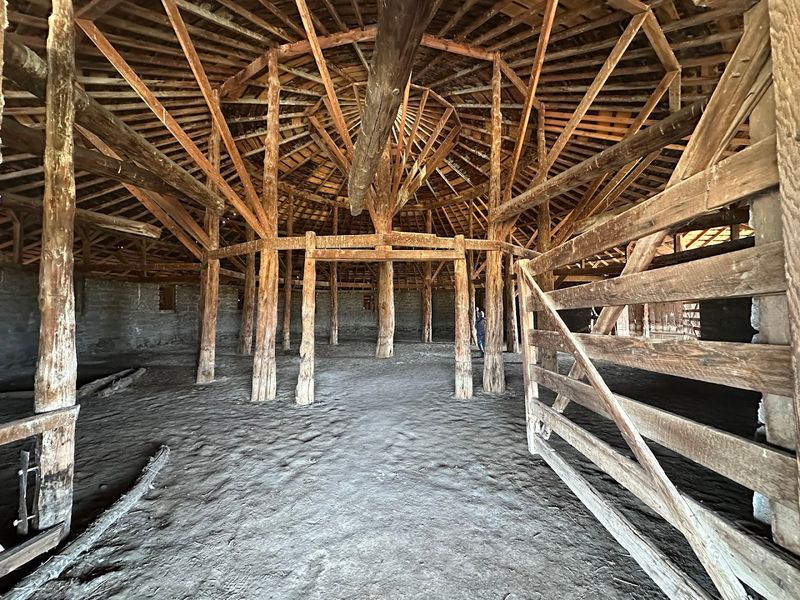
Juniper wood was harvested from the surrounding high desert and used for the interior columns and roof framing. Juniper is naturally resistant to rot and insects, making it a smart choice for a structure that would face decades of harsh Oregon winters.
The builders clearly knew their environment well.
Walking around the perimeter today, you notice how the stone has developed a beautiful patina. Lichen grows in patches across the surface, and the mortar shows its age in an honest, dignified way.
Some interpretive panels inside explain the construction methods in detail, which adds real context to what you are seeing.
The Dramatic and Violent End of Pete French
Pete French did not die peacefully of old age on his ranch. His story ended on New Year’s Day 1897, shot by a neighboring settler named Edward Oliver.
The dispute had been building for years over land access and water rights.
Oliver had been forced to travel more than six miles out of his way just to reach his own property because French had blocked the shorter route. That kind of pressure, applied relentlessly over time, eventually reached a breaking point on a cold winter morning.
A jury found Oliver not guilty on grounds of self-defense.
The verdict reflected how many local people felt about French by that point. His own brother reportedly said he could not blame Oliver for what he did.
That detail hits differently when you are standing inside the barn French built, surrounded by the empire he constructed through sheer force of will and some very ruthless tactics. His story is not simple or comfortable, but it is absolutely compelling.
The 100-Foot Round Barn and Its Remarkable Design
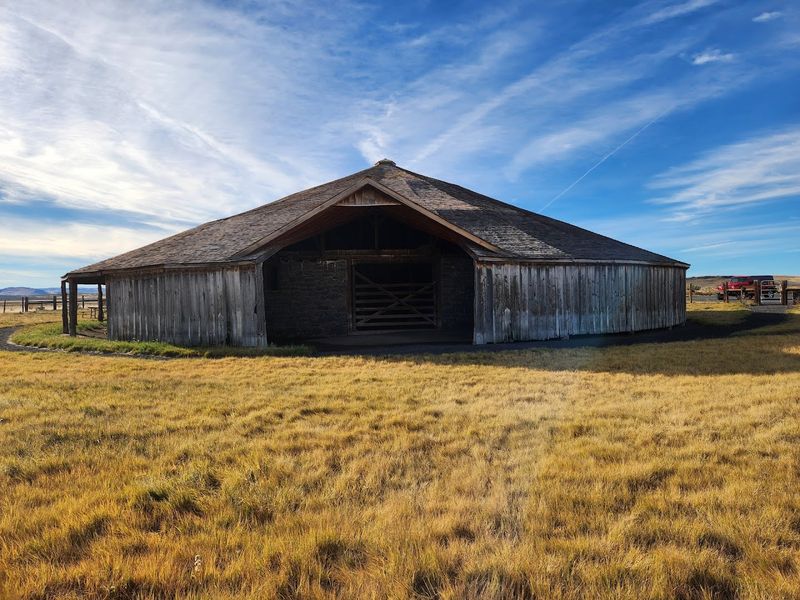
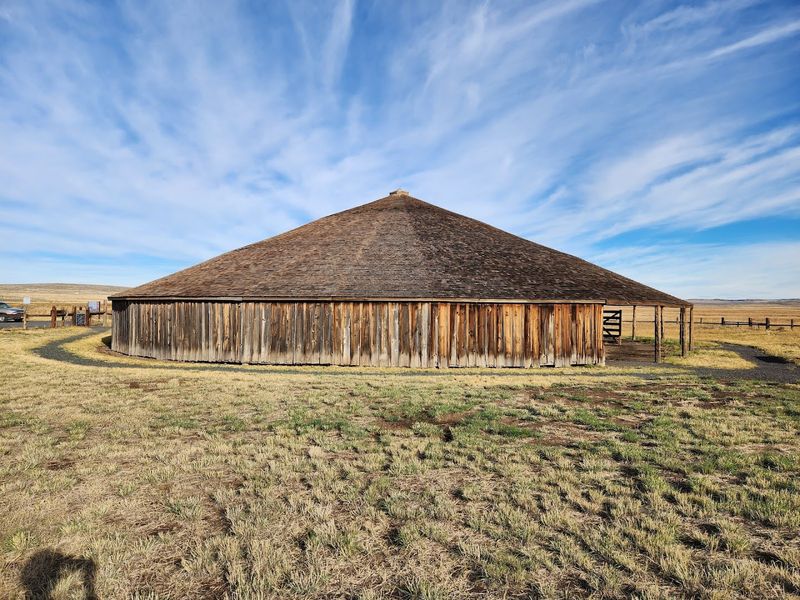
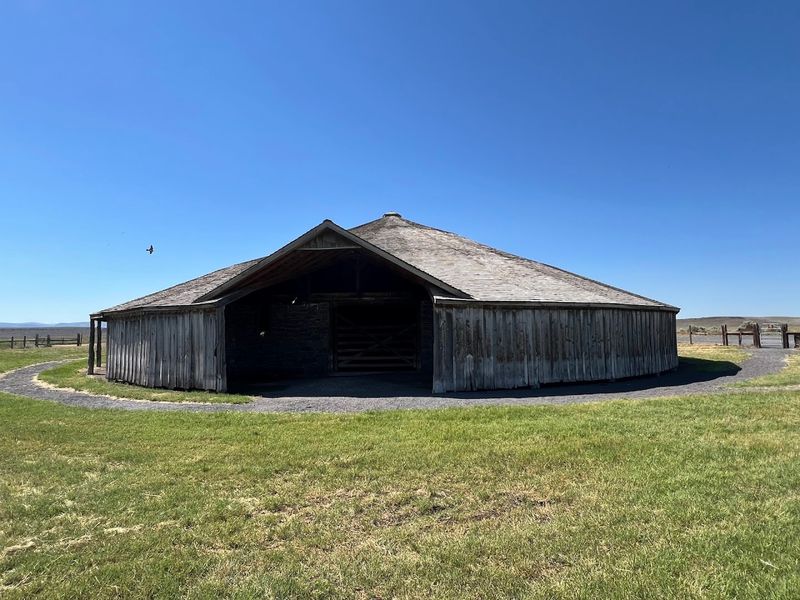
Walking through the entrance of this barn, the sheer size of it catches you off guard. The structure stretches 100 feet across, forming a perfect circle that feels almost impossible for its era.
Stone walls rise from the ground with a quiet, stubborn permanence that speaks to serious craftsmanship.
An inner ring of juniper posts supports the massive roof, creating a covered track around the central pen. Horses were once led around that inner ring repeatedly, learning to respond to riders during cold winter months.
The design kept training going even when snow and wind made outdoor work dangerous.
What makes this barn so striking is how every detail served a practical purpose. Nothing here was decorative.
The builders thought carefully about ventilation, animal movement, and structural strength. Visiting today, you can still feel that original logic in every beam and stone.
It stands as proof that frontier engineering could be elegant, efficient, and built to last well over a century.
The Visitor Center and Gift Shop Experience
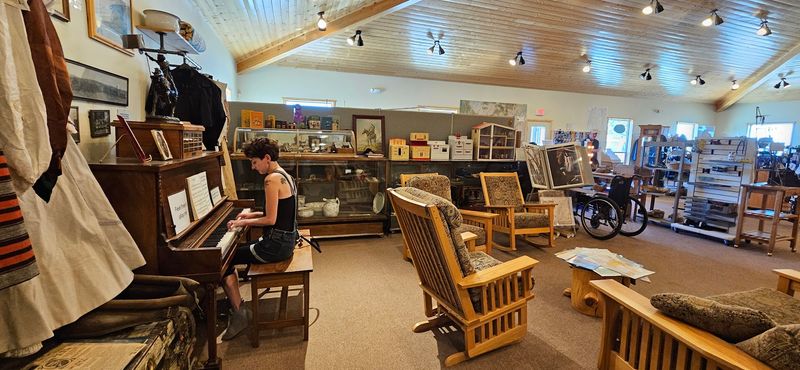
Right next to the barn sits a visitor center and gift shop that looks modest from the outside but holds more than you expect. Step inside and you find books on Oregon ranching history, Steens Mountain souvenirs, and local crafts that reflect the character of this remote region.
The staff who run this space are genuinely knowledgeable and enthusiastic about the area. Visitors have noted how freely they share recommendations for nearby sights and answer questions without rushing anyone along.
That kind of unhurried helpfulness is rare and worth appreciating when you find it.
The interpretive displays inside give real context to the barn and to Pete French’s story. Timelines, photographs, and written explanations help fill in gaps that the barn itself cannot communicate on its own.
If the center happens to be closed during your visit, outdoor signage still walks you through the key history points.
The High Desert Setting and Surrounding Landscape
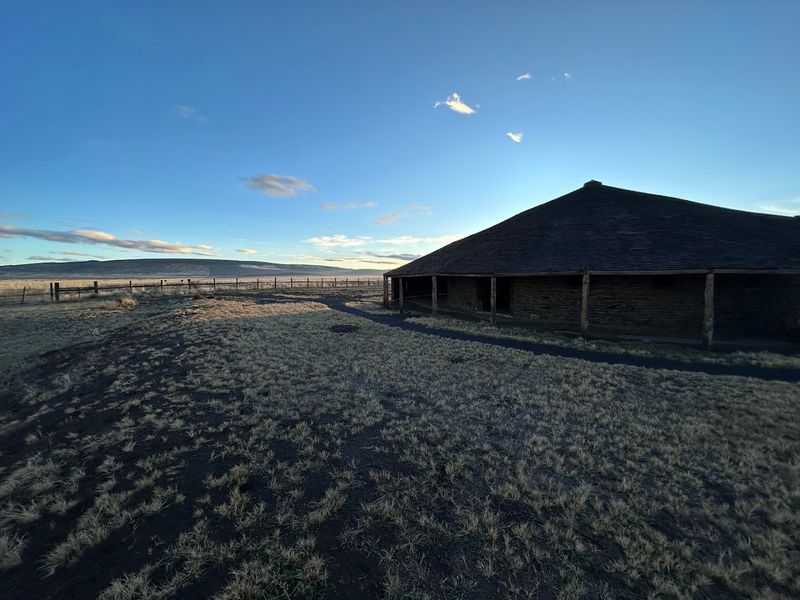
The drive to the Pete French Round Barn is part of the experience. Lava Bed Road cuts through open sagebrush country that stretches endlessly in every direction.
The sky out here feels enormous, and the silence is the kind you actually notice.
The barn becomes visible from a long distance as you approach, which adds a sense of anticipation. Seeing it appear on the horizon against nothing but flat desert and distant ridgelines makes the structure feel even more improbable and impressive.
You start wondering how anyone moved enough materials out here to build something this size.
The surrounding landscape near Diamond connects to the Malheur National Wildlife Refuge, making the area a genuine destination for birdwatching alongside history. Sandhill cranes, raptors, and shorebirds are common depending on the season.
The high desert light changes dramatically throughout the day, shifting from pale gold in the morning to deep amber at sunset.
Wildlife Living Inside and Around the Barn
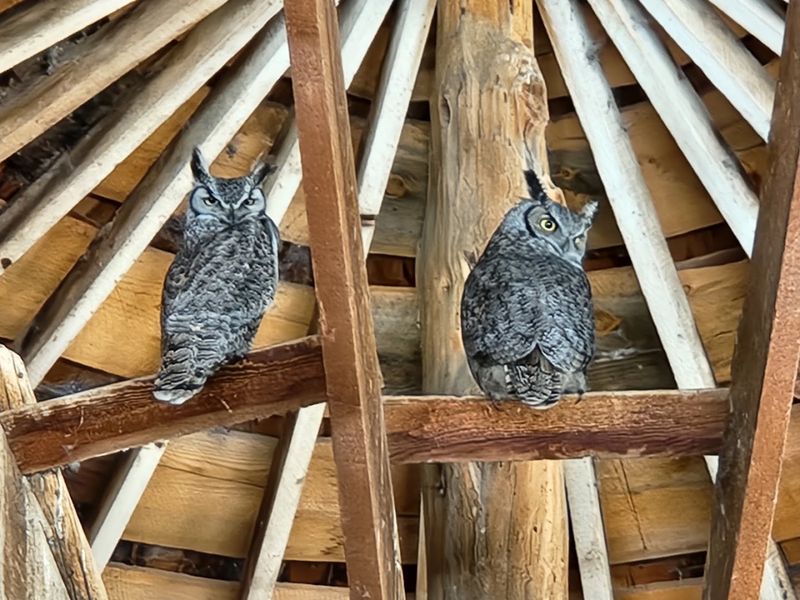
The barn has not been empty since the horses left. Barn owls have claimed the upper reaches of the structure as their own, and they are not shy about reminding visitors of that fact.
Visitors have reported being scolded loudly by protective owls while exploring the interior.
Below the owl nests, the ground tells its own story. Pellets and small bones scattered near the base of the walls show exactly what the owls have been eating.
Finding a snake mid-hunt or watching a raptor glide in through the roof gaps is apparently not unusual at all during a visit.
The area around the barn is equally alive. Ground squirrel holes dot the grass near the walls, which explains why the predator population stays so healthy here.
Rattlesnakes have also been spotted inside on at least one occasion, so watching your step is genuinely good advice. None of this feels threatening so much as authentic.
How to Visit and What to Expect When You Arrive
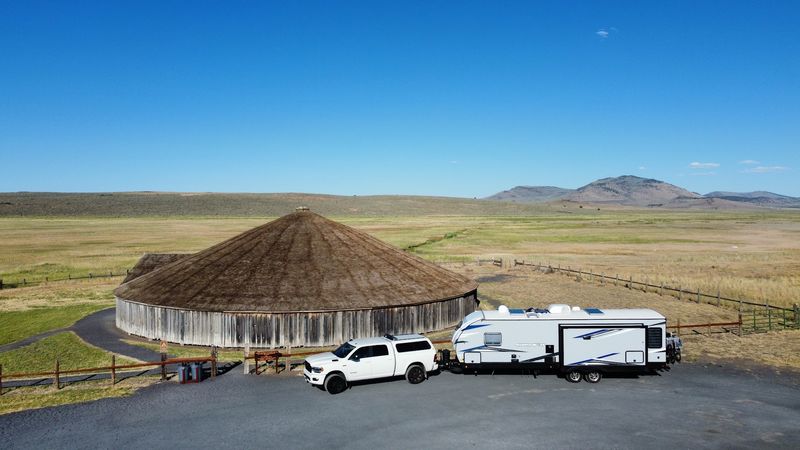
Getting to the Pete French Round Barn requires a short stretch of gravel road, but the surface is manageable for most standard vehicles in dry conditions. The site is located at 52229 Lava Bed Rd in Diamond, Oregon, roughly 60 miles south of Burns.
Giving yourself enough time to explore without rushing makes the trip much more satisfying.
The barn is open year-round, though weather can occasionally limit access during heavy winter conditions. There is no admission fee, which makes it an accessible stop for travelers on any kind of budget.
Parking is wide and easy, with room for larger vehicles including RVs.
Bringing a flashlight is a smart idea since the interior can be quite dark, especially on overcast days. A tripod helps if you want to photograph the interior architecture properly.
Wearing sturdy footwear matters too, since the ground around the barn has uneven patches and hidden holes that can catch you off guard. The whole site rewards slow, attentive exploration rather than a quick glance from the parking area.
Why This Place Deserves a Spot on Your Oregon Road Trip
Some historic sites feel like obligatory checkboxes on a road trip itinerary. This one does not.
The Pete French Round Barn earns its stop through a combination of genuine architectural wonder, layered human drama, and a remote setting that feels nothing like anywhere else in Oregon.
The story behind the barn is rich enough to keep you thinking long after you leave. A cattle empire built on ambition and controversy, a 100-foot structure engineered to solve a practical problem, and a violent end that a whole community quietly accepted as justice.
That is not a simple story, and the site does not pretend it is.
Eastern Oregon road trips often focus on the Alvord Desert or Crater Lake, and those places absolutely deserve attention. Address: Pete French Round Barn State Heritage Site, 52229 Lava Bed Rd, Diamond, OR 97722.
