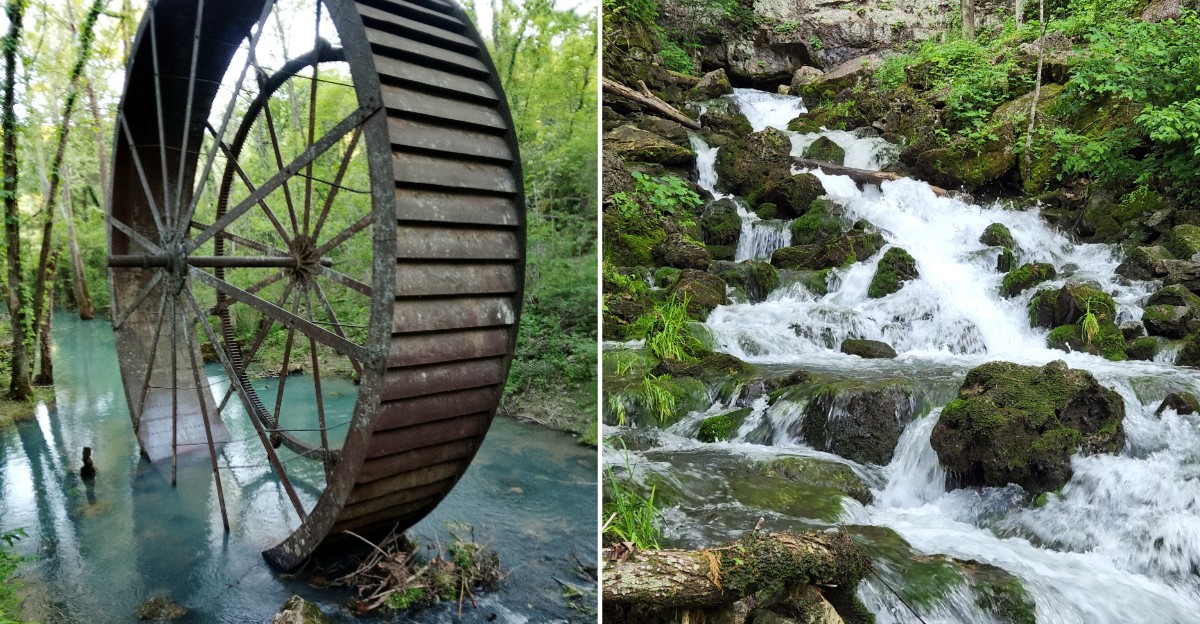
The giant steel water wheel is the first thing that makes this place feel different. This remote Missouri site sits deep in the Ozarks, where an old mill once served a small community beside the river.
The mill is gone, but parts of the old setup are still easy to spot. You can walk around the site, see the wheel, and follow the water as it moves through the area.
The cold spring nearby adds another reason to slow down and look around. Nothing here feels polished or crowded.
It is quiet, a little rough around the edges, and much more about the setting than any big attraction. That is exactly why the stop works.
The Giant Steel Overshot Wheel That Refused To Leave
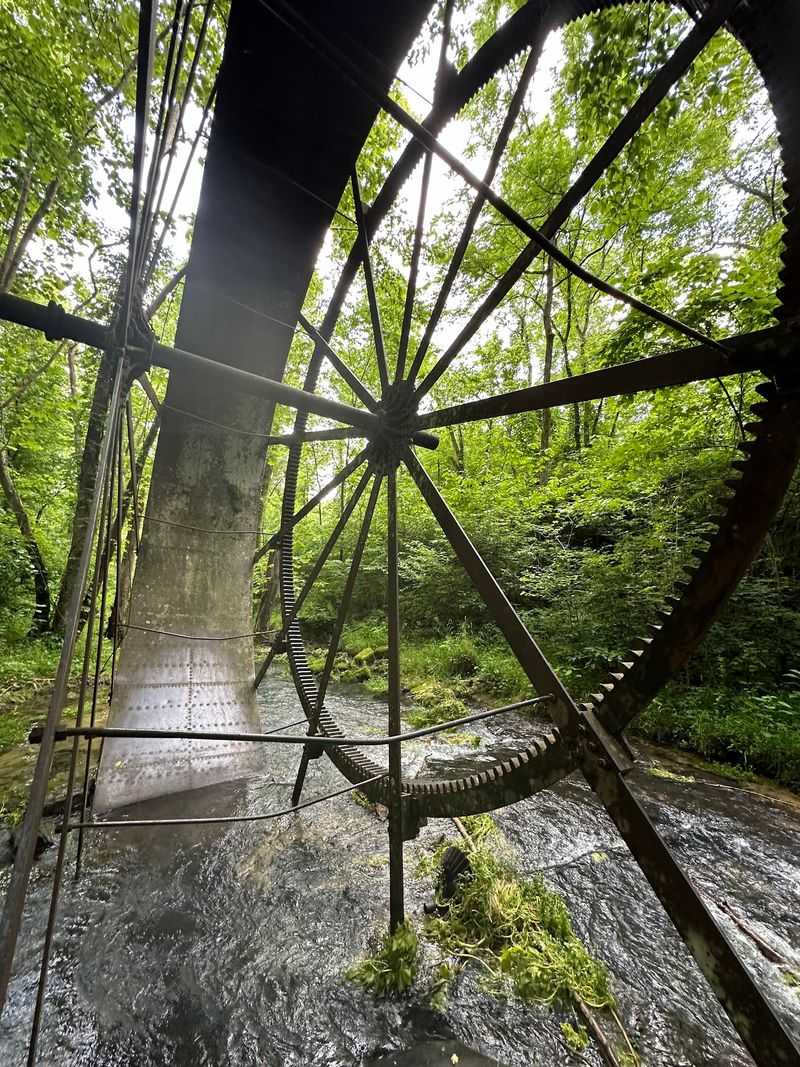
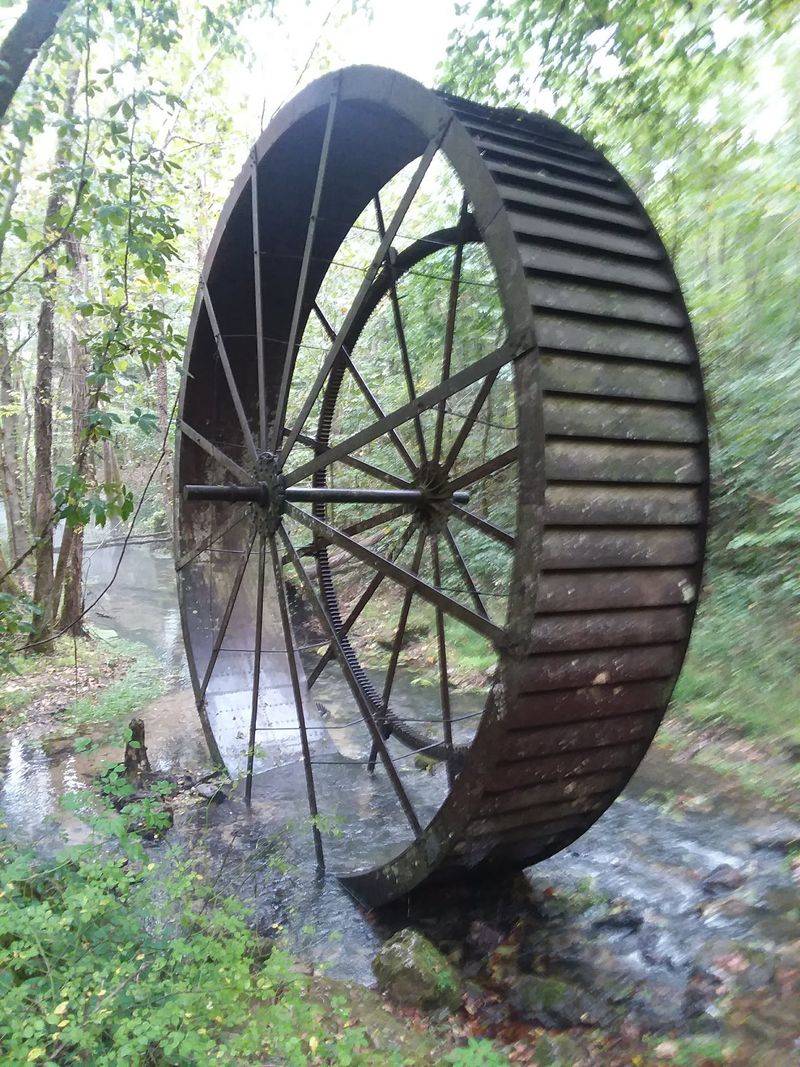
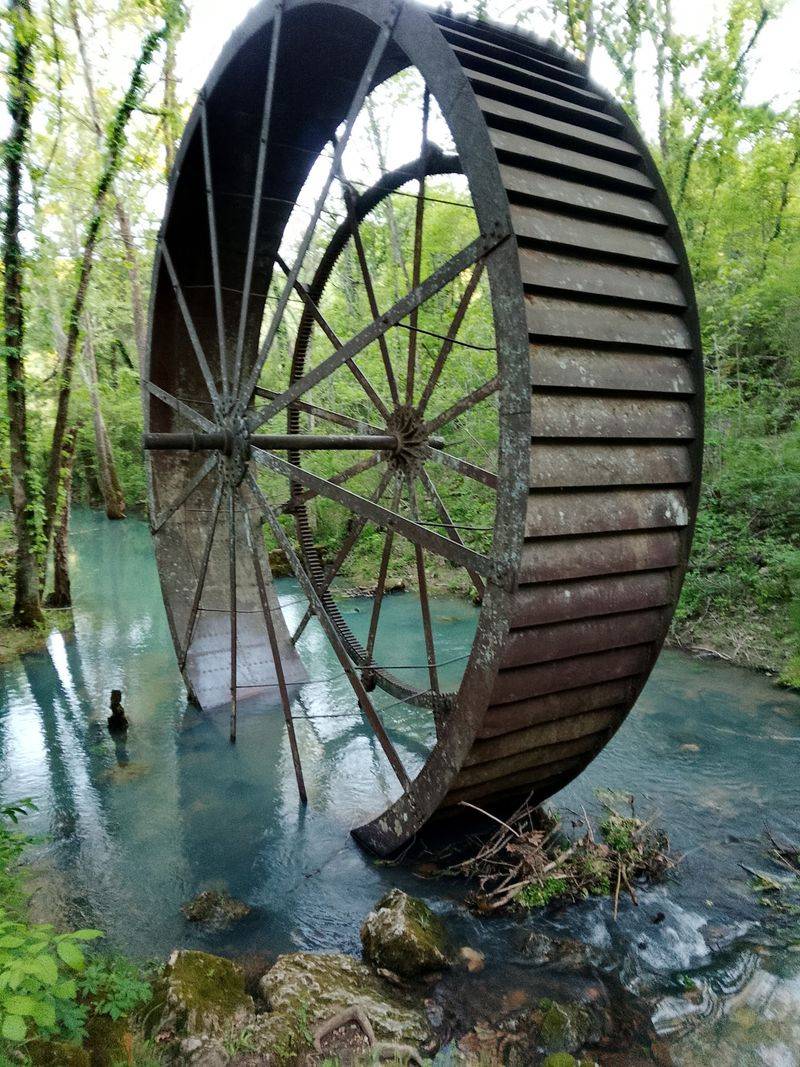
Picture a rusted steel wheel taller than a two-story house, just standing there in a shallow creek with trees growing up around it. That is the first thing you see when you walk down toward the water, and it honestly stops people mid-sentence.
It is an overshot wheel, which means the water used to pour over the top and the weight of it turned the whole thing. The wheel replaced an earlier turbine setup, so it was actually an upgrade in its day, not the original piece of equipment.
Over time the mill building disappeared, but the wheel stayed anchored in the spring branch where it was installed.
What gets me is the scale of it compared to everything around it. You expect an old mill wheel to be a cute wooden thing you could roll with your hands, and instead you get this heavy industrial object sitting in a quiet Missouri hollow.
Bring a camera with a wide lens if you have one, because you cannot back up very far without getting into the creek. Morning light tends to be softer down in the hollow, and the rust colors show up better then.
It photographs beautifully without any effort at all.
How To Actually Find The Place Without Losing Your Mind
Alright, the practical part first, because this is not a place you casually bump into. You are headed to the Turner Mill North Access, Forest Road 3152, Alton, MO 65606, and that address is worth saving offline before you go.
The roads leading in are gravel, hilly, and narrow in spots, so a higher-clearance vehicle makes the whole trip a lot more relaxing. If it has been raining hard, four-wheel drive is genuinely the smarter call rather than a luxury.
Cell service gets thin out there, which is part of the charm but also a reason to tell somebody where you are going.
I would also download your map before leaving town, because navigation apps can get confused once you are deep into forest roads with numbers instead of names. Watch for the small Forest Service signs, since they are easy to blow past when you are focused on the washboard gravel.
Give yourself more driving time than the map suggests, because you will not be going highway speeds on that last stretch. Once you park, the walk down to the wheel is short, and suddenly all that slow driving feels completely worth it.
Turner Spring Pouring Straight Out Of A Bluff
Here is the part that surprises people more than the wheel. Right at the base of a tall bluff, water comes shooting out of a small cave opening and forms a creek almost instantly.
There is no gradual trickle or muddy seep, just clear cold water arriving out of solid rock like somebody turned a tap on inside the hill. The Ozarks are full of springs because the limestone underneath is riddled with cracks and passages, and rainwater travels underground for miles before finding a way out.
Turner Spring is one of the more dramatic exits.
The water stays cold pretty much year-round, which is why the air near it feels noticeably cooler on a hot afternoon. If you have ever stuck your hand into a real Ozark spring, you know that bone-deep chill that makes you pull back fast.
Watch your footing around the spring opening, because wet limestone and moss are slicker than they look. Sturdy shoes with grip beat sandals every single time out here.
Sit for a few minutes and just listen, since the sound of that much moving water in an otherwise silent hollow is genuinely something you will remember.
Millions Of Gallons Flowing Every Single Day
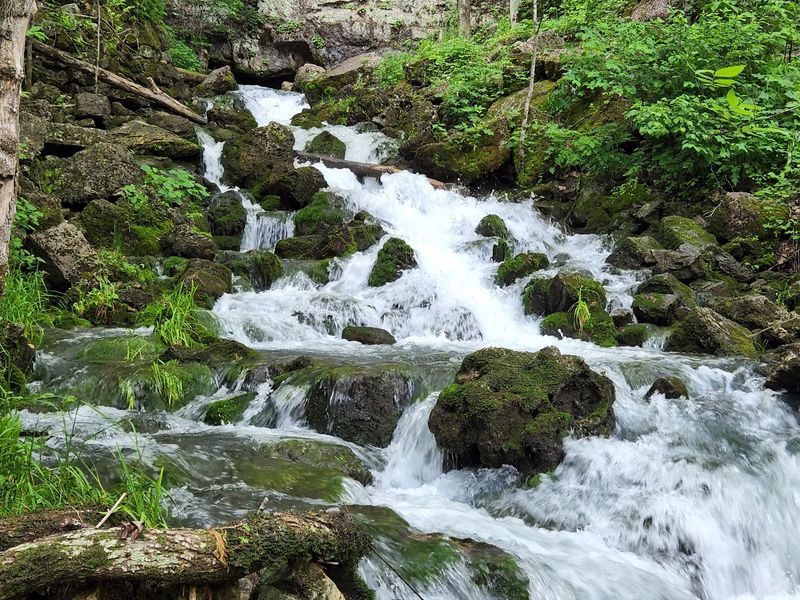
Want a number that makes you rethink what you are looking at? Turner Spring pushes out an average of about a million and a half gallons of water a day, which is not a trickle by anyone’s standards.
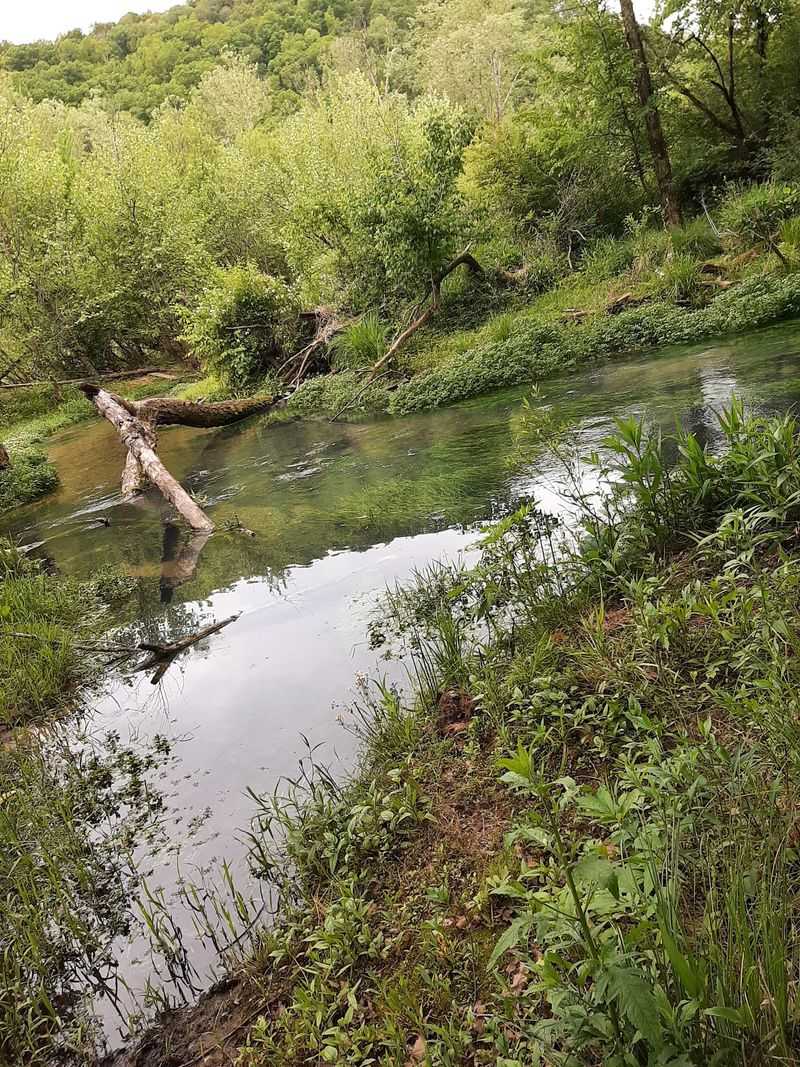
All of that comes out of one modest-looking opening in the rock, then runs downhill as a spring branch toward the Eleven Point River. When you stand beside it and realize the flow never stops, day or night, winter or summer, the whole thing starts to feel a little unreal.
That steady volume is exactly why somebody built a mill here in the first place. Reliable water meant reliable power, and in the days before electric lines reached these hills, that mattered enormously to anybody trying to grind grain or cut lumber.
You can trace the branch with your eyes and see how fast it moves over the gravel bed. Even in a dry stretch of summer when other Missouri creeks go quiet, spring-fed water like this keeps running strong.
Go ahead and toss a leaf in, then watch how quickly it disappears downstream. That little test tells you more about the flow than any statistic ever could.
Where The Wheel Sits In The Spring Branch
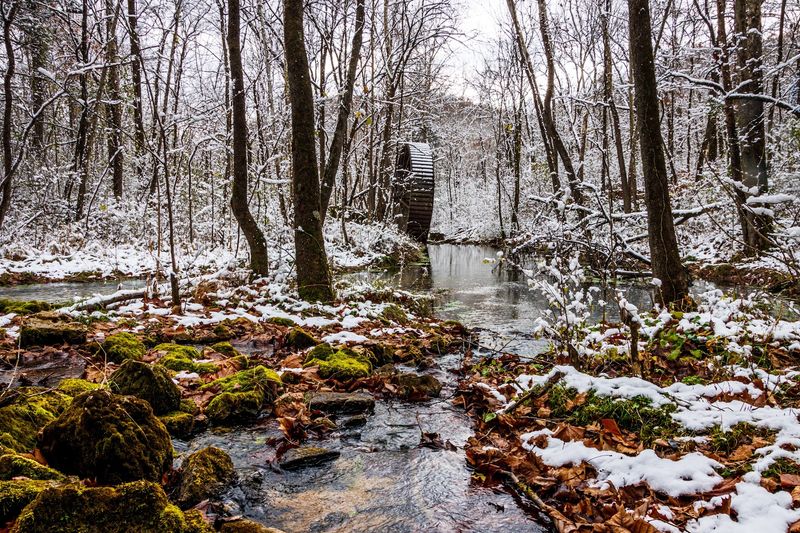
The wheel is not up on a hill or bolted to a building, which is what makes the setting so odd and so good. It stands right in the spring branch, a little downstream from where the old mill building once sat.
A short footpath takes you from the parking area down to the water, and it is not a difficult walk at all. Kids handle it fine, though you will want to keep an eye on them near the creek edge where the rocks get slippery.
Because the wheel sits in flowing water, the scene changes with the seasons in a way a museum display never could. Spring greenery crowds in close, and once the leaves drop you can see the bluff and the whole structure much more clearly.
Wear shoes you do not mind getting damp, since the best angles usually involve standing near the water. A walking stick is not a bad idea either if your knees appreciate the help on uneven ground.
Take your time on that short path instead of rushing straight to the wheel, because the creek itself is half the reason to come down here.
Echoes Of A Vanished Town Named Surprise
Here is the detail that really got me thinking. There used to be a whole little community here, and it was called Surprise, Missouri, which has to be one of the best town names ever chosen.
The post office operated right inside the mill building, which tells you how central that mill was to daily life in the hollow. People came for grain, lumber, mail, and probably whatever news was going around, all in one stop.
Now there is no town to see, just forest, water, and that stubborn wheel. Whole settlements in the Ozarks faded out when roads improved and folks moved toward bigger towns, and this is one of the clearest examples you can actually walk through.
Standing there, it is hard not to imagine wagons parked where the trees are now. The quiet feels different once you know somebody’s mail used to arrive at that spot.
If local history grabs you the way it grabs me, read a little about the area before you drive out. The visit hits harder when you can picture what used to fill the empty space around the creek.
Oxen Hauled That Thing In, Piece By Piece
Try to wrap your head around this one. That enormous steel wheel did not roll in on a flatbed truck, because there were basically no roads worth the name back then.
It arrived in pieces, hauled into the hollow by oxen across rough, rocky ground, then assembled on site. Every time I think about that, the wheel gets more impressive rather than less, because somebody looked at those hills and decided it was worth the trouble anyway.
Consider how much a single section of heavy steel weighs, then multiply that by a full wheel of that size. Now add steep grades, creek crossings, and mud, and you start to appreciate the stubbornness involved.
You cannot see any of that effort directly, but you can feel it once you know the story. The wheel stops being scenery and becomes evidence of a genuinely hard job finished well.
Point it out to whoever you drag along on the trip, because it changes how they look at the site. Facts like that turn a pretty photo stop into something people actually talk about on the drive home.
Grinding Corn And Cutting Lumber For The Whole Hollow
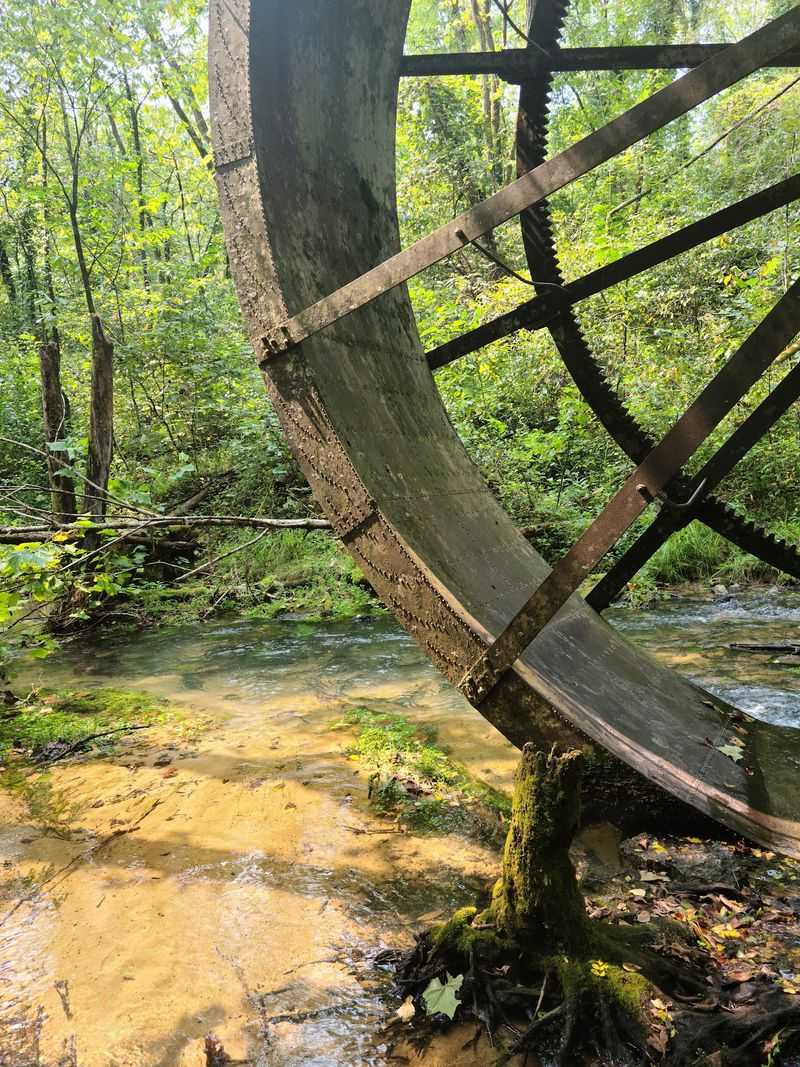
Long before the steel wheel showed up, a wooden wheel was already turning here. The milling operation at this spot goes back to the mid-eighteen hundreds, which makes it one of the older working sites in this part of the state.
The mill ground corn and wheat for families across the hollow, and it also ran saws for cutting lumber. That combination made it a genuine hub, because you could leave with flour for the kitchen and boards for the barn on the same trip.
Think about what that meant without trucks or paved roads. Your nearest mill basically decided how far you had to travel to eat bread or build a house, so a place like this shaped entire neighborhoods around it.
The building is gone now, so you have to fill in the sounds yourself, all that creaking timber and rushing water and sawblades working. Standing by the wheel, the imagination does most of the heavy lifting.
It is a good reminder that Missouri had working industry tucked into its creeks long before power lines reached the backcountry. Water did the job, and it did it reliably.
Leftover Traces Of The Old Water Chute
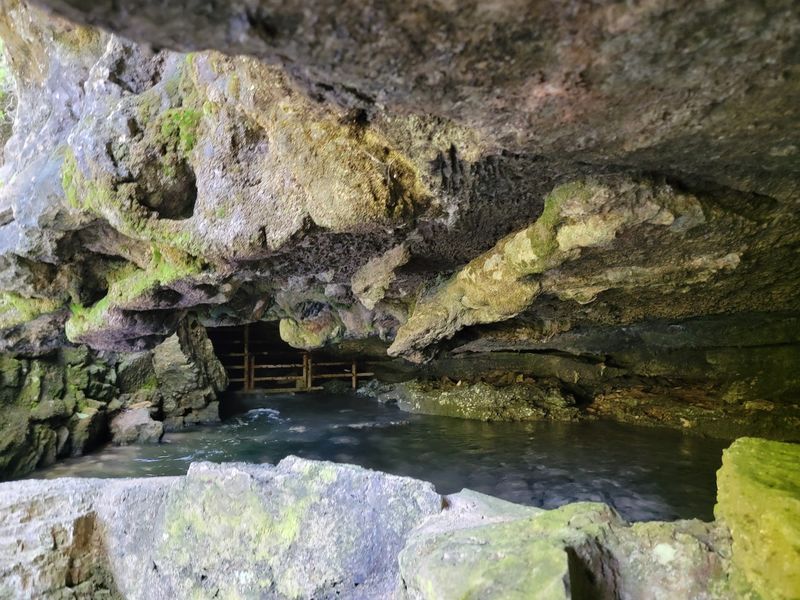
Look closely near the bluff and you will notice things that are clearly not natural rock. Those are the remains of the water chute, the channel that once carried spring water over to the wheel.
Once you spot it, the whole operation suddenly makes sense in your head. Water came out of the bluff, got routed along the chute, then dropped over the top of that overshot wheel to spin it, which is beautifully simple engineering when you think about it.
These leftover pieces are easy to miss if you walk straight to the wheel and stop there. Slow down and scan the area between the spring opening and the creek, because that is where the interesting fragments hide.
Please look without climbing on anything, since these remains are fragile and they are the last physical record of how the system worked. Photographs last longer than souvenirs anyway.
Honestly, finding the chute traces was my favorite part of reading about this place. It turns the visit into a bit of detective work rather than just a quick look at a big metal circle.
