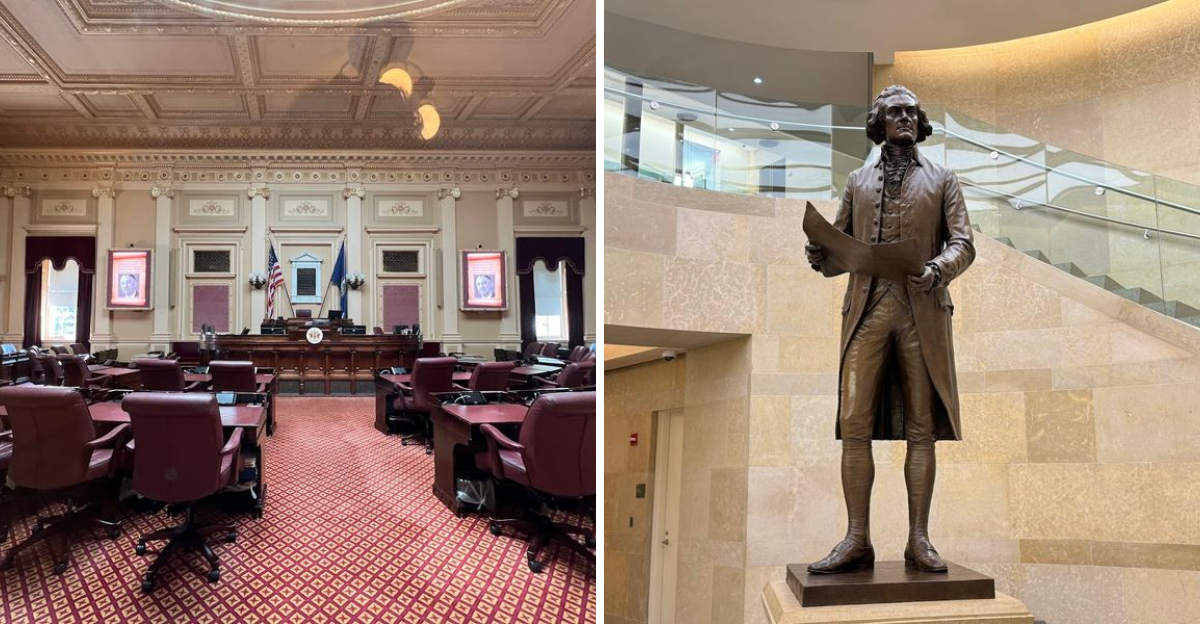
Northern Virginia likes to think it runs the show. Good economy, fancy suburbs, a commuter train to D.C.
But culture? History?
The actual soul of this state? Sorry, but that crown stays in Richmond.
Walk into the Virginia State Capitol and you will understand immediately. Thomas Jefferson designed this building.
The oldest elected legislature in North America still meets here. A life-size marble Washington stares at you from the rotunda like he is judging your outfit.
This is not a backdrop for Instagram posts. This is where Virginia’s story actually happened and keeps happening.
NoVA has the traffic. Richmond has the weight.
Come stand in these halls and try to argue otherwise. I will wait.
A Temple of Democracy Designed by a Founding Father
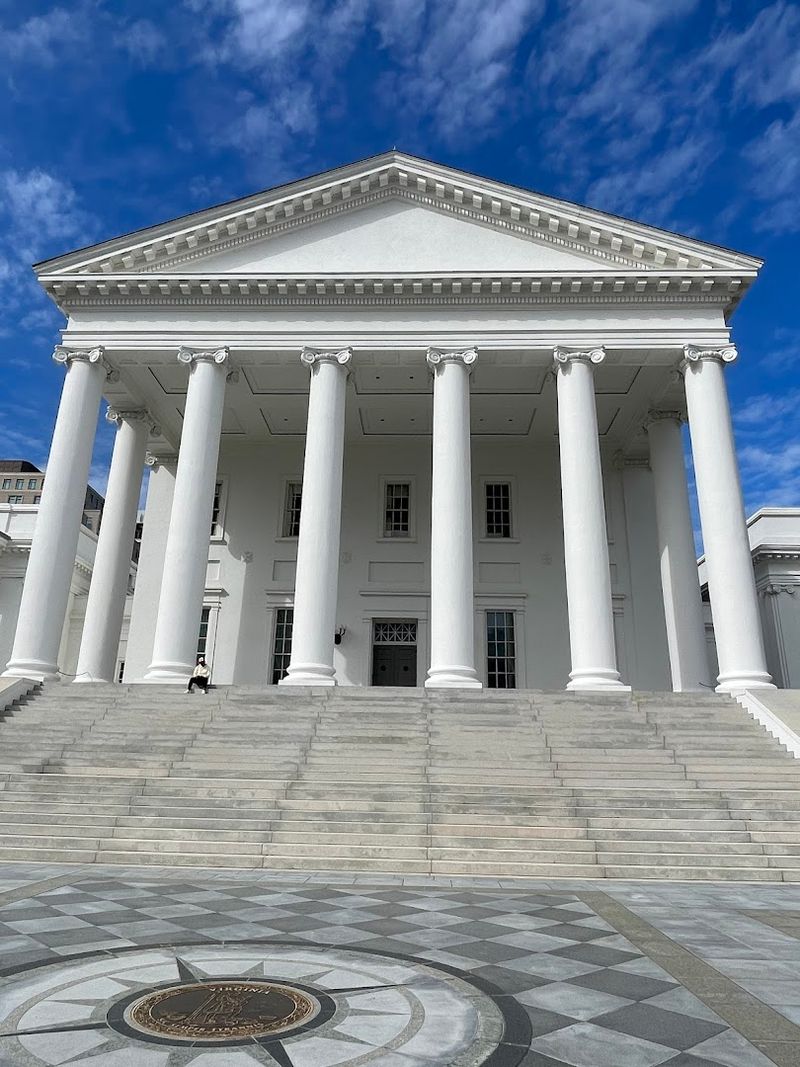
Thomas Jefferson did not just write the Declaration of Independence. He also designed a building that would become one of the most architecturally significant statehouses in the entire country.
The Virginia State Capitol was modeled after the Maison Carrée, an ancient Roman temple in Nîmes, France, and the result is jaw-dropping.
Jefferson believed that architecture could express democratic ideals, and every column on this building proves his point. Standing at the front steps, you feel the weight of history pressing down in the best possible way.
The neoclassical lines are clean, proud, and deliberately timeless.
What makes this even more remarkable is that Jefferson designed it while serving as a diplomat in Paris, sending detailed plans across the Atlantic. The building was completed in the late eighteenth century and has anchored Richmond ever since.
Virginia’s identity as a state is literally built into its stone foundation. No other building in the commonwealth carries that kind of origin story, and that alone makes it worth the trip.
The Oldest Elected Legislative Body in North America Meets Right Here
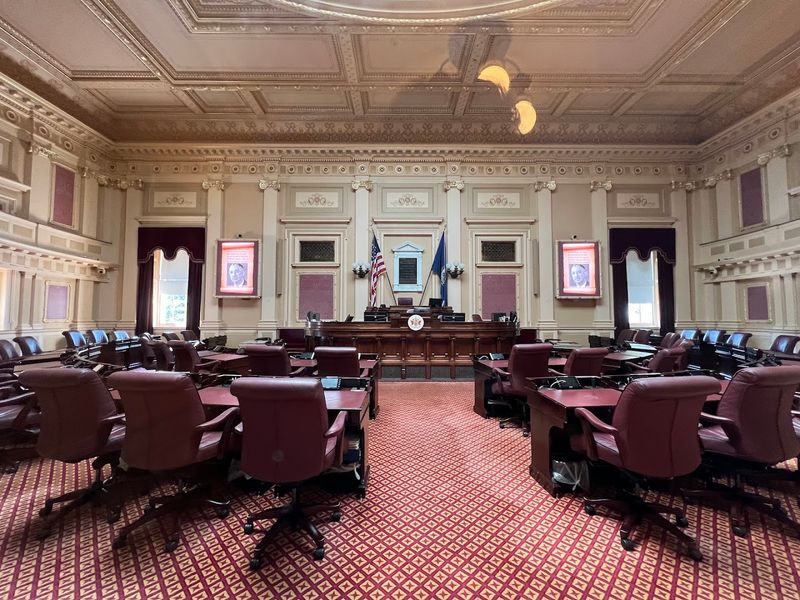
Most people do not realize that the Virginia General Assembly is the oldest elected legislative body in North America. That is not a small claim.
Democracy in this part of the world did not start in Washington, D.C. It started right here in Virginia, long before the federal government even existed.
Watching the legislature in session from the public gallery is genuinely thrilling. There is something electric about sitting above a chamber where laws that shaped an entire nation were debated.
The space feels serious, purposeful, and alive with ongoing history.
Tours of the Virginia State Capitol make sure you understand the full scope of what you are standing inside. Guides walk you through the chambers with real enthusiasm, connecting centuries of lawmaking to the present day.
The building is not a museum frozen in time. It is a working government building where Virginia’s future is still being written.
That combination of living history and active democracy is incredibly rare, and it makes this landmark stand apart from every other historical site in the state.
Capitol Square: Twelve Acres of History You Can Actually Walk Through
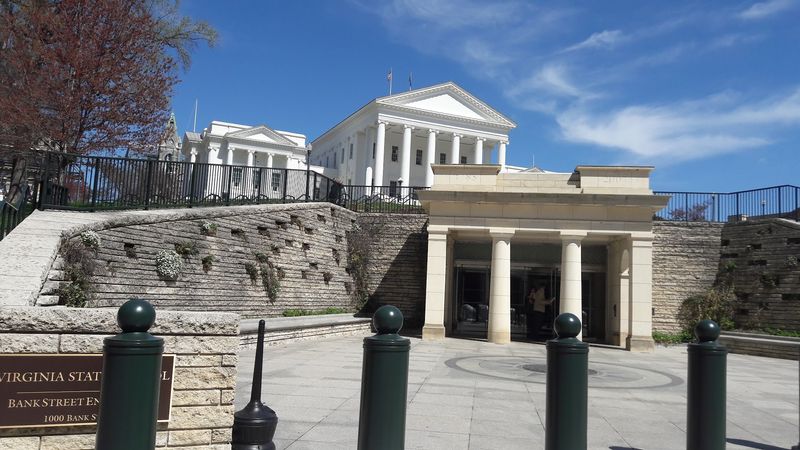
Capitol Square surrounds the Virginia State Capitol like a living museum you never have to pay to enter. Spread across a generous stretch of land in the heart of Richmond, the square is one of the earliest planned urban parks in the entire United States.
That fact alone deserves more attention than it typically gets.
Strolling through the square, you pass monuments that tell Virginia’s complicated, layered, and fascinating story. The George Washington Equestrian Monument stands tall as one of the most celebrated equestrian statues in the country.
Nearby, the Virginia Civil Rights Memorial honors the activists who fought to make democracy actually mean something for everyone.
On any given weekday, locals use the square as a lunchtime escape, sitting under massive shade trees while history literally towers above them. I spent a full morning just wandering from monument to monument, reading plaques and soaking up the atmosphere.
The grounds are immaculately maintained, and the mix of political history, natural beauty, and civic energy makes Capitol Square one of the most underrated outdoor spaces in all of Virginia.
The Life-Size George Washington Statue That Stopped Me Cold
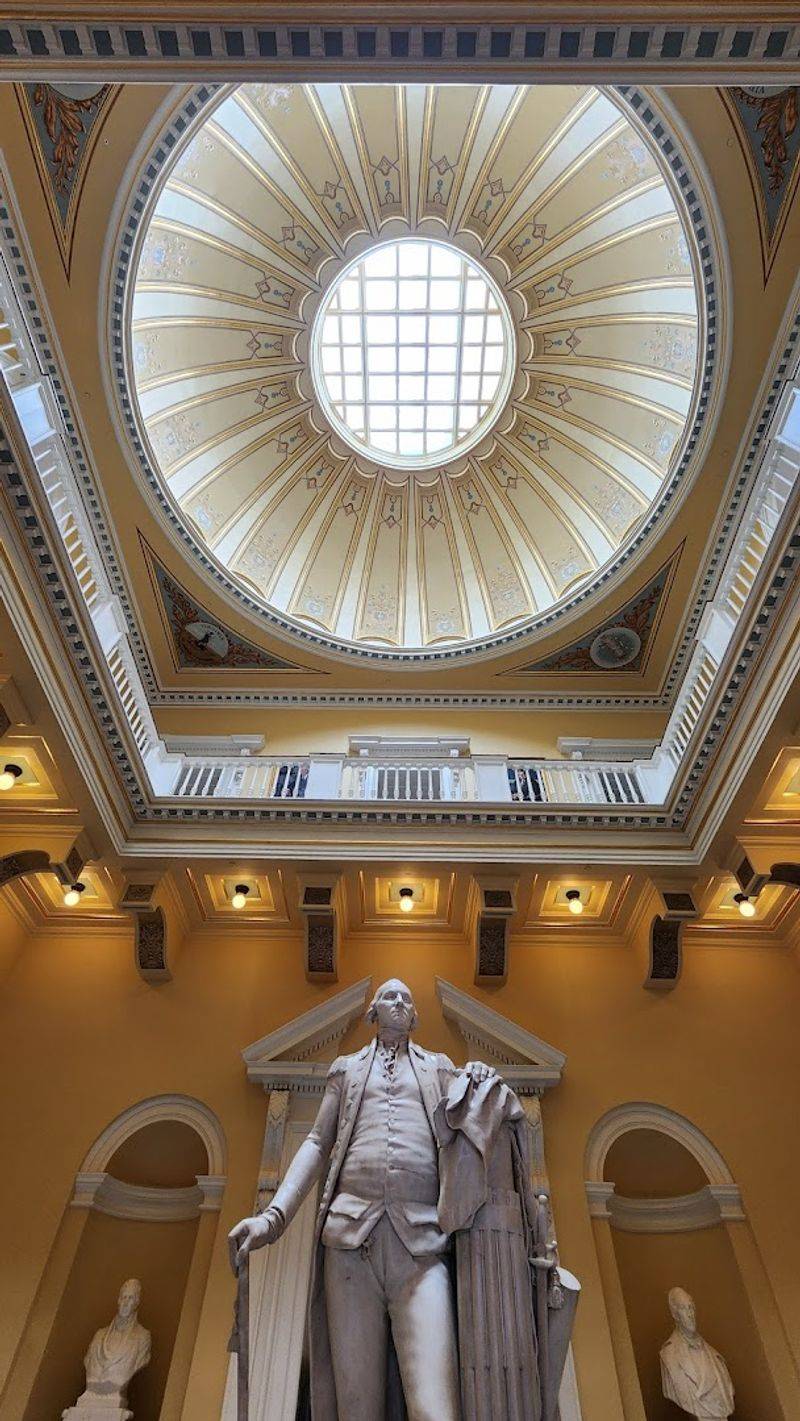
Nothing quite prepares you for the moment you walk into the rotunda and come face to face with Jean-Antoine Houdon’s life-size marble statue of George Washington. This is not a reproduction.
This is the real thing, carved from marble by one of the greatest sculptors of the eighteenth century, and it is absolutely stunning.
Houdon traveled from France to Mount Vernon specifically to take Washington’s measurements and create a life mask. The result is considered the most accurate likeness of Washington ever made.
Standing in front of it, you get the eerie sense that you are actually seeing the man as he really was, not the mythologized portrait version.
The Virginia State Capitol has housed this statue since the late 1700s, making it one of the oldest and most significant pieces of art in continuous public display in the country. Every other president depicted in the rotunda is a copy.
Washington alone gets the original. That detail says everything about how Virginia views its relationship with the first president, and the statue is worth the visit entirely on its own.
Civil War History That Hits Differently Inside These Walls
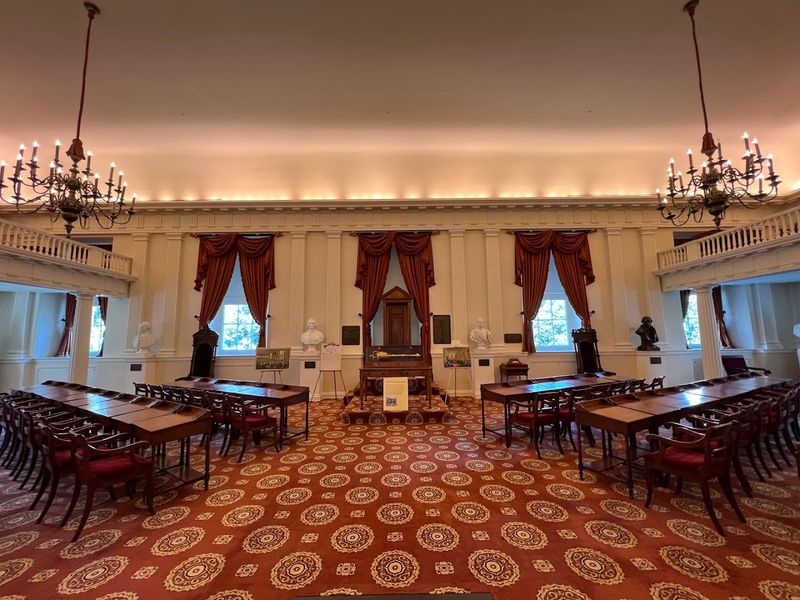
Richmond served as the capital of the Confederate States of America during the Civil War, and the Virginia State Capitol was right at the center of that turbulent chapter. The Confederate Congress held its sessions in these very chambers, making the building a witness to one of the most consequential conflicts in American history.
What makes the Capitol’s Civil War story so compelling is its complexity. This building had already been a symbol of revolutionary democracy for nearly a century before the war began.
The tension between those founding ideals and the brutal reality of the Confederacy plays out in every corner of the building’s history.
Perhaps most striking is the fact that President Abraham Lincoln visited Capitol Square in April of 1865, shortly after Richmond fell to Union forces. That moment, a sitting president walking through the former Confederate capital, carries an almost cinematic weight.
Tours at the Virginia State Capitol address this history directly and honestly, giving visitors the full picture without softening the hard parts. Virginia’s story is messy and magnificent, and this building holds all of it.
Free Tours That Are Genuinely Worth Every Minute
Free admission at a landmark this significant feels almost suspicious, like there must be a catch. There is no catch.
The Virginia State Capitol offers complimentary tours that are genuinely excellent, and the guides bring the kind of enthusiasm that turns a history lesson into a full-on experience.
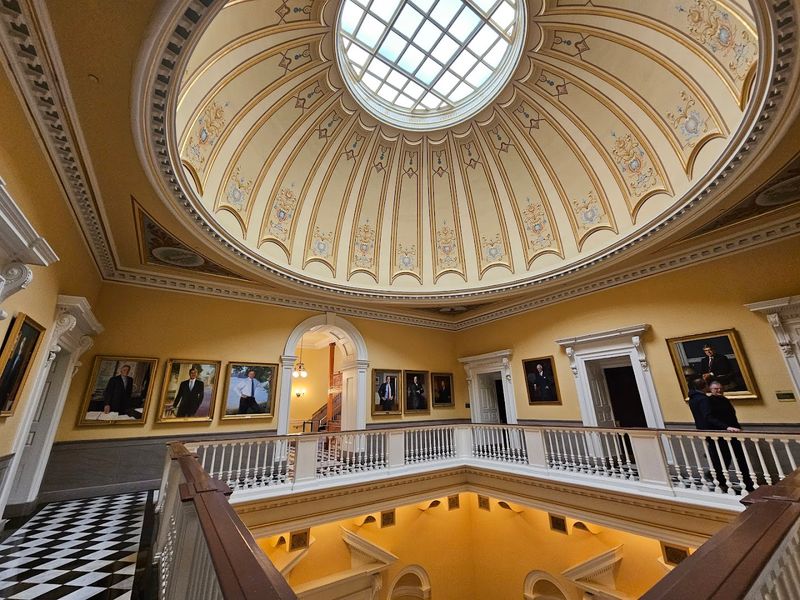
Tours run throughout the day and cover the rotunda, the legislative chambers, historic portraits, and the underground visitor center that connects to the main building. You can join a guided tour or move through at your own pace if your schedule is tight.
Both options give you real access to the building’s most impressive spaces.
What I found most impressive was how the guides handled the complicated parts of Virginia’s history. Nothing was glossed over.
The full arc of the Capitol’s story, from revolutionary idealism to Civil War politics to modern governance, was presented with honesty and depth. Walking out afterward, I felt like I had actually learned something substantial rather than just checked off a tourist box.
For a completely free experience, the quality here rivals paid attractions across the entire state.
The Underground Visitor Center That Surprises Everyone
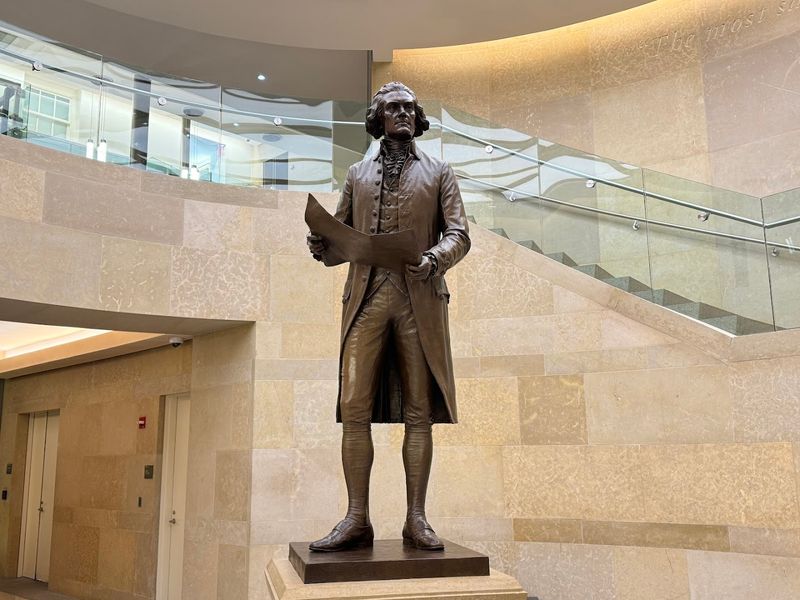
Most people arrive at the Virginia State Capitol expecting old marble and portraits, which they absolutely get. What catches nearly everyone off guard is the sleek, modern underground visitor center built beneath Capitol Square.
The entrance sits at street level on Bank Street, and the contrast between the contemporary space below and the eighteenth-century building above is genuinely striking.
The visitor center serves as the main entry point for tours and houses exhibits that provide context for everything you are about to see upstairs. Interactive displays trace the Capitol’s architectural history, its role in American democracy, and the stories of the people who shaped Virginia’s political landscape over the centuries.
There is also a gift shop stocked with Virginia-themed items, which makes for a pleasant stop before or after your tour. The underground space is fully accessible and climate-controlled, making it a practical starting point regardless of the season.
I appreciated how thoughtfully the modern addition was integrated without disturbing the historic structure above. The architects managed to add significant square footage and visitor amenities while keeping the Capitol’s iconic exterior completely intact.
Smart design, full stop.
Jefferson’s Architectural Vision and What It Means for Richmond Today
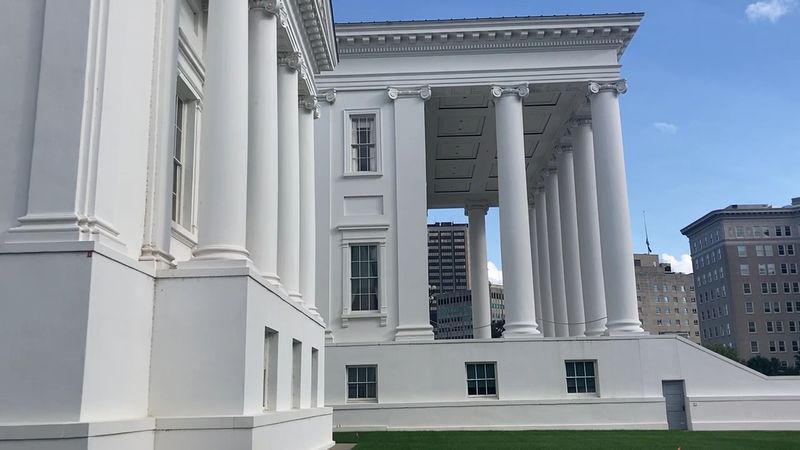
Thomas Jefferson’s obsession with classical Roman architecture was not just aesthetic. He believed that the physical form of a building could communicate the values of the society inside it.
Designing the Virginia State Capitol after a Roman temple was a deliberate statement about what kind of republic America intended to be.
Walking around the exterior, you can see exactly what he meant. The proportions are careful and deliberate.
The columns carry a sense of civic gravity that modern government buildings rarely achieve. Richmond, as a city, owes a significant part of its architectural identity to the vision Jefferson poured into this single structure.
The Capitol’s influence rippled outward through American architecture for generations. Countless courthouses, libraries, and government buildings across the country borrowed from its template.
Standing here, you are not just looking at one building. You are seeing the origin point of a visual language that defined how America chose to present its democratic institutions to the world.
For a state that sometimes gets overshadowed by its northern neighbor, Virginia planted an architectural flag that the rest of the country spent two centuries copying.
The Governor’s Mansion and the Neighborhood That Surrounds the Capitol
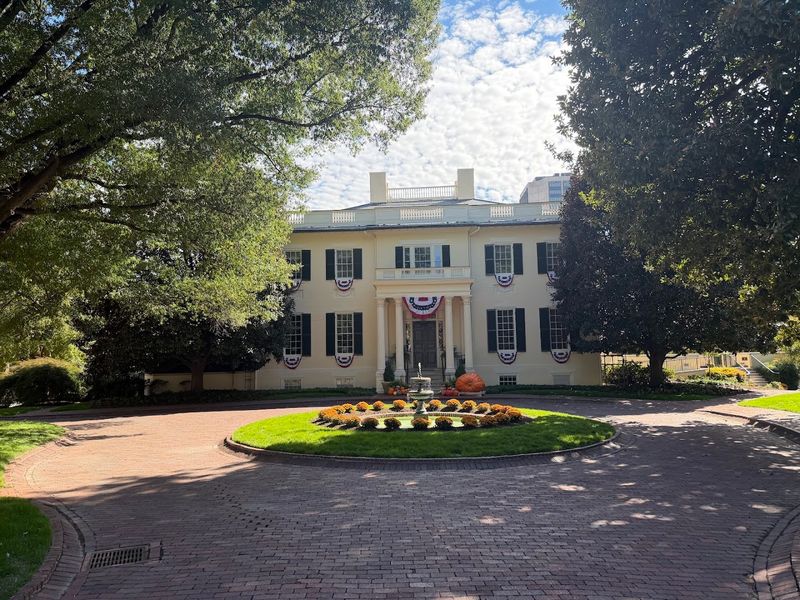
Capitol Square is not just about the Capitol building itself. The Governor’s Mansion sits on the grounds and adds another layer of living history to the entire complex.
Built in the early nineteenth century, the mansion is the oldest continuously occupied executive residence in the United States, a fact that tends to stop people mid-stride when they hear it.
The surrounding neighborhood in downtown Richmond amplifies the experience of visiting the Capitol. Old City Hall, a stunning Victorian Gothic structure directly adjacent to the square, has been recently renovated and is worth a quick look on its own.
The architectural variety packed into a few city blocks is genuinely impressive.
Richmond’s downtown core feels energized in a way that surprises first-time visitors. Coffee shops, restaurants, and local businesses fill the streets around Capitol Square, making it easy to extend your visit into a full afternoon.
The Virginia State Capitol anchors this entire neighborhood culturally and historically. Everything around it seems to orbit the building’s gravitational pull, and that relationship between landmark and city is part of what makes Richmond such a compelling destination for anyone curious about Virginia’s soul.
Plan Your Visit: What to Know Before You Go to 1000 Bank St
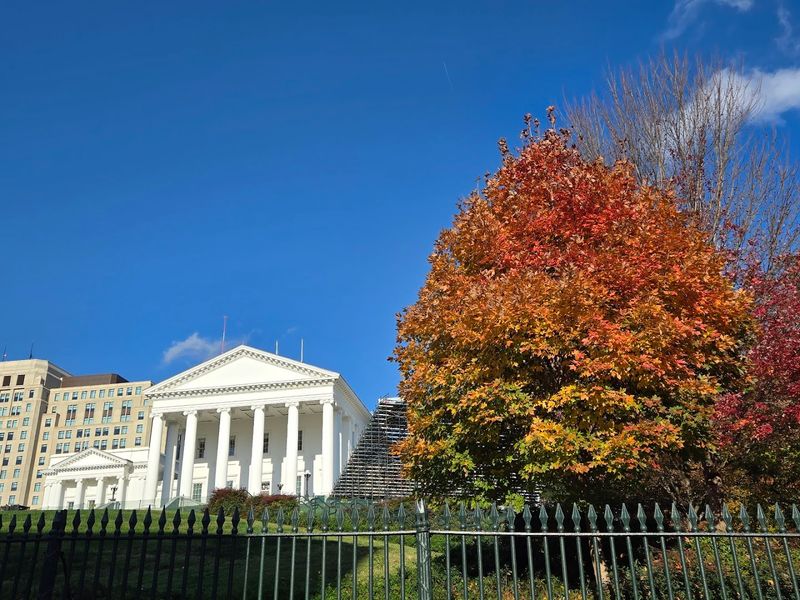
Getting the most out of the Virginia State Capitol starts with a little planning. The building is open most days of the week, with Sunday hours running on a shorter schedule.
Arriving early gives you the best chance of joining a smaller tour group, which means more time for questions and a more personal experience overall.
The main visitor entrance is at street level on Bank Street, and signage can be subtle, so knowing to look for it saves time. Security is straightforward and the staff are consistently welcoming, making the entry process smooth even during busy periods.
Parking options exist nearby in downtown Richmond, and the location is walkable from several central hotels.
Photography is welcome throughout much of the building, so bring your camera. The rotunda alone is worth a full memory card.
Budget at least ninety minutes for a thorough visit, more if you want to explore Capitol Square and the surrounding monuments at a leisurely pace. The official address is 1000 Bank St, Richmond, VA 23218, and the phone number is 804-698-1788 for tour scheduling questions.
Virginia’s most historically loaded square mile is waiting, and it costs absolutely nothing to experience it.
