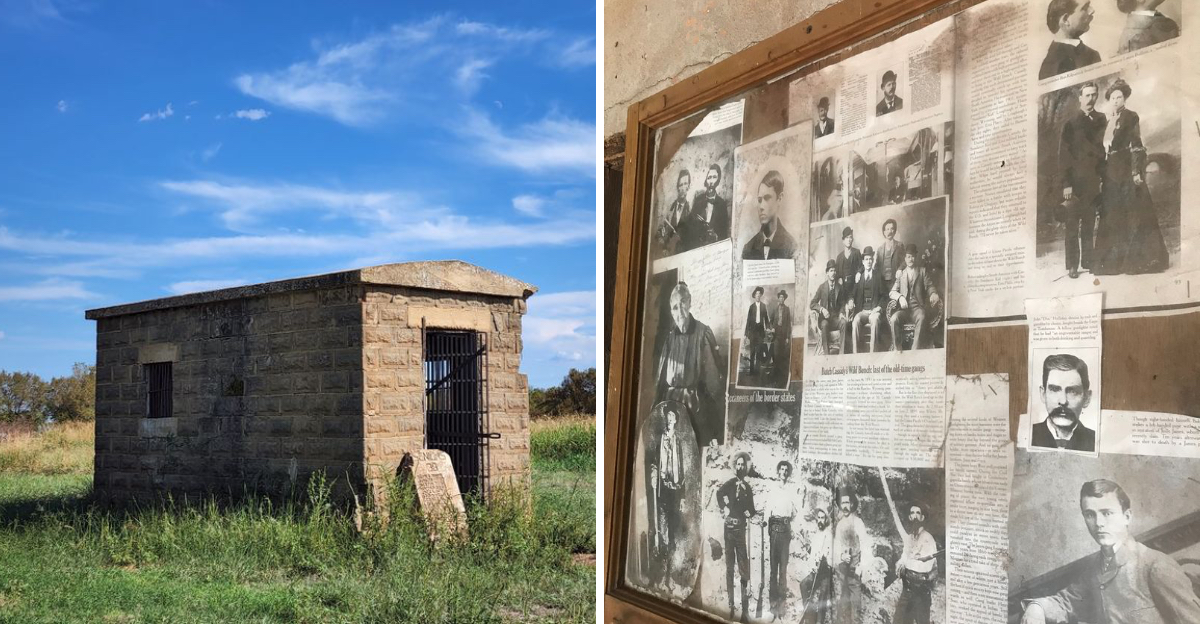
Some people think that real history lives in museums behind velvet ropes, but what if the most authentic slice of the Old West sits unlocked in a ghost town, waiting for you to walk right in?
Texola’s one-room jail doesn’t charge admission, doesn’t have a gift shop, and won’t sanitize the gritty reality of frontier law enforcement for modern sensibilities.
Built in 1910 when Oklahoma was barely three years into statehood, this cramped stone structure held outlaws, drifters, and troublemakers in conditions that would horrify anyone today.
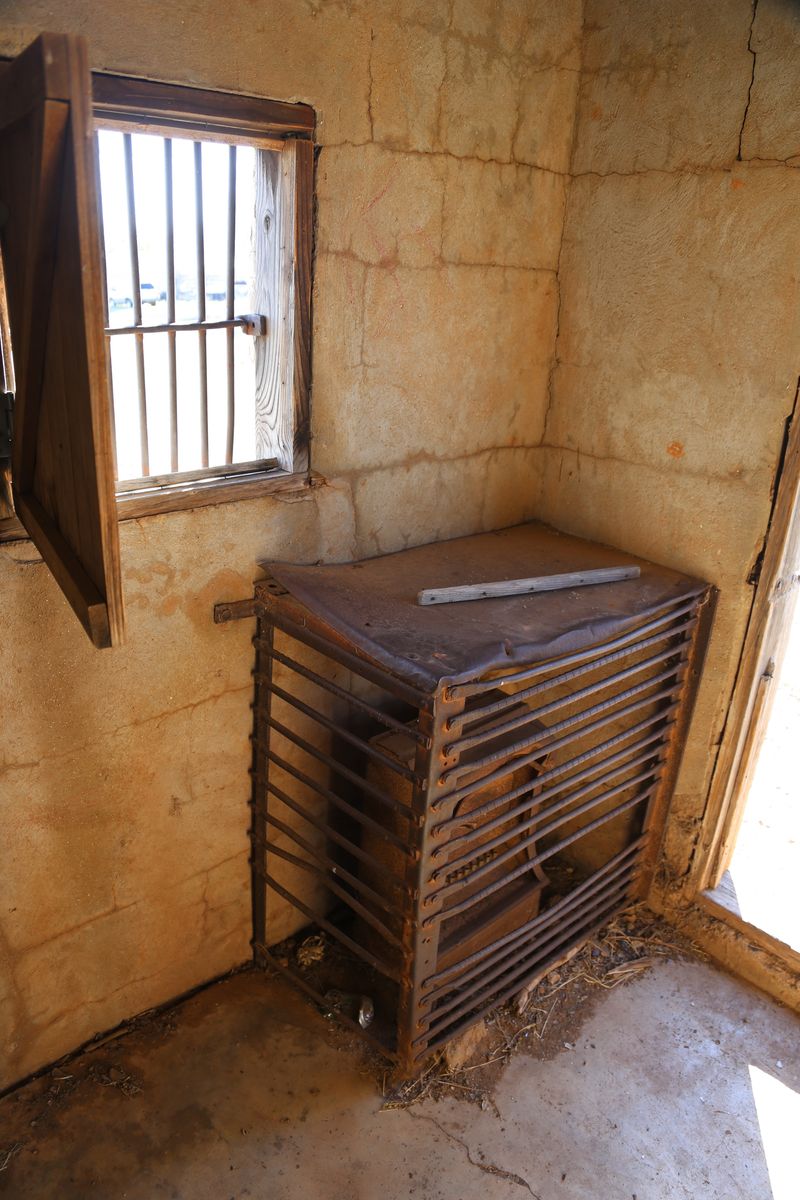
Photos of notorious criminals still hang on the walls, a rusty heater sits in the corner, and the sleeping pallet remains exactly where inmates once lay shackled.
Route 66 travelers debate whether it’s worth the detour off the main road, but those who skip it miss standing in the exact spot where justice was dispensed with iron bars and little mercy. The jail survived a century of abandonment, weather, and the slow death of Texola itself, yet remains remarkably intact.
So here’s the question that sparks arguments in every Oklahoma history group: Is this humble stone box more historically significant than the polished exhibits in big-city museums, or is it just a shed with old photos?
A Stone Box That Defined Justice in Indian Territory
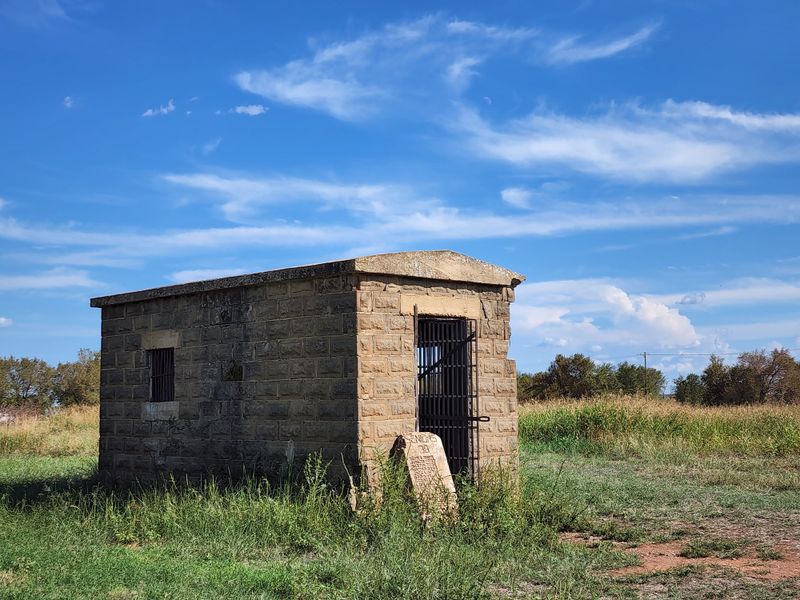
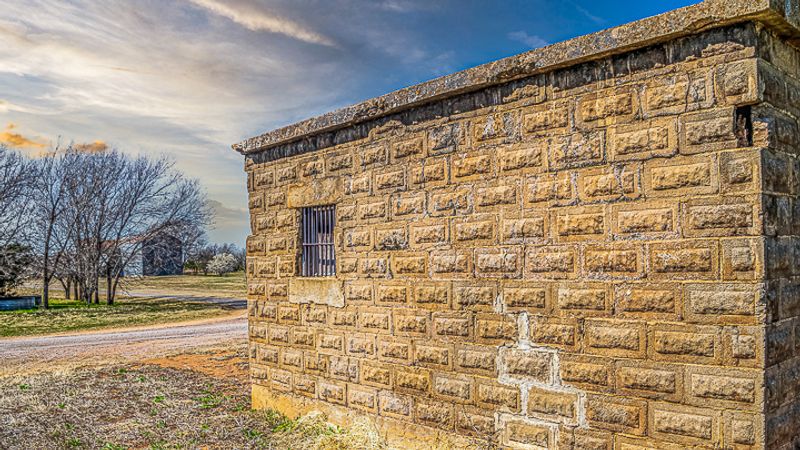
Texola’s jail rose from the prairie in 1910, constructed with thick limestone walls designed to contain the roughest characters drifting through what had recently been Indian Territory. The building measures roughly ten feet by twelve feet, with walls so solid they’ve withstood over a century of Oklahoma’s brutal weather cycles without crumbling.
Builders intentionally kept the structure small and windowless, creating a psychological pressure cooker where troublemakers would think twice before causing problems again. The single heavy door was the only connection to the outside world, and that door stayed locked until the marshal decided otherwise.
What makes this jail exceptional isn’t architectural beauty but raw functionality. Every stone was placed with the understanding that this building would hold dangerous men, sometimes multiple prisoners crammed into a space barely large enough for one.
The ceiling height barely clears six feet, adding to the oppressive atmosphere that was entirely intentional.
Texola sat on the Texas-Oklahoma border, making it a crossroads for cattle rustlers, bootleggers, and con artists working both sides of the state line. This jail represented the thin line between civilization and chaos in a region still finding its identity as part of the United States rather than tribal lands.
Address: Main Ave, Texola, Oklahoma
Walking Into a Cell That Held Real Outlaws
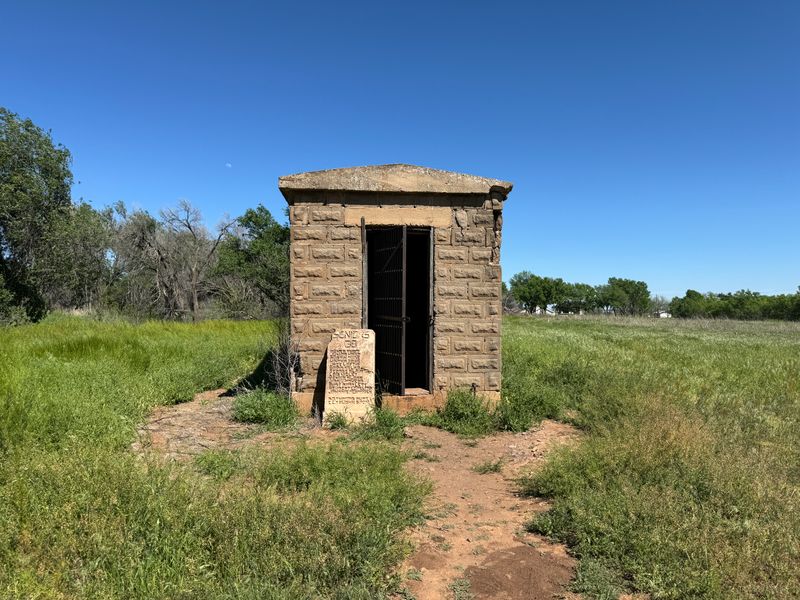
Pushing open that heavy door transports visitors into a space that feels more like a tomb than a holding cell. The interior remains remarkably preserved, with historical photos plastered across the walls depicting notorious criminals from the era when this jail actually functioned.
An old cast-iron heater stands in one corner, the only concession to human comfort during Oklahoma’s freezing winters. Inmates would huddle near that inadequate heat source, shackled to iron rings embedded in the stone walls, counting hours until their fate was decided.
The sleeping pallet looks more like a wooden board than any kind of bed, offering zero cushioning against the cold stone floor. Prisoners didn’t get blankets, pillows, or privacy, just hard surfaces and the company of whoever else got thrown in that night.
What strikes most visitors is the overwhelming sense of claustrophobia. Modern jail cells seem spacious compared to this stone box where multiple people were sometimes confined simultaneously.
The air feels heavy with history, and some visitors report an unsettling atmosphere that makes them eager to step back outside.
Broken glass litters parts of the floor, a reminder that this isn’t a sanitized museum exhibit but an authentic structure slowly surrendering to time. Respect for the space means watching your step and leaving everything exactly as you found it.
Photos of Billy the Kid and Other Legendary Criminals
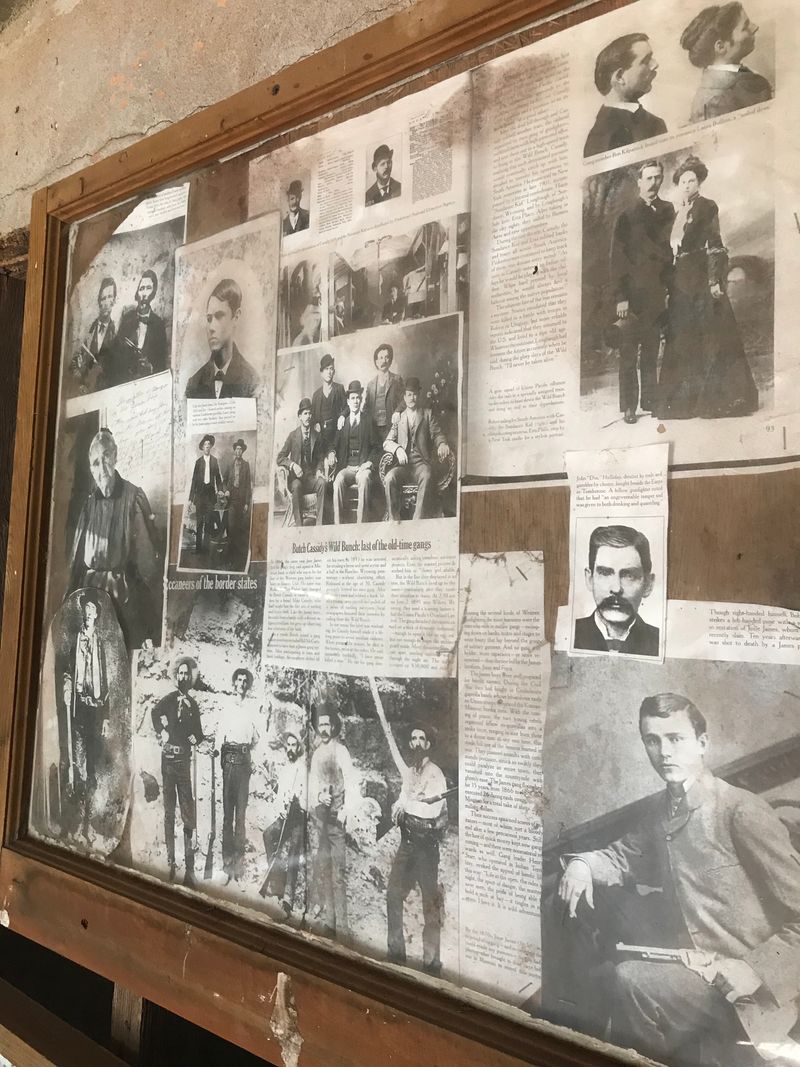
The walls inside Texola’s jail function as an impromptu gallery of frontier criminality, featuring photos and information about some of the Wild West’s most infamous characters. Billy the Kid stares out from one yellowed image, his young face belying the violence attributed to him.
Butch Cassidy appears in another photo, along with details about crimes committed across the western territories during the late 1800s and early 1900s. These weren’t just random decorations but educational materials showing what kind of men lawmen in this region dealt with regularly.
The photos serve as a sobering reminder that frontier justice wasn’t romantic adventure but deadly serious business. Many of the men pictured died violently, shot by lawmen or hanged by mobs when official justice moved too slowly for angry communities.
Some images show execution scenes and crime aftermath that wouldn’t be considered appropriate for younger visitors today. The unfiltered reality of frontier law enforcement gets displayed without modern sensitivity filters, presenting history in its raw, uncomfortable truth.
Reading the descriptions alongside these photos reveals patterns of crime that plagued the region: cattle theft, train robbery, murder over card games, and violence fueled by the lawlessness of territories transitioning into statehood.
Texola’s jail held local troublemakers rather than legendary outlaws, but the photos connected this small town to a larger narrative of frontier justice.
The Ghost Town That Surrounds This Historical Landmark
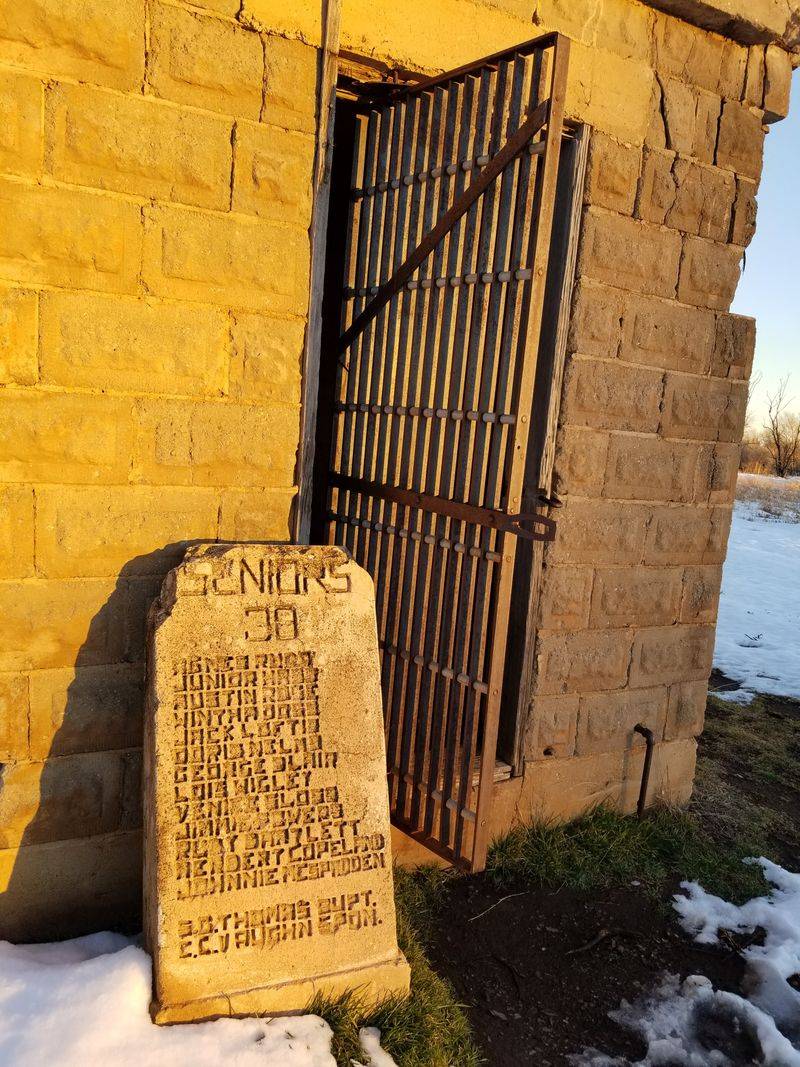
Texola itself tells a story as compelling as the jail, transforming from a bustling Route 66 town into one of Oklahoma’s most photogenic ghost towns. The population has dwindled to fewer than forty residents, leaving behind empty buildings and streets reclaimed by prairie grass.
Main Avenue, where the jail sits, once bustled with travelers stopping for gas, food, and lodging during Route 66’s heyday. Now the silence is profound, broken only by wind whistling through abandoned storefronts and the occasional vehicle passing through without stopping.
The town’s decline mirrors the fate of countless small communities bypassed when Interstate 40 replaced the old highway. Businesses closed, families moved away, and Texola became a place people drove past rather than through, reducing it to a curiosity for history buffs and Route 66 enthusiasts.
Walking through Texola feels like exploring a movie set after the crew has left. Buildings sag under the weight of decades, paint peels in long strips, and nature slowly reclaims structures that once represented prosperity and progress.
The jail stands as the most intact structure, ironically outlasting the homes and businesses it once served.
This ghost town context makes visiting the jail even more poignant. You’re not just seeing a historical building but experiencing the complete lifecycle of a frontier town from hopeful beginning to quiet fade into memory.
Route 66 History Intersects With Frontier Law Enforcement
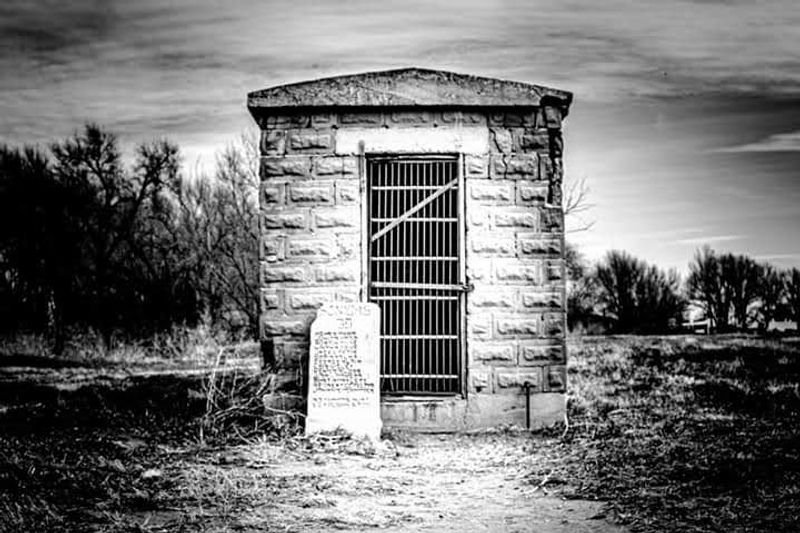
Texola’s location on Route 66 created a unique historical intersection where frontier justice met America’s growing automobile culture. The jail was built before the highway existed, but Route 66’s designation in 1926 brought new life and new problems to this border town.
Travelers racing between Chicago and Los Angeles sometimes brought trouble with them, and local law enforcement had to deal with a new breed of criminal: the mobile offender who could be in another state before anyone noticed.
The old jail suddenly had to accommodate speeders, bootleggers using the highway for smuggling, and drifters looking for easy targets.
Route 66 tourism now keeps the jail from complete obscurity. History enthusiasts traveling the Mother Road make Texola a stop specifically to see this authentic piece of frontier architecture, photographing it alongside other Route 66 landmarks.
The highway’s decline mirrored Texola’s own deterioration. When Interstate 40 opened in the 1970s, traffic that once flowed through town disappeared almost overnight.
Businesses dependent on travelers closed, and the population exodus accelerated, leaving the jail as one of the few structures maintained enough for visitors to explore.
Today, the jail represents two distinct eras of American history: the rough frontier period when Oklahoma was barely civilized, and the mid-twentieth century when automobile tourism connected the country in unprecedented ways. Both stories live in that small stone building.
Preserved Without Restoration Makes History Feel Real
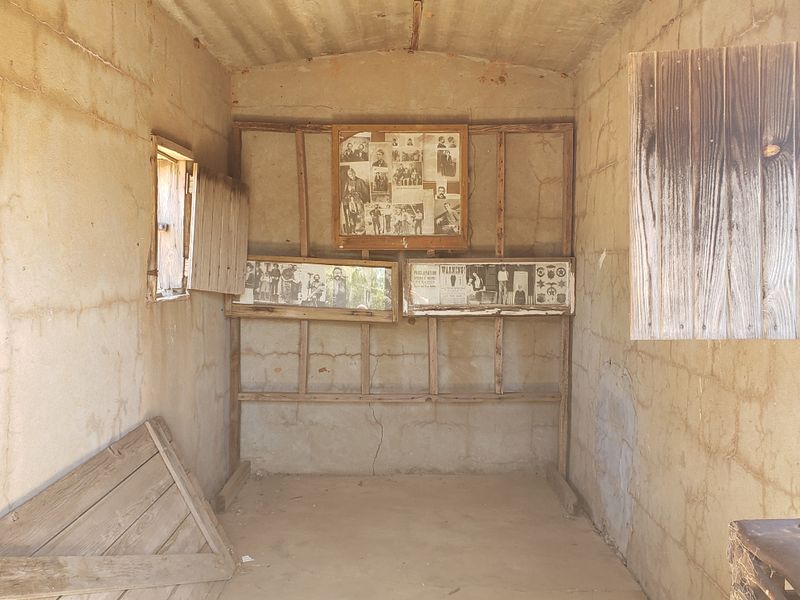
Unlike many historical sites that get cleaned up and restored to an idealized version of their past, Texola’s jail remains authentically deteriorated. The rust on the heater is real rust, the wear on the walls comes from actual use, and the overall atmosphere hasn’t been manufactured for tourist consumption.
This preservation-without-restoration approach creates a visceral connection to the past that polished museums can’t replicate. Standing in that cramped space with its genuine patina of age, visitors experience something closer to what prisoners actually endured rather than a sanitized representation.
Some broken glass and debris inside reminds visitors that this isn’t a theme park attraction with safety measures and insurance considerations. The site requires personal responsibility and awareness, adding an element of adventure that appeals to people tired of overly managed tourist experiences.
The lack of admission fees, gift shops, or official guides means the jail remains accessible to anyone willing to drive to Texola. This democratic approach to historical preservation allows people of all economic backgrounds to experience frontier history without financial barriers.
Graffiti remains notably absent despite the building being unlocked and accessible. The respect shown by visitors over decades demonstrates that people value authentic historical sites and will protect them even without formal oversight.
That community respect has preserved the jail more effectively than any fence or security system.
Open Twenty-Four Hours Without Gates or Guards
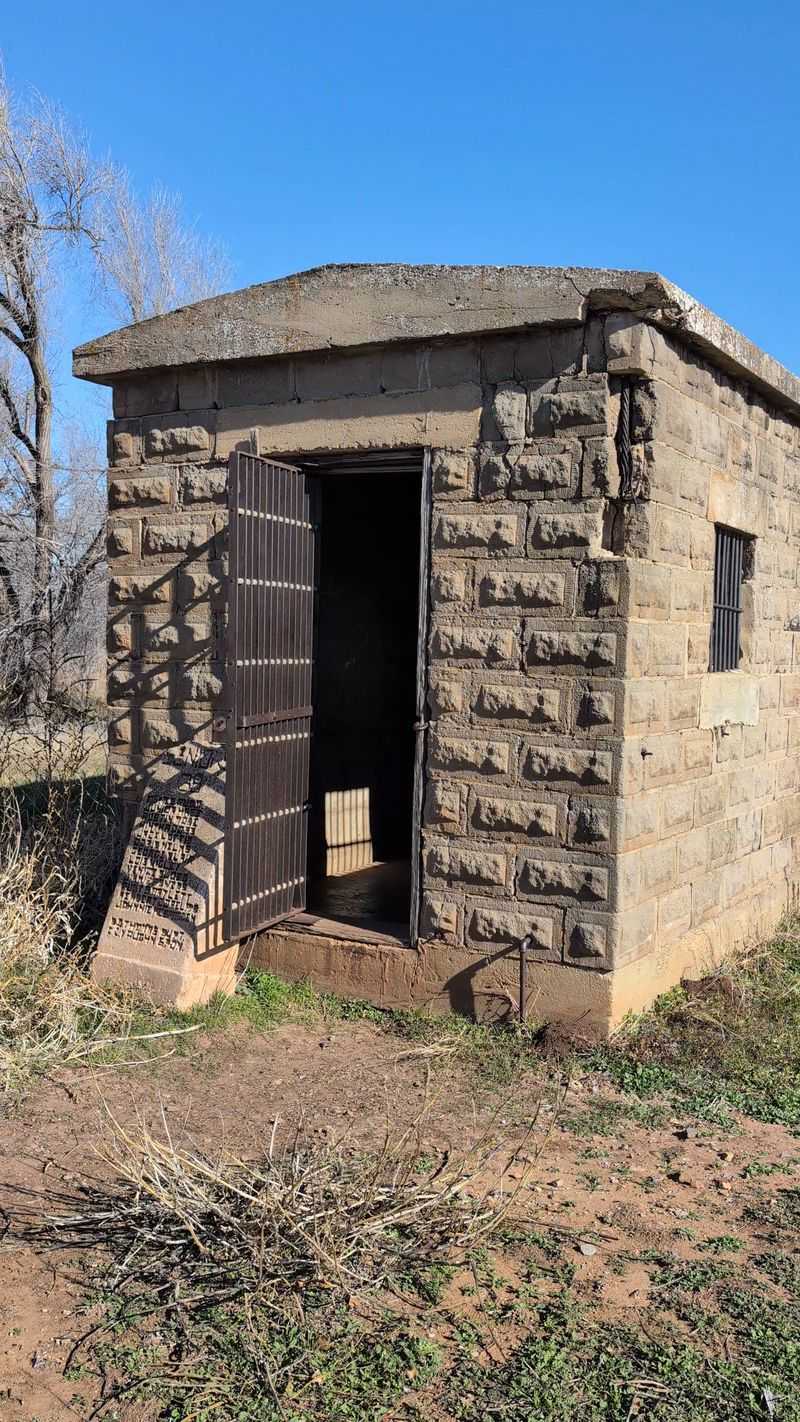
Perhaps the most remarkable aspect of Texola’s jail is its complete accessibility. No gates block entry, no guards monitor visitors, and no admission fees get collected.
The site remains open twenty-four hours a day, trusting visitors to respect what they’ve come to see.
This open-access approach feels increasingly rare in modern America, where liability concerns and vandalism fears lead most historical sites to implement strict controls. Texola’s jail proves that public trust can work when people genuinely value what they’re experiencing.
Visitors can arrive at dawn, midday, or midnight, experiencing the jail under different lighting conditions that dramatically alter its atmosphere. Early morning light streaming through the doorway creates long shadows across the stone floor, while nighttime visits offer an eerie authenticity that daylight softens.
The lack of official oversight means visitors must use common sense regarding safety. The broken glass mentioned in reviews requires careful navigation, and the structure’s age means nothing should be touched unnecessarily or removed as souvenirs.
This accessibility makes the jail perfect for spontaneous stops during Route 66 road trips. No need to check operating hours or plan around closing times, just pull off the highway, walk to the jail, and spend as much or as little time as you want exploring this piece of Oklahoma history.
Conditions That Would Horrify Modern Standards
Modern visitors often express shock at the conditions prisoners endured in Texola’s jail. The space barely accommodates two adults standing comfortably, yet historical records indicate multiple prisoners were sometimes confined here simultaneously for days or weeks.
No bathroom facilities existed inside the cell. Prisoners used buckets that were emptied periodically, adding humiliation to the physical discomfort of confinement.
The smell in summer heat with multiple occupants must have been overwhelming, creating punishment beyond just loss of freedom.
Winter presented equally harsh challenges. That single cast-iron heater couldn’t adequately warm the space, and prisoners had no blankets or warm clothing beyond what they wore when arrested.
Hypothermia was a real risk during Oklahoma’s occasional severe cold snaps.
Food was basic and infrequent, delivered by the marshal or his deputy when they remembered. Prisoners couldn’t see outside, had no reading material beyond what captors provided, and spent hours in near-total darkness when the door was closed.
These conditions weren’t unusual for the era. Frontier justice prioritized containment over rehabilitation or humane treatment.
The jail’s purpose was to hold people until trial or transfer, not to provide comfort or consider long-term psychological effects. Understanding this context helps modern visitors appreciate how dramatically American attitudes toward imprisonment have evolved, even if current conditions still fall short of ideal.
Perfect Stop for History Enthusiasts and Route 66 Travelers
Road trippers consistently rate Texola’s jail as a worthwhile detour from Route 66, praising its authenticity and the brief but memorable experience it provides.
Most visitors spend ten to fifteen minutes exploring the site, enough time to read the historical information and absorb the atmosphere without requiring a major time commitment.
Photography enthusiasts particularly appreciate the jail’s visual appeal. The weathered stone, dramatic shadows, and ghost town setting create compelling images that capture the romance of both frontier history and Route 66’s faded glory.
The site appears frequently on social media, shared by travelers documenting their Mother Road adventures.
History buffs value the jail as a tangible connection to Oklahoma’s territorial period and early statehood. Unlike museums where artifacts sit behind glass, this building lets visitors physically enter the same space where frontier justice was administered, creating an immersive historical experience.
The jail’s location makes it an easy addition to Route 66 itineraries. Texola sits near the Texas border, making it a convenient first or last Oklahoma stop depending on travel direction.
The town’s ghost town character adds bonus exploration opportunities for those interested in abandoned places and urban decay photography.
Families with older children find the jail educational, though parents should preview the criminal photos inside to determine age-appropriateness. The site offers a reality check about historical law enforcement that textbooks can’t match.
Dear Reader: This page may contain affiliate links which may earn a commission if you click through and make a purchase. Our independent journalism is not influenced by any advertiser or commercial initiative unless it is clearly marked as sponsored content. As travel products change, please be sure to reconfirm all details and stay up to date with current events to ensure a safe and successful trip.
