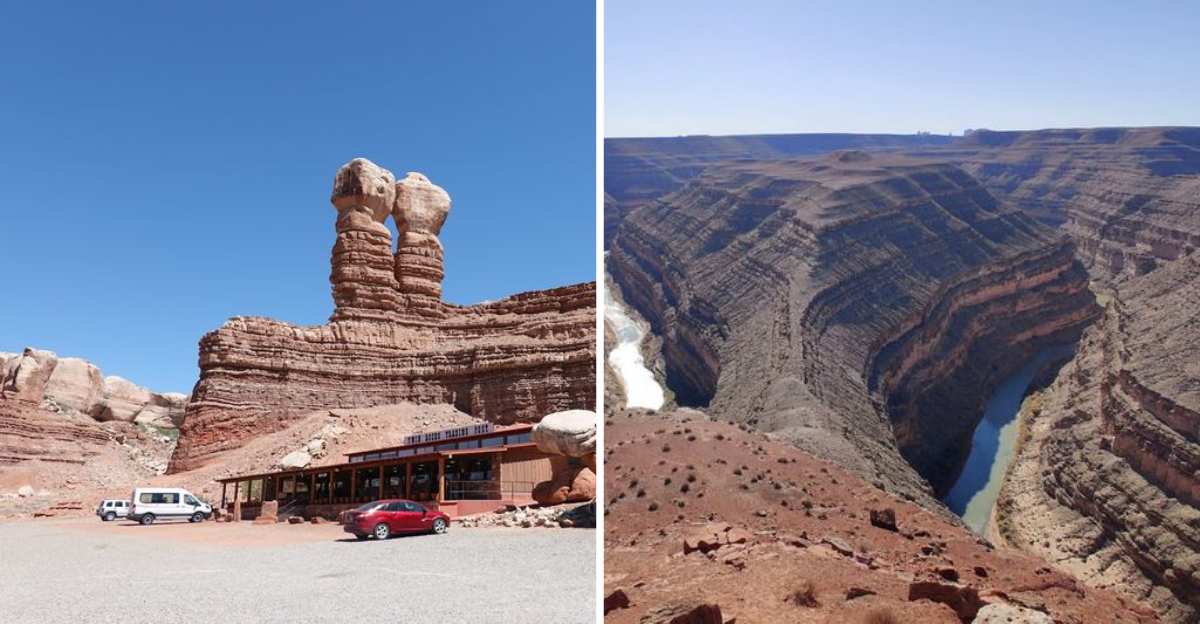
The ground simply drops away in southern Utah. A canyon more than a thousand feet deep, carved by water that never stopped moving. The river below snakes through bends so tight it travels six miles just to move one and a half forward.
I had heard about it before visiting, but no photo prepares you for the scale. The walls hold over three hundred million years of history. You peer over the edge and your brain does a double take.
This place makes you feel genuinely small in the best possible way.
The San Juan River: The Sculptor You Never See Coming
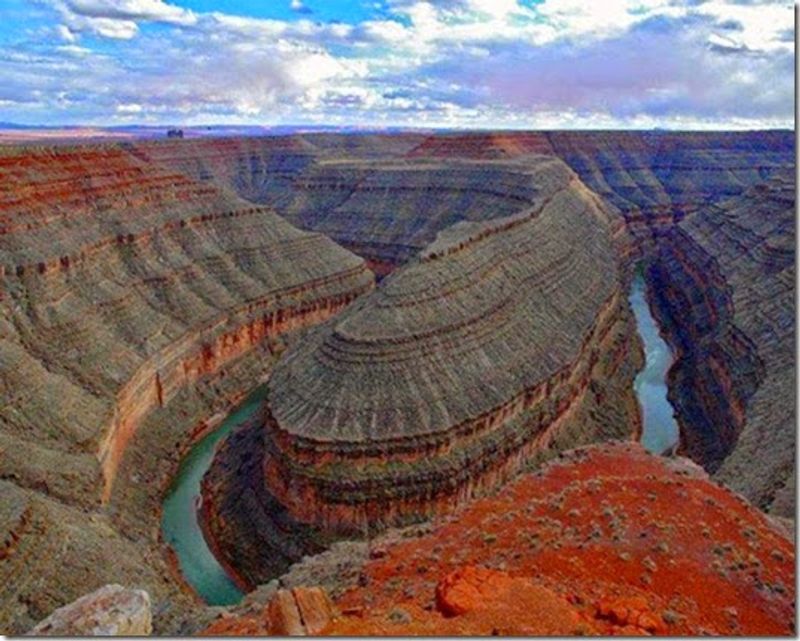
Most sculptures take a few months. The San Juan River took about 300 million years, and the result is honestly unfair to everything else in the art world.
The river flows through a canyon it carved entirely on its own, cutting through layer after layer of ancient rock without ever stopping to take a break.
What makes the San Juan so fascinating here is how it moves. It travels roughly six miles of winding, looping river bends just to advance about one and a half miles in a straight line.
That kind of inefficiency, by human standards, produced one of the most jaw-dropping landscapes in the American Southwest.
The river began carving these meanders when the Colorado Plateau started slowly pushing upward around 70 to 80 million years ago. As the land rose, the river cut deeper while keeping its original curving path.
The result is what geologists call entrenched meanders, a technical term for something that looks absolutely impossible. You can watch the river glinting far below from the overlook, still moving, still carving, still working on a project that will never truly be finished.
300 Million Years of Rock Layers Hiding in Plain Sight
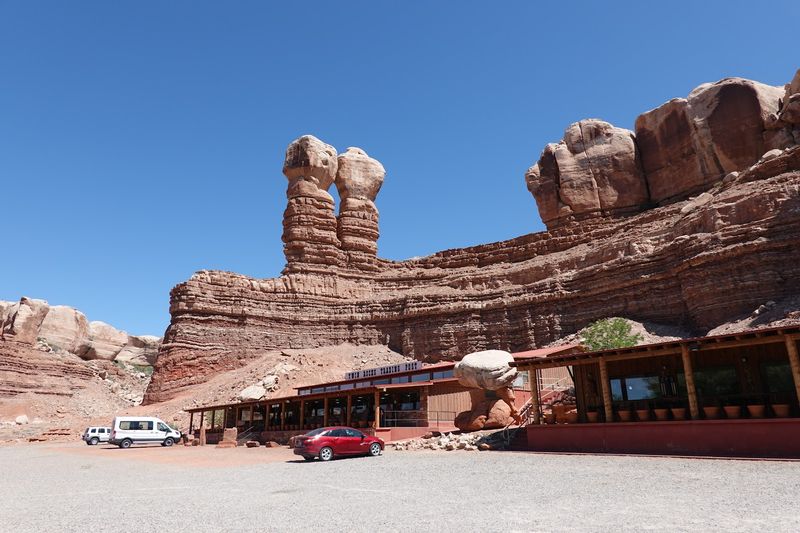
Geology textbooks can be dry. But standing at the rim of Goosenecks and looking across at the canyon walls is like reading that textbook in the most cinematic way possible.
Each visible stripe of color in the rock face represents a different era, a different world, stacked up like the pages of a very old story.
The canyon exposes 16 distinct layers of geology, with the oldest formations dating back over 300 million years to the Pennsylvanian period. Two of the most notable are the Paradox Formation and the Honaker Trail Formation, both of which tell the story of ancient seas that once covered this region.
Softer shale layers erode faster, creating stepped ledges in the canyon walls, while tougher limestone holds firm and forms sharp vertical drops. That contrast is what gives the canyon its layered, almost architectural look.
The eroded material does not just disappear either. The river grinds it down gradually, turning ancient rock into the fine sand that lines riverbanks far downstream.
Every grain of sand you might see near the river was once part of a canyon wall that existed before dinosaurs walked the earth.
The Overlook That Rewards Zero Effort
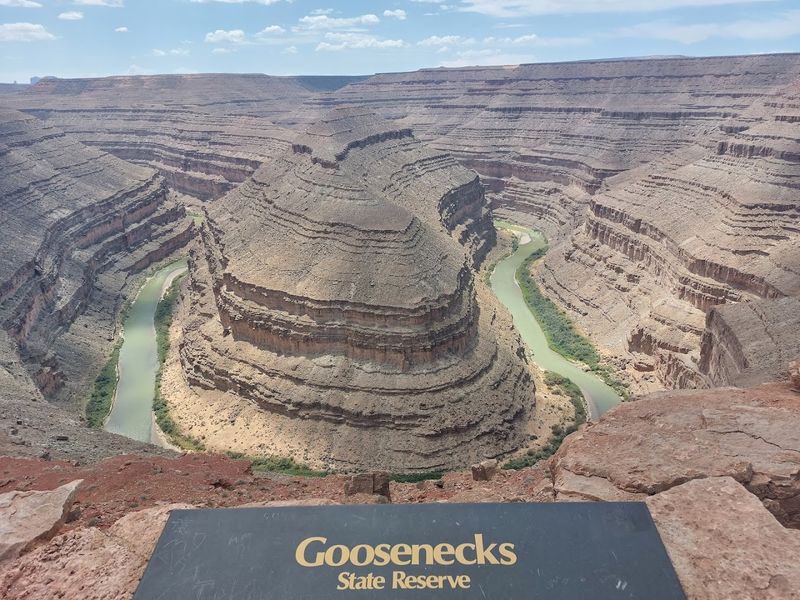
Not every incredible view requires a brutal hike. Goosenecks State Park is refreshingly honest about that fact, placing one of the most dramatic overlooks in Utah just a short walk from the parking area.
You drive in, park, take about thirty steps, and suddenly the earth vanishes beneath you.
The canyon drops more than 1,000 feet straight down, and the river below looks almost toy-like from up top. It is the kind of view that makes people go quiet for a few seconds before they start reaching for their cameras.
Benches and picnic tables are scattered near the overlook, which means you can sit and stare for as long as you want without needing to stand at the edge the entire time.
The park is open 24 hours every day, which opens up some genuinely special timing options. Sunrise hits the canyon walls with warm orange light that makes the rock glow.
Sunset turns everything a deeper amber, and the shadows in the bends look almost purple. Even midday has its own harsh, dramatic beauty.
For a place that asks almost nothing physically, Goosenecks delivers a lot in return.
Camping on the Rim: Sleeping Next to Something Ancient
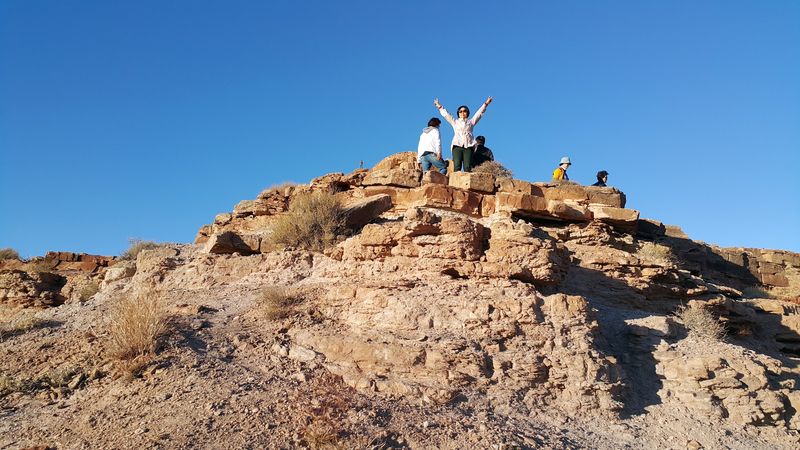
Camping at Goosenecks is not glamping. There are no hookups, no fancy facilities, and the ground is raw desert rock.
But camping here means waking up a few feet from the edge of a 1,000-foot canyon, and that trade-off is absolutely worth it.
Sites are first-come, first-served, and the layout follows the canyon rim in a loose loop, meaning most spots have unobstructed views. Fire rings are already in place at many sites, and vault toilets are available.
The park operates on an honor system for fees, with a QR code option for those who do not carry cash.
The real magic happens after dark. Because Goosenecks sits in a remote corner of southeastern Utah with very little light pollution, the night sky here is extraordinary.
The Milky Way arches clearly overhead on clear nights, and the silence is the kind you rarely find anymore. RVs are welcome and fit well along the rim.
Tent campers should bring thick sleeping pads since the ground is rocky and uneven. It is primitive camping in every sense, but falling asleep with a canyon that took 300 million years to form right outside your tent is a pretty hard experience to top.
What Entrenched Meanders Actually Mean and Why It Matters
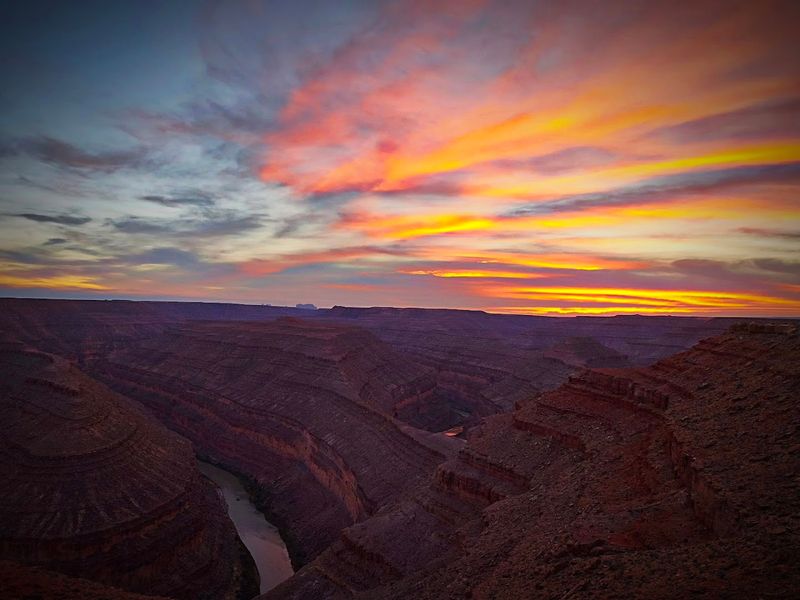
The term entrenched meanders sounds like something from a college geology exam, but the concept is actually pretty easy to picture once someone explains it well. A river that meanders normally does so across flat ground, curving lazily from side to side.
An entrenched meander does the same thing, but deep inside a canyon it carved itself.
Here is how it happened at Goosenecks. The ancestral San Juan River originally flowed across a broad, flat plain, winding gently as rivers do.
Then the Colorado Plateau began rising very slowly over millions of years. As the ground lifted, the river did not straighten out.
Instead, it kept its curving pattern and cut straight down into the rising rock beneath it, like a slow drill following a crooked path.
The result is a canyon that twists dramatically rather than running in a straight line. Scientists use the tight meanders and the progressively older gravel deposits found at different heights along the walls as evidence of slow, steady uplift rather than any kind of sudden flood event.
A catastrophic flood would have carved something straighter and less complex. The Goosenecks exist precisely because time, not force, was the dominant ingredient.
Getting There and Making the Most of a Remote Location
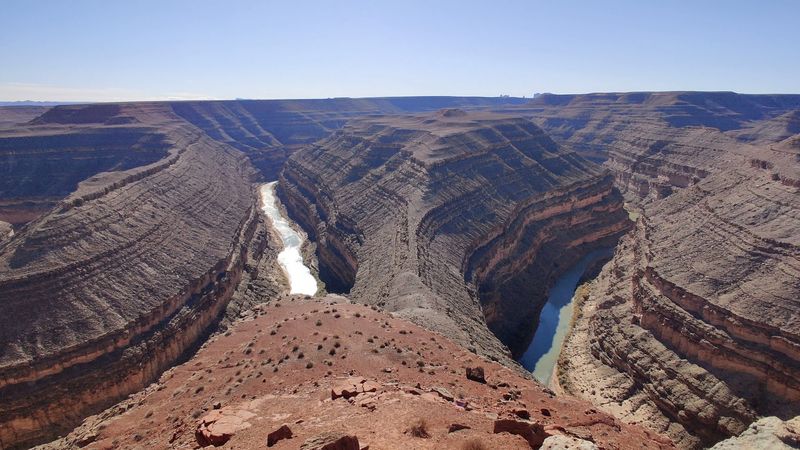
Remote is a word that gets thrown around loosely in travel writing, but Goosenecks genuinely earns it. The park sits off UT-316 near the small community of Mexican Hat in San Juan County, a stretch of southern Utah that feels deliberately far from everything else.
That distance is part of what keeps it quieter than more famous nearby parks.
The drive in is paved all the way to the parking area, which makes it accessible for most vehicles including low-clearance cars. From there, the gravel continues around the rim for RVs and those wanting different vantage points along the edge.
Cell service is limited, so downloading offline maps before you leave is a smart move.
There are no stores, gas stations, or restaurants at the park, so arriving prepared matters. Bring enough water, food, and any supplies you need for your stay.
The nearest services are in Mexican Hat or farther along toward Monument Valley. That said, the remoteness is genuinely part of the experience.
Fewer crowds mean more space to breathe, more room to sit quietly at the overlook, and a stronger sense that you found something real rather than something packaged for tourists.
Stargazing, Sunsets, and the Slow Art of Just Looking
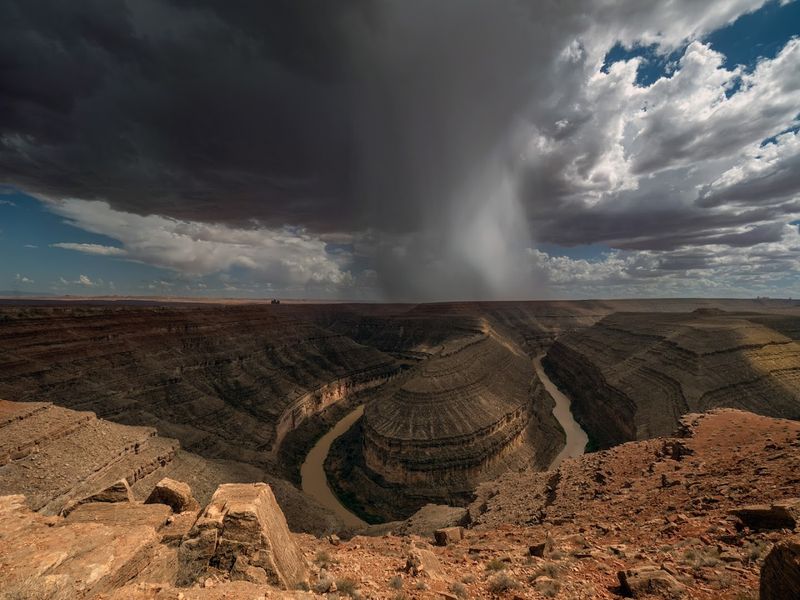
Some places are worth visiting for one specific moment, and at Goosenecks, that moment tends to happen twice a day. Sunrise and sunset both transform the canyon in completely different ways, and neither one disappoints.
The low-angle light catches the curves of the river and throws long shadows across the canyon walls that make the depth look even more extreme than it already is.
Sunset is probably the more popular choice, and the west-facing aspect of the overlook makes it ideal. The light goes through shades of gold, orange, and deep red before the canyon falls into shadow.
Photographers tend to arrive early to claim the best angles along the rim.
After dark, the park becomes something else entirely. The lack of nearby towns means the sky fills up with stars in a way that genuinely surprises people who are used to light-polluted skies.
Astrophotography enthusiasts have been catching the Milky Way here for years, and even casual stargazers will find it worth staying up late. There is something quietly powerful about sitting at the edge of a canyon carved over hundreds of millions of years, watching a sky full of stars that were there for every moment of it.
Address: UT-316, Mexican Hat, UT 84531
