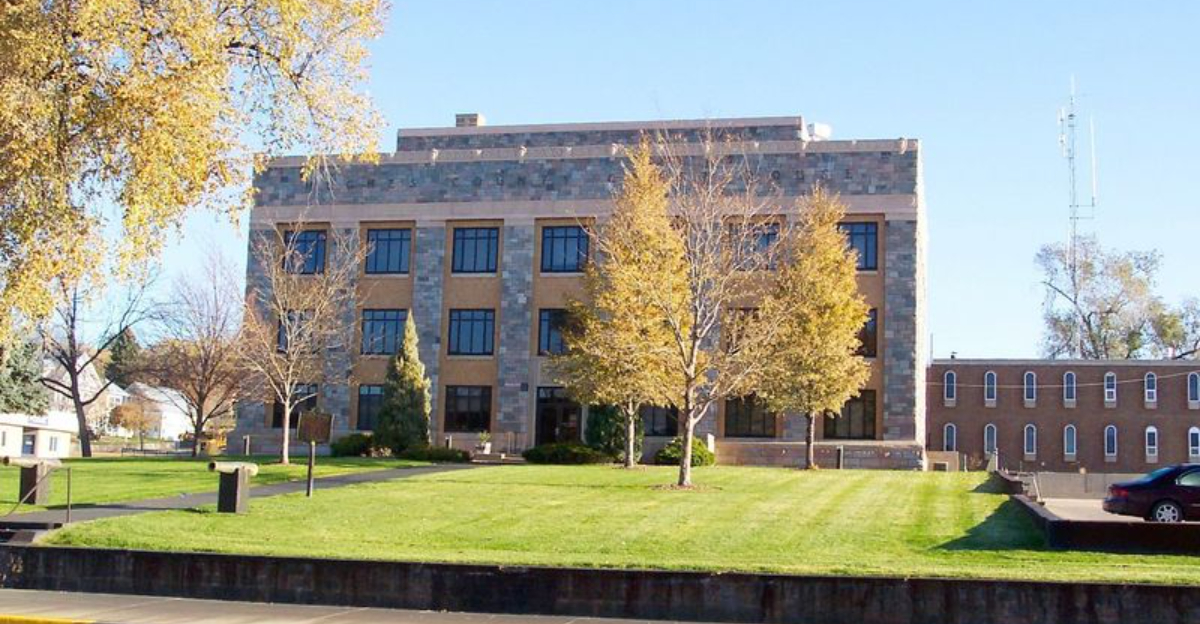
Oklahoma’s small towns are home to some of the most beautiful and historic courthouses in America. These architectural gems tell stories of our state’s past while still serving their communities today. From grand domes to unusual designs, these 8 courthouses showcase Oklahoma’s rich history and small-town pride.
1. Pawnee County Courthouse’s Sandstone Marvel
Built in 1932, the Pawnee County Courthouse stands as a testament to Depression-era craftsmanship. Local sandstone gives this building its distinctive reddish-brown color that glows beautifully at sunset.
The courthouse features intricate carvings of Native American symbols, honoring the area’s rich heritage. These details were crafted by skilled artisans who found work during economic hardship.
A unique octagonal tower rises from the center, topped with a copper dome that has weathered to a lovely green patina. Visitors often remark on the building’s perfect symmetry and the peaceful courtyard with century-old oak trees.
2. Kingfisher’s Prairie Palace
Standing tall since 1898, the Kingfisher County Courthouse brings Victorian elegance to the prairie landscape. Its red brick exterior contrasts beautifully with white limestone trim and corner quoins that add a touch of sophistication.
The clock tower remains fully functional after more than a century, still chiming on the hour. Local residents set their watches by it, continuing a tradition that spans generations of Kingfisher families.
Inside, a spiral staircase with ornate iron railings leads to courtrooms with original wood paneling and pressed tin ceilings. The building survived the Dust Bowl and multiple tornado seasons virtually unscathed.
3. Perry’s Limestone Landmark
The Noble County Courthouse in Perry commands attention with its gleaming white limestone exterior and imposing columns. Completed in 1915, this neoclassical beauty features a perfect balance of elegance and frontier practicality.
What makes this courthouse special is the unusual double staircase that splits and reunites as it climbs to the main entrance. Legend says it was designed this way so ladies in long skirts could ascend gracefully without tripping.
The building survived a direct lightning strike in 1952 that left a black scar still visible on the eastern corner. Four magnificent lion statues guard each corner of the property, added during a 1930s renovation.
4. Sayre’s Art Deco Dream
Featured in the opening scenes of “The Grapes of Wrath,” Sayre’s Beckham County Courthouse remains one of Oklahoma’s most photographed buildings. This 1911 structure received an Art Deco makeover in the 1930s, creating a striking blend of architectural styles.
Zigzag patterns and geometric motifs adorn the façade, while sleek aluminum doors contrast with the original stone foundation. The courthouse clock has four faces, each pointing in a cardinal direction, allowing farmers from miles around to check the time.
The interior boasts terrazzo floors with inlaid brass designs showing Oklahoma’s native plants. A hidden basement once served as a fallout shelter during the Cold War, complete with supplies still stored there today.
5. Newkirk’s Towering Castle
From certain angles, the Kay County Courthouse in Newkirk resembles a medieval castle more than a government building. Constructed from distinctive pink granite in 1926, its imposing tower and crenellated roofline create an unexpected silhouette against the Oklahoma sky.
Gargoyles peer down from corner perches, each representing different aspects of justice and law. Local stonemasons carved these figures by hand, often including hidden symbols and occasionally their own likenesses in the stonework.
During restoration in 1998, workers discovered a time capsule containing newspapers, coins, and a handwritten letter predicting what Newkirk might look like in the future. The courthouse grounds feature a small garden with plants mentioned in famous court cases.
6. Stigler’s Prairie School Gem
The Haskell County Courthouse in Stigler represents a rare example of Prairie School architecture in a government building. Completed in 1905, its low, horizontal lines and wide overhanging eaves create a sense of harmony with the surrounding landscape.
Frank Lloyd Wright’s influence is evident in the geometric stained glass windows and built-in wooden benches that line the main corridor. These benches have supported generations of Oklahomans waiting for their day in court.
A unique feature is the courthouse’s “whispering arch” – a curved hallway where acoustic properties allow conversations to travel from one end to the other. During Prohibition, this architectural quirk reportedly helped expose more than one local bootlegger discussing business too loudly!
7. Holdenville’s Copper-Topped Wonder
Rising above the trees in Holdenville, the Hughes County Courthouse’s distinctive copper dome has turned a brilliant green over its century-long existence. Built in 1901, this Romanesque Revival structure features arched windows and rusticated stone that gives it a fortress-like appearance.
The courthouse survived a devastating tornado in 1947 that destroyed much of downtown. According to local legend, the building was spared because of a blessing performed by a Seminole medicine man during its construction.
Four different types of Oklahoma stone were used in building the courthouse, creating subtle color variations that change with the light. The building’s cornerstone contains a Bible, a copy of the constitution, and seeds from crops important to early settlers.
8. Wewoka’s Spanish Colonial Surprise
Standing out among Oklahoma’s courthouses, the Seminole County Courthouse in Wewoka embraces Spanish Colonial Revival style with stucco walls and a red tile roof. Completed in 1927, it feels more like it belongs in the Southwest than in oil country.
A series of arched walkways surrounds the building, providing shade during hot Oklahoma summers. These walkways feature hand-painted tiles depicting scenes from Seminole tribal history and the early oil boom days.
The courthouse bell was salvaged from a Spanish mission and dates to 1791, making it older than Oklahoma itself. Every Christmas, the building transforms with thousands of lights outlining its distinctive silhouette, creating a holiday tradition that draws visitors from surrounding counties.
Dear Reader: This page may contain affiliate links which may earn a commission if you click through and make a purchase. Our independent journalism is not influenced by any advertiser or commercial initiative unless it is clearly marked as sponsored content. As travel products change, please be sure to reconfirm all details and stay up to date with current events to ensure a safe and successful trip.
