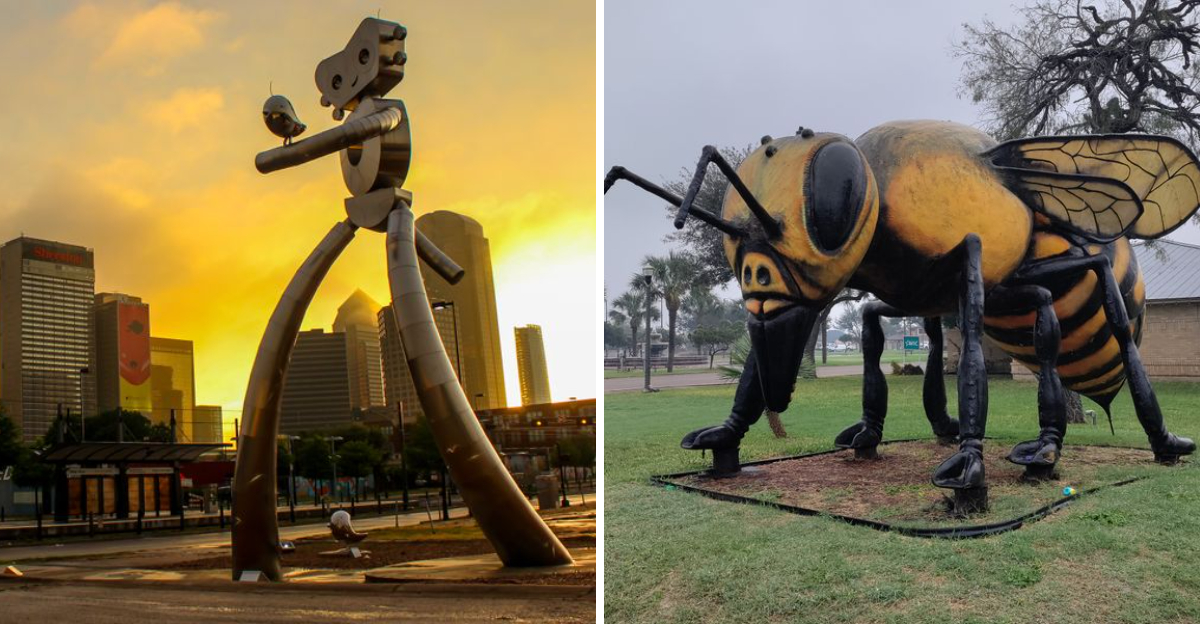
Texas stretches across a vast landscape where art meets open sky, and creativity takes bold, unexpected forms.
From towering robots in urban districts to whimsical giants guarding small towns, the Lone Star State surprises visitors with sculptures that challenge convention and spark imagination.
These installations transform ordinary roadside stops into memorable destinations, offering photographers and travelers alike the chance to capture something truly one-of-a-kind.
Whether you crave quirky roadside attractions or thought-provoking modern art, Texas delivers visual treasures that demand a second look and a camera ready to click.
1. Cadillac Ranch
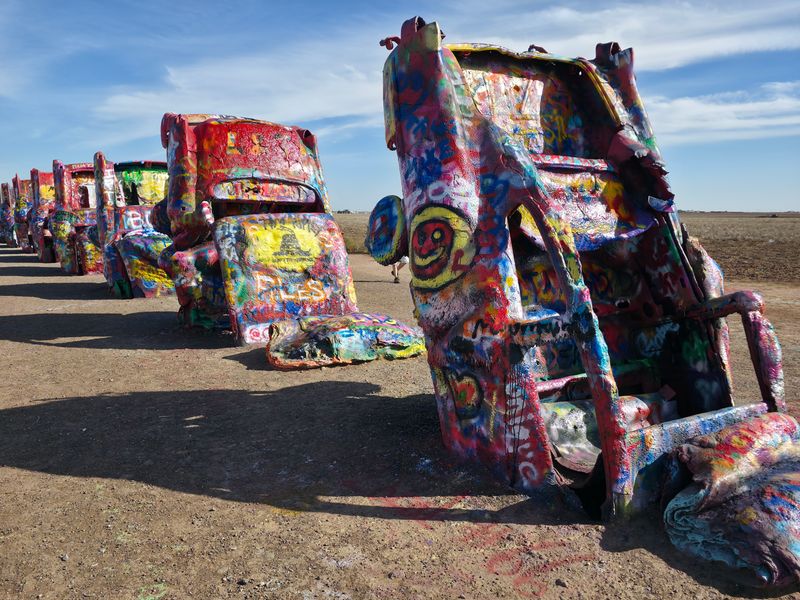
Standing in a wheat field just west of Amarillo, ten classic Cadillacs jut from the earth at the same angle as the Great Pyramid of Giza, creating one of America’s most recognized roadside art installations.
The art collective Ant Farm conceived this project in 1974, burying the cars nose-first to celebrate the evolution of the Cadillac tail fin from 1949 to 1963.
What started as a statement about American consumerism has evolved into an interactive canvas where visitors are encouraged to leave their mark with spray paint.
Layers upon layers of graffiti now coat every surface, creating a constantly changing palette of colors, messages, and artistic expressions.
Photographers arrive at dawn to catch the soft light illuminating the vibrant hues, while sunset casts dramatic shadows across the installation.
The site sits on private land but remains open to the public year-round, welcoming travelers who pull off Interstate 40 with cans of spray paint in hand.
Families, couples, and solo adventurers alike add their personal touches, making each visit unique from the last.
The juxtaposition of classic American automobiles against the endless Texas plains creates a surreal scene that feels both nostalgic and futuristic.
No two photographs of Cadillac Ranch ever look identical because the artwork transforms daily through countless contributions.
This living sculpture represents freedom, creativity, and the collaborative spirit that defines much of Texas’s artistic landscape.
Bring your own spray paint, leave your worries behind, and capture images that tell your personal story within this evolving masterpiece.
Address: 13651 I-40 Frontage Rd, Amarillo, Texas
2. The Traveling Man
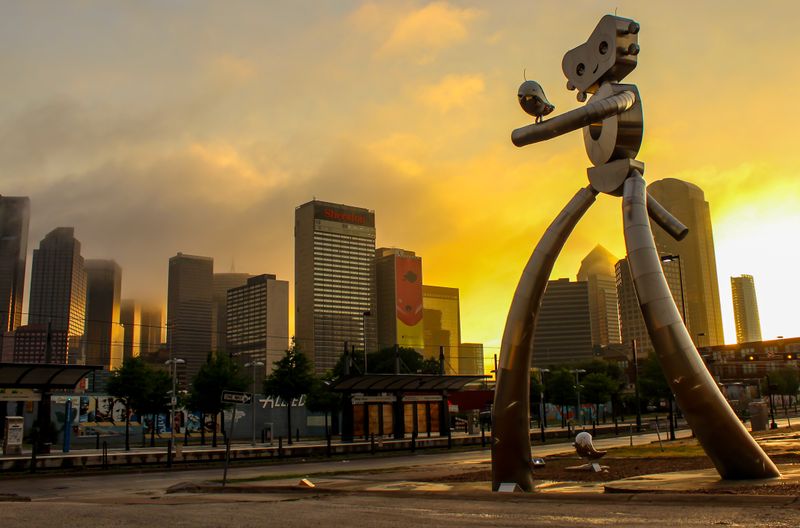
Deep Ellum’s historic streets host a trio of towering mechanical figures that seem ready to stride across the Dallas skyline at any moment.
Created by sculptor Brandon Oldenburg and commissioned by Dallas Area Rapid Transit in 2009, these stainless steel giants reach heights of 25 to 35 feet.
Each robot carries a distinct personality, with birds perched upon their shoulders and heads, suggesting a harmony between technology and nature.
The sculptures symbolize the neighborhood’s transformation and the journey of travelers passing through this vibrant artistic district.
Brushed and polished stainless steel surfaces catch sunlight during the day, creating brilliant reflections that shift with the sun’s movement.
At night, strategic lighting transforms the figures into glowing sentinels watching over the entertainment district below.
The largest of the three stands near the DART Green Line station, serving as an unmistakable landmark for commuters and visitors.
Photographers find endless angles to explore, from ground-level shots that emphasize their imposing scale to distance views that show them against the Dallas skyline.
The robots have become unofficial mascots of Deep Ellum, appearing in countless social media posts and travel guides.
Their presence speaks to Dallas’s commitment to public art and the city’s desire to blend industrial heritage with contemporary creativity.
Street art, live music venues, and eclectic shops surround the sculptures, making this destination perfect for a full day of exploration and photography.
Address: 2777 Commerce St, Dallas, Texas
3. Stonehenge II

Hidden among the rolling hills near Ingram, an unexpected replica of England’s most mysterious monument rises from the Texas landscape.
Al Shepperd and Doug Hill constructed this 90 percent scale version using steel reinforcement and concrete, completing their ambitious project in the 1980s.
What began as a lighthearted endeavor between friends has become a beloved attraction that draws curious travelers from across the state.
The creators added their own twist by including two Easter Island moai statues standing guard nearby, creating an archaeological mashup that defies geographical logic.
Unlike its ancient British counterpart, Stonehenge II welcomes visitors to walk freely among the standing stones and touch the weathered concrete surfaces.
The Hill Country setting provides a dramatically different backdrop than the Salisbury Plain, with oak trees and wildflowers replacing English grasslands.
During spring, Texas bluebonnets bloom around the base of the stones, creating a uniquely Texan photo opportunity that celebrates both local and ancient heritage.
Photographers time their visits for golden hour when warm light bathes the stones and casts long shadows across the ground.
The site suffered damage from a storm in 2017 but was lovingly restored and relocated to the Hill Country Arts Foundation campus.
This quirky installation reminds visitors that Texas embraces humor and creativity in equal measure, never taking itself too seriously.
Families enjoy picnicking on the grounds while children run between the massive stones, creating memories against this improbable backdrop.
Address: 120 Point Theatre Rd S, Ingram, Texas
4. Ms. Pearl, the Giant Squirrel
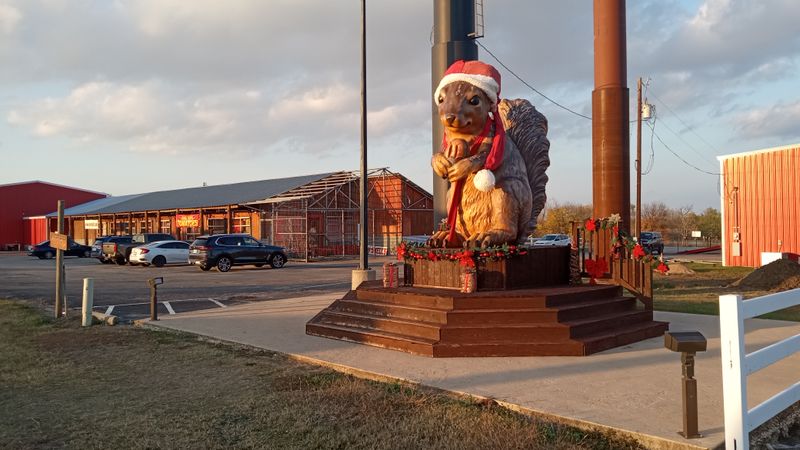
Clutching an oversized pecan in her paws, a fourteen-foot-tall squirrel greets visitors to the Berdoll Pecan Candy and Gift Company with an unmistakable Texas-sized welcome.
Ms. Pearl holds the distinction of being the world’s largest squirrel statue, a title that perfectly captures the state’s fondness for supersized roadside attractions.
Her fiberglass form towers over parked cars, creating a delightfully absurd photo opportunity that travelers simply cannot resist.
The statue serves as both mascot and marketing genius for the family-owned pecan business that has operated in Central Texas for decades.
Children squeal with delight upon spotting her from the road, begging parents to stop for pictures and, inevitably, some pecan pralines from the shop.
Her cheerful expression and bright colors make her approachable despite her imposing size, embodying the friendly spirit of small-town Texas.
Photographers position themselves at various distances to either emphasize her scale against human subjects or capture her full glory from head to tail.
The surrounding area offers classic Texas scenery with pecan groves and rolling hills providing a natural setting for this unnatural giant.
Seasonal decorations sometimes adorn Ms. Pearl, with holiday wreaths or patriotic accessories adding festive touches throughout the year.
Her presence has transformed a simple roadside business into a destination worth the detour off Highway 21.
Visitors leave with both photographs and bags of pecan treats, making Ms. Pearl a successful ambassador for Texas agriculture and whimsy.
Address: 2626 TX-21, Cedar Creek, Texas
5. The Eye
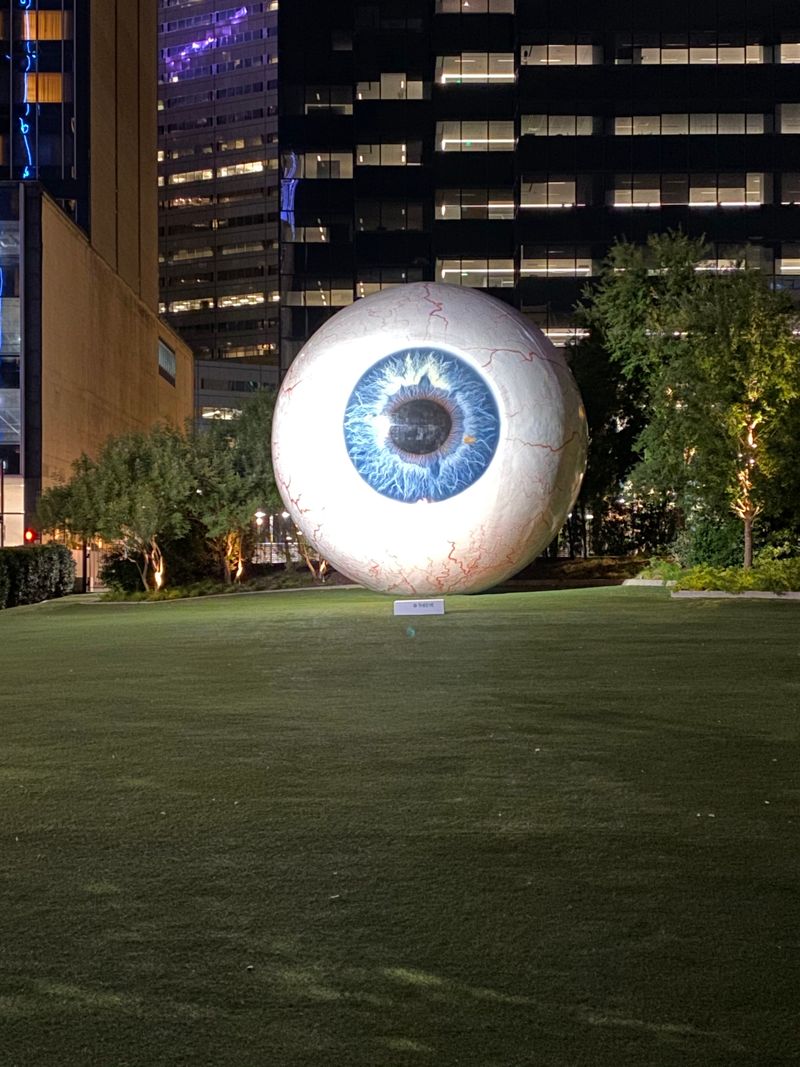
A colossal human eyeball stares unblinking from the heart of Dallas’s Victory Park, its thirty-foot diameter commanding attention from every passerby.
Artist Tony Tasset created this fiberglass, steel, and resin masterpiece in 2013, intending to provoke contemplation about surveillance, observation, and human connection.
The blue iris contains intricate details including realistic bloodshot veins that make the sculpture both beautiful and slightly unsettling.
Many visitors report the eerie sensation that the pupil follows them as they move around the plaza, though this remains an optical illusion.
The Eye has rapidly become one of Dallas’s most photographed landmarks, appearing in countless Instagram feeds and travel blogs.
Its placement in an upscale urban development creates an interesting contrast between high art and commercial space.
Photographers experiment with perspectives, shooting from ground level to emphasize its overwhelming presence or from nearby buildings to capture its relationship with the surrounding architecture.
At night, subtle lighting illuminates the sculpture, giving it an otherworldly glow that transforms the viewing experience entirely.
The artwork sparks conversations about what it means to see and be seen in an increasingly visual culture.
Children find it simultaneously fascinating and slightly spooky, often approaching cautiously before warming up to its strange charm.
The Eye represents Dallas’s commitment to bold public art that challenges viewers rather than simply decorating empty spaces.
Address: 2777 N. Stemmons Fwy, Dallas, Texas
6. Prada Marfa
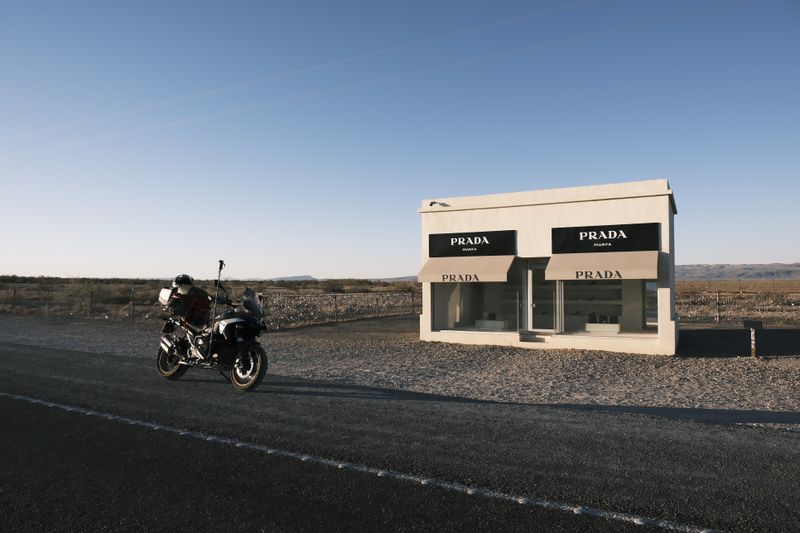
Rising improbably from the Chihuahuan Desert landscape, a pristine Prada boutique stands alone along a remote stretch of Highway 90 near Valentine.
Artists Elmgreen and Dragset created this permanent sculpture in 2005 as a commentary on consumerism and the collision of high fashion with desolate wilderness.
The building contains real Prada handbags and shoes from the 2005 collection, displayed behind glass windows that will never open for business.
This surreal installation challenges viewers to question luxury, accessibility, and the meaning of value in contexts stripped of urban infrastructure.
The structure sits exactly 1.4 miles from Valentine, positioned to remain forever isolated from the communities it might theoretically serve.
Photographers make pilgrimages to capture this bizarre juxtaposition of haute couture against scrubland and endless sky.
The stark white building glows against the desert at different times of day, from harsh midday sun to the soft pastels of sunrise.
Despite its remote location, the sculpture attracts thousands of visitors annually who journey specifically to witness this artistic statement.
Vandals have occasionally targeted the installation, but it has been carefully restored each time to maintain its pristine appearance.
The surrounding landscape offers its own dramatic beauty, with mountains visible in the distance and vast open spaces emphasizing human smallness.
Prada Marfa has appeared in films, music videos, and fashion editorials, cementing its status as a cultural landmark beyond the art world.
Address: 1 Prada Marfa, Valentine, Texas
7. Dinosaur Valley State Park Tracks
While not traditional sculptures, the preserved dinosaur tracks embedded in the Paluxy River limestone represent nature’s own three-dimensional artwork from 113 million years ago.
These fossilized footprints belong to both carnivorous theropods and massive sauropods that once roamed the mudflats of prehistoric Texas.
The tracks remain visible in the riverbed when water levels drop, revealing perfectly preserved toe impressions and stride patterns.
Visitors can walk alongside these ancient pathways, placing their own feet next to prints that dwarf human scale.
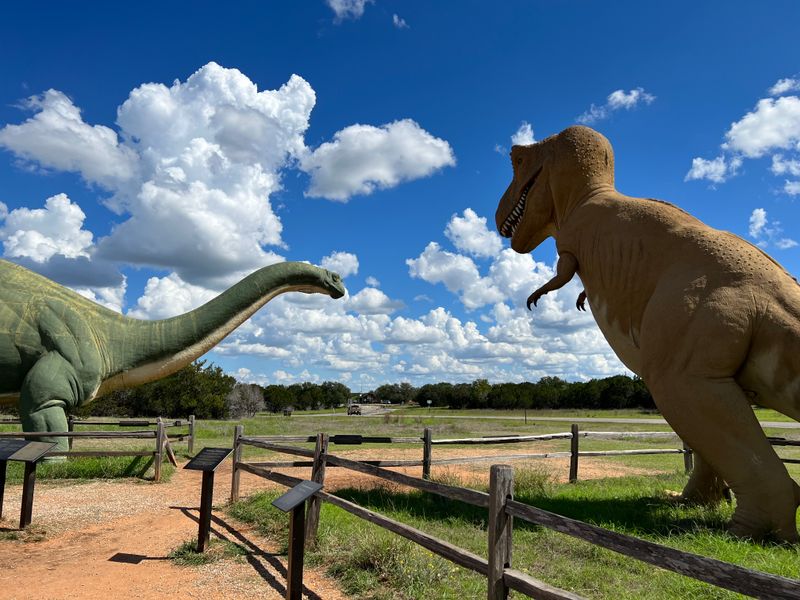
The park also features life-sized fiberglass dinosaur models that have become photography favorites since their installation in the 1960s.
A towering Apatosaurus stands in the river while a fearsome Tyrannosaurus Rex guards the park entrance, both offering campy photo opportunities.
These vintage models capture a specific era of dinosaur understanding, before scientific discoveries changed how we envision these creatures.
Their slightly outdated appearance adds nostalgic charm, reminding visitors of childhood museum trips and dinosaur obsessions.
Photographers balance shots between the authentic fossil tracks and the whimsical fiberglass recreations, documenting both natural history and human interpretation.
The park’s scenic beauty extends beyond its paleontological treasures, with hiking trails, camping areas, and the winding Paluxy River creating a full outdoor experience.
Families spend hours exploring the riverbed, hunting for visible tracks and imagining the ancient world these creatures inhabited.
Address: 1629 Park Road 59, Glen Rose, Texas
8. The World’s Largest Killer Bee
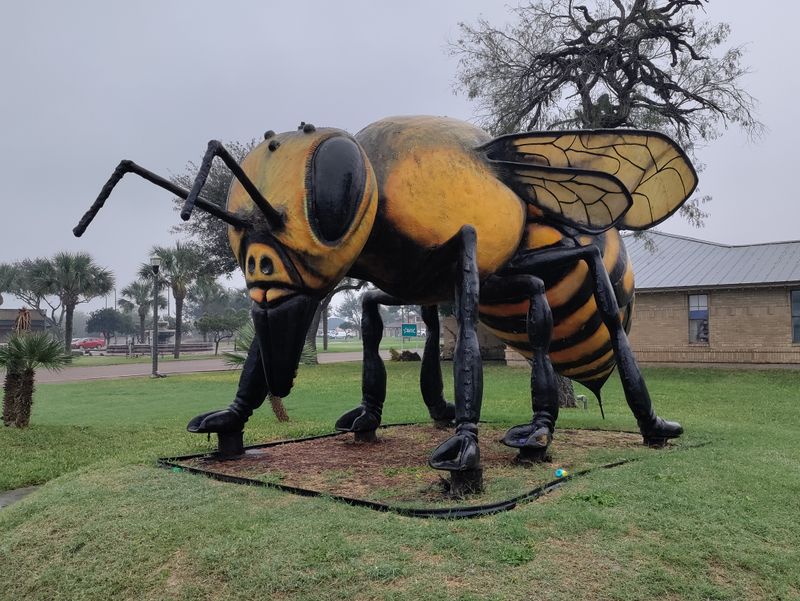
Hidalgo proudly displays a twenty-foot-long fiberglass killer bee, celebrating the town’s unusual claim to fame as the site of the first Africanized bee swarm documented in the United States.
This distinction arrived in 1990 when the aggressive bee species crossed into Texas from Mexico, forever changing local beekeeping and agriculture.
Rather than shrink from this notorious invasion, Hidalgo embraced it with characteristic Texas bravado by commissioning an enormous monument to their tiny antagonists.
The sculpture features exaggerated anatomical details including massive compound eyes, fuzzy thorax, and translucent wings that seem ready to buzz into action.
Its bright yellow and black stripes make it impossible to miss, drawing attention from Highway 281 and beckoning travelers to stop for a closer look.
The bee rests on a platform that allows visitors to safely approach and photograph this oversized insect from multiple angles.
Children react with a mixture of fascination and fear, keeping a respectful distance despite knowing the sculpture poses no threat.
The monument stands near the Killer Bee Museum, which documents the ecological and agricultural impact of Africanized bees in the Rio Grande Valley.
Photographers capture the bee against blue sky backgrounds, emphasizing its improbable scale and the absurdity of celebrating such an unwelcome arrival.
The sculpture embodies Texas’s ability to find pride and humor in unexpected circumstances, turning a biological invasion into a tourist attraction.
Local festivals sometimes incorporate the bee into celebrations, with the sculpture serving as a backdrop for community events and gatherings.
Address: 601 E. Coma Ave, Hidalgo, Texas
9. The World’s Largest Fire Hydrant

Beaumont’s Fire Museum of Texas features a twenty-four-foot-tall fire hydrant painted in glossy red, originally created as a promotional piece for the 1996 Disney film about spotted rescue dogs.
After serving its Hollywood purpose, the hydrant found a permanent home in Texas, where it now honors firefighters and serves as the museum’s unmistakable landmark.
The massive steel structure weighs several tons, constructed with the same attention to detail as a functional hydrant but scaled to cartoonish proportions.
Its bright red paint gleams in the Texas sun, visible from blocks away and drawing curious visitors who initially mistake it for a water tower.
The hydrant stands as a playful tribute to both firefighting heritage and the whimsical roadside attractions that dot Texas highways.
Photographers position subjects at the base to emphasize the hydrant’s towering height, creating images that play with scale and perspective.
Families with young children particularly enjoy this stop, as kids recognize the connection to the famous movie and delight in seeing something familiar rendered enormous.
The Fire Museum itself contains fascinating historical artifacts including vintage fire engines, equipment, and photographs documenting firefighting evolution.
Visitors often spend more time exploring the museum than initially planned, discovering the rich history of fire prevention and response in Texas.
The hydrant’s Hollywood origins add an extra layer of interest, connecting small-town Texas to the entertainment industry in unexpected ways.
Local fire departments sometimes hold events at the museum, with the giant hydrant serving as a gathering point and photo backdrop.
Address: 400 Walnut St, Beaumont, Texas
10. The Beer Can House
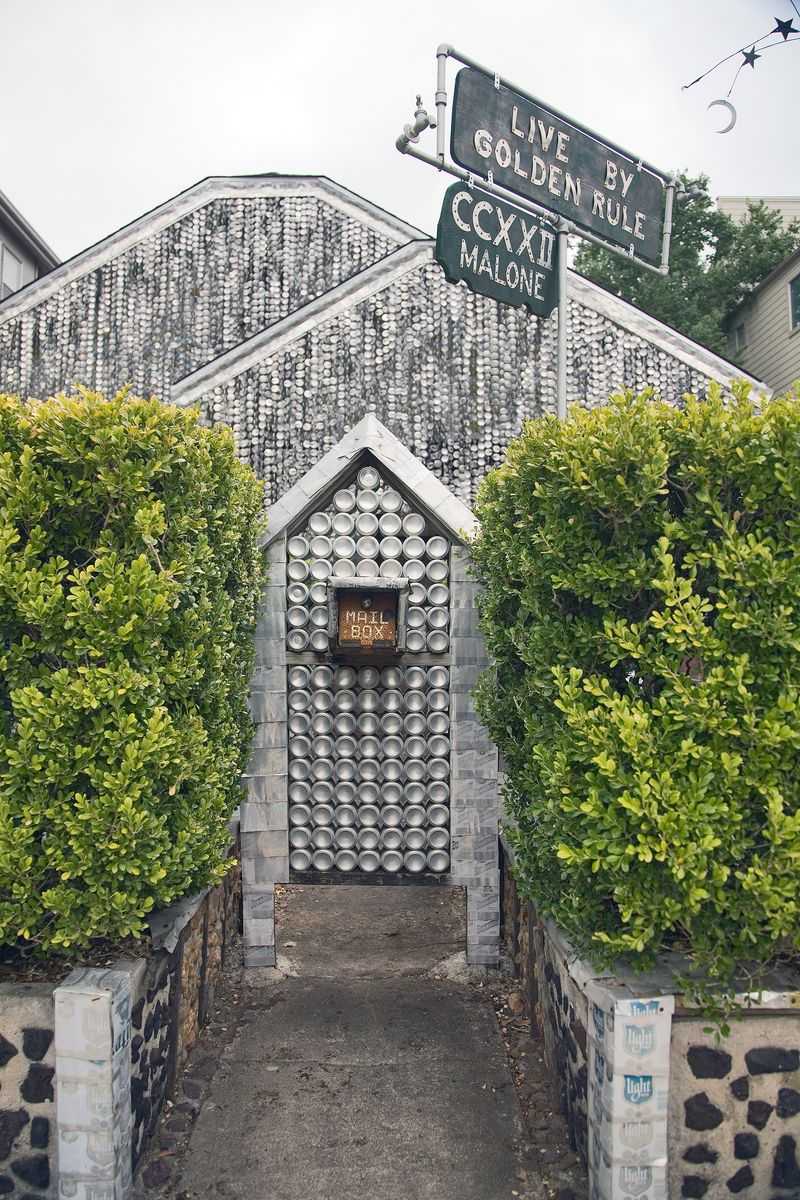
John Milkovisch spent eighteen years transforming his ordinary Houston bungalow into a shimmering monument to recycling and obsessive creativity using over 50,000 beer cans.
Beginning in 1968, the retired upholsterer covered every exterior surface with flattened aluminum cans, creating a unique siding that reflected light and clinked musically in the breeze.
Bottle caps dangle from the eaves in long curtains, creating a constant tinkling soundtrack and casting dancing shadows across the yard.
The project began practically when Milkovisch sought a maintenance-free alternative to painting, but it evolved into one of Houston’s most celebrated examples of folk art.
Labels from various beer brands create an unintentional historical record of American brewing from the late twentieth century.
The Orange Show Center for Visionary Art now maintains the property, preserving it as a testament to individual artistic vision and determination.
Guided tours reveal the intricate patterns and construction techniques Milkovisch developed, demonstrating surprising sophistication in his seemingly haphazard approach.
Photographers capture the play of light across the metallic surfaces, with different times of day producing dramatically different visual effects.
The house represents outsider art at its finest, created not for galleries or critics but from personal compulsion and creative necessity.
Visitors leave inspired by Milkovisch’s dedication and the transformation of humble materials into something genuinely extraordinary.
The surrounding neighborhood of modest homes makes the Beer Can House stand out even more dramatically, a beacon of individuality among conformity.
Address: 222 Malone St, Houston, Texas
Dear Reader: This page may contain affiliate links which may earn a commission if you click through and make a purchase. Our independent journalism is not influenced by any advertiser or commercial initiative unless it is clearly marked as sponsored content. As travel products change, please be sure to reconfirm all details and stay up to date with current events to ensure a safe and successful trip.
