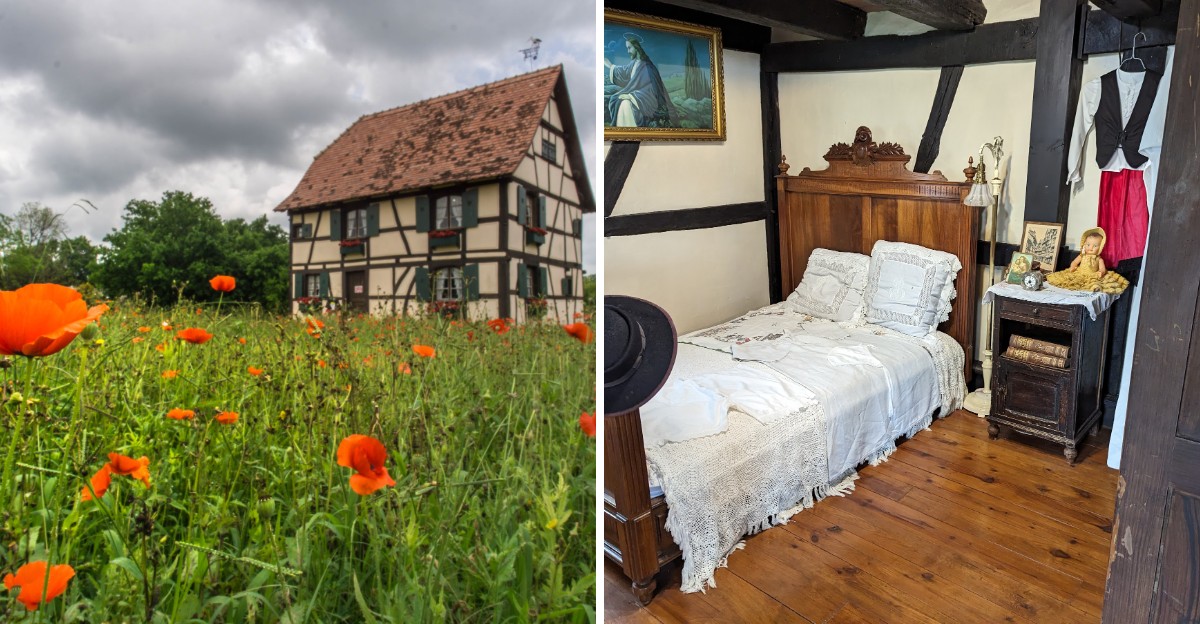
You look around and wonder if you took a wrong turn somewhere. This does not feel like Texas.
The architecture, the atmosphere, the whole vibe. It feels like another country, another continent, somewhere far from the Lone Star State.
But it is here. Hidden in plain sight.
This Texas attraction has managed to capture the essence of a place thousands of miles away, and it does it so well that you forget where you are. The details are impressive.
The design is immersive. And the experience is unlike anything else you will find in the state.
A true hidden gem. A place that surprises you.
And a reminder that Texas is full of unexpected treasures. Go see it for yourself.
You will understand the confusion. And you will love every minute of it.
The Double Take From Highway 90
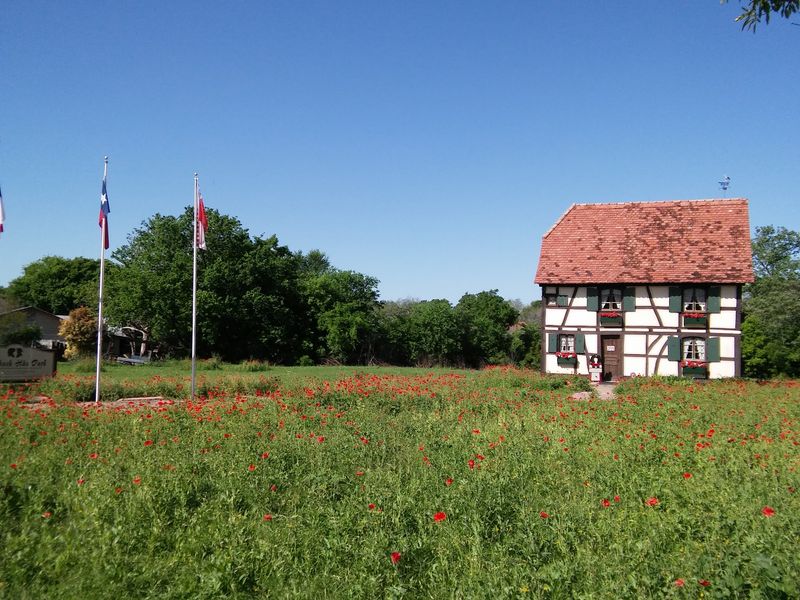
Plenty of travelers describe the same moment. They are cruising along, half-listening to the radio, and suddenly there is a gingerbread-looking cottage sitting where a gas station or a barbecue joint should be.
The building is fully visible from the road, which is part of the fun. No hidden driveway, no maze of side streets, no need for detailed directions.
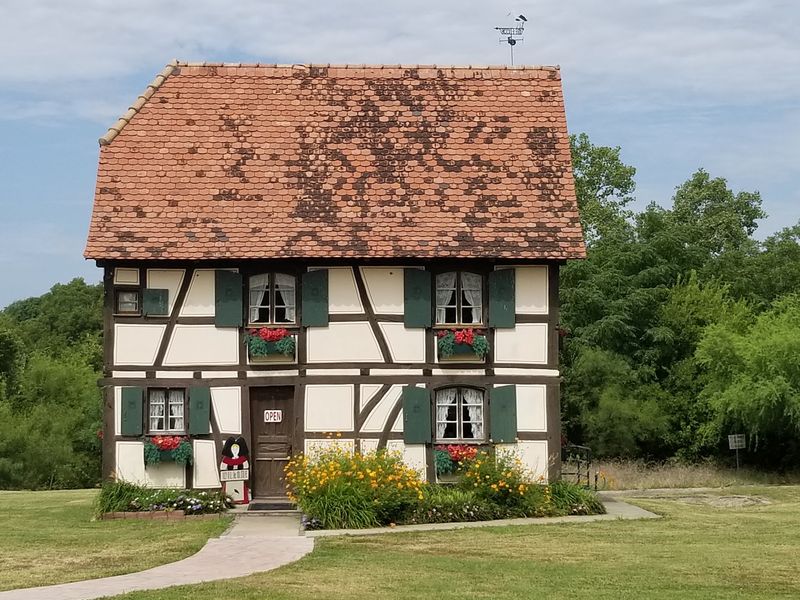
Its shape is what grabs attention first. A steeply pitched roof drops down low, the walls are pale stucco, and dark timber beams crisscross the front in a pattern that simply does not show up anywhere else in this part of Texas.
Parking sits right off the highway and is usually easy, with spaces close to the entrance and accessible spots available. That matters more than it sounds, because the stop works beautifully as a quick break on a longer drive.
Visitors often mention circling back after spotting it. One glance is rarely enough.
Photographers get a treat here too. Morning light hits the front nicely, while late afternoon softens the beams and makes the plaster glow a warm cream color.
Little details reward a slow walk around the outside, including the wooden pegs holding the frame together and the way the panels are packed between the timbers. Nothing about it feels mass-produced.
For travelers heading toward Hondo, Uvalde or Del Rio, the house makes a natural pause point. Stretch the legs, look at something genuinely old, then get back on the road with a better story than usual.
A Farmhouse That Crossed An Ocean
Here is the part that makes people pause mid-sentence. The house was not built in Texas at all.
Its original home was Wahlbach, a village in the Sundgau area of Alsace, France, where the Steinbach family raised it sometime between 1618 and 1648. Generations lived under that roof while Europe changed around them.
Centuries later, the people of Alsace decided to give the structure to Castroville, a town founded by their own countrymen. It was a gift with serious weight behind it, both emotionally and literally.
Crews carefully took the house apart in 1998, labeling every timber and panel so the whole thing could be put back together correctly. The pieces sailed to Houston by ship, then finished the trip to Castroville by truck.
Reassembly took roughly four years. The Association Jardin des Racines worked alongside students and faculty from the Lycée Agricole in Rouffach, Alsace, which means young French builders helped rebuild a 17th-century house on Texas soil.
Doors opened to the public in 2002.
Standing in front of it with that timeline in mind changes the experience completely. These are not reproduction beams cut last decade, they are the actual timbers that sheltered an Alsatian farming family four hundred years ago.
Staff inside are happy to walk through the details, and the displays cover the move in a clear, easy-to-follow way. The story lands even harder for anyone who has ever struggled to reassemble flat-pack furniture with instructions included.
Old Beams, Old Tricks, Real Craftsmanship
Builders and woodworking fans tend to linger longer than everyone else here, and for good reason. The construction method on display is a genuine lesson in how homes were made before nails and power tools ran the show.
The style is called fachwerk, or half-timbered. Heavy wooden beams form a visible skeleton, and the gaps between them are filled with reed panels covered in stucco.
Wooden pegs hold the frame together. No screws, no brackets, just precisely cut joints and a lot of skill.
Inside, the house rises two and a half stories across about 1,232 square feet. Compact by modern standards, but every inch was put to work.
Up top sits the dachzimmer, a half-story loft space traditionally used for sleeping. Low ceilings, exposed rafters, and the kind of cozy tightness that makes modern open-plan houses feel a little wasteful.
Ceilings and doorways throughout run lower than most people expect, which is a quiet reminder of how differently homes were designed centuries ago. Taller visitors should watch their heads on the way up.
The stairway to the second floor is narrow and steep, so slow steps and a free hand on the rail are smart. Families with very small children often find carrying them easier than wrangling a stroller, and strollers can usually be left downstairs.
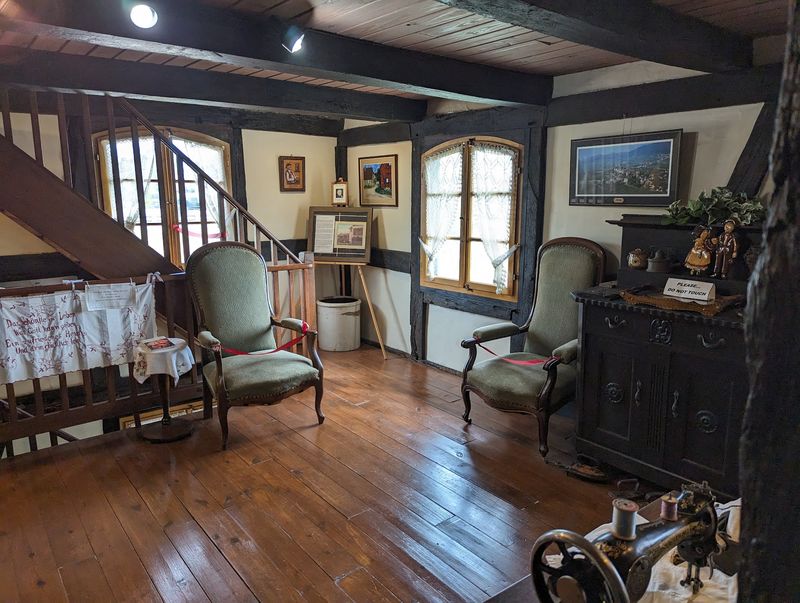
Signs ask guests not to touch the displayed items, which makes sense given their age. Photography, on the other hand, is welcomed.
Inside The Rooms Where Daily Life Unfolded
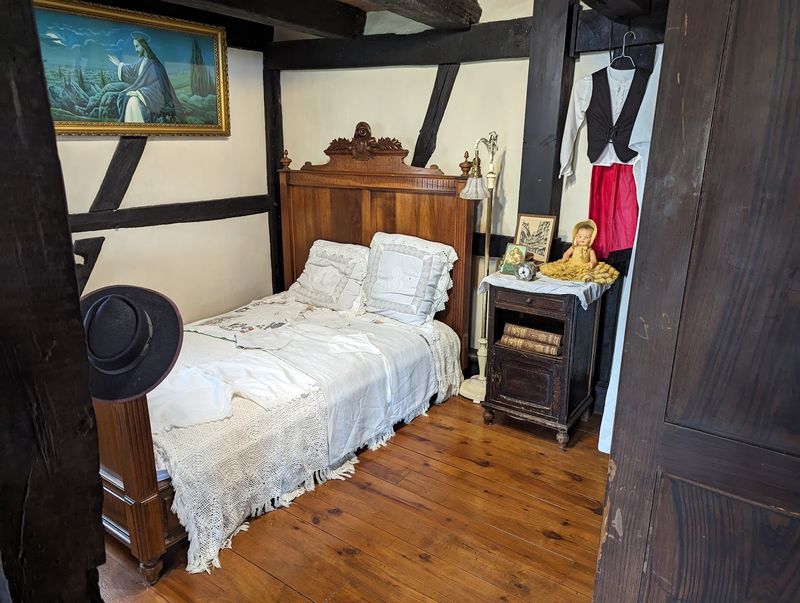
The inside surprises people who expect an empty shell. Two floors are open, and both are furnished rather than roped off behind glass.
Downstairs works as Castroville’s visitor center, stocked with maps, brochures and helpful context for exploring the rest of town. Grab a walking tour guide while there, since it turns the rest of the afternoon into something planned instead of random.
Climb the stairs and the mood shifts toward museum. Rooms have been arranged to match their original layout, filled with antique pieces and household items donated by people from Alsace.
Place settings sit ready on the table. Clothing hangs as though someone might come back for it.
Painted plates, dolls, framed artwork and heavy wooden cabinets fill the space, and each piece tells something about how an Alsatian family cooked, slept and spent evenings together. Visitors have even added to the collection over the years, bringing small items from Alsace as gifts.
Everything feels smaller than modern equivalents, which is one of the most charming parts of the whole visit. Beds, chairs, doorways, all scaled to a different era.
Admission is free, and donations are accepted without any pressure. Dropping a few dollars in the box helps keep the lights on, since the operation runs lean.
Plan on twenty to forty minutes depending on how deep the questions go. Curious visitors have been known to stay much longer.
Castroville, The Little Alsace Of Texas
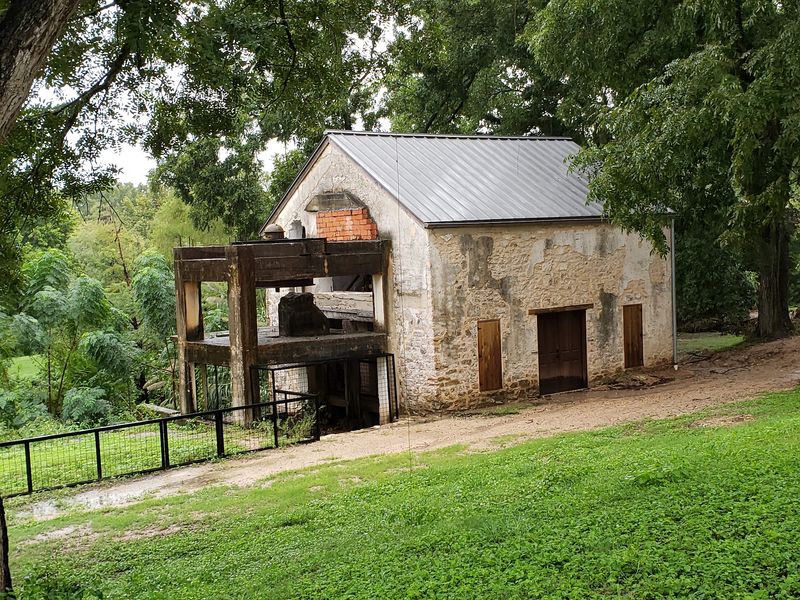
None of this makes sense without the town behind it. Castroville came to life in 1844 when Henri Castro, an empresario working under the Republic of Texas, brought settlers to land along the Medina River.
Most of those families came from Alsace, a region where French and German culture have been blending for centuries. They packed their customs, their building styles and their language and started over on the Texas frontier.
What they built looked like home. Thick limestone walls, cypress beams, native rock, steep roofs and tidy stucco fronts.
Downtown Castroville is now a National Historic District, and a remarkable number of those 1840s buildings still stand. Some house businesses, others remain private homes, which keeps the whole place feeling alive instead of staged.
A self-guided walking tour connects more than fifty historic sites, including houses, churches and shops. Driving the route works too for anyone short on time or dealing with summer heat.
The Steinbach Haus, sitting at 203 US-90, Castroville, TX 78009, United States, serves as the natural starting line for that exploration.
For decades, many locals spoke Alsatian, a Germanic dialect carried over by the founders. Visitors from modern Alsace have noticed the version preserved here holds onto older forms of the language.
Names like Haby, Tschirhart, Zinsmeyer and Lutz still show up around town, which says plenty about how deep those roots run.
The People Behind The Front Desk
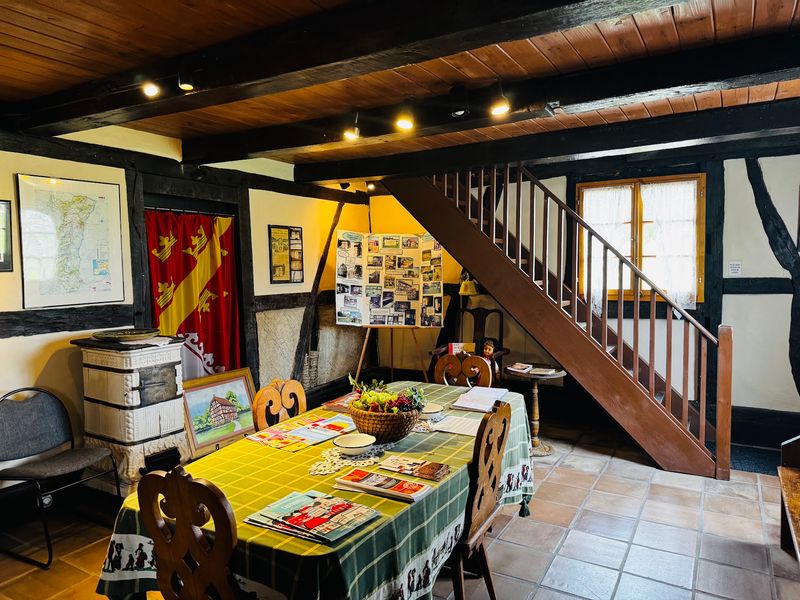
Ask almost anyone who has stopped here what stood out, and the answer usually involves whoever was staffing the desk that day. The knowledge on hand goes well beyond a memorized script.
Docents explain how the house traveled, who the original owners were, what the objects upstairs were used for, and how the town came together. Questions get real answers, not brochure summaries.
They also point visitors toward the rest of Castroville, including which historic homes are worth a slow drive-by and where locals actually eat. That kind of advice beats any app.
Staffing here runs thin, and the center often depends on a single person being available. Posted hours are Wednesday through Saturday from 10 AM to 4 PM and Sunday from 11 AM to 3 PM, with Monday and Tuesday closed.
Even so, an unexpected closure can happen. Calling ahead or checking the website before making a special trip is a sensible move.
Good news for anyone who arrives on a closed day, though. The exterior alone is worth the stop, and the grounds stay open to wander.
Guests who have had strong experiences often leave donations or small gifts, and some have brought ceramics from Alsace to add to the displays. That back-and-forth between visitors and the house gives the place an unusually warm feeling.
It runs on care rather than budget, and that shows in the best way.
Poppies, Picnics And The Little Green Space Outside
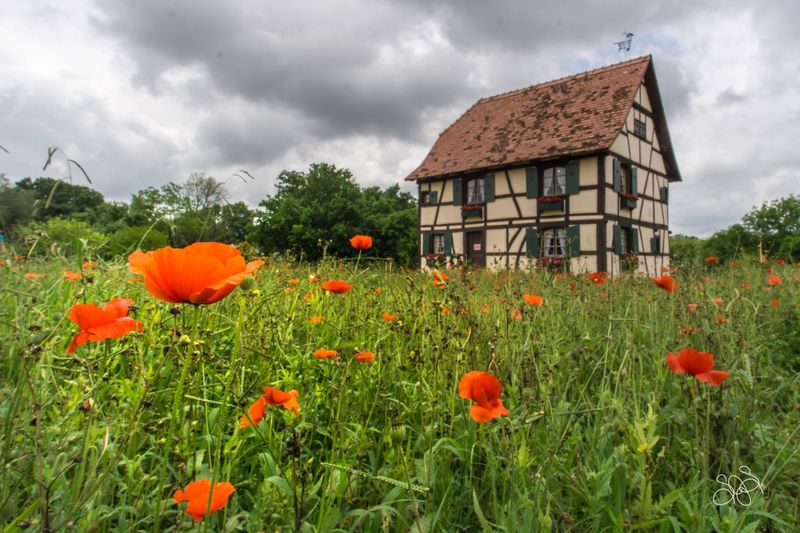
Spring turns the grounds into something unexpected. Red poppies bloom around the house, a nod to Alsatian tradition, and the contrast against the pale walls and dark beams is genuinely lovely.
Photographers time trips around it. Anyone who happens to roll through in late March or April gets lucky by accident.
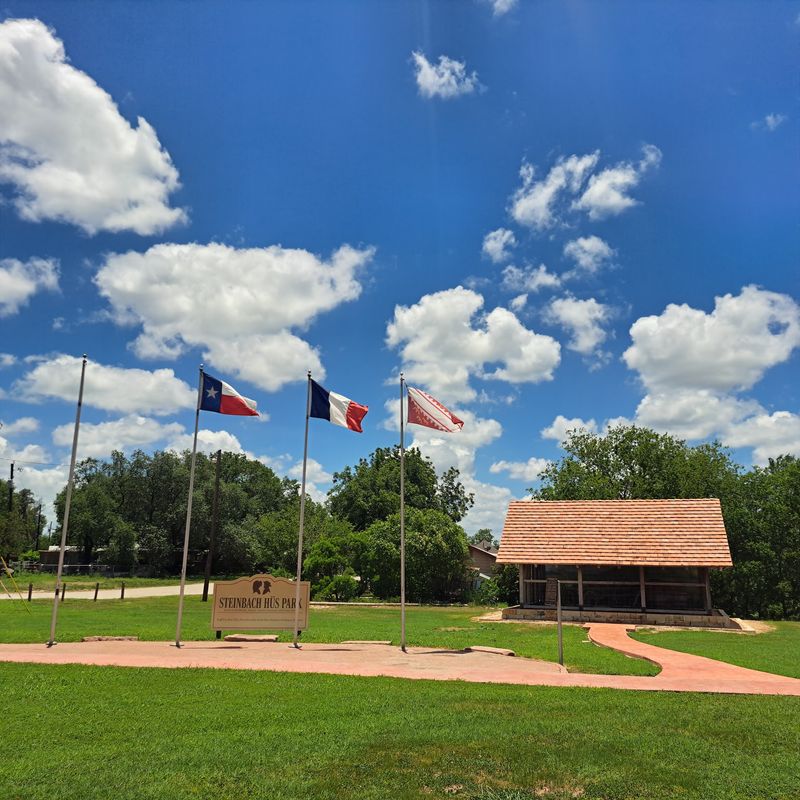
Even outside poppy season, the small park area beside the building makes a nice pause. There is shade, grass, and enough room to eat a packed lunch without feeling rushed.
Families traveling with restless kids will appreciate that. Twenty minutes of running around beats another hour strapped into a car seat.
The setting itself deserves credit too. Castroville sits at the edge of the Hill Country, where oak trees, gentle rises and the Medina River valley create scenery that feels softer than the flat stretches further west.
Fall and early spring bring the most comfortable weather for lingering outdoors. Summer afternoons get hot, so mornings work better.
Walking the perimeter of the house reveals angles missed from the parking lot, including how the roof slopes and how the timber frame wraps around the corners. It is worth the extra five minutes.
Benches and shade make it an easy place to sit and let the strangeness of the whole scene sink in. A 400-year-old French farmhouse, a Texas highway humming nearby, and poppies nodding in the breeze.
Odd combination. Completely charming.
Fitting It Into A Bigger Texas Road Trip
Location works heavily in this stop’s favor. Castroville sits roughly twenty-five miles west of San Antonio, close enough for a half-day outing and perfectly placed for anyone heading toward Big Bend, Uvalde or the Rio Grande.
Pair it with breakfast in San Antonio and a wander through Castroville’s historic streets, and the morning fills itself. Add lunch in town afterward and the timing lands nicely.
Travelers staying near San Antonio during a holiday week often use it as a low-effort escape from crowds. The pace out here is slower by several gears.
A practical tip worth remembering is to start at the house rather than end there. Picking up the walking tour guide first means the rest of the town makes far more sense.
Comfortable shoes help if the plan includes exploring on foot, since the historic district spreads across several blocks. Driving the route is a fine alternative.
Photographers, history buffs and anyone with European roots will find the most to chew on here. But even travelers with zero interest in architecture tend to walk out impressed, mostly because the backstory is so unlikely.
Texas holds plenty of surprises, though few of them arrived in numbered crates on a cargo ship. That detail alone earns the detour.
Skip the rush, ask questions, leave a donation, and let the small scale of the place do its work. Some of the best stops on a road trip are the ones nobody saw coming.
