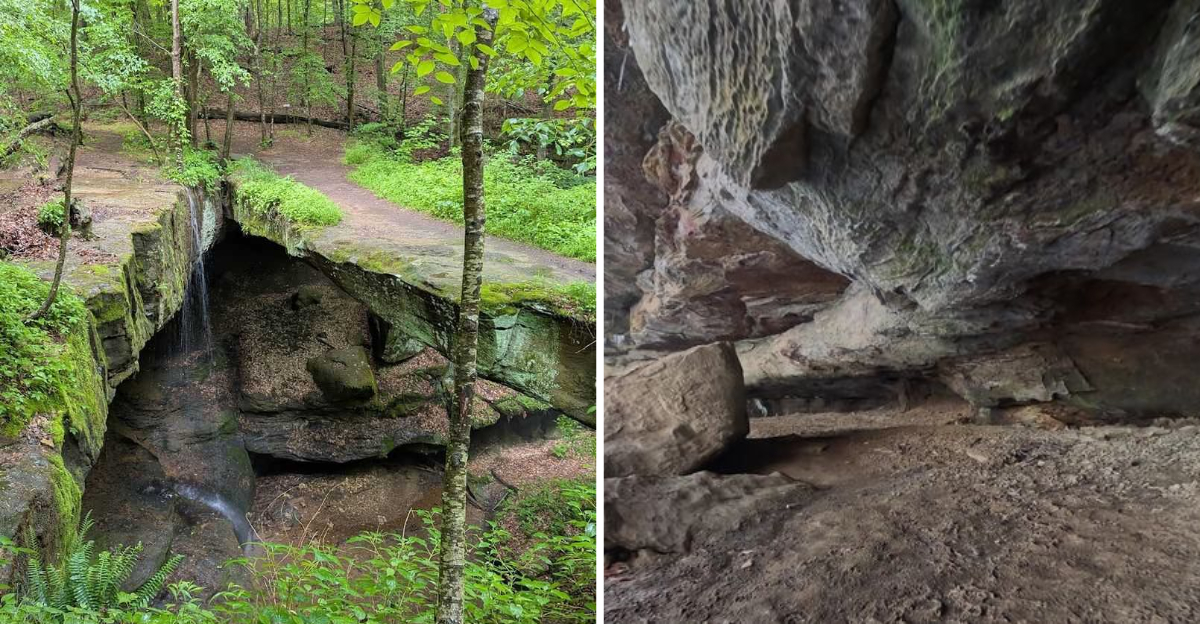
The trees part and there it is. Ohio’s largest natural bridge, carved from sandstone millions of years ago, stretching over a hundred feet across a deep ravine.
No one expects to find something this massive in Ohio. That is what makes it so good. The trail is short, the payoff is huge, and the whole place feels less like a tourist attraction and more like a secret the landscape has been quietly keeping.
You are not fighting crowds or waiting for a photo op. You are just standing there, looking up at something ancient, wondering how it has held on for so long.
Ohio’s Largest Natural Arch and Why It Stops You Cold
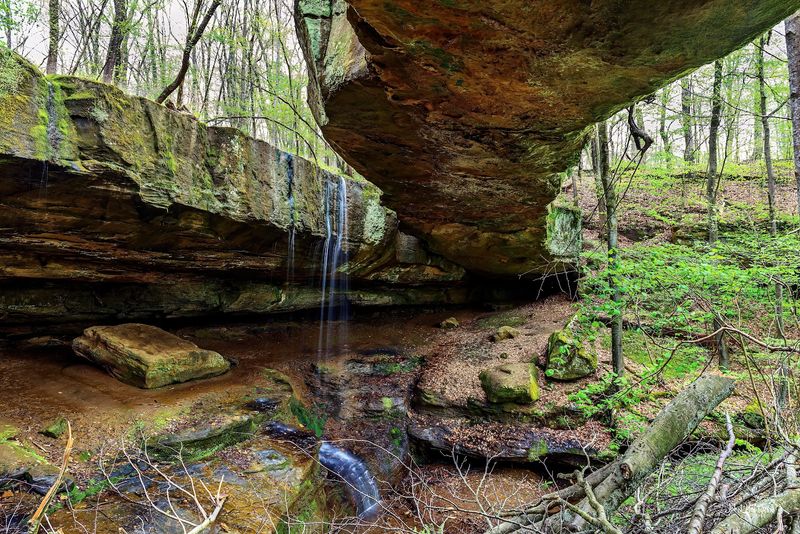
The numbers alone are enough to make you pause before you even reach it. Over 100 feet long, 10 to 20 feet wide, roughly 3 feet thick at the top, and spanning 50 feet across a wooded ravine, the natural arch at Rockbridge State Nature Preserve is genuinely one of the most impressive geological features in the eastern United States.
It holds the title of Ohio’s largest natural bridge and is unofficially ranked as the ninth largest natural arch east of the Mississippi River.
What makes it even more remarkable is how it formed. Millions of years ago, Ohio was covered by a warm inland sea.
Layers of sand accumulated on the seafloor, compressed over time, and hardened into Black Hand sandstone. Then came centuries of wind, rain, and groundwater slowly wearing away the softer sections of rock, carving out the graceful arch that stands today.
When you actually see it for the first time, the geology lesson fades away fast. You are just standing there, a little breathless, trying to take in something that feels both enormous and delicate at the same time.
The arch does not announce itself from a distance. It appears almost suddenly, and that surprise is part of what makes it unforgettable.
Crossing the top is a strange, quiet thrill. The rock is solid underfoot, the ravine drops away on either side, and for a moment the whole forest goes still around you.
Ohio has at least 12 known natural rock bridges, but this one earns its top spot without any argument.
The Trail That Gets You There
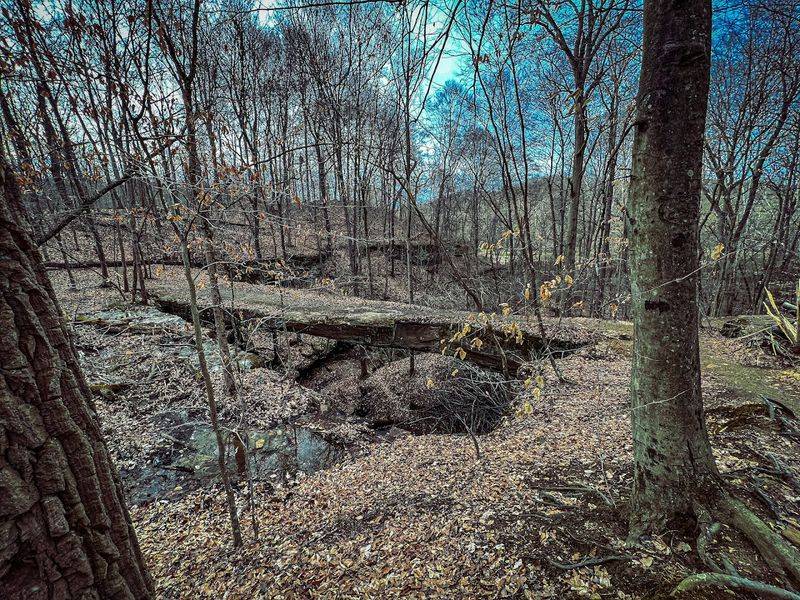
The trail system at Rockbridge State Nature Preserve covers nearly 3 miles total, and it is the kind of hike that rewards patience. The first stretch from the small parking area moves through an open meadow, which can feel a little underwhelming at first.
Stick with it. Once the trees close in around you, the character of the trail completely changes.
Two main loops make up the trail system. One leads directly to the natural bridge, while the other explores a rock shelter tucked into the hillside.
Both are well-marked with maps posted at every intersection, so getting turned around is unlikely. That said, the terrain does ask something of you.
Expect steep climbs, sections of exposed roots threading across the path, and a few muddy patches after rainfall. The elevation change across the full hike is noticeable, around 660 feet over roughly 2.5 miles of looped trail.
The hike is generally considered moderate, meaning most reasonably active people can handle it without much trouble. Hikers with young kids should know the inclines can tire little legs out faster than expected.
In winter, the trails get genuinely slippery, and a pair of shoe spikes makes a real difference on icy sections. After rain, small waterfalls appear along the route and add a layer of atmosphere that makes the whole experience feel more alive.
Bring water, wear solid shoes, and give yourself more time than you think you need. The trail rewards anyone who is not in a hurry.
The Geology Beneath Your Feet Tells a Wilder Story
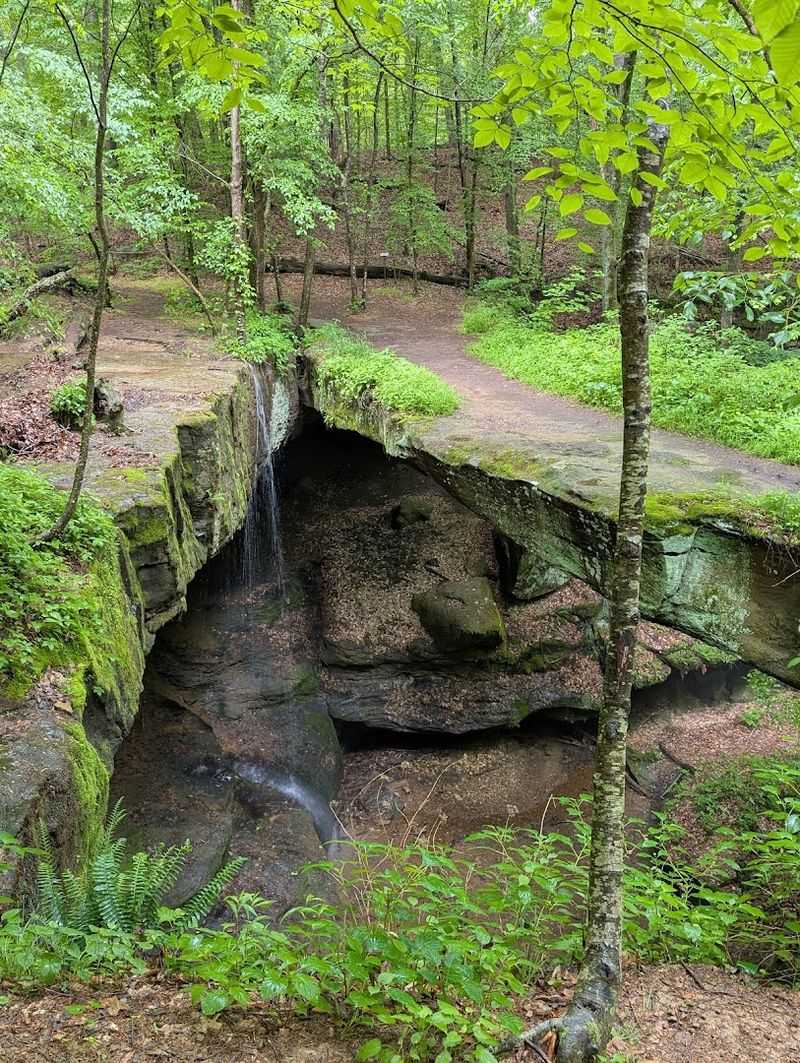
Black Hand sandstone is not a name most people recognize, but once you know what it is, you start seeing it everywhere in this part of Ohio. It is a coarse, iron-stained rock that formed when the region sat beneath a shallow inland sea hundreds of millions of years ago.
Sand piled up on the seafloor, layer upon layer, until the weight compressed it into dense stone. That stone is now the foundation of the entire Hocking Hills region.
What carved the arch was not a single dramatic event but rather an almost unimaginably slow process. Groundwater seeped into cracks.
Rain softened edges. Wind worked away at exposed surfaces over thousands of years.
The softer portions of the sandstone eroded while the denser sections held their shape, and the result is the arch you can walk across today. It is essentially a remnant, a section of stone that survived while everything around it gradually disappeared.
Ohio has at least 12 known natural rock bridges, most of them concentrated in areas with heavy sandstone deposits across south-central and eastern Ohio. Rockbridge is the most dramatic of the group by a significant margin.
The rock shelter trail at the preserve gives you a chance to see another side of this geology up close, where overhanging sandstone walls created natural caves that were used for shelter long before anyone thought to build trails nearby. Running your hand along those walls, you can feel the grit of millions of years pressed into something solid and real.
What the Preserve Feels Like Beyond the Bridge
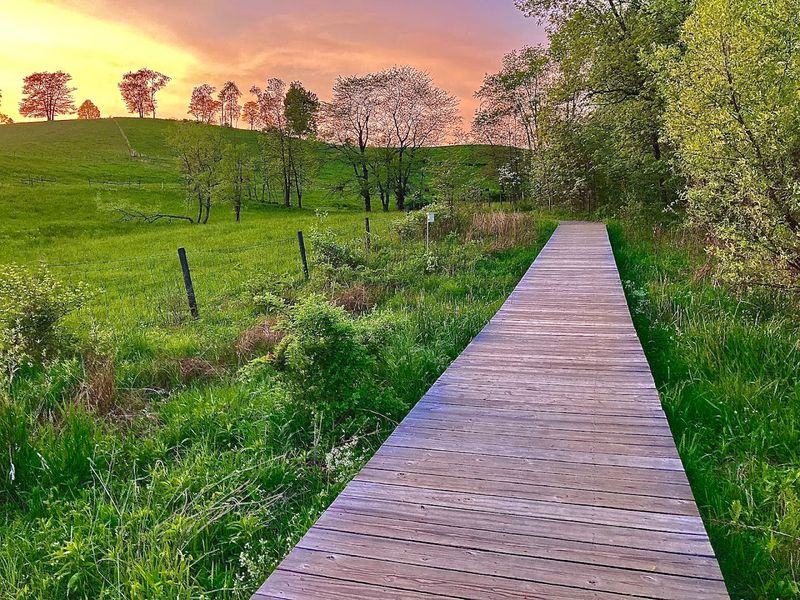
The natural arch gets most of the attention, and fairly so, but the preserve itself is worth appreciating as a whole. Covering between 182 and 220 acres in the Hocking Hills area near the Hocking River, it is a genuinely quiet piece of Ohio countryside that does not feel overrun even on busier weekends.
The meadow section near the trailhead carries a different kind of beauty, open and breezy, with tall grass and the occasional smell of wildflowers drifting across the path.
Wildlife shows up regularly here. Birds are active throughout the canopy, and the dense understory provides cover for the kinds of creatures that go unnoticed unless you slow down enough to look.
The river is accessible from the trail, and there is even a canoe access point near the preserve, which adds a whole other way to experience the landscape if you are feeling adventurous. In spring, the honeysuckle along parts of the trail releases a smell that is almost distractingly pleasant.
One thing visitors should know before arriving is that pets are not permitted anywhere in the preserve. It is a nature preserve in the truest sense, managed to protect the ecosystem rather than accommodate every convenience.
There are no restrooms and no trash cans on site, so planning ahead matters. The preserve opens half an hour before sunrise and closes half an hour after sunset.
Those boundaries actually make early morning visits incredibly rewarding, when the light filters through the trees and the trail is still mostly empty and the whole place feels like it belongs entirely to you.
Practical Tips That Will Actually Make Your Visit Better
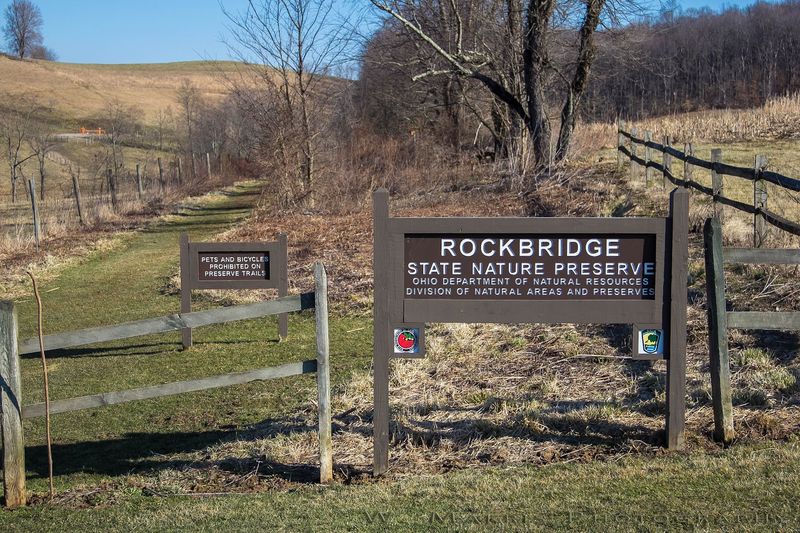
The parking situation at Rockbridge is one of those things that catches people off guard. The lot holds roughly 10 to 15 cars, and on weekends it fills up faster than you would expect for a place that still feels relatively under the radar.
Arriving early, especially on Saturday and Sunday mornings, is genuinely the best move. Weekday visits tend to be far quieter across the board.
Footwear matters more here than at a lot of other Ohio trails. The exposed roots, steep climbs, and occasionally muddy stretches are manageable in good hiking shoes or sturdy boots, but they become genuinely frustrating in anything flat-soled or casual.
Winter visits require extra thought. Ice builds up on the bridge surface itself and on shaded sections of trail, so shoe spikes are a smart addition to your pack from November through early March.
There are no amenities at the trailhead beyond the parking area and trail maps posted at intersections. No restrooms, no water fountains, no trash cans.
Bring everything you need and take everything back out with you. The access road into the preserve is narrow, so drive slowly and be prepared to pull over if another car is heading out as you head in.
Poison ivy grows along portions of the trail, so staying on the designated path is both a preserve rule and a personal health strategy. The trail is well-marked and easy to follow, which makes sticking to it simple.
Cell service can be spotty depending on your carrier, so downloading an offline map before you leave home is a quietly useful habit.
Why This Place Deserves a Spot on Your Ohio Travel List
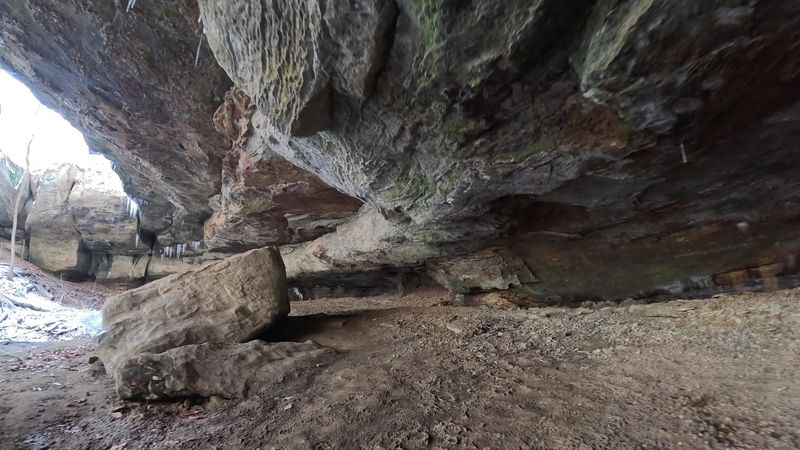
Hocking Hills gets a lot of well-deserved praise for Ash Cave, Old Man’s Cave, and Cedar Falls, but Rockbridge sits just slightly off that main circuit in a way that gives it a different feeling entirely. It is less crowded, less developed, and in some ways more surprising.
The arch is not preceded by a long boardwalk or a visitor center. You hike through woods and meadow, and then it is just there, enormous and unhurried, as if it has been waiting for exactly this long without any particular urgency.
The preserve has seen genuine improvements over recent years. Boardwalk upgrades over rough and wet sections of trail have made a real difference in accessibility and comfort.
Trail maps at every intersection remove the guesswork entirely. The overall experience is polished enough to feel welcoming but wild enough to feel earned.
That balance is harder to get right than it sounds.
Spring is widely considered the best time to visit, when water is flowing through the ravine below the arch and the forest is full of new green. Fall brings color that turns the whole trail into something almost theatrical.
Summer is lush and shaded, which helps on warm days. Even winter has its own stark appeal, provided you come prepared for the ice.
Any season works, honestly. The arch has been standing for millions of years and is not going anywhere.
What changes is the light, the water, and the feeling in the air around it. Every version of this place is worth the drive.
Address: 11475 Dalton Rd, Rockbridge, OH 43149
