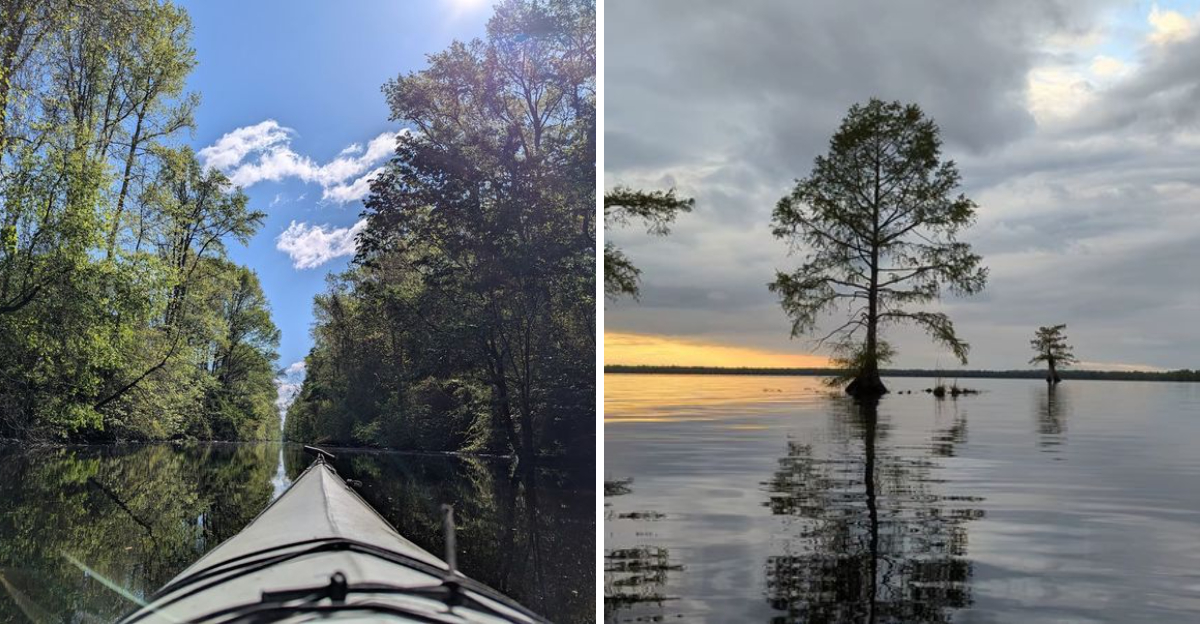
Strange things have been reported in this Virginia lake. Boats that drift off course.
Compasses that spin without reason. A stillness that feels unnatural.
It is no wonder that Lake Drummond is often called the “Bermuda Triangle of the Commonwealth.” I paddled across its dark waters on a calm morning, and even in the daylight, I could feel the mystery. The lake is located deep in the Great Dismal Swamp, surrounded by trees and silence.
Its water is dark, stained by the roots of cypress trees, giving it an almost otherworldly appearance. The stories of disappearances and strange phenomena have been passed down for generations.
Virginia has plenty of lakes, but this one holds a legend that keeps people guessing.
The Origin Story Nobody Can Fully Explain
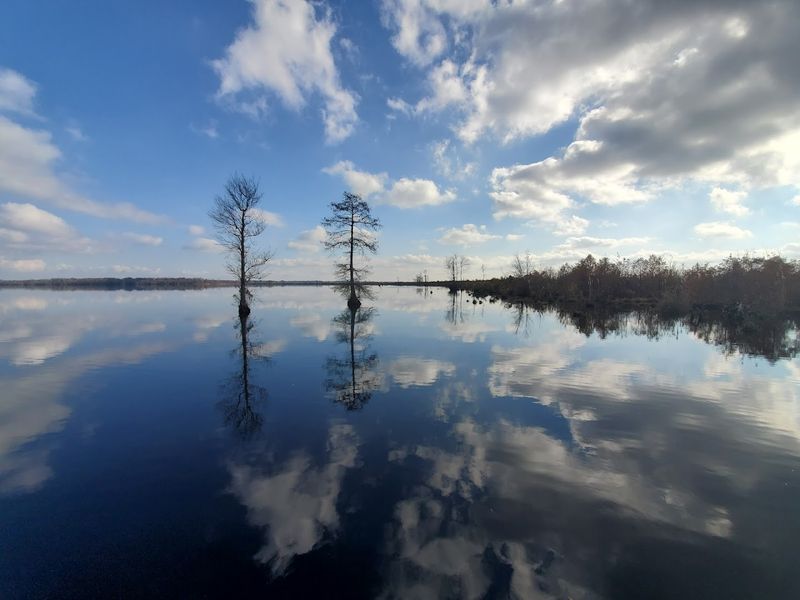
Nobody agrees on how Lake Drummond actually formed, and honestly, that mystery is part of its charm. Scientists have floated several theories over the years, ranging from a massive underground peat fire that burned out a hollow in the earth, to a meteorite impact, to a slow tectonic shift beneath the swamp floor.
My personal favorite, though, is the one told by the Nansemond Indian Nation. According to their oral tradition, a giant firebird swooped down and scorched the earth, leaving behind this perfectly round lake as its fiery footprint.
The lake does sit at the highest elevation point in the entire swamp, which means water flows outward from it rather than into it. That alone feels wonderfully backwards.
Lake Drummond covers roughly the same footprint as a small city, yet its average depth barely reaches your waist. Scientists estimate it formed somewhere between four thousand and six thousand years ago.
Standing at the water’s edge, staring out at that dark, glassy surface surrounded by ancient cypress trees, I found it very easy to believe something extraordinary happened here long ago.
Tea-Colored Water That Is Surprisingly Pure
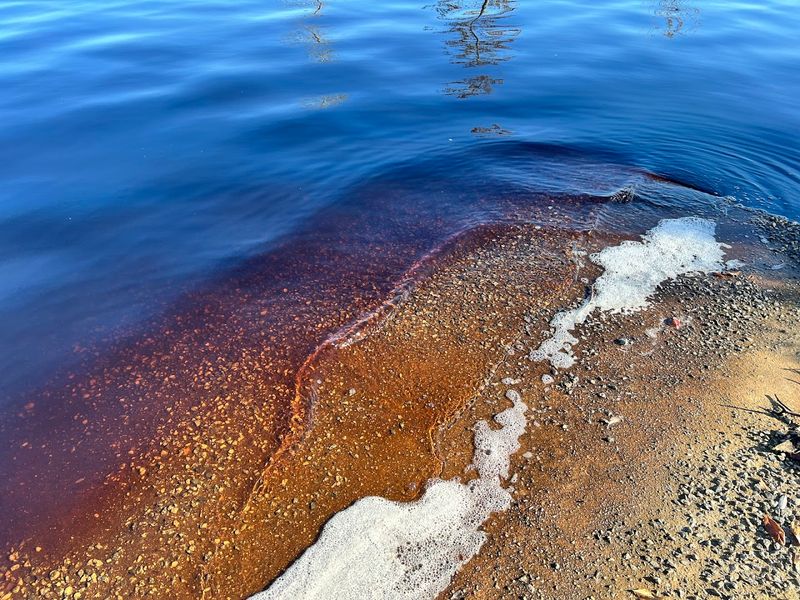
At first glance, the water in Lake Drummond looks like someone brewed a giant pot of very strong tea and forgot to drain it. That deep, rich brown color comes from the surrounding peat soil, which leaches tannins and other organic acids into the water continuously.
Here’s the twist that surprises almost everyone: despite looking like something you’d find at the bottom of an old mug, the water is remarkably pure. Its naturally low pH creates an environment that’s actually hostile to many harmful bacteria.
Sailors historically prized this water for long voyages because it stayed fresh far longer than water from typical sources.
The acidity does limit which fish species can thrive here, so you won’t find the usual abundance of freshwater life you might expect in a lake this size. Crappie, yellow perch, bowfin, and bullhead catfish manage just fine, though.
I stood at the shoreline watching the water barely ripple, its surface so dark and still it looked like polished mahogany. Virginia has plenty of beautiful lakes, but none look quite like this one.
Phantom Lovers and the White Canoe Legend
Of all the legends attached to Lake Drummond, the Phantom Lovers story is the one that lingers longest after you leave. The tale begins with a young Native American woman who died tragically before her wedding day.
Her heartbroken lover, refusing to accept her death, believed he saw her spirit gliding across the water in a white canoe.
He paddled out to reach her and was never seen again. Some say on quiet evenings, especially in late autumn when the mist rolls low over the water, two figures can still be spotted drifting together in that same white canoe.
Irish poet Thomas Moore was so captivated by this legend during his early nineteenth-century visit that he immortalized it in verse.
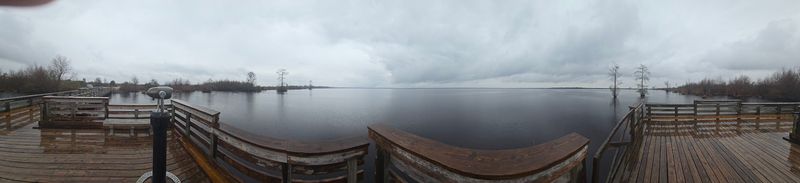
Standing on the reflection pier near the southwest corner of the lake as the light faded, I completely understood why this story has survived so long. The atmosphere here does something to your imagination.
The silence is thick, the water is dark, and the tree line looks like the edge of another world entirely. Virginia has no shortage of ghost stories, but this one feels genuinely earned by the landscape itself.
Mysterious Lights That Have No Simple Answer
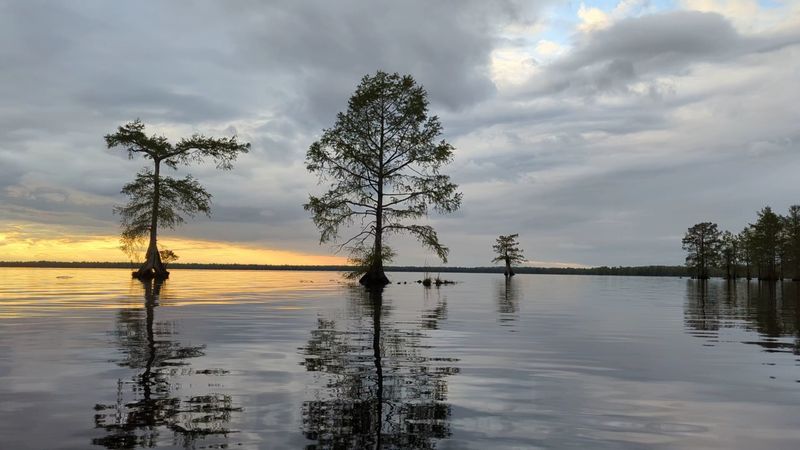
One of the most frequently reported and genuinely unsettling phenomena around Lake Drummond is the appearance of strange, floating lights after dark.
Locals and explorers have documented these glowing orbs drifting through the trees and hovering over the water for as long as people have been recording observations about this swamp.
Scientists point to a few possible explanations. Foxfire, a bioluminescent glow produced by certain fungi growing on decaying wood, creates a soft, eerie light that can look supernatural in the right conditions.
Burning methane gas released from decomposing organic matter beneath the water is another candidate. Smoldering peat, which can burn underground for extended periods without a visible flame, may also contribute to unexpected light sources appearing at the surface.
None of these explanations feel entirely satisfying when you’re actually standing in the dark among those ancient trees. I visited the swamp at twilight, and the way the last light filtered through the cypress canopy created shapes and glows that my brain kept trying to interpret as something deliberate.
The Great Dismal Swamp earns its spooky reputation honestly, and Lake Drummond sits right at the center of all that atmospheric weirdness.
The Underground Railroad’s Secret Refuge
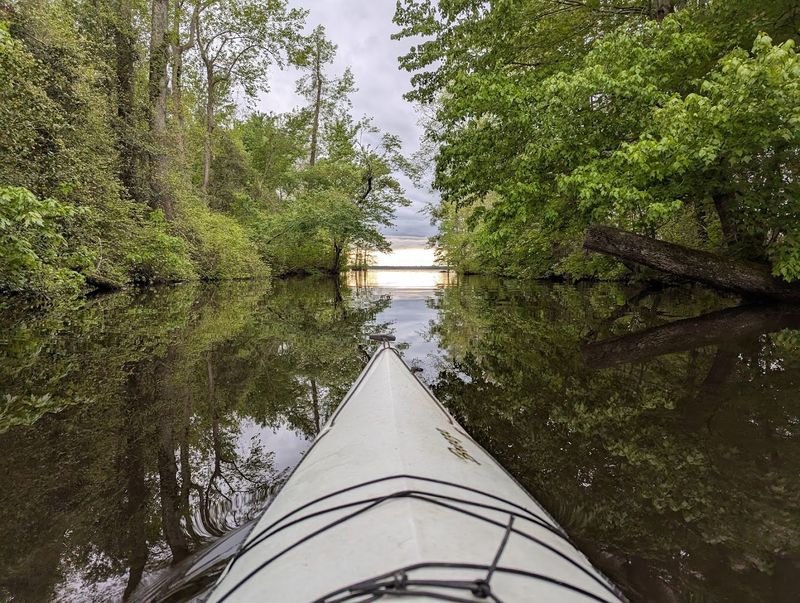
Beyond all the ghost stories and natural mysteries, Lake Drummond and the surrounding swamp hold a history that is profoundly human and deeply moving. The Great Dismal Swamp served as a critical sanctuary on the Underground Railroad, offering cover and community to freedom seekers making their way north.
The dense, nearly impenetrable wetlands made pursuit by slave catchers extremely difficult. Hidden communities known as maroons established themselves within the swamp’s interior, with some individuals living there for years or even decades.
Archaeological research in recent years has uncovered remarkable evidence of these communities, including tools, pottery, and the remnants of shelters built on elevated islands deep within the swamp.
An Underground Railroad Pavilion is available for visitors near the refuge, offering important historical context about this chapter of American history. I found myself standing quietly at that pavilion for a long time, thinking about the courage it took to disappear into a place as formidable as this.
Virginia’s history is complicated and layered, and the Great Dismal Swamp holds some of its most important and least-told stories. Lake Drummond was not just a geographical landmark but a beacon of hope for people who had everything to lose.
Wildlife So Wild It Will Catch You Off Guard
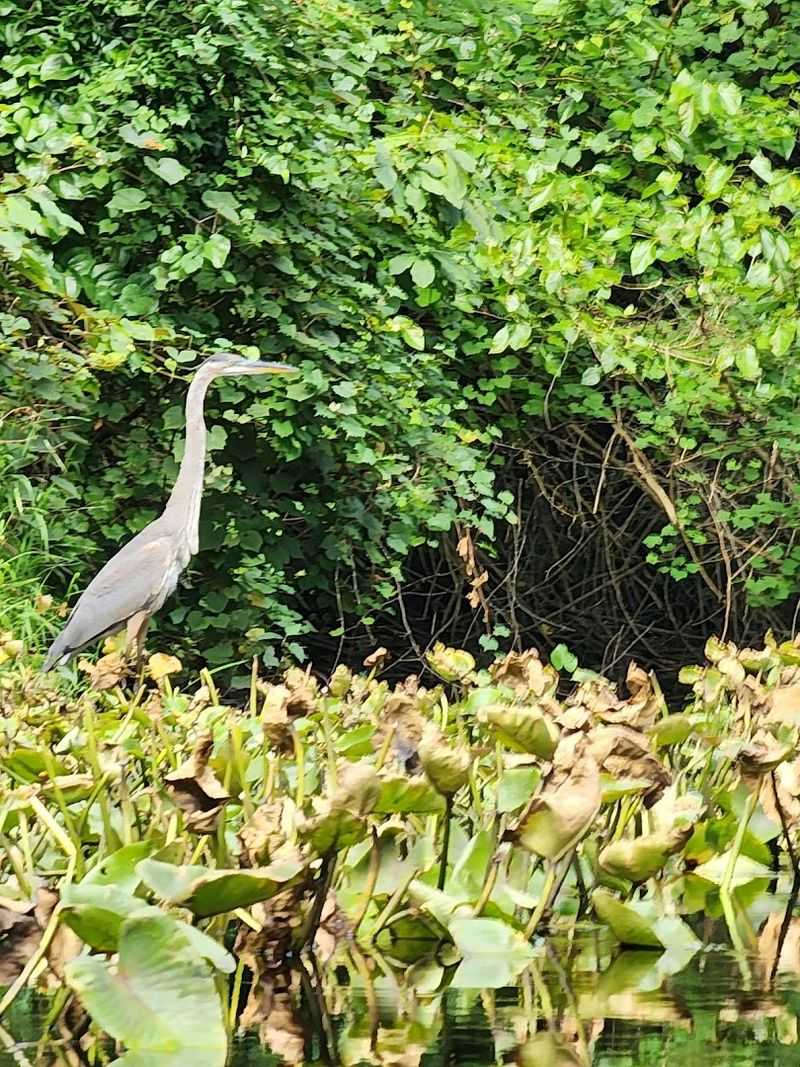
Forget everything you think you know about quiet, pastoral nature walks. The Great Dismal Swamp around Lake Drummond is alive in ways that feel almost overwhelming when you first step into it.
One of the largest black bear populations on the entire East Coast calls this place home, and spotting one moving silently through the tree line is an experience that sharpens your attention very quickly.
Bobcats, river otters, beavers, white-tailed deer, red foxes, and minks all share this ecosystem. The bird life alone is extraordinary, with over two hundred species documented in the refuge.
Bald eagles soar overhead, great blue herons stand motionless at the water’s edge, and during spring migration the warbler diversity here rivals anything I’ve seen anywhere in Virginia.
Tundra swans and snow geese arrive in winter, transforming the atmosphere entirely. Reptile encounters are also very real, with water moccasins and rattlesnakes both present in the swamp.
Despite persistent rumors, there are no alligators in Lake Drummond, though I’ll admit the dark water and dense vegetation make it very easy to imagine otherwise. Spring migration between mid-April and mid-May is the absolute prime window for birding here.
George Washington Walked These Grounds
Long before Lake Drummond became famous for its legends and ecological significance, it attracted the attention of one of America’s most famous founding fathers. George Washington personally surveyed the Great Dismal Swamp in the eighteenth century, recognizing its potential for drainage and timber harvesting.
Washington later co-founded the Dismal Swamp Land Company, an enterprise aimed at draining portions of the swamp for agricultural use. His vision led to the construction of a network of canals, including the historic Dismal Swamp Canal, which borders the eastern edge of the refuge.
That canal holds the distinction of being the oldest continuously operating canal in America, and it was excavated in large part by enslaved individuals.
The weight of that history is palpable when you paddle or walk along its banks today. The canal is fed directly by Lake Drummond, giving the lake a functional role in American transportation history that most people never realize.
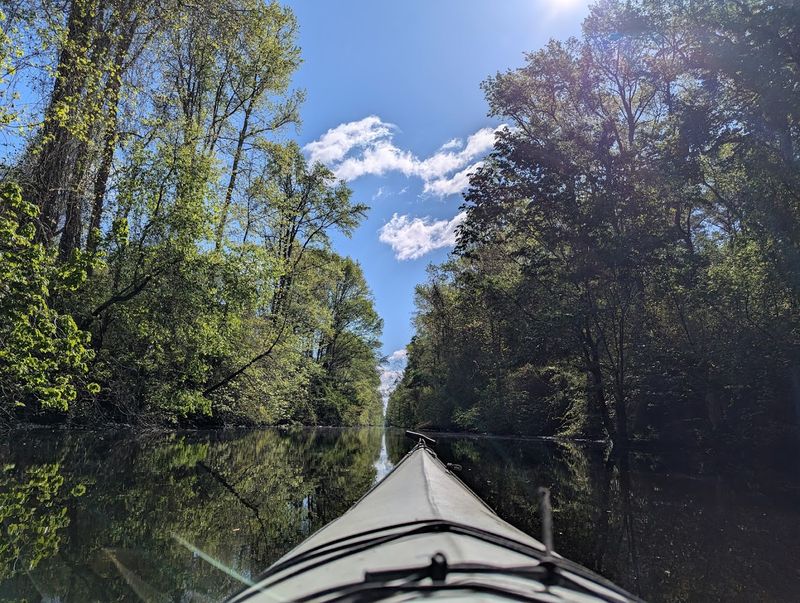
I kayaked a portion of the feeder ditch on a cool morning, surrounded by the same tree species Washington would have documented in his survey notes. Virginia carries enormous historical depth, and few places layer natural wonder with human history as densely as this corner of the Commonwealth.
Paddling Into the Heart of the Swamp
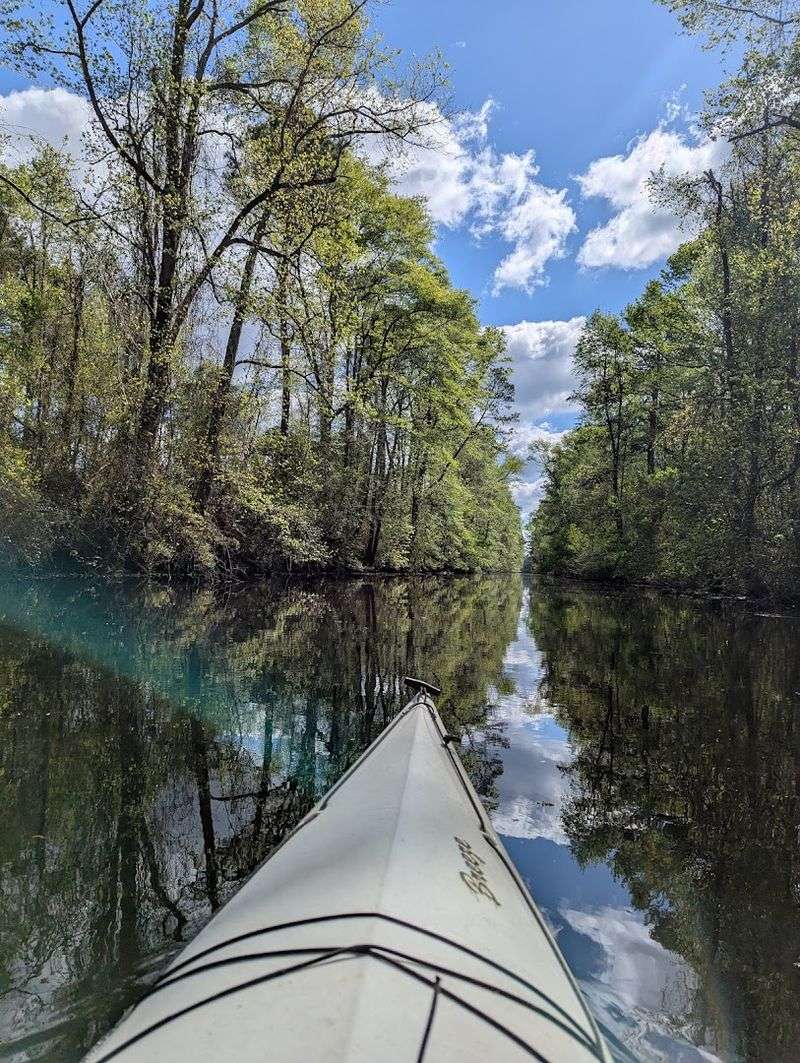
Getting to Lake Drummond by water is one of those experiences that resets your entire understanding of what a nature adventure can feel like. The feeder ditch is accessible from the Ballahack Road Boat Ramp along the Dismal Swamp Canal in Chesapeake, Virginia.
It channels you deep into the refuge on a narrow, tree-lined waterway that feels increasingly remote with every paddle stroke.
The silence builds gradually as you move further from the road. Bald cypress trees rise directly from the water on both sides, their knobby roots creating a texture along the banks that looks prehistoric.
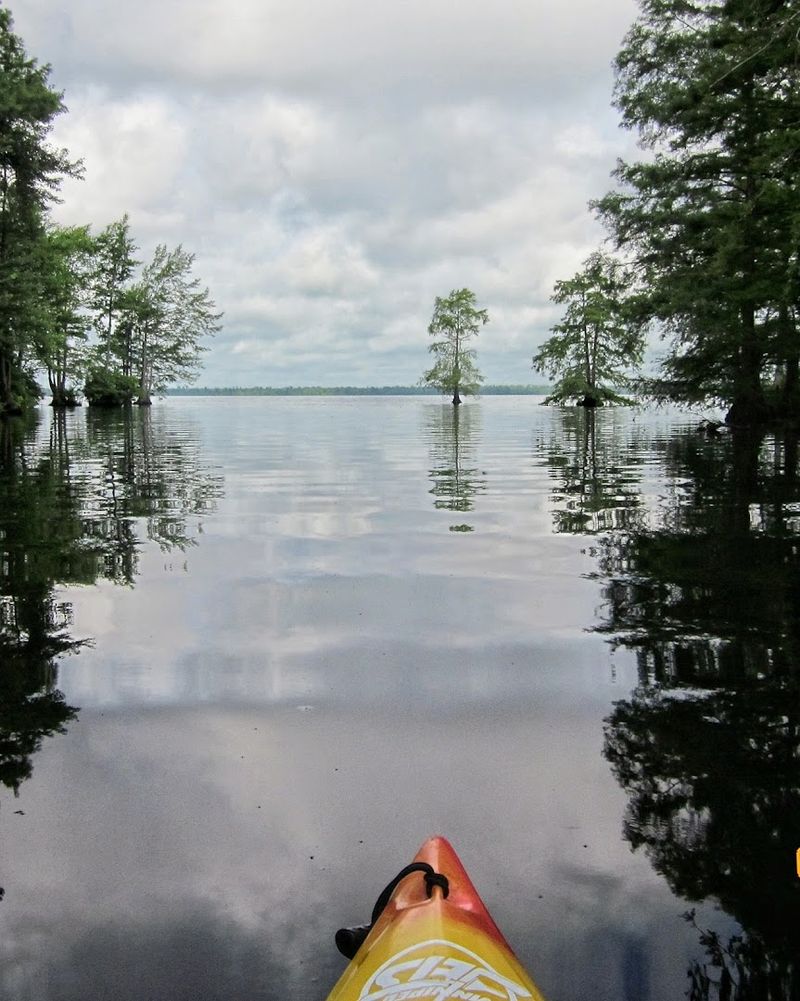
The water darkens as you approach the lake, and when the trees finally open up to reveal that vast, flat expanse of open water, the visual impact is genuinely startling.
Canoes, kayaks, and small motorized boats are all permitted on Lake Drummond, with a maximum engine size limit that keeps the atmosphere mercifully quiet. Rustic campsites accessible only by water offer an overnight option that feels genuinely adventurous.
I paddled out near the center of the lake on a still afternoon and sat there for a while, surrounded by nothing but dark water, sky, and the sound of distant birds. Completely unforgettable.
Hiking Trails Through a Landscape That Feels Prehistoric
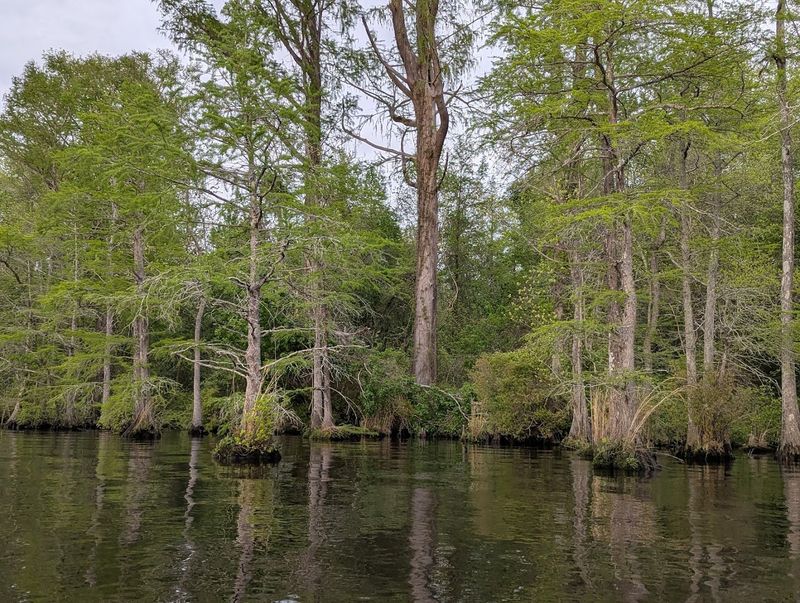
More than forty miles of nearly flat earthen trails and roads wind through the Great Dismal Swamp National Wildlife Refuge. It’s offering hikers and cyclists a chance to explore this extraordinary ecosystem at their own pace.
The Washington Ditch Trail is one of the most popular routes, following a historic canal corridor lined with towering trees that block out most of the sky. The Interior Ditch Trail takes you deeper into the refuge’s core, where the forest feels increasingly ancient and untouched.
The Lake Drummond Wildlife Drive provides a self-guided vehicle or walking route that ends at the lake overlook, complete with a short boardwalk, a dock, and fixed binoculars for scanning the water.
The drive itself is a narrow, unpaved road that runs arrow-straight through the swamp, barely elevated above the water table on either side.
A high-clearance vehicle is strongly recommended for the Wildlife Drive, as the road surface can be rough and uneven. Spring is spectacular here, with wildflowers emerging along the trail edges and bird activity reaching its annual peak.
I hiked the Washington Ditch Trail on a grey November morning and found the bare trees and still water created a mood that was equal parts eerie and breathtaking. Virginia’s outdoor offerings are vast, but this trail system is genuinely unlike anything else.
Plan Your Visit to Lake Drummond, Chesapeake
Planning a trip to Lake Drummond, Chesapeake requires a little preparation, but the payoff is absolutely worth every bit of effort. The Dismal Swamp Canal Trail trailhead is located at 1246 Dismal Swamp Canal Trail, Chesapeake, VA.
It is a fantastic starting point for biking, walking, or launching a kayak toward the refuge.
Cell phone signal can be limited or nonexistent inside the refuge, so download your maps before you arrive.
Bug spray is not optional here. Mosquitoes are a serious presence, particularly from late spring through early fall.
Lightweight long sleeves and pants are smart choices regardless of the temperature, and a hat with a brim will serve you well on the water. A Virginia Department of Wildlife Resources fishing license is required if you plan to fish, so sort that out in advance.
Swimming is not permitted in Lake Drummond, so leave the swimsuit at home. The refuge is open year-round, with each season offering a completely different atmosphere.
Winter brings quiet solitude and spectacular waterfowl. Spring delivers an explosion of bird activity and wildflowers.
Autumn wraps the whole landscape in fog and golden light that makes every legend feel entirely plausible. Come ready to be surprised by how deeply this corner of Virginia gets under your skin.
