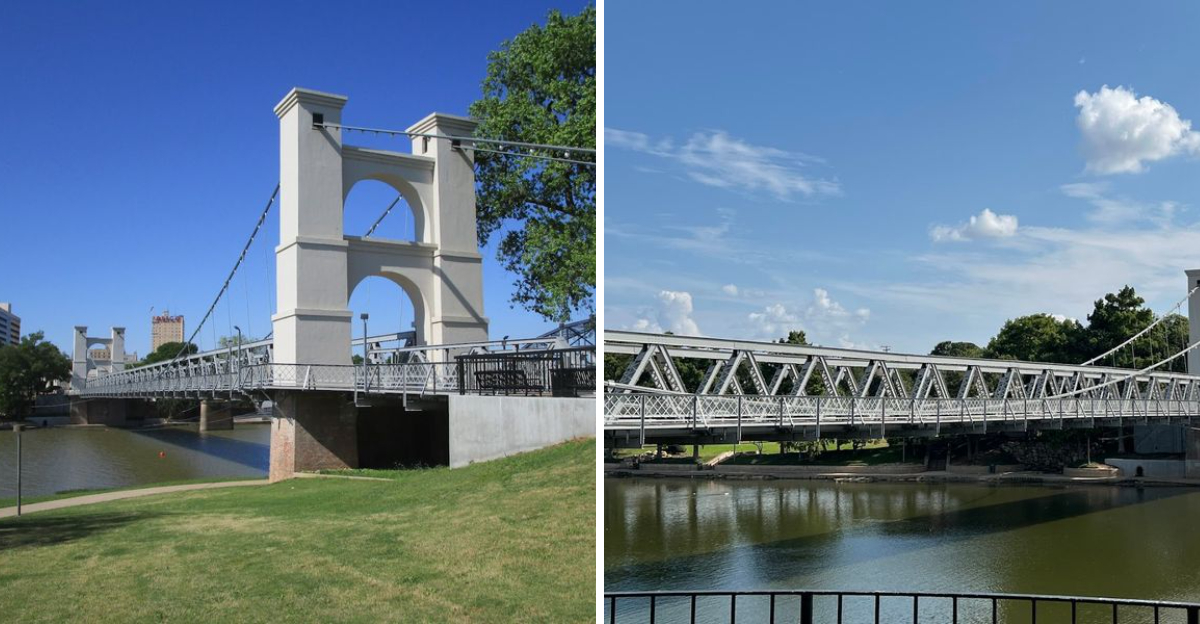
Some bridges are just for cars, noisy and forgettable. This one is different.
You can actually walk across it, feel the planks under your feet, and take in the river below. It has been standing for well over a century, holding stories of cattle drives, travelers, and locals who have crossed it thousands of times.
The view from the middle is peaceful, especially when the light hits the water just right. You will see families, couples, and solo wanderers all slowing down to enjoy the moment.
It is not just a bridge, it is a piece of history you can still experience with your own two feet.
The Bridge That Changed the West
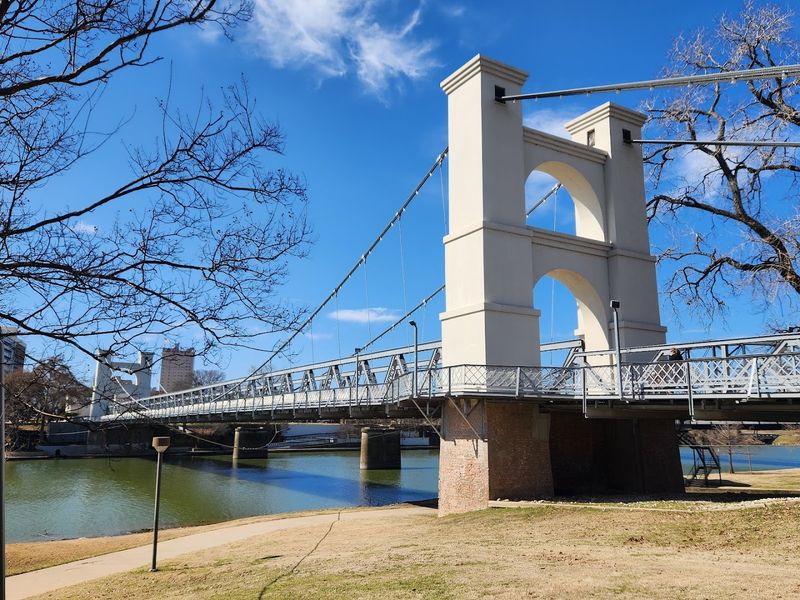
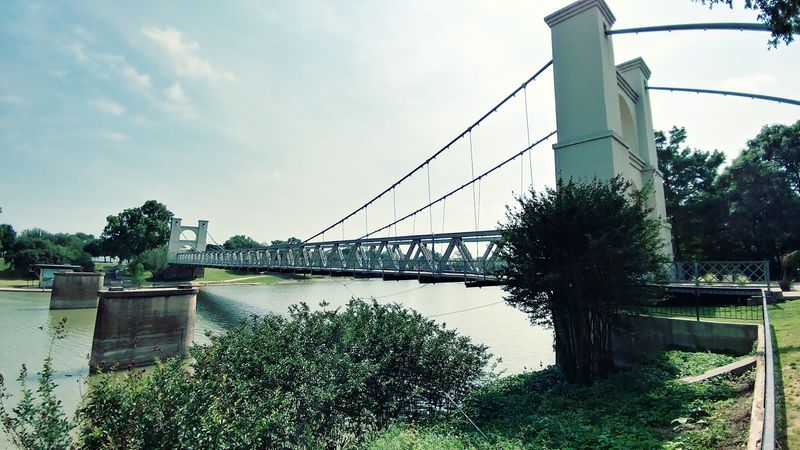
Before the Brooklyn Bridge became famous, a quieter engineering milestone was already making history in Central Texas. The Waco Suspension Bridge was completed in 1870, and at that time it was the longest single-span suspension bridge west of the Mississippi River.
That is not a small thing to wrap your head around.
The cables were supplied by John A. Roebling’s Sons Co., the very same company that later built the Brooklyn Bridge in New York.
So in a way, Waco got a preview of what that engineering team could do. The bridge originally operated as a toll crossing, collecting fees from travelers and cattle drivers moving through the region.
By 1889, McLennan County purchased it and sold it to the city of Waco for just one dollar. That might be the best real estate deal in Texas history.
It was extensively modified in 1914 to handle heavier traffic loads, and it served vehicles until 1971, when it was converted exclusively for pedestrians. The bridge was added to the National Register of Historic Places in 1970, cementing its status as one of Texas’s most significant landmarks.
A Free Walk with a View Worth Every Step
No ticket booth, no reservation, no admission fee. You just walk up and cross it.
That kind of simplicity is rare for a landmark this historically significant, and it makes the whole experience feel refreshingly unguarded.
The bridge connects Indian Spring Park on the west bank to Doris D. Miller Park, also known as Martin Luther King, Jr. Park, on the east side of the Brazos River.
Both parks are worth exploring once you cross. The views from the middle of the bridge are genuinely stunning, especially in the early morning when the light hits the water at a low angle.
I noticed that the bridge draws a real mix of visitors: joggers, families with strollers, couples on a slow afternoon walk, and solo travelers with cameras. Nobody seems to be in a hurry out there, which says something about the atmosphere.
The gentle sway of the cables, the sound of the river below, and the open sky above create a sensory experience that a photograph can only partially capture. It is the kind of place that earns a second visit without even trying.
The Chisholm Trail Connection You Did Not Expect
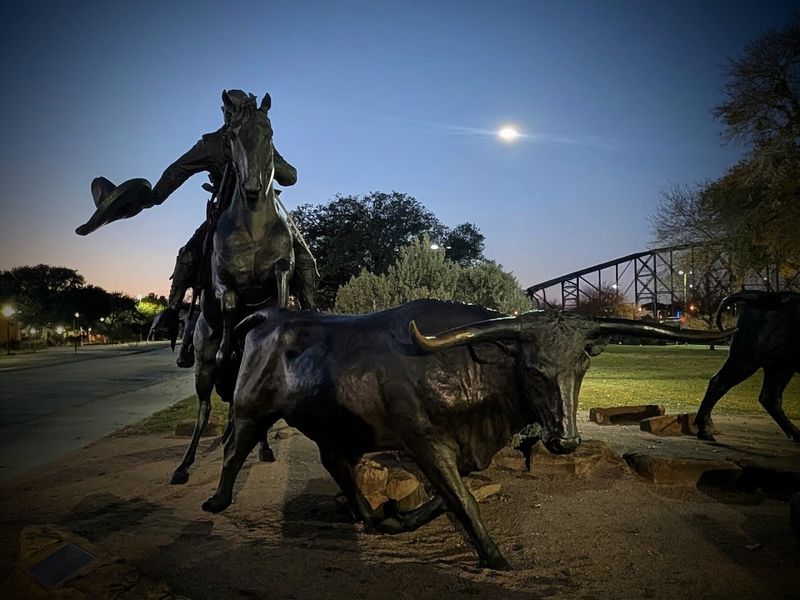
Right next to the bridge in Indian Spring Park, a remarkable set of bronze sculptures stops nearly every visitor in their tracks. The installation is called “Branding the Brazos,” and it depicts an oversized cattle drive with longhorns and cowboys rendered in stunning bronze detail.
It is one of those public art pieces that earns its space completely.
The sculptures are there for a specific historical reason. The Waco Suspension Bridge served as a critical crossing point on the Chisholm Trail, the famous cattle route that moved millions of longhorns northward from Texas ranches to Kansas markets during the late 1800s.
Without a reliable river crossing, those drives would have been significantly harder to complete.
Knowing that context transforms the bridge from a pretty structure into something with real narrative weight. You start to picture the noise and dust of a cattle drive moving across those planks, the river rushing below, cowboys guiding the herd through.
The sculptures bring that image into sharp focus. It is a smart piece of storytelling that connects the bridge’s physical history to the broader story of the American West in a way that feels earned rather than staged.
The Riverwalk That Wraps the Whole Experience Together
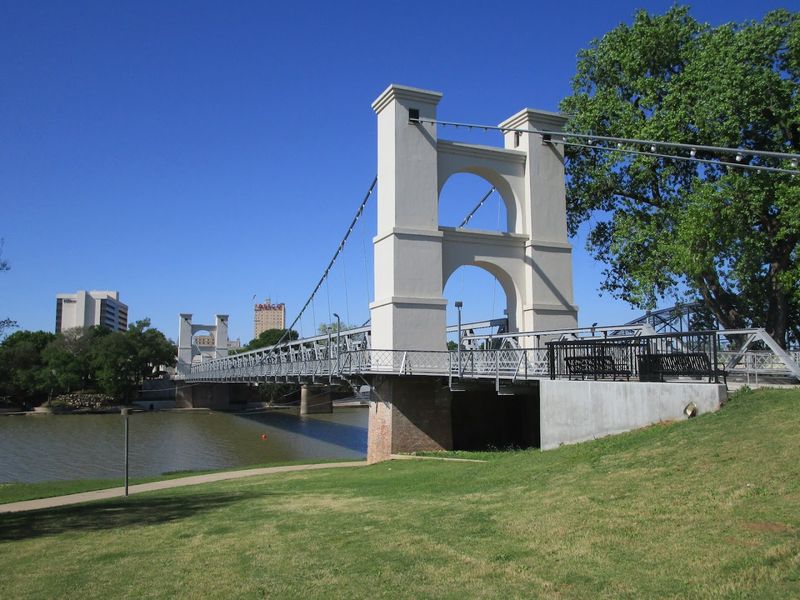
The bridge is actually just one part of a larger outdoor experience. The Waco Riverwalk is a multi-use, lighted trail that loops along both banks of the Brazos River, and the suspension bridge serves as its visual and geographic centerpiece.
Getting on the trail before or after crossing the bridge turns a short visit into a genuinely satisfying outing.
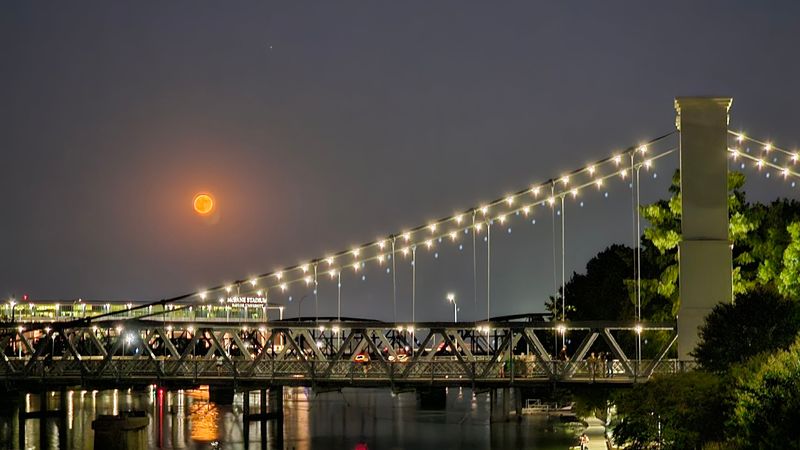
The trail is well-maintained and easy to navigate, which makes it accessible for walkers, joggers, and cyclists alike. At night, the lighting along the path gives the whole area a warm glow that reflects off the river in a way that feels almost cinematic.
I would honestly recommend an evening walk just for that effect alone.
The Riverwalk connects multiple parks and green spaces, so you can extend your route depending on how much time you have. It is a great way to see downtown Waco from a different angle, away from traffic and storefronts, closer to the natural rhythm of the city.
The combination of the historic bridge, the river views, and the well-designed trail makes this one of the most complete outdoor experiences in Central Texas.
The Major Rehabilitation That Brought It Back to Life
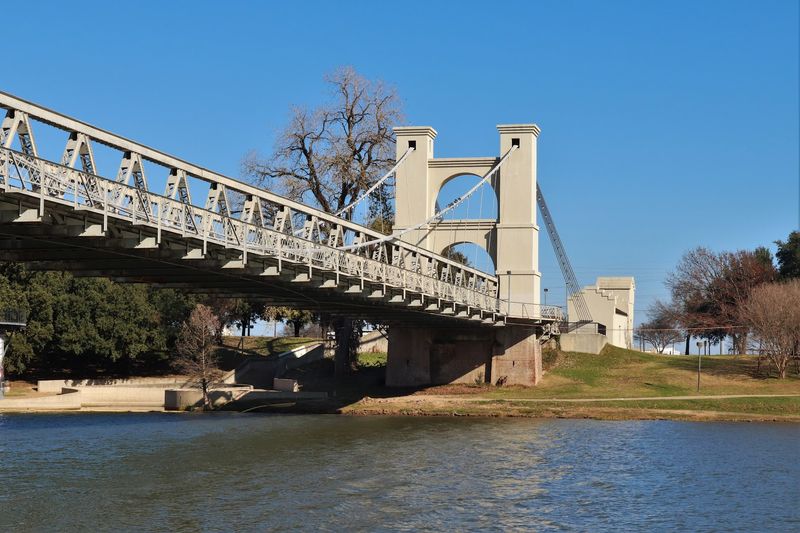
By 2020, the bridge needed serious attention. A rehabilitation project worth between 12 and 14 million dollars launched in the fall of that year, and it was one of the most comprehensive restorations the structure had ever undergone.
The suspension cables were replaced, the anchors were reinforced, and the decking and railings were fully updated.
The bridge reopened officially in April 2023 with a grand celebration that brought the Waco community out in force. For locals who had grown up walking across it, the reopening carried real emotional weight.
For visitors arriving after the renovation, the result is a bridge that looks and feels renewed without losing its historic character.
The new cables maintain the same visual profile as the originals, which was clearly an intentional design choice to preserve the bridge’s iconic silhouette. The updated decking is smooth and solid underfoot, a noticeable improvement from the worn surface that preceded it.
What impressed me most was how the restoration respected the structure’s age rather than trying to modernize it beyond recognition. The bridge still feels old in the best possible way, like something that has earned every year of its existence.
Photography Spots That Actually Deliver
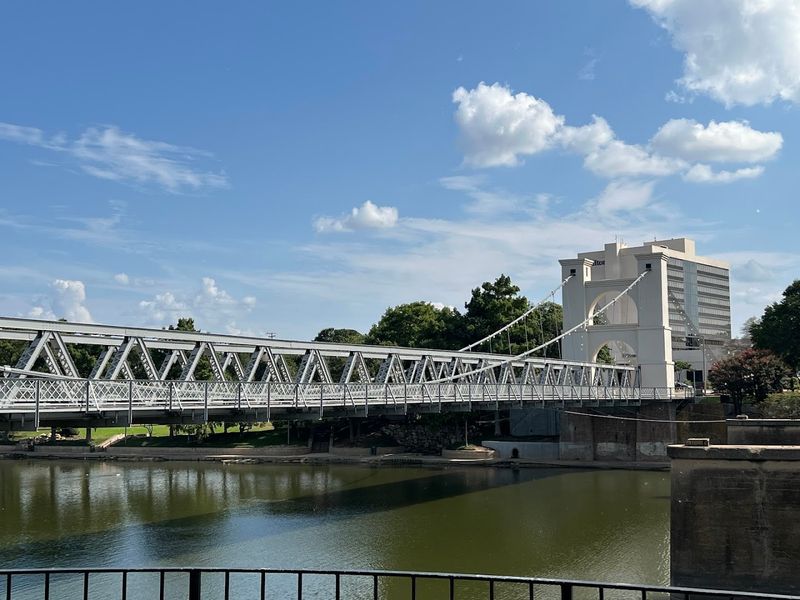
Few bridges in Texas offer as many natural photography angles as this one. The reflection of the cables in the Brazos River on a calm morning is the kind of shot that looks almost too good to be real.
Arrive early and the light will do most of the work for you.
From the riverbank in Indian Spring Park, you get a full profile view of the bridge with the downtown Waco skyline in the soft background. That angle works especially well at golden hour when the warm light catches the metal cables and gives the whole scene a slightly amber tone.
From the bridge itself, looking downriver, the view opens up into a wide, peaceful stretch of water framed by trees on both banks.
The bronze sculptures nearby also make for compelling foreground elements when composing a wider environmental shot. I spent about forty minutes just moving between different spots along the bank, and each position offered something distinct.
You do not need expensive gear to come away with memorable images here. The location does the heavy lifting, and your main job is simply to show up at the right time of day and pay attention to where the light falls.
What the Surrounding Parks Add to the Visit
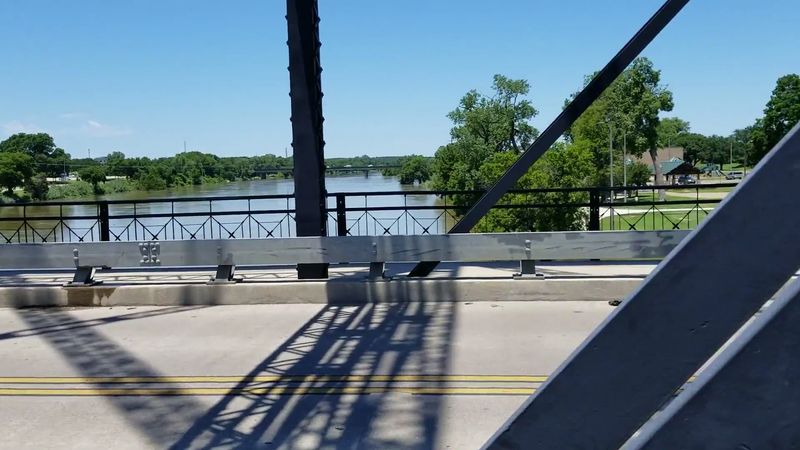
The parks on either side of the bridge are not just transition zones between parking and the crossing. They are destinations in their own right, and spending time in them before or after the walk adds real depth to the visit.
Indian Spring Park on the west side has open green space, mature shade trees, and a relaxed atmosphere that invites lingering.
Doris D. Miller Park on the east bank offers a quieter, more shaded experience with river access and benches positioned to take advantage of the water views.
Both parks are well-maintained and feel like genuine community spaces rather than tourist infrastructure. That distinction matters because it gives the whole area an authentic local energy.
On weekends, you will likely find families having picnics, kids running around near the water, and people simply sitting and watching the river move. There is no agenda required.
The parks support whatever pace you bring to them, whether that is an active morning jog, a slow afternoon with a book, or a sunset stroll that ends at the bridge. They make the overall experience feel complete rather than just a quick box to check off a travel list.
Why Waco Deserves a Spot on Your Texas Travel List
Waco has been quietly building a reputation as one of Central Texas’s most interesting stops, and the suspension bridge is a big part of why. It is not a manufactured attraction.
It is a genuine piece of American infrastructure with a compelling story attached to it, and it sits right in the middle of a walkable, welcoming downtown area.
Beyond the bridge, the city offers a solid mix of history, food, and outdoor space. The Cameron Park Zoo, the Texas Ranger Hall of Fame and Museum, and the Dr Pepper Museum are all within easy reach.
Waco is also a natural stopping point on road trips between Dallas and Austin, making it easy to justify a few hours or even an overnight stay.
What surprised me most was how much the bridge anchors the city’s identity without overwhelming it. Locals treat it as part of daily life, not just a backdrop for tourist photos.
That relationship between a community and its landmark is something you either feel immediately or you miss entirely. In Waco, you feel it.
The suspension bridge is not just a place to visit. It is a reason to stay a little longer than you planned.
Address: 101 N University Parks Dr, Waco, TX
