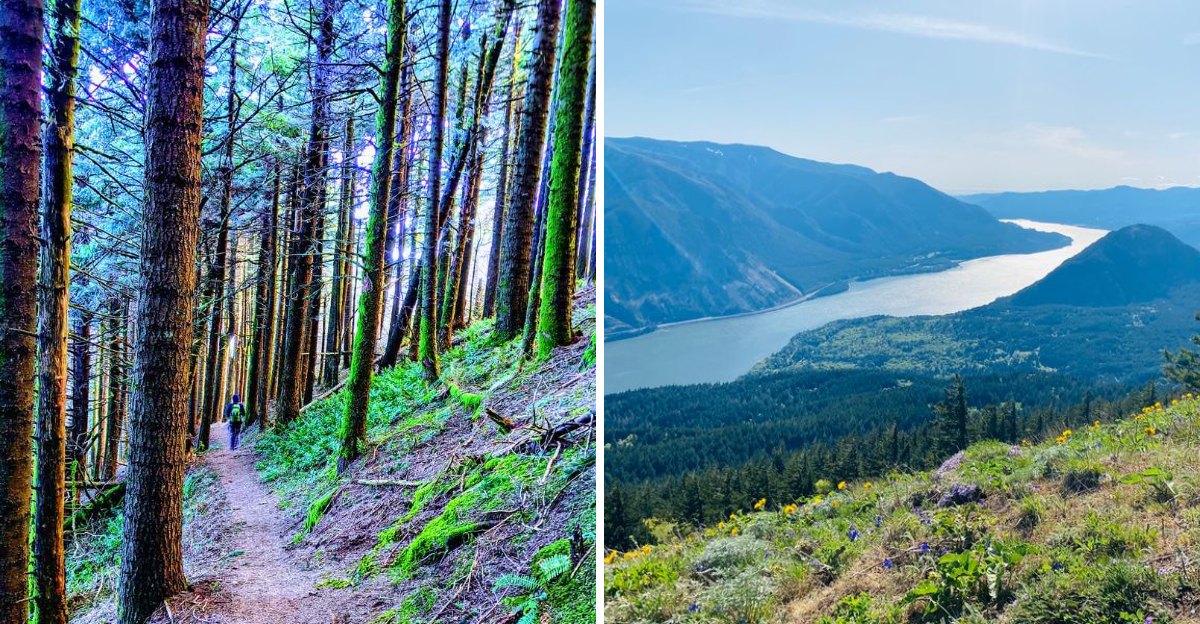
I’d heard whispers about Dog Mountain for years before I finally laced up my boots and made the trek. People described it as brutal, beautiful, and completely otherworldly, all in the same breath.
When I reached the summit after three miles of relentless climbing, I understood why this hike has such a cult following among Pacific Northwest adventurers.
Located along the Columbia River Gorge on the Washington side but often accessed from Oregon, Dog Mountain isn’t your typical forest walk. From the moment you start climbing, you know you’re in for something different.
This isn’t a hike that eases you in gently. It demands respect, rewards persistence, and delivers views that make you feel like you’ve stepped onto another planet entirely.
Vast, Unobstructed River Views
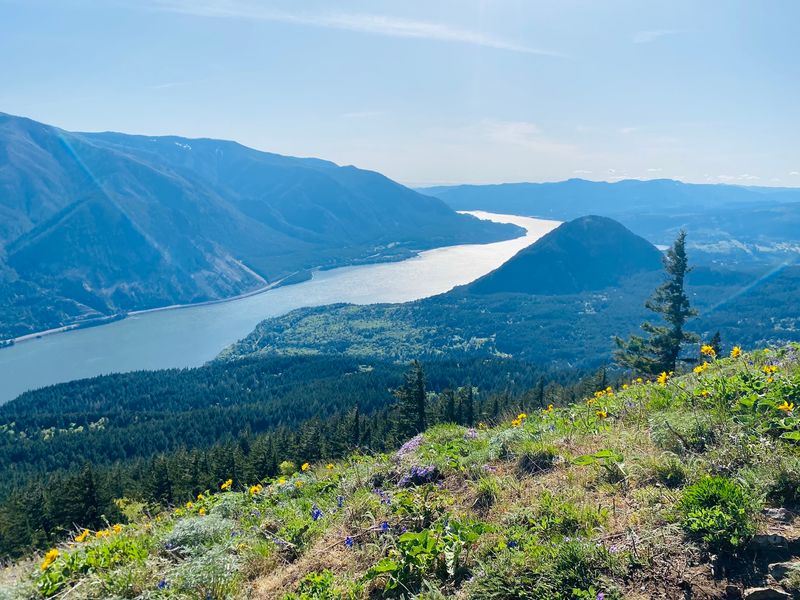
Standing at the summit, I felt like I could see forever. The Columbia River stretched out below me like a silver ribbon, winding through the gorge with Oregon on one side and Washington on the other.
Mountains stacked up in layers, fading into the distance until they became hazy silhouettes against the sky.
What struck me most was the sheer scale of everything. Down on the river, boats looked like toys.
The highway became a thin line. Trees that towered overhead at the trailhead now appeared as tiny green dots far below.
This perspective shift made me feel simultaneously insignificant and incredibly alive.
On clear days, you can spot Mount Hood rising majestically to the south, its snow-capped peak gleaming in the sunlight. Mount St. Helens sometimes makes an appearance to the north, a reminder of the volcanic forces that shaped this landscape.
The view encompasses nearly 360 degrees of pure Pacific Northwest majesty, unobstructed by buildings, power lines, or any other human interference.
It’s the kind of vista that makes three miles of grueling uphill effort feel completely worthwhile.
Dense, Colorful Wildflower Fields
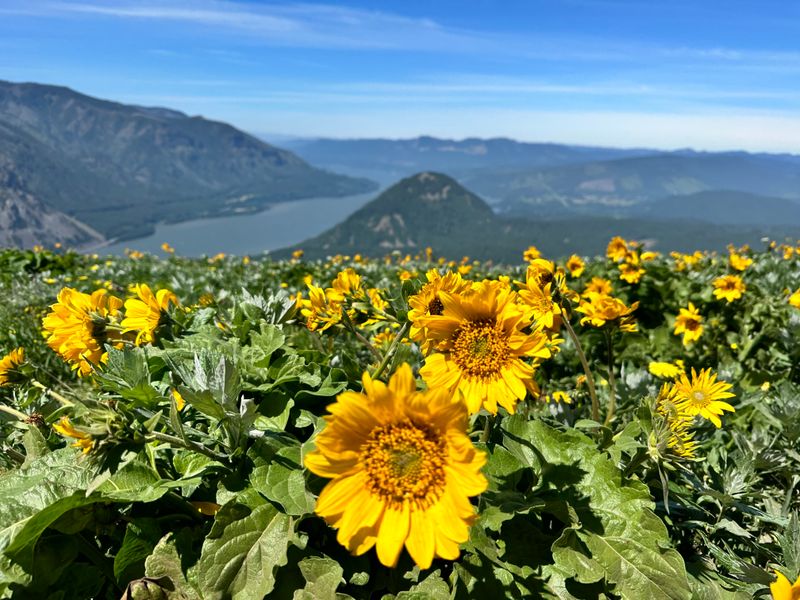
Nothing prepared me for the explosion of color that greeted me during peak wildflower season. The slopes transformed into something that looked more like a painting than reality.
Bright yellow balsamroot flowers carpeted the hillsides in every direction, their cheerful blooms creating an almost surreal landscape that photographers dream about.
Mixed among the balsamroot, I spotted vibrant red Indian paintbrush adding pops of contrasting color. The combination created a visual feast that had me stopping every few steps to take another photo, even though my legs were screaming for a break.
Other hikers around me were doing the same thing, all of us mesmerized by nature’s display.
The wildflower show typically runs from mid-April through mid-June, with peak bloom usually happening in May. I visited in late May and hit it perfectly.
The flowers were so dense in some areas that the ground was completely hidden beneath the blooms.
Walking through these fields felt like stepping into an alien world where everything glowed with impossible brightness.
Surreal Wind-Swept Summit
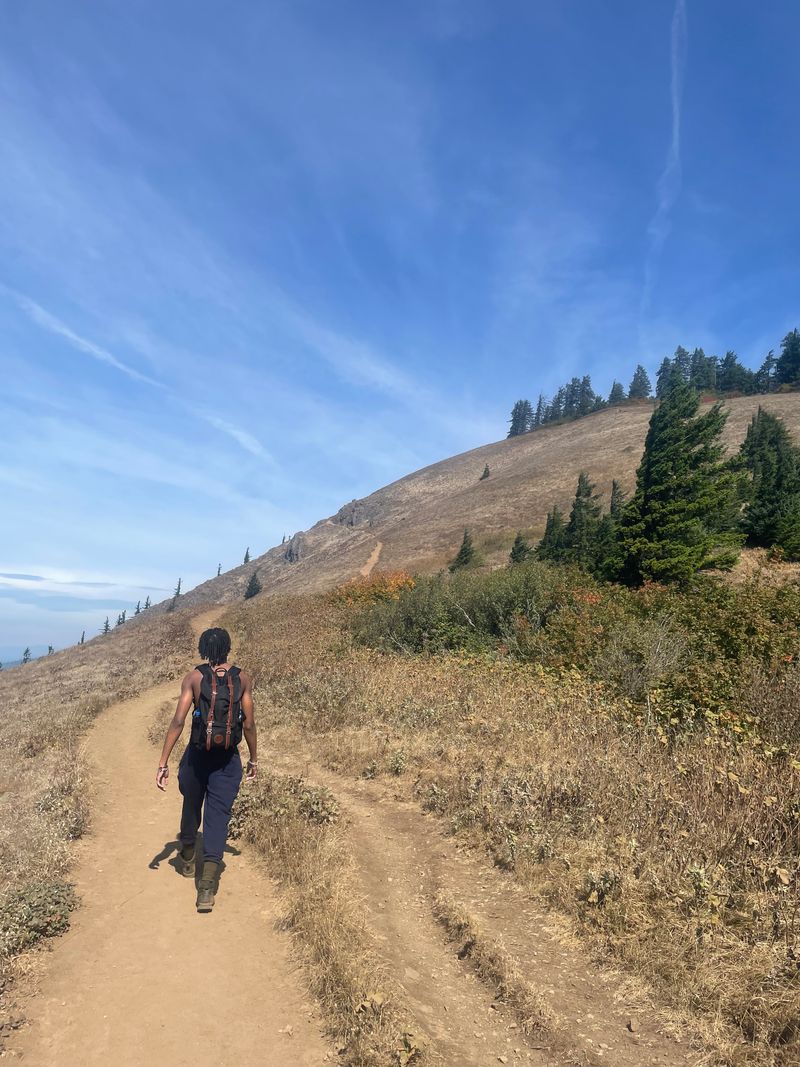
The wind at the top nearly knocked me over. I’m not exaggerating.
One moment I was standing upright, admiring the view, and the next I was leaning hard into a gust that felt strong enough to lift me off my feet. It’s an intense, almost primal experience that makes you acutely aware of the power of nature.
Multiple hikers I encountered mentioned the wind, some laughing about how they had to brace themselves just to stay standing. One woman told me she felt like she was on a different planet entirely, with the relentless gusts creating a constant roar in her ears.
I had to agree with her assessment.
I strongly recommend bringing a windbreaker or jacket, even on seemingly calm days. The temperature drops noticeably at the summit, and the wind chill can make it feel much colder than down below.
I watched several unprepared hikers huddle together for warmth, their smiles frozen but their spirits still high.
The wind adds to the otherworldly atmosphere, making the summit feel like a place where normal rules don’t quite apply.
Steep, Difficult and More Difficult Paths
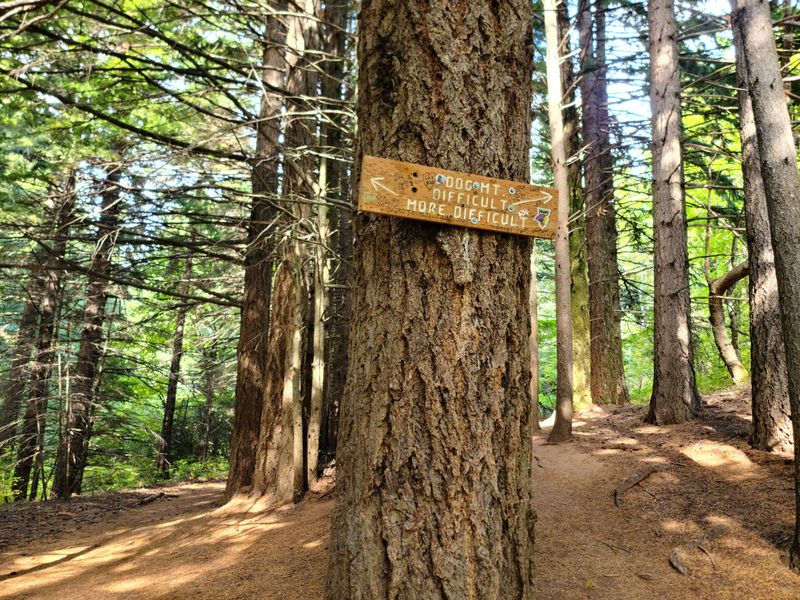
Dog Mountain doesn’t mess around. From the parking lot, you’re presented with two route options: difficult and more difficult.
I chose the more difficult route on the way up, figuring I’d get the hardest part over with first. That decision tested every muscle in my legs.
The trail gains 3,000 feet in just three miles, which translates to about 1,000 feet of elevation per mile. That’s a relentless climb that never really lets up.
My quads were burning within the first half mile, and I found myself taking frequent breaks to catch my breath and let my heart rate settle down a bit.
What makes this hike feel so earned is that constant upward push. You can’t coast for even a moment.
Every step requires effort and intention. By the time I reached the summit, I felt like I’d accomplished something genuinely challenging.
The descent proved equally demanding in different ways, with my knees taking the brunt of the impact. Several hikers recommended taking the longer, gentler Augspurger trail down to save your joints, advice I wish I’d followed.
The trailhead sits at WA-14, Cook, WA 98605.
Dramatic Cliff-Edge Perspectives
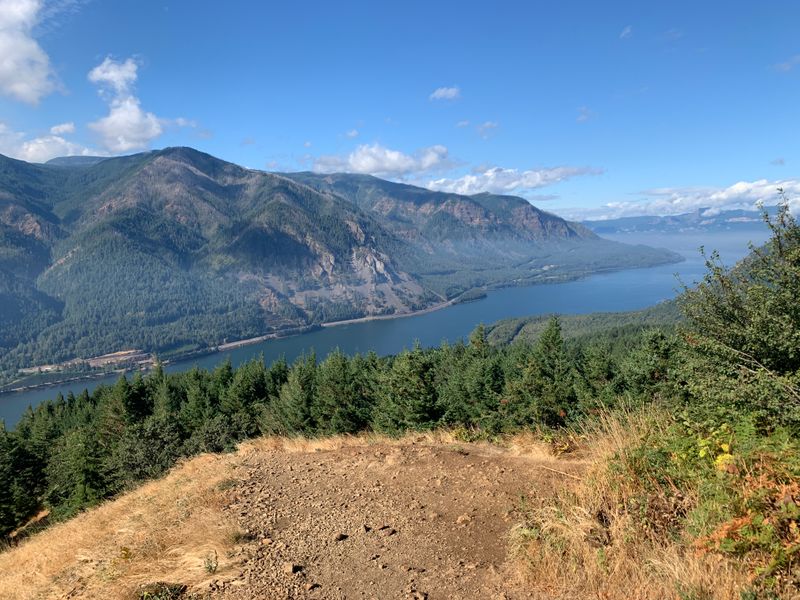
My stomach did a little flip the first time I approached one of the cliff-edge viewpoints. Looking down, I could see hundreds of feet of empty air between me and the ground below.
The exposure is real and thrilling, offering perspectives that make your heart race in the best possible way.
These dramatic drop-offs appear at several points along the trail, particularly near the summit. I watched other hikers carefully inch toward the edges to snap photos, their faces showing a mix of excitement and healthy respect for the height.
The narrow paths along some of these sections require focus and sure footing.
For anyone with a fear of heights, these sections might prove challenging. But for those who can handle the exposure, they provide some of the most memorable moments of the entire hike.
Standing at the edge, wind whipping around me, with the Columbia River far below and mountains stretching to the horizon, I felt a thrill that’s hard to replicate anywhere else.
Just remember to stay on the designated trail and never venture too close to unstable edges.
Unobstructed, Open Treeline
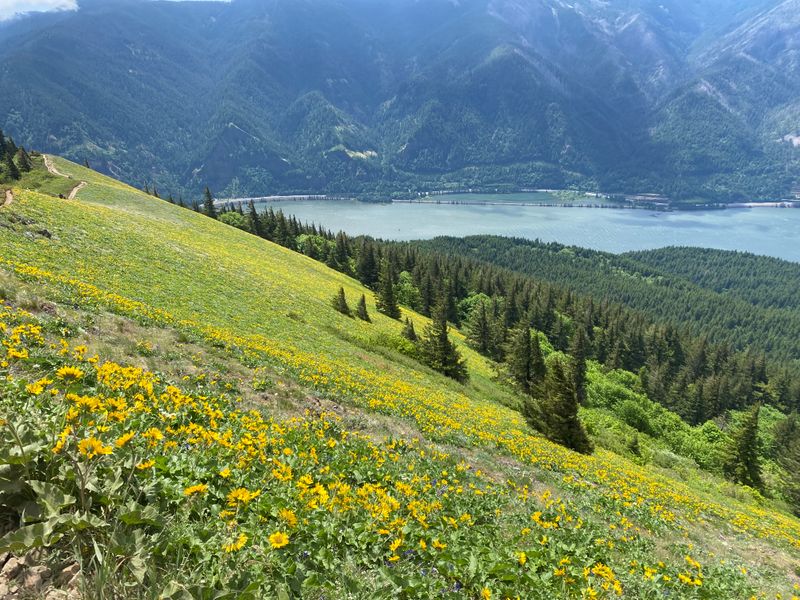
Breaking through the treeline felt like emerging into a completely different world. For the first couple of miles, the trail winds through dense forest that provides welcome shade but limited views.
Then suddenly, the trees fall away and you’re standing in open meadows with nothing blocking your sight in any direction.
This transition is one of the most dramatic aspects of the hike. The summit area is largely exposed and shade-free, which means you need to be prepared for sun exposure and bring plenty of water.
I made the mistake of not applying enough sunscreen and paid for it later with a nice sunburn on my arms.
The lack of trees at the top allows for those incredible 360-degree views that make Dog Mountain famous. You can see the Columbia River snaking through the gorge, distant mountains in every direction, and on clear days, both Mount Hood and Mount St. Helens standing guard over the landscape.
The openness creates a feeling of being on top of the world, exposed to the elements but rewarded with vistas that few other Oregon trails can match.
Constant Natural Sounds
One of the most striking things about reaching the summit was the absence of human noise. No traffic sounds, no voices from nearby buildings, no mechanical hum of modern life.
Just wind rushing past my ears and the occasional call of a bird riding the air currents above the gorge.
This auditory escape from civilization proved surprisingly powerful. As someone who lives in a city, I’d forgotten what true quiet sounds like.
Even the conversations of other hikers seemed muted and respectful, as if everyone instinctively understood that this place demanded a certain reverence.
The wind creates its own symphony at the summit, sometimes howling, sometimes whistling softly through the grasses and wildflowers. During my descent through the forested sections, I heard the rustling of leaves, the crunch of my boots on the trail, and the distant sound of water flowing somewhere in the ravines below.
These natural sounds provided a meditative quality to the experience, allowing me to disconnect from daily stresses and fully immerse myself in the present moment.
It’s a rare gift in our increasingly noisy world.
Unique Ecosystem Transition
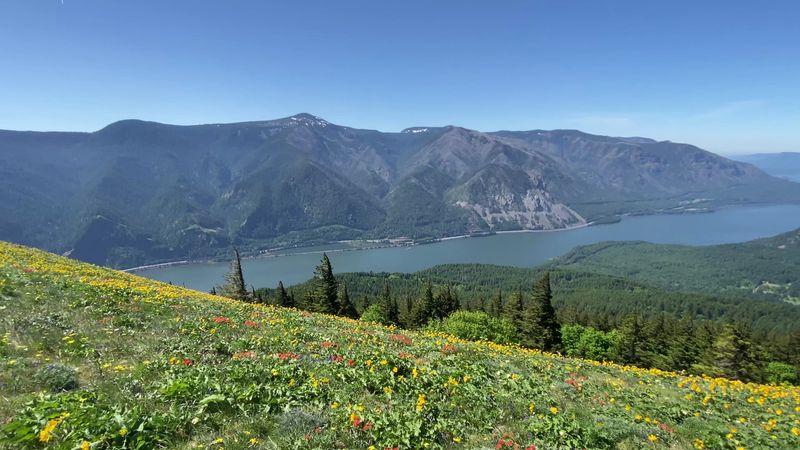
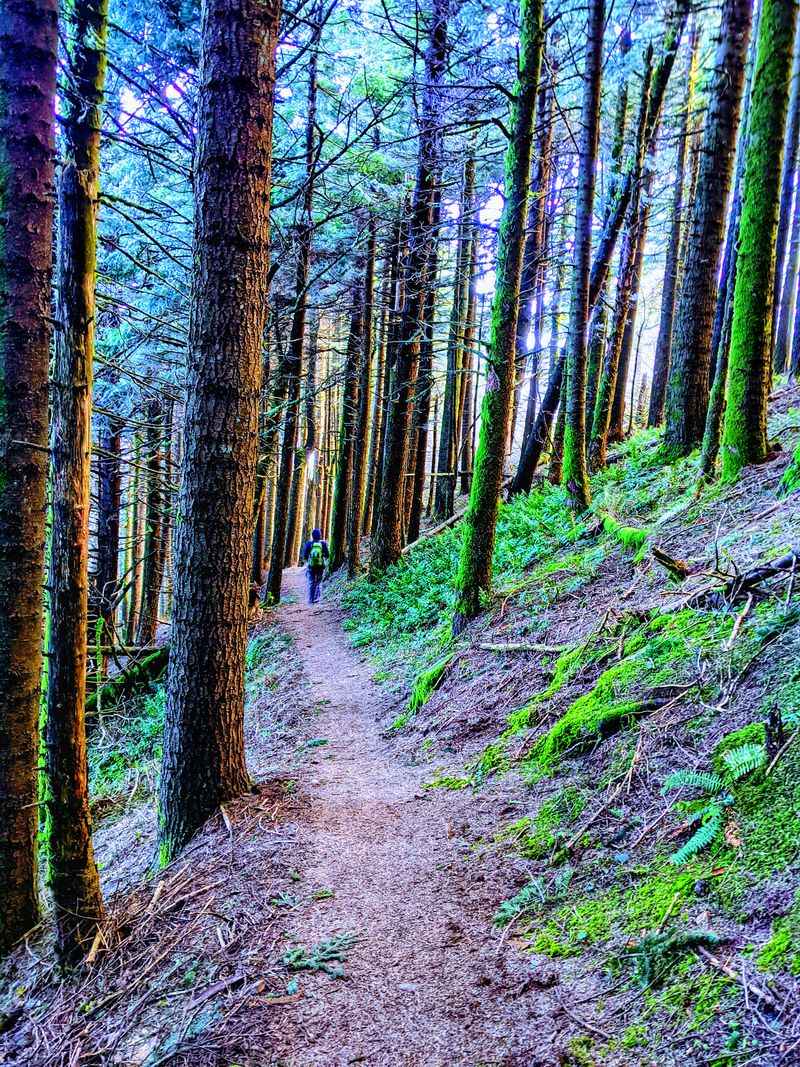
Hiking Dog Mountain is like walking through several different worlds in a single afternoon. The journey begins in cool, shaded forest where ferns carpet the ground and moss hangs from tree branches.
The air feels damp and earthy, and the canopy filters the sunlight into soft green shadows.
As you climb higher, the ecosystem begins to shift. The dense forest gradually opens up, with more light penetrating through the thinning canopy.
Different plant species appear, adapted to the increasing sun exposure and drier conditions. I noticed the temperature rising as I left the shade behind and entered more exposed terrain.
By the time you reach the summit, you’re in a completely different ecological zone. Sunny, exposed meadows replace the dark forest.
Wildflowers thrive in the open conditions, and grasses wave in the constant wind. The temperature, light levels, moisture, and plant life all differ dramatically from where you started just three miles below.
This rapid transition through multiple ecosystems creates a sense of traveling through different worlds, adding to the otherworldly feeling that makes Dog Mountain such a unique hiking experience in the Columbia River Gorge region.
Dear Reader: This page may contain affiliate links which may earn a commission if you click through and make a purchase. Our independent journalism is not influenced by any advertiser or commercial initiative unless it is clearly marked as sponsored content. As travel products change, please be sure to reconfirm all details and stay up to date with current events to ensure a safe and successful trip.
