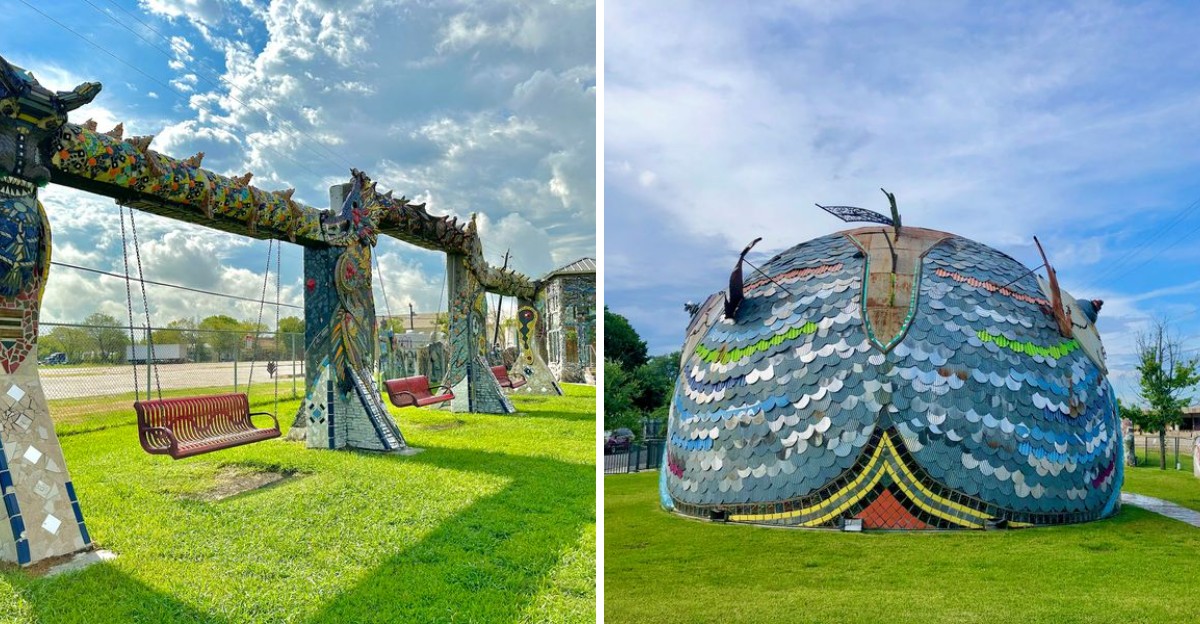
One person’s trash is another person’s art. And at this Texas park, that idea is taken to a whole new level.
Giant sculptures covered in colorful mosaics fill the space, each one made from recycled materials that could have ended up in a landfill. Instead, they became something beautiful.
You can wander through the park, take photos, and let your eyes bounce from one vibrant creation to the next. It is free, it is quirky, and it is one of the coolest public art spaces in the state.
Kids love it, adults find themselves smiling, and photographers cannot get enough. It is proof that creativity does not need a big budget.
Just imagination, a little elbow grease, and a willingness to see potential where others see junk. A true Texas original.
The First Few Steps Feel Like Opening a Jewelry Box
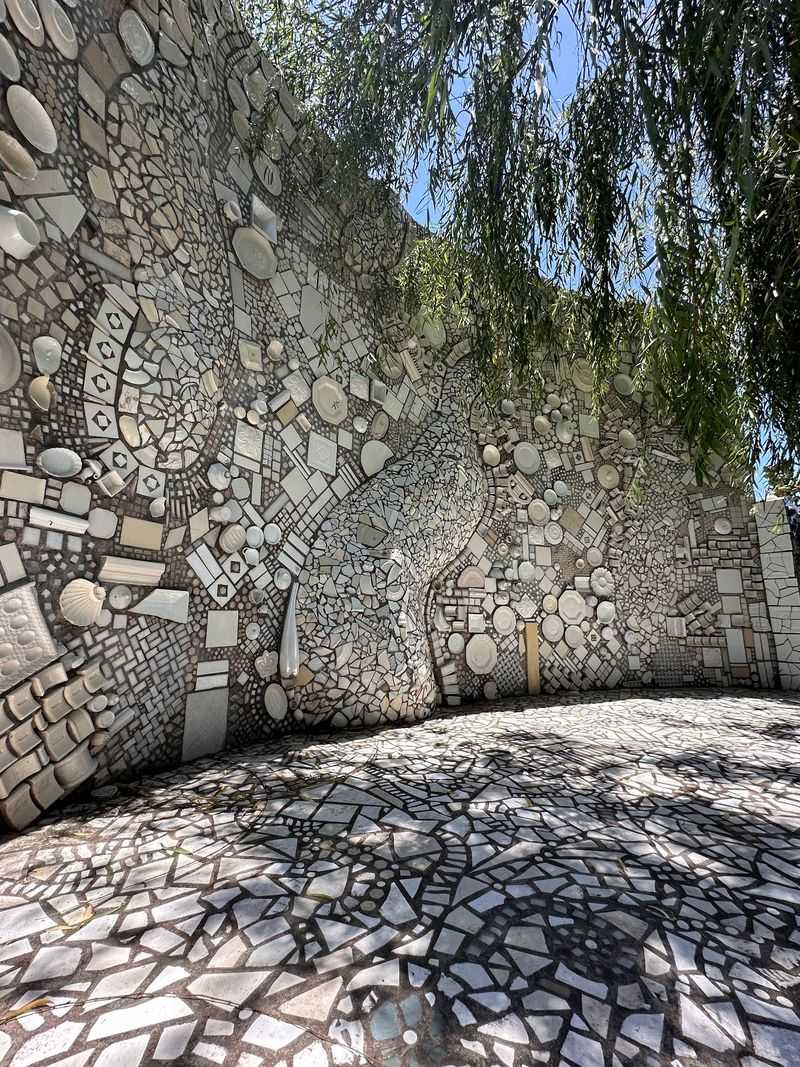
Color hits first. Before any single sculpture registers, the whole lot reads as one enormous glittering surface, the kind of shine that makes people slow their walk without deciding to.
The park sits on a narrow strip in Houston’s East End, wedged into a quiet residential block where the surrounding houses are plain and low. That contrast does a lot of the work.
One minute it is ordinary neighborhood pavement, the next it is a corridor of shimmering tile and mirror.
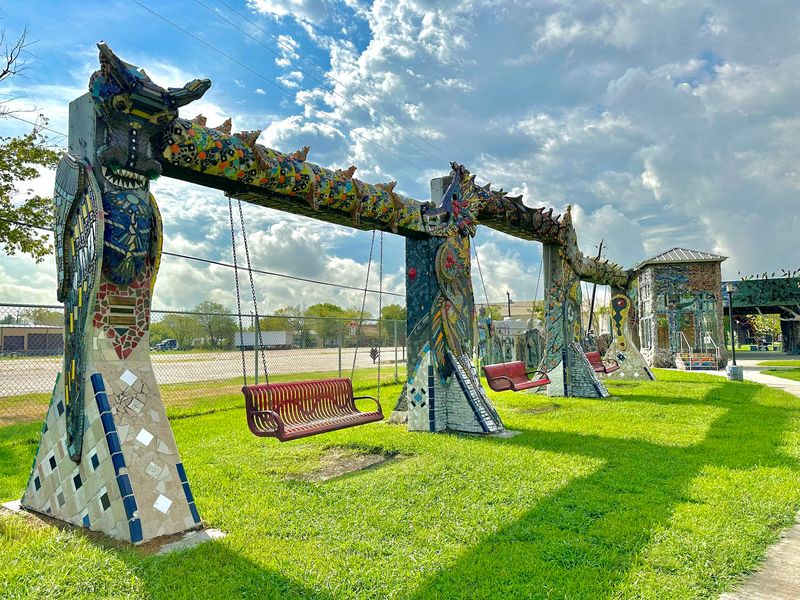
Pathways curve rather than run straight, so nothing is visible all at once. A pillar blocks one view, a swing frame hides another, and the shape of the space keeps pulling visitors forward to see what sits around the bend.
Worth knowing upfront: the park is smaller than photos suggest. Reviews mention this often, and it is true.
The size is not the point, though, because the density of detail means a small footprint holds hours of looking.
Sunlight changes everything here. Mirror pieces throw little flashes across the ground in the afternoon, while overcast days mute the sparkle and let the colors and patterns come forward instead.
Give the entrance a minute before charging in. Notice how the mosaics wrap around posts, edges, and steps, not just the flat display walls.
That habit of covering every available surface is the signature of the place.
Then wander. There is no correct route, no arrows, no start or finish, just a long ribbon of art meant to be explored at whatever speed feels right.
Built to Honor a Man Who Loved Outsider Art
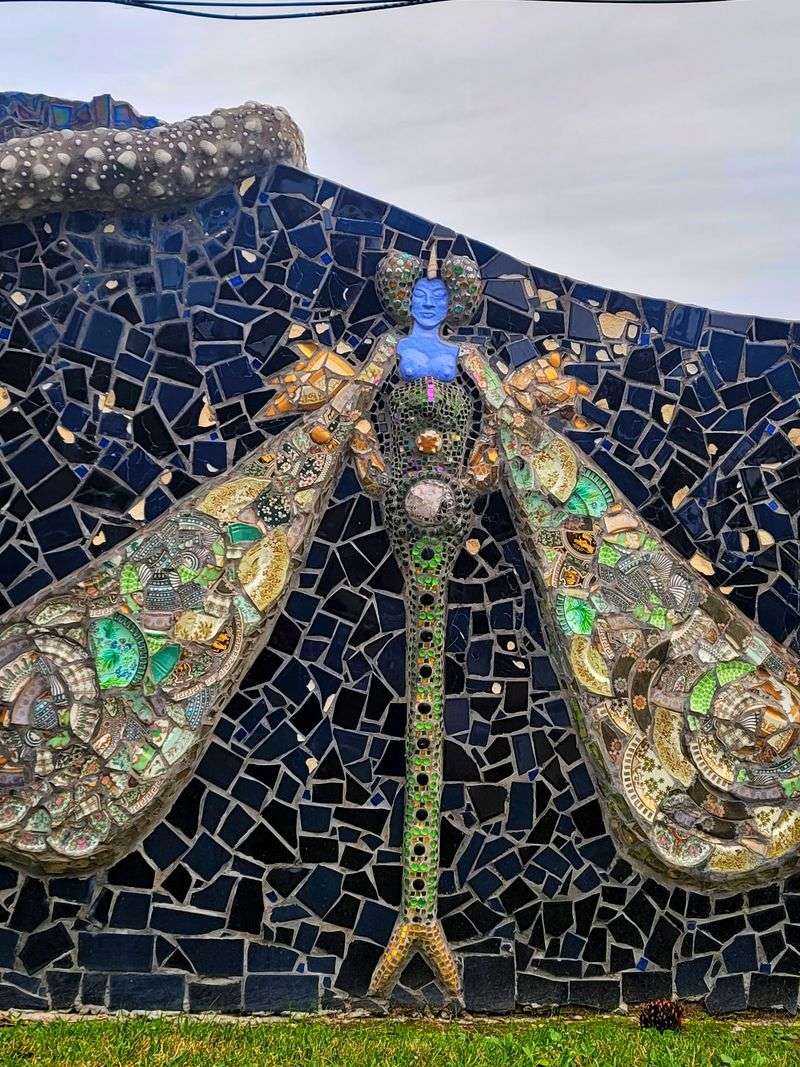
Behind the sparkle sits a family story. The park honors John H.
Smither, a Houston collector and patron who spent years championing self-taught art, the kind made outside of galleries and art schools.
His wife, Stephanie Smither, wanted a tribute that matched his taste. Not a statue.
Not a plaque on a lawn. Something alive and homemade and slightly wild.
Enter Dan Phillips, a builder and artist known around Texas for constructing houses out of salvaged and leftover materials. His approach fit perfectly, since the whole idea rested on giving discarded objects a second life.
Ground broke in 2011 on a modest half-acre plot. Construction stretched across years, piece by piece, until the formal dedication took place in September 2016.
The Orange Show Center for Visionary Art took the project under its wing and still maintains it today. That connection makes sense, because the Orange Show has spent decades promoting visionary and folk art in Houston, including the famous Art Car Parade.
Visitors familiar with the Orange Show monument nearby often stumble onto the park by accident and assume the two are the same site. They are separate places, though the spirit runs through both.
Knowing the origin story changes how the mosaics read. Suddenly the broken plates and old beads feel less like decoration and more like a memorial built from the leftovers of everyday life.
It is a tribute that keeps growing, which is arguably the most fitting kind.
Hundreds of Hands Made This, Not One Famous Artist
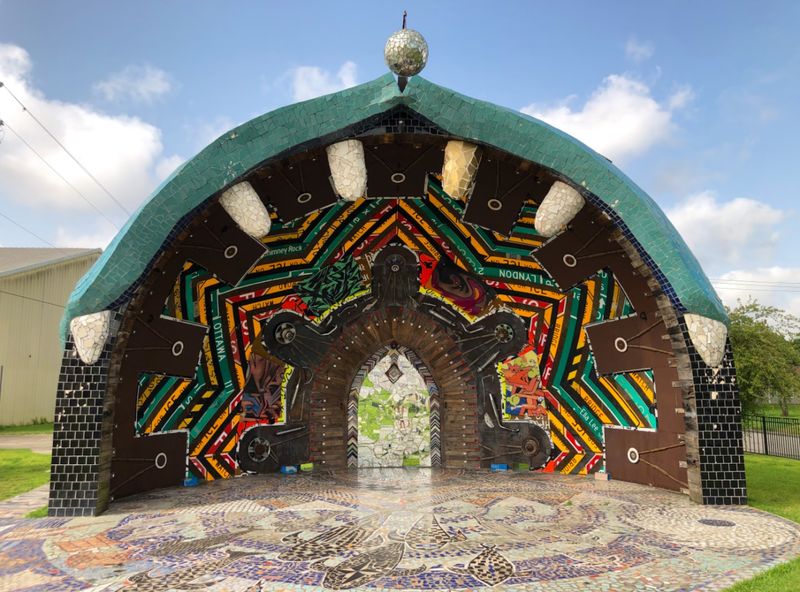
No single signature hangs over the place. More than 300 self-taught artists and community members have contributed permanent mosaic work here, which explains the delightful lack of uniformity.
Styles bump into each other. One panel might be tightly geometric, the next loose and dreamlike, and a third pure cartoon energy.
Rather than feeling messy, the mix reads like a conversation. Different voices, same room.
The project also refuses to be finished. New sections keep getting added, so a return visit a year later can genuinely look different from the first.
On many Saturdays, weather cooperating, artists work on site. Visitors sometimes get to watch tile being set, grout being spread, and designs taking shape in real time.
Occasionally there is a chance to help. Several visitors have described being invited to press a piece into place, which turns a casual stop into something they remember for years.
Even without participating, watching the process reframes the whole park. Those walls represent staggering amounts of patient, sweaty, unglamorous labor.
A gentle reminder for anyone hoping to join in: work sessions depend on volunteers, weather, and the season, so checking with the Orange Show Center for Visionary Art beforehand saves disappointment.
The collaborative model is also why the park feels welcoming rather than precious. Community-built art tends to invite touching, sitting, and lingering instead of keeping people at a rope’s distance.
It belongs to the neighborhood, and that shows.
Four Hundred Feet of Mosaic Panels Telling Personal Stories
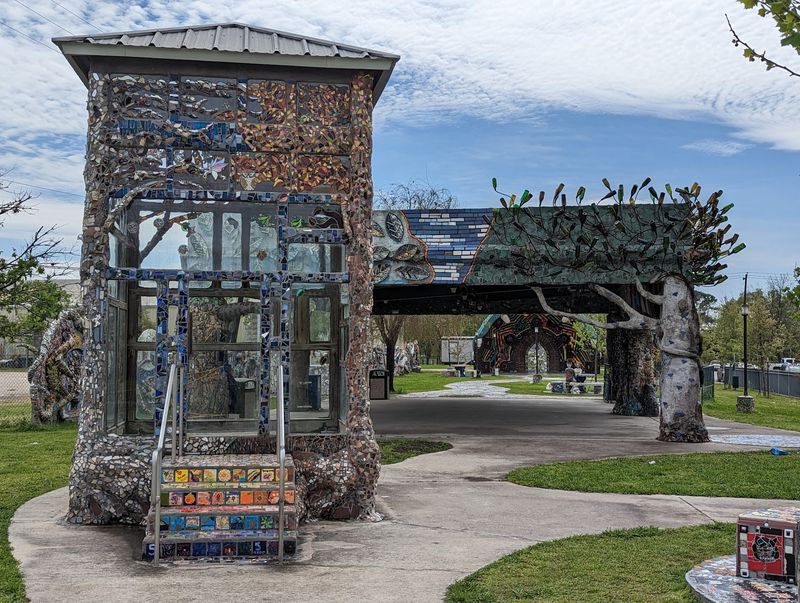
The Memory Wall is the centerpiece, and it runs roughly 400 feet. Over 50 separate panels stretch along its length, each one designed by a different contributor.
Because of that, the wall behaves like a flip book of personalities. A quiet abstract section might sit right beside a panel packed with guitars, kayaks, or invented creatures.
Some panels feel tender. Others are pure whimsy, and a few carry a slightly mysterious mood that visitors often describe as eerie in a charming way.
Colored glass, broken dishes, and found objects cover every inch. There is no blank breathing room, which is exactly why the wall rewards slow walking.
Best approach: walk the full length once without stopping, then double back and pick three or four panels to really study. Trying to absorb all fifty at once turns into visual overload.
Photographers tend to love the wall in late afternoon, when low sun rakes across the textures and every raised edge throws a small shadow.
Families often turn it into a game, hunting for hidden objects hidden into the designs. Little items appear where nobody expects them.
Because the panels were made by so many different people, the wall doubles as a group memoir. Each square becomes a small window into somebody’s interests, memories, or sense of humor.
Standing back at one end, the whole thing reads as a single glittering ribbon. Up close, it splinters into dozens of separate lives.
Chessboards, Light Poles, and the Little Details Nobody Expects
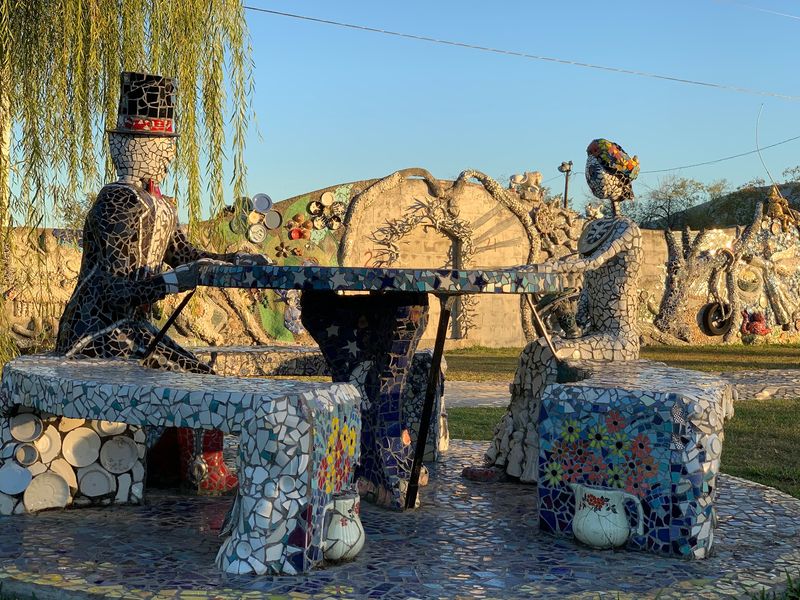
Half the joy hides in the stuff that is easy to miss. Mosaic work does not stop at the big installations, it climbs onto tables, pillars, benches, and even the light poles along the walkways.
Look down. Sections of sidewalk carry colorful fragments too, so the ground counts as part of the artwork.
One picnic table hides a full chessboard built into its surface. Flanking it are characters inspired by Day of the Dead skeletons, cheerful rather than spooky, permanently mid-game.
Bringing a set of chess pieces is a genuinely good idea. Very few parks offer a hand-tiled board under open sky.
Somewhere in the park sits a Little Free Library, a small book box where people leave and take titles. Tossing a paperback in the trunk before visiting is an easy way to contribute.
Scattered benches and tables make picnicking simple, and plenty of visitors treat the park as a lunch spot rather than a quick photo stop.
A quirky detail worth chasing: many visitors approach the mosaics like a scavenger hunt, spotting keys, toys, dice, or animal figures pressed into the designs.
Practical heads-up, since it matters for planning. There are no restrooms on site and no traditional playground equipment, so families usually build a stop into the drive.
The lesson of the whole park lives in these small touches. Beauty ends up in the places nobody thought to decorate.
Free Admission From Sunrise Until Evening
No ticket booth. No entry line.
No membership pitch at the door.
The park welcomes everyone free of charge, and the gates open early. Hours run from 7 AM to 7 PM every day of the week, which leaves room for both sunrise walks and post-work strolls.
That schedule matters more than it sounds. Houston summers punish midday visitors, so early morning is genuinely the smartest window from June through September.
Golden hour is the other sweet spot. Low light makes the mirror and glass pieces glow, and photos taken then look noticeably better than harsh noon shots.
Parking is street-only and limited, spread along the residential blocks nearby. Arriving outside peak weekend hours makes finding a spot much easier.
Since admission costs nothing, the park works beautifully as a spontaneous stop. There is no pressure to squeeze value out of a fee, so a fifteen minute visit feels just as legitimate as two hours.
Accessibility was clearly considered in the layout, with paved walkways connecting most of the structures rather than gravel or grass paths.
Anyone planning a longer stay should pack water. Shade exists under the pavilion and among the taller structures, but Texas humidity does not negotiate.
Questions about hours, events, or volunteer days can go to the Orange Show Center for Visionary Art, which maintains the site and keeps its calendar.
Free public art of this quality is rare anywhere. Treating it gently keeps it that way.
Weekend Energy, Live Music and Craft Tables
Weekends shift the mood entirely. Weekdays lean peaceful, almost meditative, but Saturdays and first Sundays bring people, sound, and activity.
Many Saturdays put artists on site, mixing grout and setting tile while visitors watch. Seeing a blank patch of wall start filling in is oddly satisfying.
Smither Park Sundays happen on the first Sunday of each month, running 1 PM to 5 PM. The lineup typically includes live music, crafting activities for children and adults, and a selection of artisan vendors.
Crafting tables tend to be the surprise hit. Sitting down to make something small, surrounded by walls made the same way, connects the dots quickly.
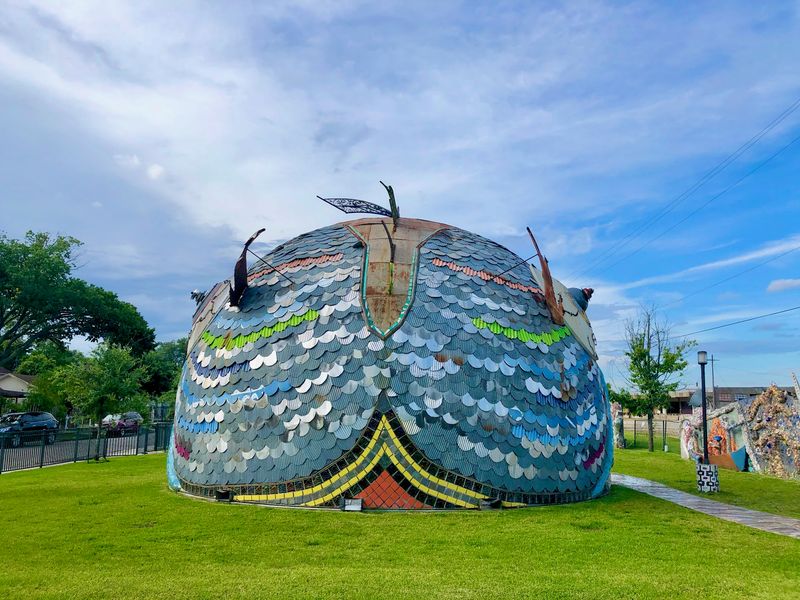
The fish amphitheater earns its keep on these days, since the stage puts performers right in the middle of the mosaic landscape instead of on some separate platform.
Vendor tables offer handmade goods, which suits a park built on craftsmanship rather than mass production.
Anyone hoping for quiet contemplation should aim for a weekday morning instead. Both versions of the park are worth experiencing, they just serve different moods.
Event schedules can shift with weather, so a quick check before driving over is wise.
Houston’s folk art community shows up for these gatherings, and that crowd tends to be chatty, curious, and generous with recommendations for other offbeat spots around town.
Come hungry, since food often factors into these afternoons, and stay for the music.
Why Houston Keeps Sending Visitors to Munger Street
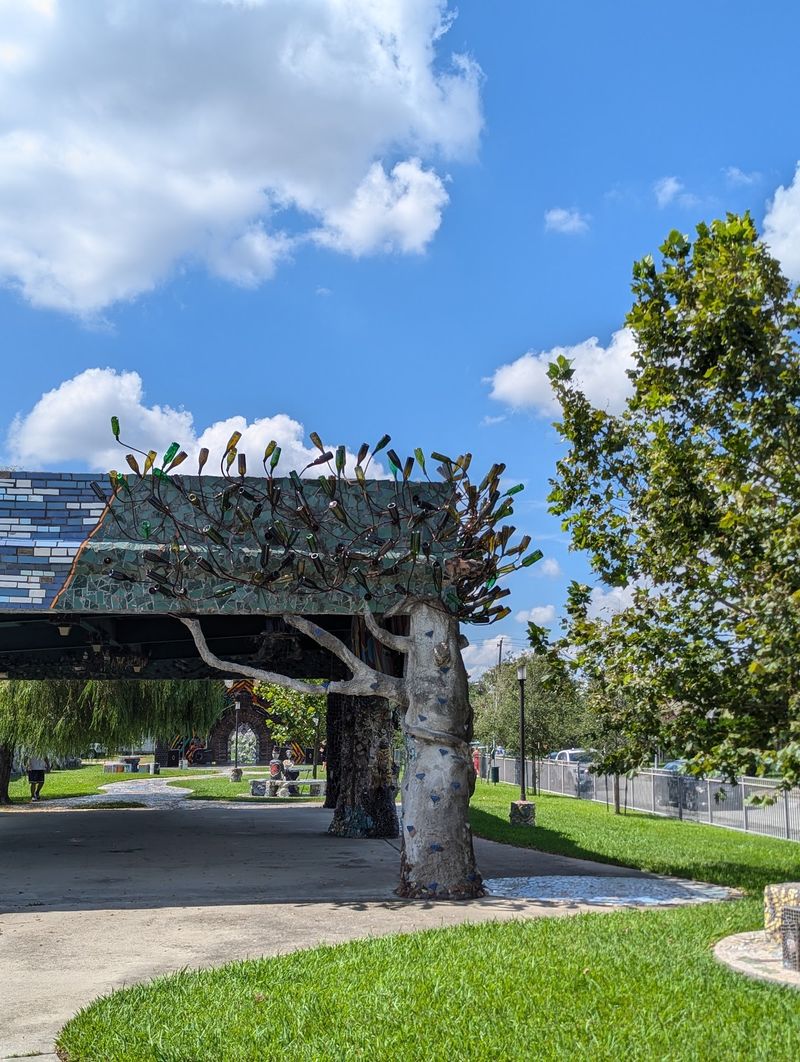
Address first, because this one is easy to drive past: 2441 Munger St, Houston, TX 77023, hidden into the East End near the Orange Show monument.
Locals routinely call it a hidden gem, and visitors describe it as one of the coolest free things in the city. Both labels stick because the place delivers something no museum can.
Photographers love it. Nearly every angle works, and the sheer density of pattern means backgrounds never look boring.
Picnickers love it too. Benches and mosaic tables invite lunch, and the linear layout means finding a semi-private nook is simple.
Pair the visit with the Orange Show monument nearby for a full afternoon of Houston visionary art, though checking that site’s hours first avoids a locked gate.
Expect a compact footprint, on-street parking, no restrooms, and the occasional patched or weathered section. Knowing that in advance keeps expectations right where they should be.
What lingers afterward is less about any single sculpture and more about the idea underneath. Broken things, gathered patiently, can become something people cross a city to see.
Several visitors admit leaving with an urge to tile everything in their own homes. That impulse is a decent measure of success.
Bring a book for the library box, a chess set for the table, and plenty of curiosity for the walls.
Houston has plenty of big attractions. This small one might stay with visitors longest.
