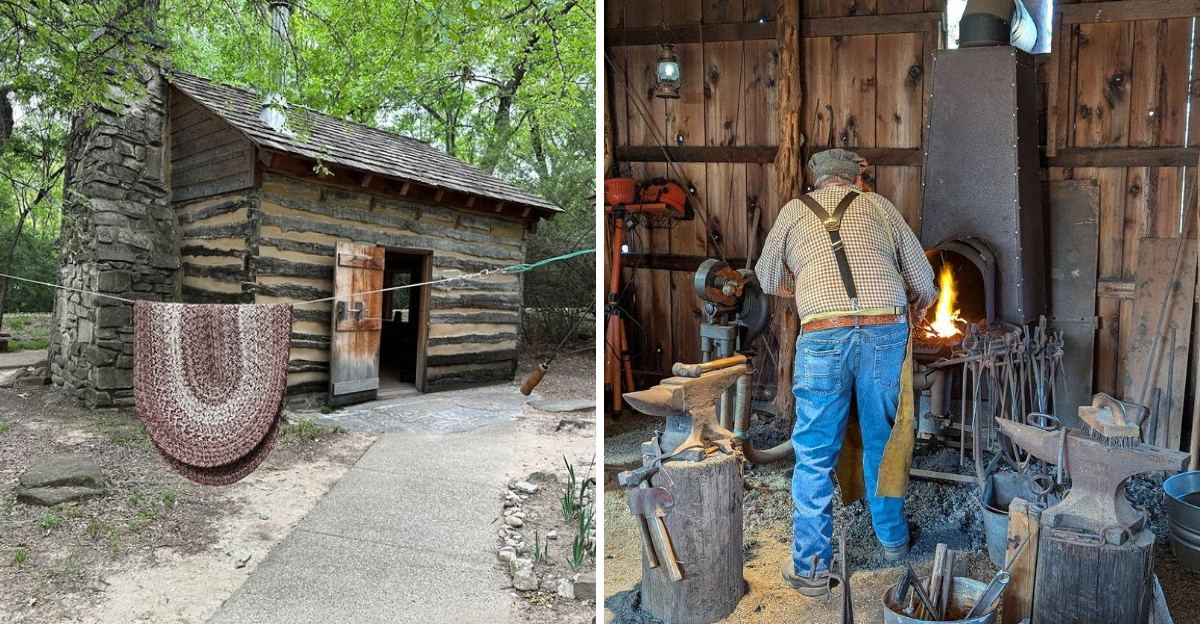
It feels less like visiting a place and more like slipping into a different century for a while.
You walk in and suddenly everything slows down, wood smoke in the air, tools that actually get used, buildings that are not just for show. People are working, crafting, demonstrating, and it all feels lived-in instead of staged.
You catch yourself paying attention to small things, how things were built, how they worked, how much effort went into everyday life. Texas has plenty of history, but this is one of those spots where it actually feels close enough to touch.
The Historic Log Cabins That Started It All
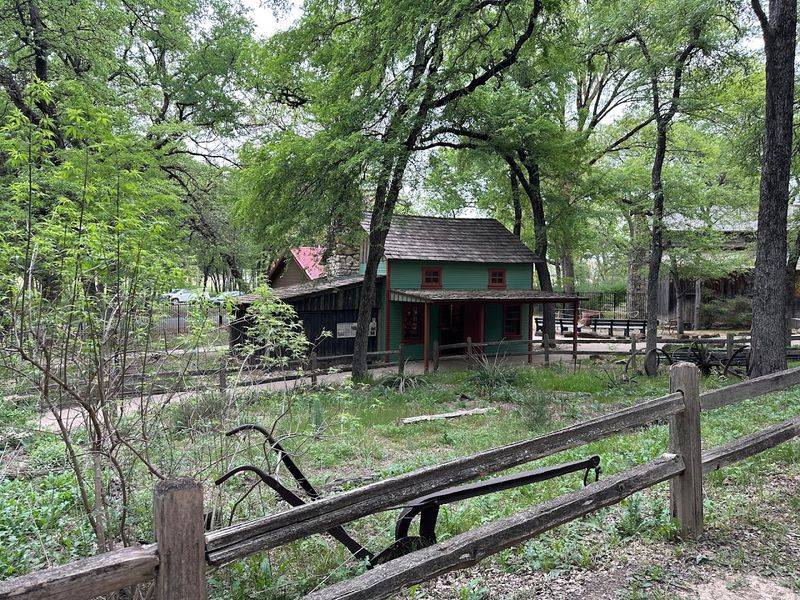
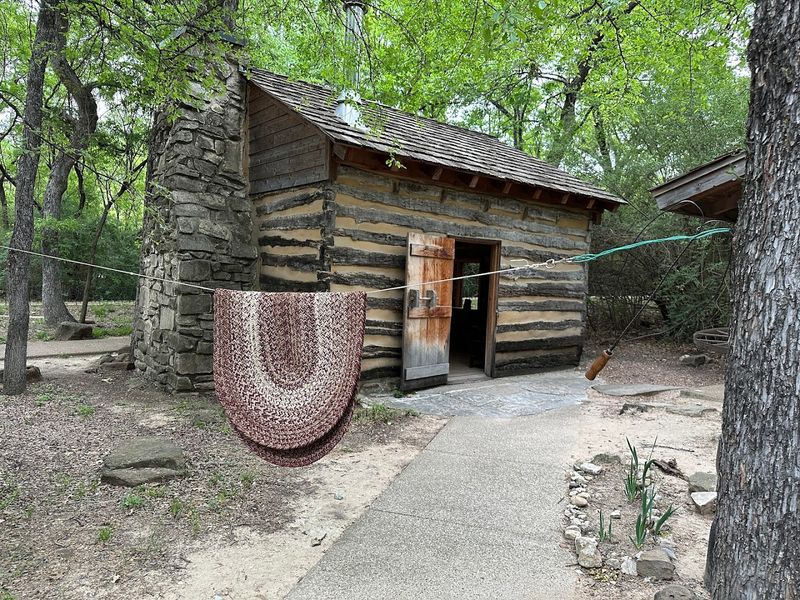
There is a quiet dignity to the log cabins at Log Cabin Village that you notice before you even step inside one. These are not replicas.
Each structure was built by real families in the mid-1800s and later relocated here so they would not be lost forever.
The village opened in 1966 and has been carefully preserving these buildings ever since. Some cabins have just one room.
Others have a loft or a small separate kitchen structure out back, which pioneers built away from the main cabin to reduce fire risk.
Each cabin is furnished with period-accurate items, from cast iron cookware to handmade quilts draped over simple wooden beds. You get a real sense of how compact and intentional frontier living had to be.
There was no space for anything unnecessary.
What makes these cabins so compelling is that they are not frozen in a museum case. You can walk through the doorways, lean in close to examine the tools, and really feel the scale of the rooms.
Small families lived, cooked, slept, and survived in these spaces. That reality is humbling in the best possible way.
A Water-Powered Gristmill That Still Runs
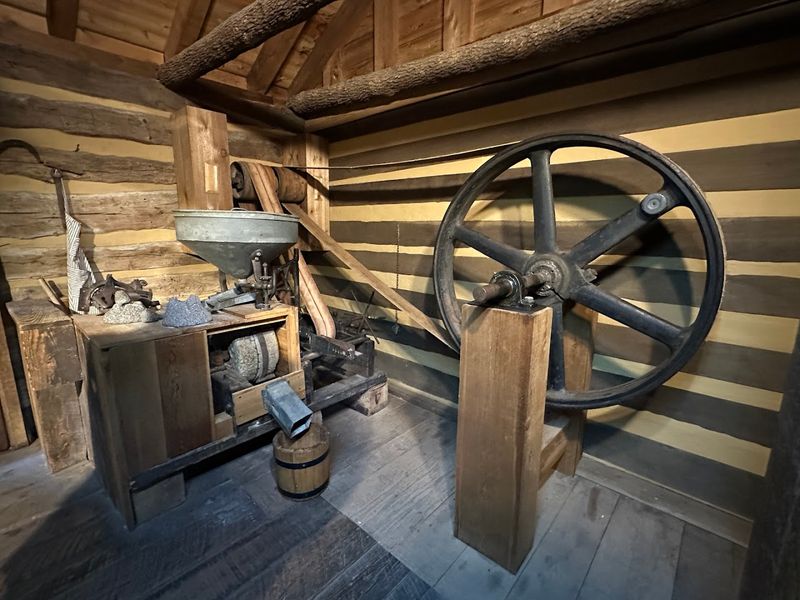
Honestly, the gristmill was the thing that surprised me most. You hear the word “gristmill” and picture something dusty and broken behind a velvet rope.
What you actually find here is a working mill powered by water, still capable of grinding grain the same way it did over a century ago.
The mechanism is fascinating to watch. Water flows through, the wheel turns, and the grinding stones do their work with a low, steady rumble that fills the small structure.
It is loud in a satisfying, mechanical way that no digital exhibit could ever replicate.
For frontier families, a gristmill was not a novelty. It was survival.
Corn had to be ground into meal for bread and porridge, and access to a working mill meant the difference between a family eating well or going hungry through a long winter.
Seeing the actual process in motion makes the history feel immediate rather than distant. Kids especially tend to stop and stare, which is exactly the reaction this place is designed to produce.
It is the kind of exhibit that answers a question you did not know you had about how people actually fed themselves in 19th-century Texas.
The One-Room Schoolhouse and What It Teaches Us Now
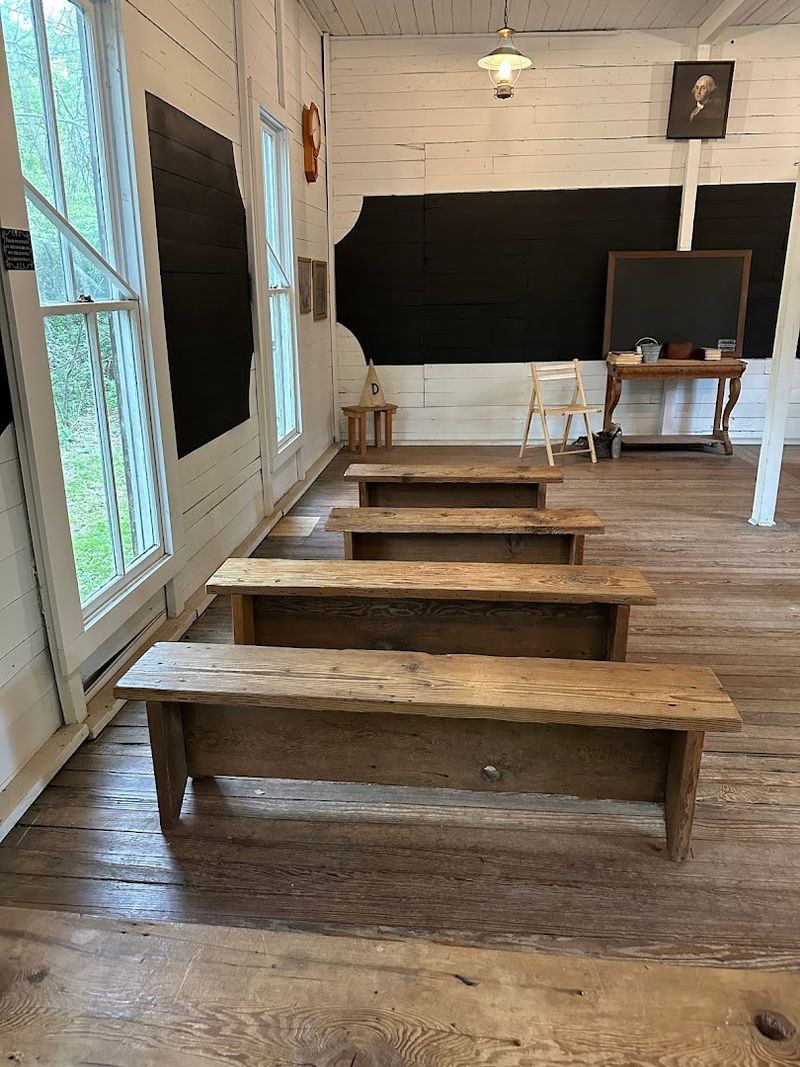
The schoolhouse at Log Cabin Village is small enough that you can see all four walls from any spot inside it. Rows of simple wooden desks face a chalkboard, and a single teacher’s desk sits at the front with an air of quiet authority.
Children of all ages learned together in spaces like this one. A twelve-year-old might sit beside a six-year-old, both working on different lessons while the teacher moved between them.
It required a kind of self-direction that modern classrooms rarely ask of students.
What strikes me about this room is how personal it feels. You can almost picture the chalk dust, hear the recitation of multiplication tables, and imagine the nervous energy of a child who had not finished their work before the teacher arrived.
Education on the frontier was not guaranteed. Families who valued schooling often had to fight for it, building the structure themselves and pooling resources to pay a teacher.
The fact that this building still exists, still looks like it did then, and still holds that specific kind of silence is something worth pausing over. It is a reminder that learning has always been worth the effort it takes to make happen.
The Blacksmith Shop Where Iron Met Fire
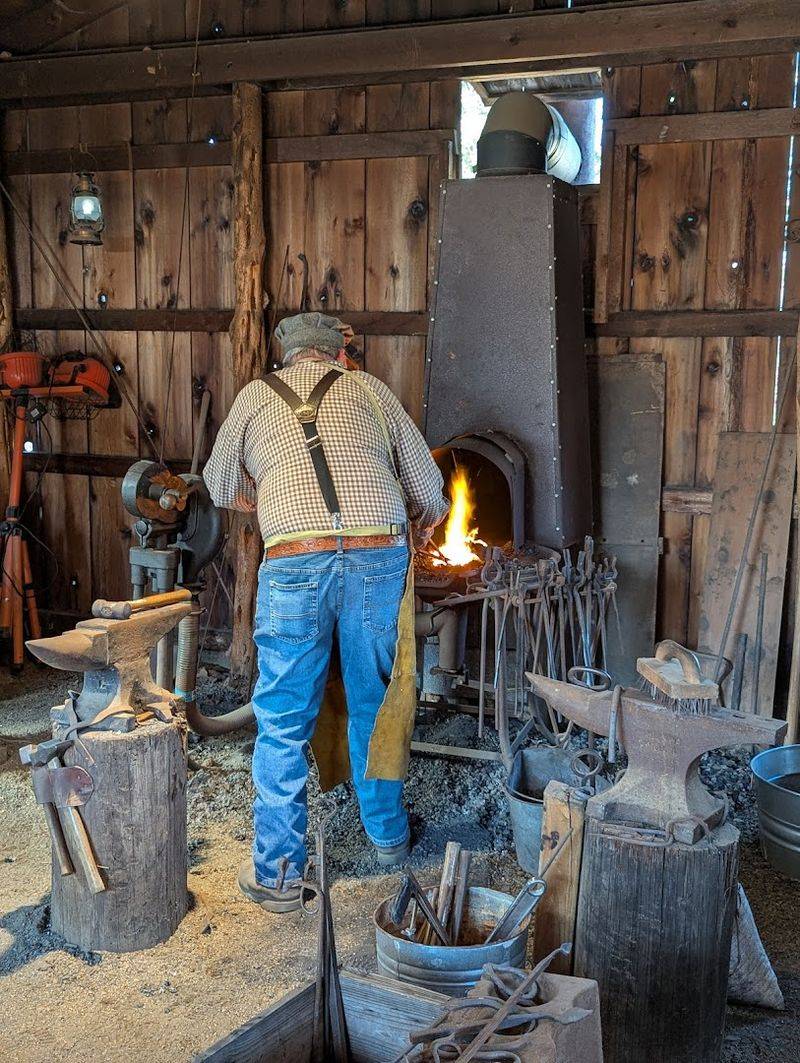
Heat, metal, and the rhythmic clang of a hammer on an anvil, the blacksmith shop is one of the most sensory-rich stops in the entire village. Even on a cool day, you feel the warmth radiating from the forge before you get close.
The blacksmith was one of the most essential people in any frontier settlement. Without someone who could shape iron, there were no tools, no horseshoes, no hardware for doors or wagons.
Everything that required metal had to be made by hand, piece by piece, in a shop much like this one.
Historical interpreters here demonstrate the process in real time, and watching someone shape a piece of iron with nothing but heat and a hammer is genuinely impressive. It takes strength, precision, and a lot of patience.
The finished products look simple until you realize how much skill each one required.
This is one of those spots where you find yourself staying longer than planned. The combination of the physical drama of the forge, the smell of hot metal, and the sound of the work creates an atmosphere that is hard to walk away from quickly.
It is active, real, and completely unlike anything you encounter in a typical museum visit.
Historical Interpreters Bringing the Past to Life
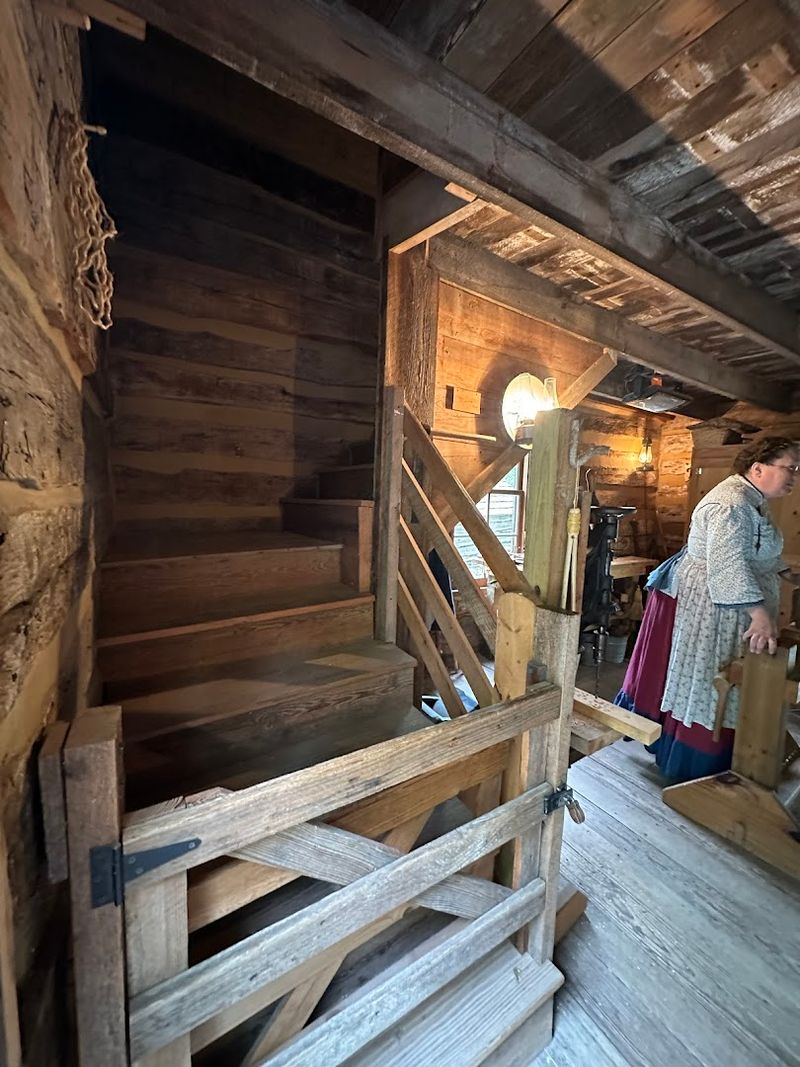
The people in period clothing scattered throughout Log Cabin Village are not just there for atmosphere. They are trained interpreters who know the history of this region deeply and share it through demonstration rather than lecture.
On any given visit, you might catch someone spinning wool into thread, dipping candles by hand, or explaining how a particular herb in the garden was used as medicine. Each demonstration is grounded in what actual frontier families did, not a romanticized version of it.
What makes these interactions work so well is that the interpreters invite questions. There is no velvet rope keeping you at a distance.
You can ask how long it takes to spin a full spool of thread, or what candles were made of before paraffin wax became common, and you will get a real answer with real context.
I found myself genuinely curious in ways I did not anticipate. The demonstrations have a way of reframing everyday objects.
A simple candle stops being a decorative item and becomes an object with a whole production story behind it. That shift in perspective is what living history museums do best, and the interpreters here are clearly skilled at creating it without making you feel like you are in a classroom.
The Herb Garden and Its Frontier Pharmacy Roots
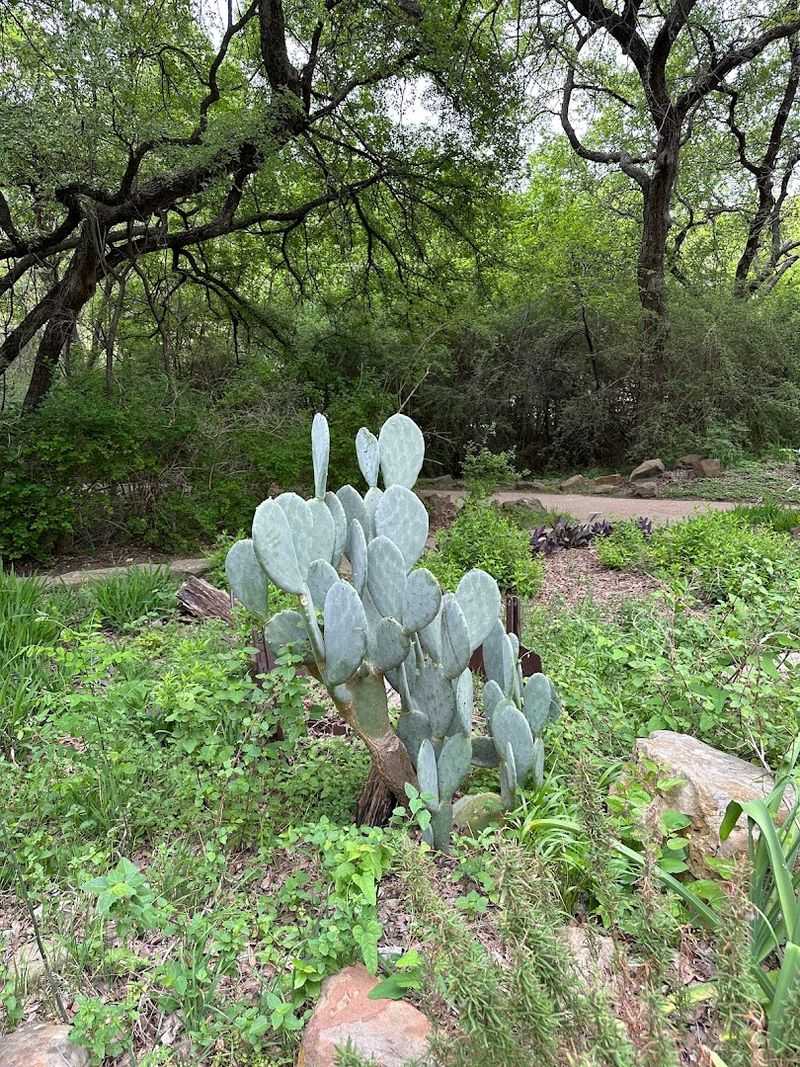
Hidden beside one of the cabins, the herb garden at Log Cabin Village is easy to overlook if you are moving quickly. That would be a mistake.
This small patch of carefully tended plants tells a surprisingly rich story about frontier health and daily survival.
Before pharmacies and doctors were accessible on the Texas frontier, plants were medicine. Families grew herbs not just for cooking but to treat fevers, ease pain, and manage illness with whatever nature provided.
The garden here reflects that practical relationship between people and plants.
Labels identify each plant and explain how it was historically used. Some are familiar, like rosemary and mint.
Others are less well known but were considered essential by 19th-century homesteaders. Reading through them gives you a new appreciation for how observant and resourceful early Texans had to be.
There is something grounding about a garden. Even in the middle of a history tour, slowing down to look at growing things changes the pace of the visit in a good way.
The herb garden is one of those quiet corners of Log Cabin Village that rewards curiosity. It is not the flashiest exhibit, but it lingers in your memory as a reminder of how much knowledge once lived in the soil.
Candle Making and Spinning Demonstrations You Can Try
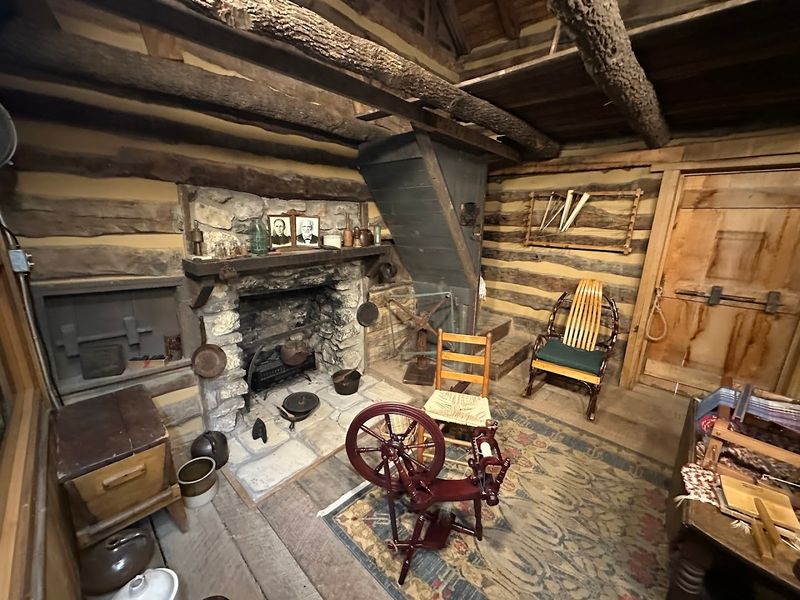
Few things make history feel more immediate than doing it with your own hands. The candle making and spinning demonstrations at Log Cabin Village are not just for watching.
Visitors, especially kids, often get the chance to participate directly.
Dipping a candle sounds simple until you try it. You have to move slowly, let each layer cool just enough, and repeat the process more times than you would expect to build up a usable candle.
Frontier families did this regularly, because without candles, the night was completely dark.
Spinning is its own kind of revelation. Turning raw fiber into thread with a spinning wheel takes coordination and rhythm that takes time to develop.
Even a brief attempt at the wheel gives you enormous respect for the women who did this for hours each day as a matter of household necessity.
These hands-on moments are what separate Log Cabin Village from a standard history exhibit. Reading about pioneer skills is one thing.
Feeling the resistance of the wheel or watching a candle take shape in your hands is something entirely different. The experience sticks with you in a way that a placard on a wall simply cannot replicate.
It is education that actually gets under your skin.
Authentic Artifacts That Tell Personal Stories
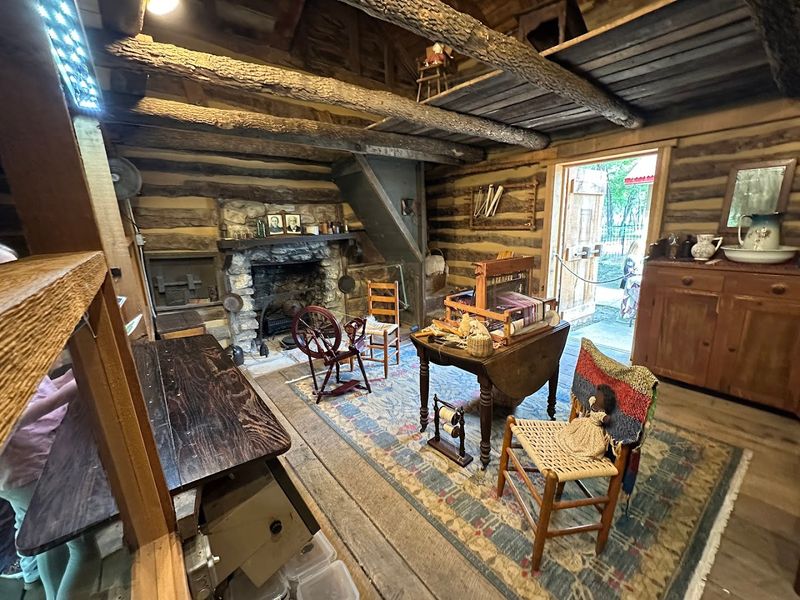
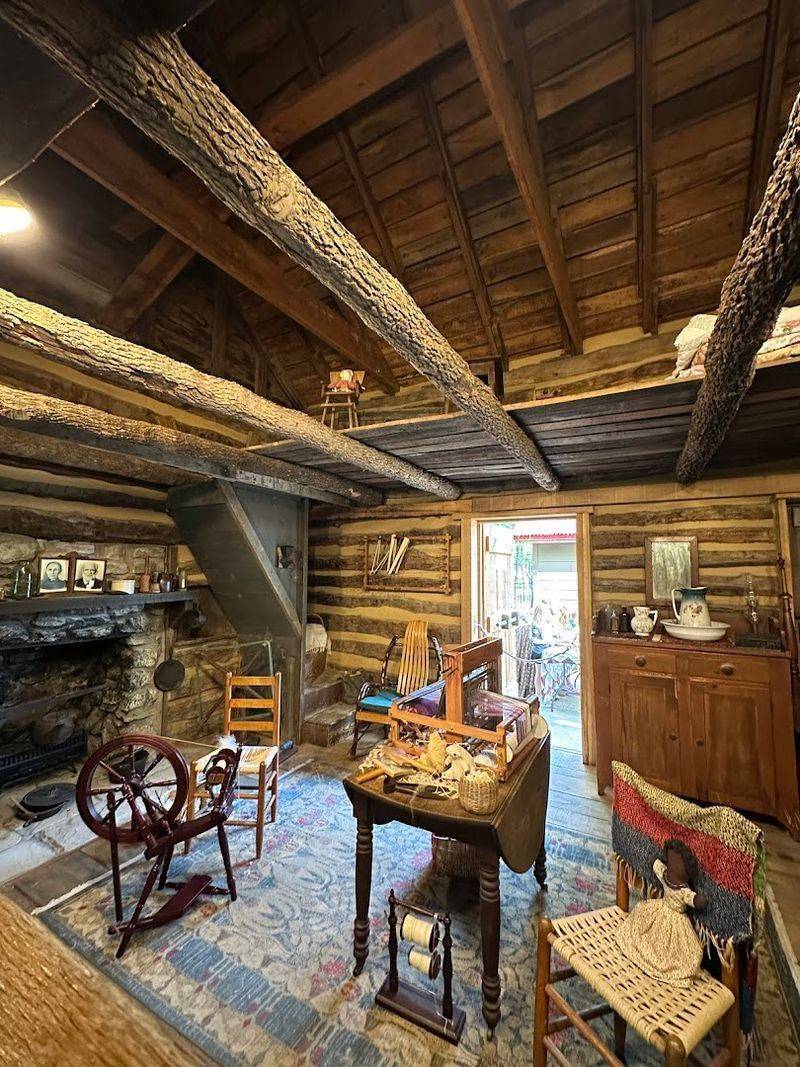
Every object inside the cabins at Log Cabin Village was chosen because it belonged to this time and place. Cast iron pots, hand-stitched quilts, wooden cradles, leather-bound books, and simple clay dishes are arranged as if the family just stepped outside for a moment.
That staging is intentional. The goal is not to display objects behind glass but to let visitors imagine real people using them.
A well-worn quilt on a bed is not just a textile artifact. It is evidence of someone sitting by firelight, stitching together scraps of fabric to keep their family warm through a North Texas winter.
Some items are so familiar in form but so different in context that they stop you in your tracks. A baby cradle made from rough-hewn wood, placed near a stone fireplace, makes you think about what it meant to raise a child on the frontier with none of the safety nets we take for granted today.
The artifact displays work because they are specific rather than generic. These are not stand-ins for pioneer life.
They are pieces of it. That specificity is what gives the village its emotional weight, and it is why visitors often leave feeling connected to people they never could have met.
Educational Programs Designed for School Groups and Families
Log Cabin Village has clearly put serious thought into how it serves younger visitors. The educational programs here go beyond a guided walk through the grounds.
They are structured to connect students directly to the lives of 19th-century Texas families through hands-on activities and guided exploration.
School groups visit regularly, and the programs are designed to align with curriculum goals while still feeling like an adventure rather than an extension of the classroom.
There is a difference between learning about frontier life from a textbook and standing inside the actual cabin where a family of six once lived. This place offers the latter.
Families visiting on weekends will find that the experience translates just as well without a formal program. The interpreters engage children naturally, asking them questions and drawing them into demonstrations.
Kids who come in skeptical tend to leave genuinely interested.
The museum also offers sensory-friendly programming options, which reflects a thoughtful approach to accessibility. History should be available to every kind of learner.
The team here seems to understand that, and it shows in how the programs are structured. Whether your visit is a school field trip or a spontaneous Saturday outing, the experience is designed to leave something lasting behind.
Why Log Cabin Village Belongs on Every Fort Worth Itinerary
Fort Worth has a lot going for it as a destination. The Stockyards, the Kimbell Art Museum, the Botanic Garden, there is no shortage of places worth your time.
Log Cabin Village earns its place on that list not by competing with those attractions but by offering something none of them do.
This is a place where you slow down. There are no flashing screens or audio-visual spectacles.
The experience is built on quiet observation, personal interaction, and the kind of curiosity that gets rewarded when you take your time.
For visitors who have kids, it is one of the most genuinely educational outings available in the city, and the low admission cost makes it accessible for most families. For adults visiting without children, it still holds up as a thoughtful, immersive afternoon.
I left Log Cabin Village with a different feeling about Fort Worth. The city has deep roots, and this village is one of the places where those roots are visible and tangible.
It is the kind of attraction that reminds you history is not just something that happened to other people in other places. It happened right here, in this soil, in these buildings, by the hands of people whose stories are still worth knowing.
Address: 2100 Log Cabin Village Ln, Fort Worth, TX 76109
