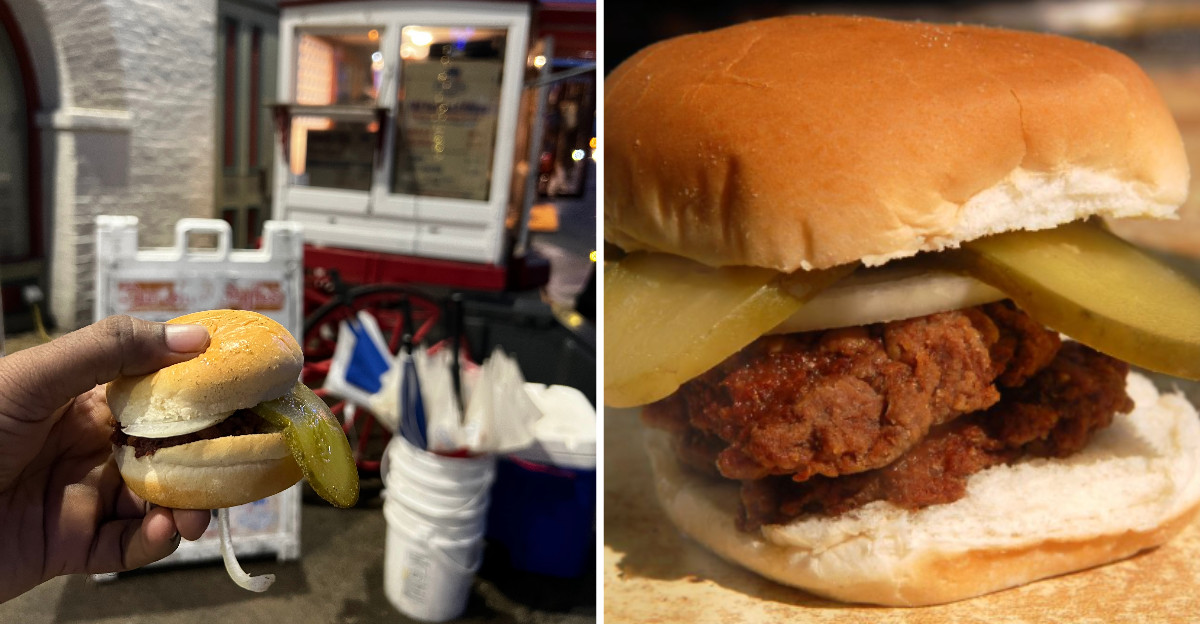
White paint and red wheels mark a little cart parked beside an Ohio building, and the line still forms every morning. Word of it reached me through a friend, who described it as almost too small to be famous.
So a drive was made to see it in person. The smell arrived before the sidewalk did, that warm sizzle of beef in a cast-iron skillet that pulls you forward without asking permission.
What surprised most was the history, because the whole thing started in 1913 when a river flooded the town and a local man began cooking burgers for people who had lost everything. He did not wait for help or permission.
He just fired up a skillet and started feeding his neighbors. More than a century later, the same little wagon still rolls out every morning and the line still forms.
The sliders are small, the onions are cooked into the meat, and the pickles come on the side. Generations of families have made this a Saturday ritual, and nobody seems in a hurry to change a thing.
Leaving with a paper bag of sliders and a real appreciation for how a simple idea can outlast almost everything around it.
The 1913 Flood That Accidentally Created a Legend
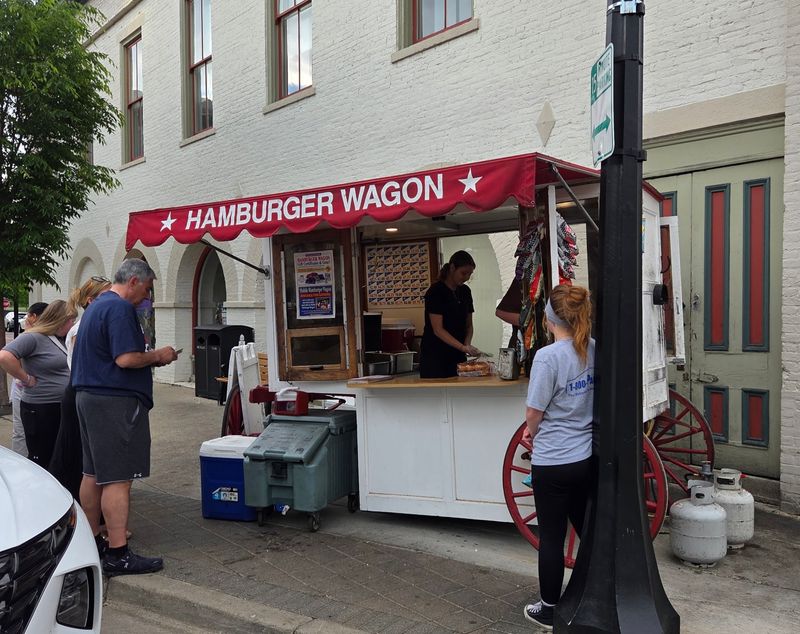
Standing by the wagon, it is easy to forget that the whole story began with water. In March 1913, the Great Miami River overflowed and swallowed much of Miamisburg, leaving families without homes or kitchens.
A Red Cross tent city went up on Mound Hill, and a local man named Sherman Porter, known around town as Cocky, stepped in to help feed everyone there.
He used a family recipe to cook small, hot hamburgers for flood victims and relief workers, and those burgers did something nobody planned. People remembered them.
Once the water drained away and the town started rebuilding, folks kept asking Porter when he was going to make those burgers again.
He gave in and began selling them on Saturdays, which slowly turned into a full-time business at Market Square. That casual weekend habit became one of Ohio’s longest-running food traditions.
I find that part genuinely moving. A disaster that wrecked a town somehow left behind something warm and lasting, and it still smells like frying onions on a Tuesday afternoon.
Knowing the backstory changes how the first bite lands. You are not just eating a slider, you are eating a recipe that once comforted people standing in mud with nothing left.
More than a century later, that connection still feels surprisingly close.
A Cart Small Enough for Two People and Big Enough for a Town
The thing that made me smile first was the size. This is not a restaurant with a dining room, it is a compact white cart with cheerful red wheels tucked alongside a building.
Two employees can work in it, side by side, and that is honestly the limit.
The original wagon was rebuilt in 1980 by Mike Hunter of Miamisburg’s Woodcraft, who followed the first design closely so the look would stay true. That respect for the original shape is part of why the place still feels authentic instead of staged.
Every night the wagon gets rolled away and stored indoors, then wheeled back out the next day like clockwork.
I love that detail. A business that has been running for over a century still gets tucked in each evening, the way you would put away a favorite tool.
Ownership has only changed six times in all those years, and Jack Sperry took over in 2008 with a clear promise to protect the tradition rather than modernize it.
No expansion, no second location with a drive-thru, no sprawling menu boards.
Seeing something that small hold the attention of an entire community says a lot about how much people value consistency. Miamisburg clearly does, and the little wagon keeps earning it every single day it opens.
Sliders Cooked in a Skillet That Never Really Cools Down
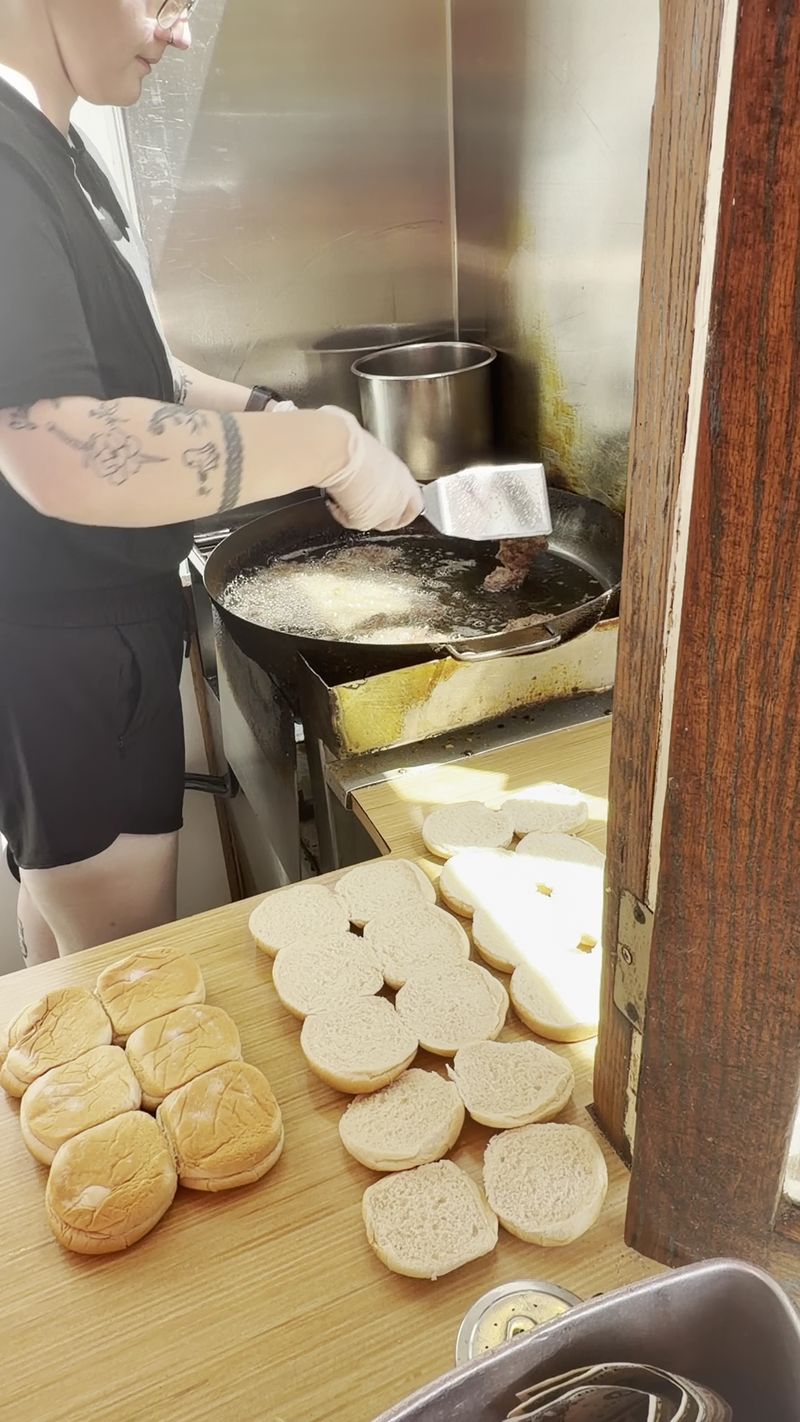
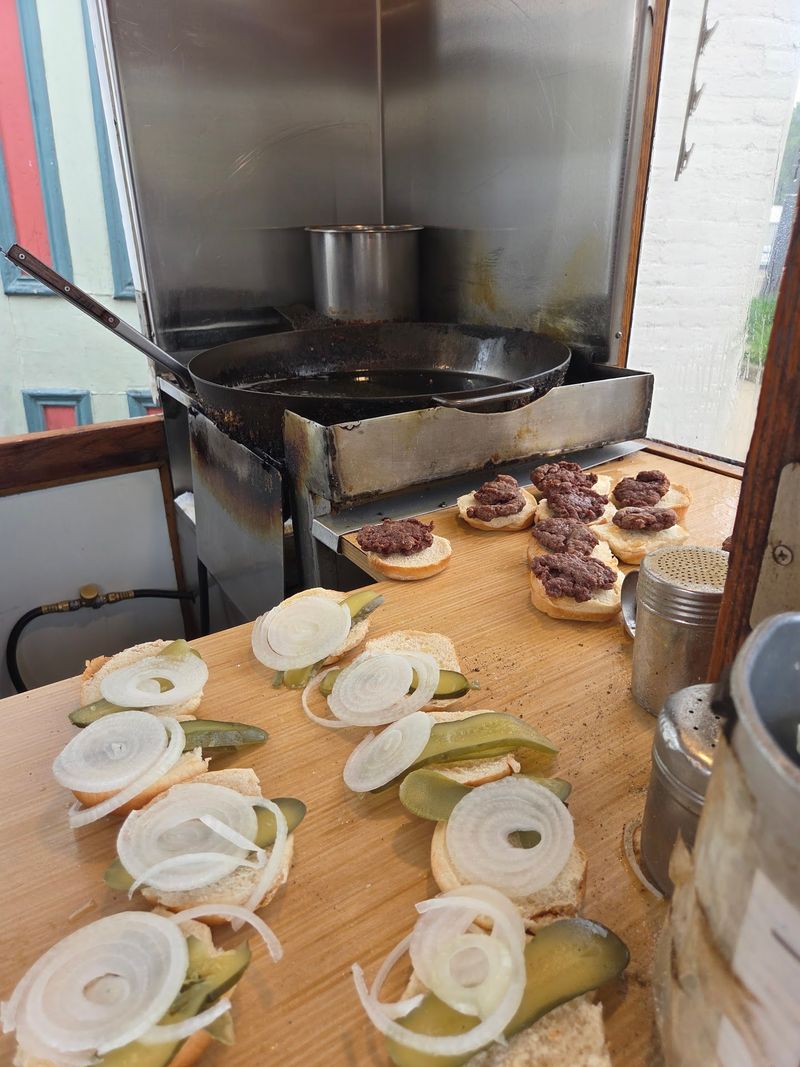
Order here and you get something small, maybe two or three ounces of beef, which sounds modest until you taste it. The patties are flash-fried in a big, well-seasoned cast-iron skillet that works all day long.
They cook in their own accumulating grease, and that skillet keeps building flavor hour after hour.
The result is a thin patty with crispy, lacy edges and a savory bite that does not need help from anything else. Regulars order in handfuls, five or ten at a time, and after one you understand exactly why.
What struck me is how unchanged it all is. The ingredients, the condiments, and the method have stayed the same for over a hundred years, which is almost unheard of in the food world.
Watching the patties hit that hot pan right in front of you is half the fun.
There is no mystery kitchen in the back, no assembly line. You see your food made, bagged, and handed over in a paper sack that gets a little translucent on the way to your car.
I would suggest ordering more than you think you need. They are small, they go fast, and nobody has ever walked back to their car wishing they had bought fewer.
No Stinkin’ Cheeses and No Sloppy Sauces
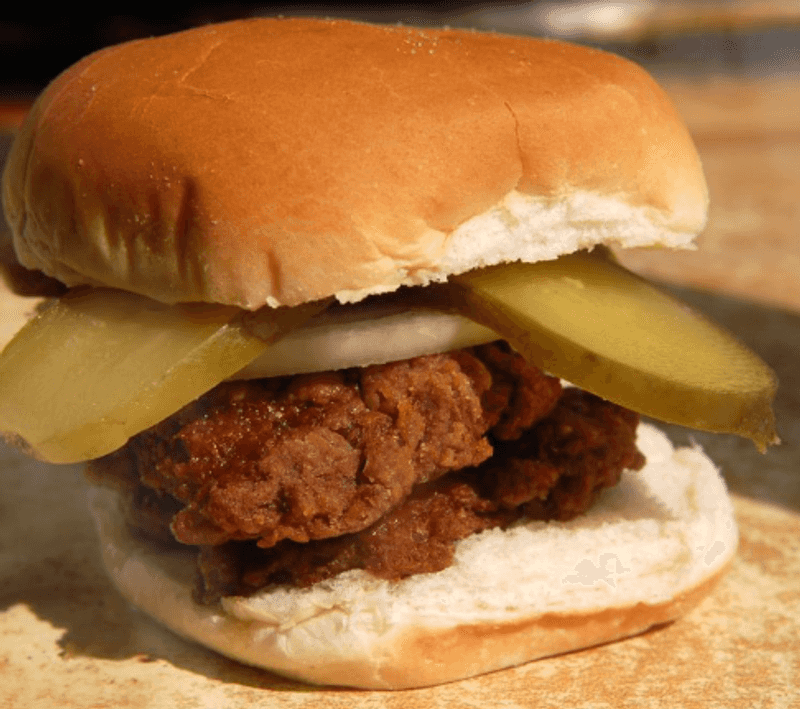
The slogan alone is worth the trip. Owner Jack Sperry coined the line “No stinkin’ cheeses and no sloppy sauces,” and the wagon means it completely.
You pick single or double, and that is your entire decision.
Each burger arrives with thin-sliced fresh onion, one dill pickle slice, and a shake of salt and pepper. No ketchup, no mustard, no mayonnaise, no secret aioli with a clever name.
If you prefer yours plain, you can ask for it without toppings, and that is about as much customizing as the place allows.
Honestly, I found the limited choice refreshing. There is no menu anxiety, no studying a board for five minutes while the line grows behind you.
Beyond the burgers, the only other things sold are bagged chips and bottled drinks.
That is it. A century of resisting the urge to add fries, milkshakes, or a chicken sandwich takes real discipline.
The prices stay friendly too, which is part of why families walk away carrying bags instead of single sandwiches.
Simplicity here is not laziness, it is confidence. When one recipe has worked since 1913, there is not much reason to start experimenting now, and the steady crowd out front seems to agree wholeheartedly.
The Recipe Nobody Will Tell You
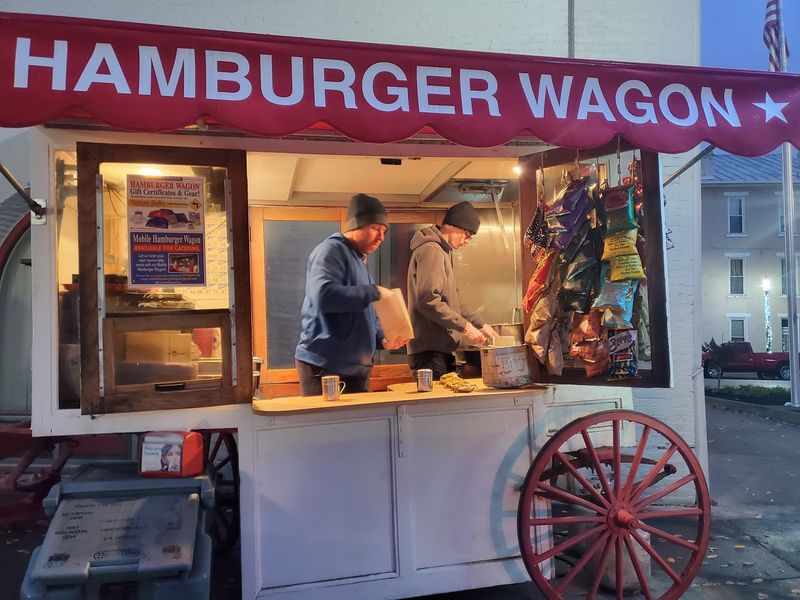
Ask what is in the meat and you will get a friendly smile and absolutely nothing else. The blend of beef and spices behind these patties is a guarded family secret that has survived more than a hundred years.
Some employees are even asked to sign a liability agreement promising not to reveal the formula if they happen to figure it out.
That level of protection is remarkable for a cart the size of a garden shed. Customers have speculated for decades, with some insisting there is sausage mixed in, though nobody outside the operation knows for certain.
Part of me hopes it stays that way forever.
The guessing is half the charm, and every visitor seems to have their own theory. You hear people debating it while they wait, which turns a line into a conversation.
What matters more is the consistency. Whatever goes into that mix has tasted the same for generations, so a grandparent and grandchild can describe the exact same flavor.
Very few foods manage that kind of continuity.
I walked away without a single clue about the seasoning, and strangely, I was fine with it. Some mysteries are better kept in the pan.
Generations Lining Up Down the Sidewalk
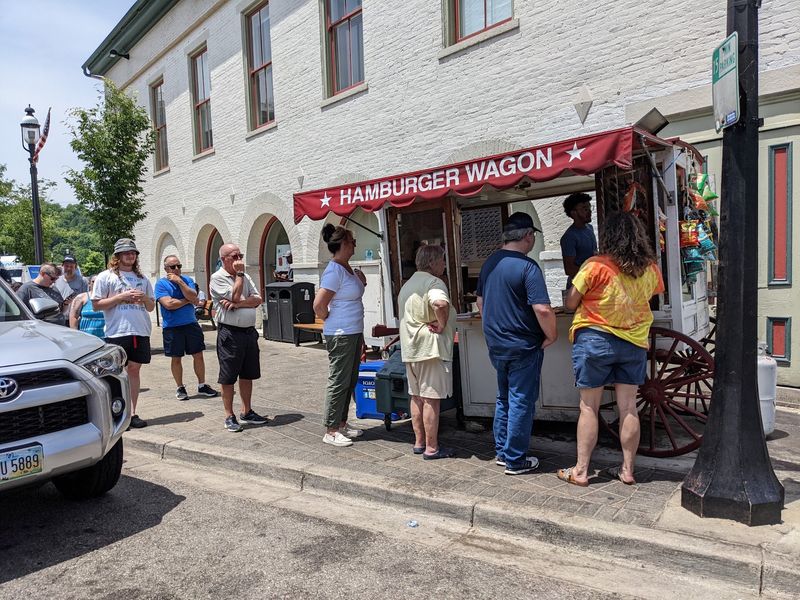
Show up around lunchtime and the line often stretches down the sidewalk, which tells you everything. People are not stopping for one burger, they are buying bags of five or ten to bring home.
On busy days the wagon moves through an enormous number of sliders, and the line keeps moving because the crew has the rhythm down.
Recognition has come from well beyond Ohio. The book “Hamburger America” ranked it among the top 100 burgers in the country, CNN Travel featured it as a classic American burger stop, and it regularly wins Best Hamburger in the Dayton Daily News Best of Dayton contest.
Still, the local loyalty feels like the real prize.
Many regulars are known by name, and families treat a visit as a tradition passed down like a recipe card. Parents who came as kids now bring their own children, pointing at the same little window.
If the wait looks long, hang in there. It moves quicker than it appears, and standing in that line is honestly part of the experience rather than an obstacle to it.
Cash in Hand and a Bench in Historic Downtown
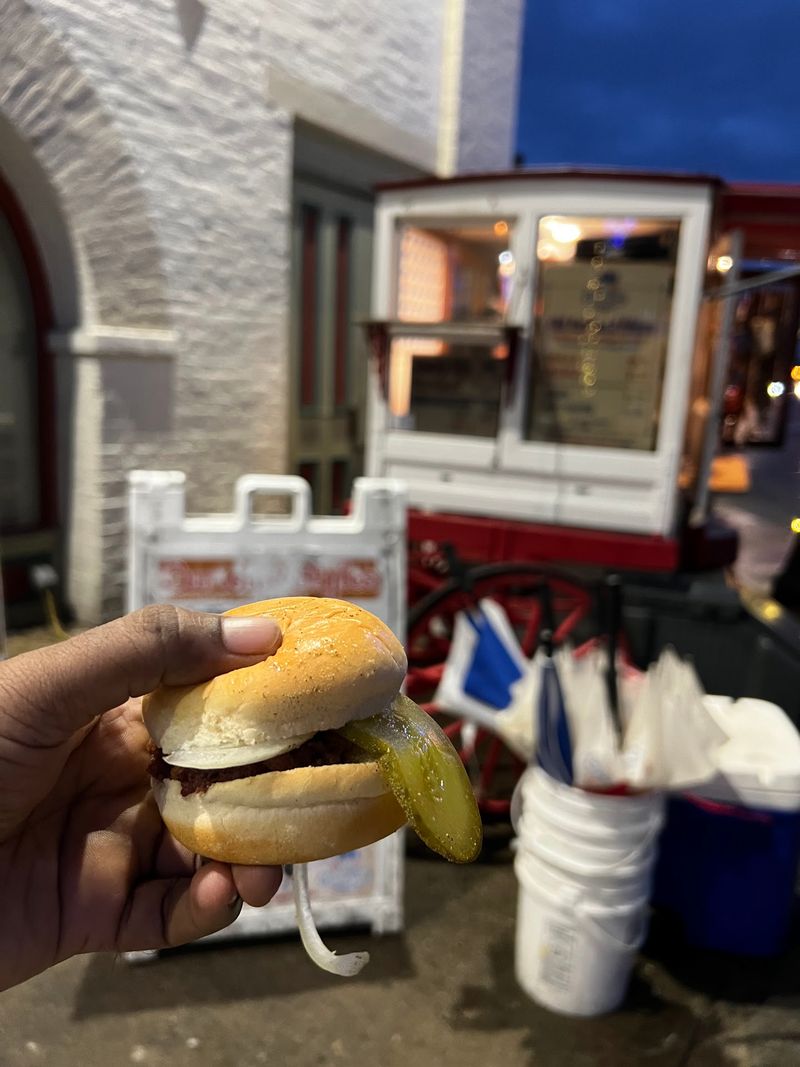
Bring cash. That is the single most useful piece of advice anyone can give you before visiting, because the wagon has always been a cash-only operation and shows no interest in changing.
I saw more than one visitor jog off toward an ATM, so save yourself the detour.
There is no indoor dining room, no tables, no host stand. A couple of benches sit nearby, historic downtown Miamisburg has more scattered around, and plenty of people simply eat in their cars.
The nearby park works nicely on a decent day.
Parking right at the wagon can be tight, but there is a free public lot about two minutes away and free street spaces if you look a block or two out.
Hours run 11 AM to 6 PM, seven days a week, all year long.
Arriving right at opening is a solid trick if you want to skip the heaviest crowd, though mid-afternoon between rushes works well too.
What stayed with me was how unfussy the whole thing feels. You order, you pay, you carry a warm paper bag into the sunshine, and a piece of 1913 tastes exactly the way it always has.
Address: 12 E Central Ave, Miamisburg, Ohio
