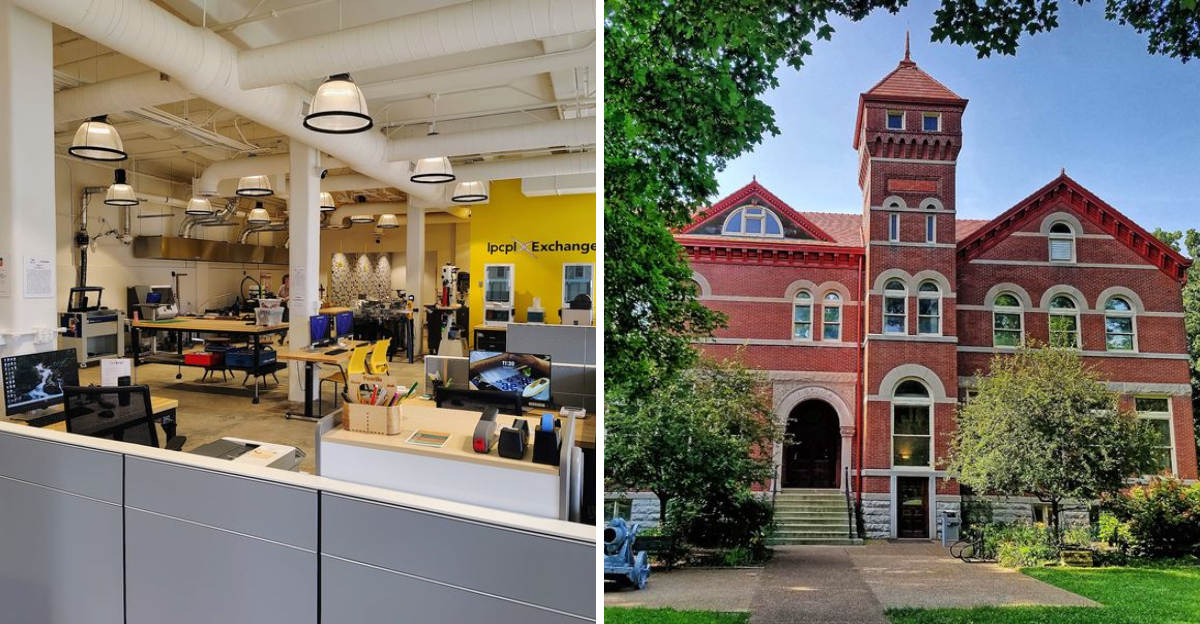
Some weekends start with nothing more than a full tank of gas and a library card tucked in the cupholder. Old reading rooms turn out to be far more dramatic than expected, with painted ceilings, spiral stairs, stained glass, and the smell of paper that has sat quietly for a century.
Along one loop across this state, a Civil War horse skeleton waits on a museum floor, a doughboy statue keeps watch over a park lawn, and a genealogy collection stretches deep enough to trace a family back generations. What makes these ten stops special is simple.
They cost nothing to walk into, sit within an easy two-hour drive, and hide small details most travelers rush right past. This route stitches together river towns, campus corners, and courthouse squares across Indiana.
Pack comfortable shoes, bring some curiosity, and clear space on your phone for photos.
1. Indianapolis Central Library, Where Old Limestone Meets Glass
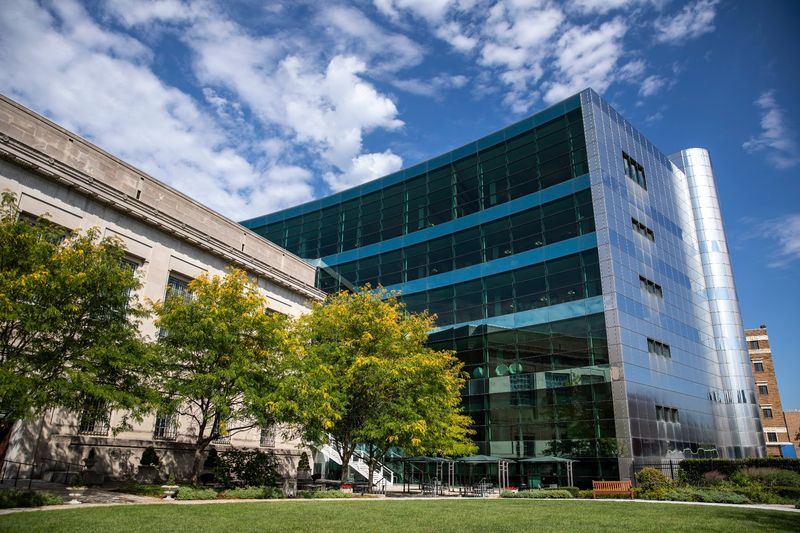
My first stop turned out to be the one that set the bar for everything after it. The original 1917 building wears Indiana limestone over a Vermont marble base, built in a Greek Doric style that looks serious and welcoming at the same time.
The Simon Reading Room is the moment that stops most people mid-step. Its Pompeian style ceiling carries murals of early Indiana history, and two 30-foot bronze chandeliers hang above the tables like something borrowed from a palace.
Then you turn a corner and everything changes. A six-story glass and steel addition opened in 2007, and its atrium ties the century-old rooms to something bright and airy without either side feeling out of place.
Go upstairs. The city skyline spreads out through the glass, and I stood there longer than I meant to, watching traffic crawl below while nobody rushed me along.
Downstairs, the Center for Black Literature and Culture opened in 2017 inside the R.B. Annis West Reading Room.
A full wall mural features figures including Madam C.J. Walker and Maya Angelou, and the space invites you to sit down rather than just look.
Look closely at the walls outside and in. Author names are carved right into the limestone, in both the old building and the newer addition, a small detail that rewards anyone paying attention.
Address: 40 E. St. Clair St., Indianapolis, IN
2. Willard Public Library in Evansville and Its Grey Lady
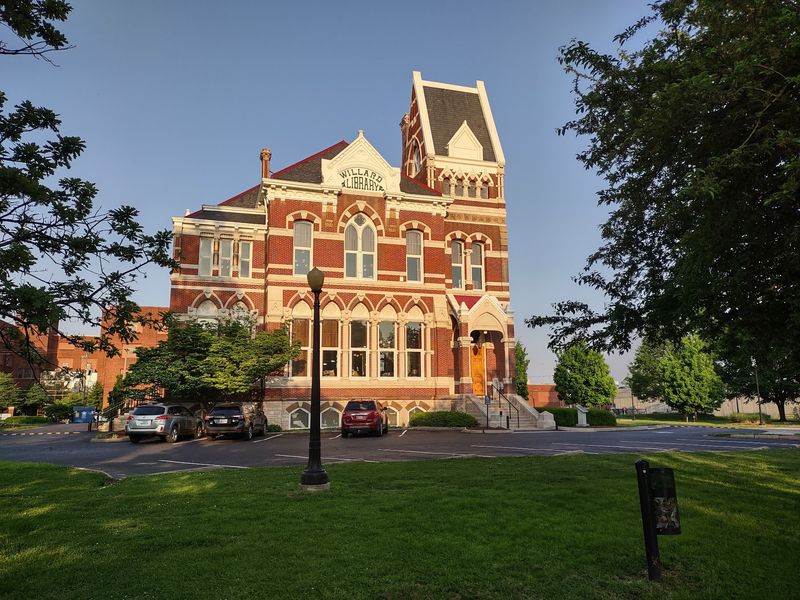
Turrets. Steep roofs.
Pointed windows with tiny stained-glass rose details. Evansville hides a Victorian Gothic building that looks pulled straight from a storybook, and I circled it twice before going in.
Incorporated in 1881 and opened to the public in 1885, it holds the title of Indiana’s oldest continuously operating public library building. Philanthropist Willard Carpenter founded it with the idea that everyone should be welcome inside, which was a bold notion for the late 1800s.
Researchers come here for a reason. The genealogy and local history archives rank among the strongest in the state, and I watched several visitors settle in with folders and notebooks like they had cleared their whole afternoon.
Now for the part everybody asks about. A resident ghost known as the Grey Lady has been reported since the 1930s, and rather than brushing it off, the staff lean into the story with audio ghost tours and cameras running around the clock.
Whether or not you believe a word of it, the atmosphere does the heavy lifting. Wooden floors creak, light filters through colored glass, and the quiet feels older than the shelves.
I left thinking this might be the most photogenic stop on the whole route, and it makes a natural starting point if you are working your way north.
Address: 21 1st Ave., Evansville, IN
3. Indiana State Library and the Stairs of Knowledge
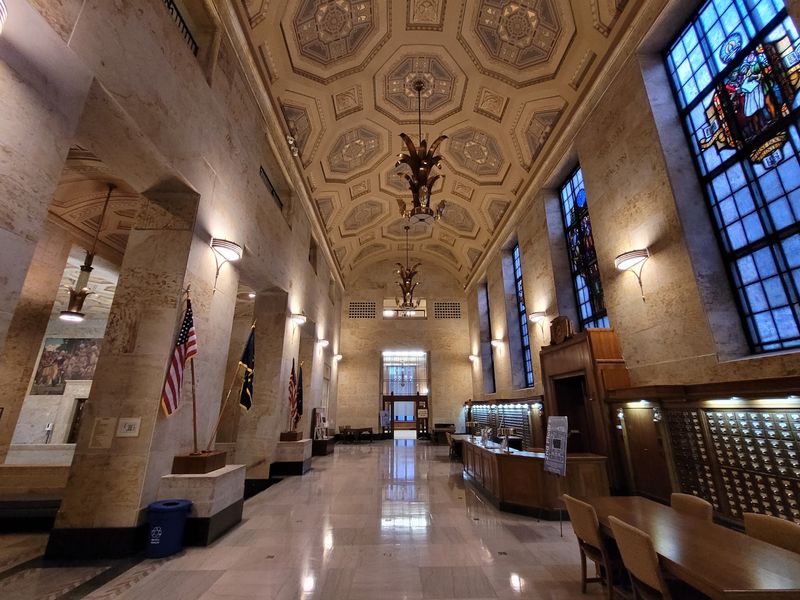
A few blocks from the Statehouse sits a limestone building I had driven past for years without realizing it was open to the public. Dedicated in 1934, it is a striking example of early 1930s American design, Neoclassical revival with quiet Art Deco touches inside and out.
The Great Hall hits you the second you step through the doors. A grand staircase climbs upward, nicknamed the Stairs of Knowledge, and the name fits better than it has any right to.
Details pile up as you wander. Stained glass windows throw color across the floor, hand-painted murals trace Indiana history along the walls, and walnut paneling pairs with brass accents and carved wood.
There is real substance behind the pretty surfaces. A Rare Books and Manuscripts Reading Room sits alongside a deep genealogy collection, which makes this a solid research day if you are chasing family names.
My favorite corner was the least formal one. The Indiana Young Readers Center holds a giant Clifford the Big Red Dog doghouse, and kids crawl inside with books while parents get a rare quiet minute.
Pair it with the Central Library and you have an easy walking day downtown. Two very different buildings, one city, and no admission line to worry about.
Address: 140 N. Senate Ave., Indianapolis, IN 46204
4. Lilly Library at Indiana University, Bloomington
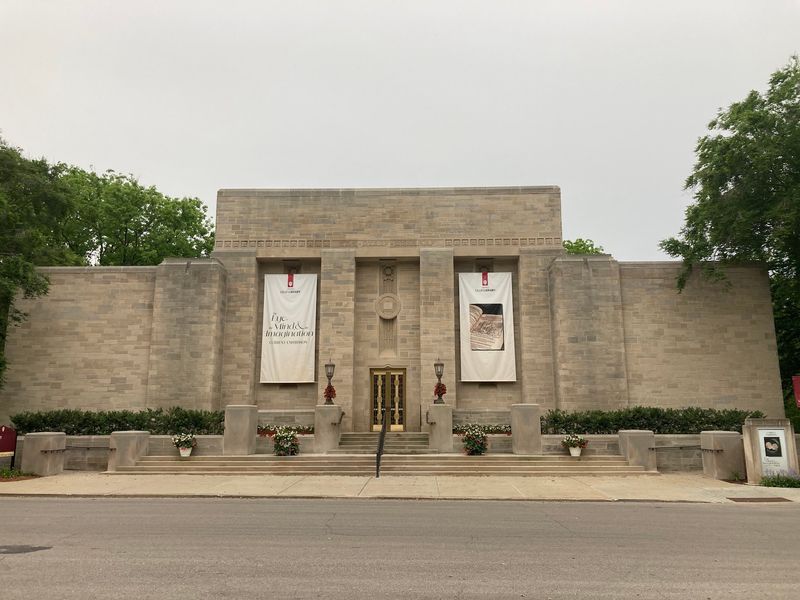
Bloomington surprised me. Tucked into the Indiana University campus is a rare book library with a reputation that stretches well past state lines, and admission costs nothing.
The numbers are almost silly. More than 8.5 million manuscripts, 450,000 books, 60,000 comic books, 16,000 mini books, 35,000 mechanical puzzles, and 150,000 pieces of sheet music live under one roof.
Some items make you lower your voice without being told. A New Testament of the Gutenberg Bible, Shakespeare’s First Folio, and George Washington’s letter accepting the presidency all sit here, along with archives from Orson Welles, Sylvia Plath, and Kurt Vonnegut Jr.
Free guided tours cover the main galleries, classrooms, and Reading Room. I liked the murals by artist Ralph Gilbert most of all, since the color feels unexpected against all those careful glass cases.
Permanent exhibits include the Gutenberg Bible and John James Audubon prints from Birds of America, and the rotating shows give returning visitors a reason to swing back through.
The mechanical puzzle collection is the detail I keep repeating to friends. Somebody decided puzzles belonged beside priceless folios, and honestly, that choice makes the whole place feel more human.
Campus walking is pleasant here, so give yourself extra time to drift between buildings afterward.
Address: 1200 E. Seventh Street, Bloomington, IN 47405-5500
5. Working Men’s Institute, New Harmony
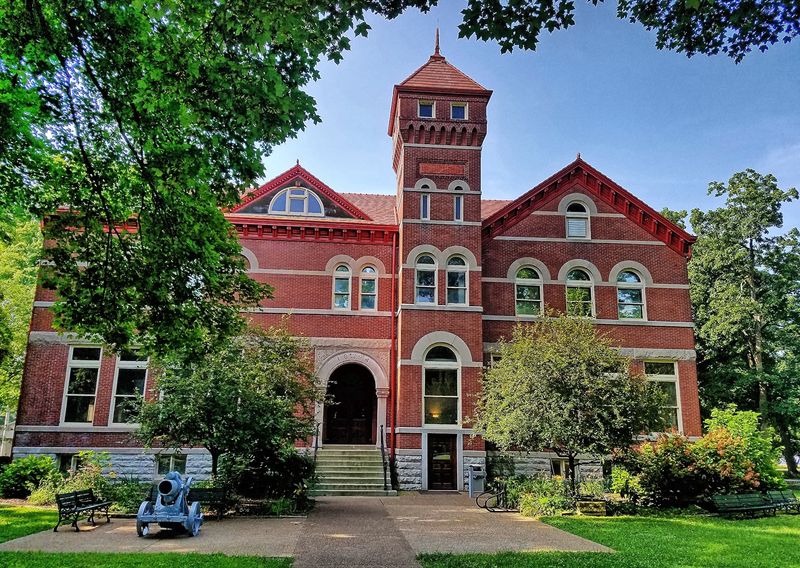
New Harmony moves slowly, and that is exactly the point. The town grew out of a utopian experiment, and its library still carries that ambitious streak.
Established in 1838, it is Indiana’s oldest continuously operating public library, though calling it just a library undersells things badly. It works as library, museum, and archive all at once.
The red brick Romanesque Revival building was completed in 1894, and the second floor is where the day gets strange in the best way. Exhibits include cultural artifacts, natural history specimens, the skeleton of a Civil War horse, and an eight-legged calf.
I did not expect Renaissance art in a small Indiana town. The Murphy Gallery holds reproductions roughly 130 years old, commissioned so ordinary people could see masterworks without crossing an ocean.
Downstairs, the archives hold rare books and papers from the Owenite and Harmonist societies, and scholars travel here from other countries to read them.
Community life still runs through the place, with events keeping the rooms busy. A small garden fountain outside offers what the institute itself calls a Moment of Zen, and I sat beside it long enough to earn the phrase.
If you only pick one stop on this route, this one gives you the most stories per square foot.
Address: 407 Tavern Street, New Harmony, IN 47631
6. LaPorte Public Library, Carnegie Bones and a Makerspace
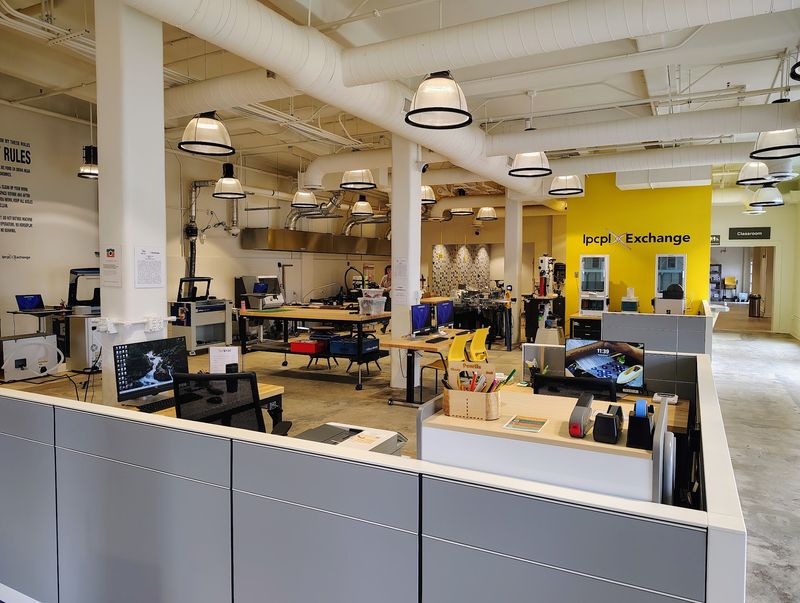
Up in the lake country, LaPorte keeps a Carnegie building that has aged with more flexibility than most. The Neoclassical main branch opened in 1920 holding 30,000 volumes, designed by architect Wilson B.
Parker.
Change came without erasing the past. A major renovation and expansion in 1991, designed by architect William Koster, preserved the original 1920 section and reused restored original brick.
The result reads as classical with a modern twist, and that mix is easy to spot once you know where to look. Old surfaces sit right beside newer ones, and neither apologizes.
What pulled me in was the makerspace. Patrons work with tools including a 3D printer, and hands-on classes cover a range of artisan skills, which is not what I pictured when I walked toward a century-old facade.
Local history buffs have their own reason to visit. The library holds extensive reference material on Belle Gunness, the alleged serial killer who lived in LaPorte around 1900, and the collection draws steady curiosity.
Sunlight through the older windows makes the reading areas feel calm on a weekend morning. I lingered by a table, half reading, half watching people come and go with armloads of books.
An easy detour if you are already heading toward the northern part of the state.
Address: 904 Indiana Avenue, La Porte, IN 46350
7. Monon Public Library, Small Town Carnegie Charm
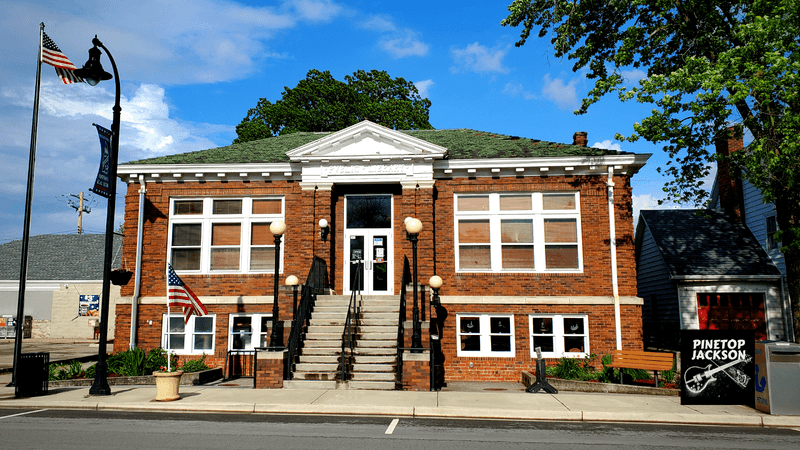
Blink and you might drive past Monon entirely, which would be a shame. The town keeps a picturesque old Carnegie building that still feels genuinely lived in.
A $10,000 grant from the Carnegie Foundation in 1913 paid for the original structure, and the character survived the decades. Inside, original brick walls mark the earliest spaces, and the classic Carnegie stairs remain.
Outside, original gas lights sit near the entrance. Small thing, but I noticed it immediately, and it sets the mood before you even open the door.
Growth arrived in 1994 with an expansion and renovation that more than tripled the size of the building. New front steps, a ground-level entrance, an elevator, and a meeting room made the space usable for everyone.
Technology showed up early here too. In 1997 it became the first automated library in White County, then joined the Evergreen Indiana consortium in 2009, which connects patrons to materials from a wide statewide network.
That combination is what I found charming. A tiny town library with old brick walls quietly plugged into a system that reaches across the whole state.
Stop in on a slow afternoon and the pace of the place will rub off on you. Country roads surround the town, so the drive there is half the reward.
Address: 427 North Market Street, Monon, IN 47959
8. Allen County Public Library in Fort Wayne for Family Roots
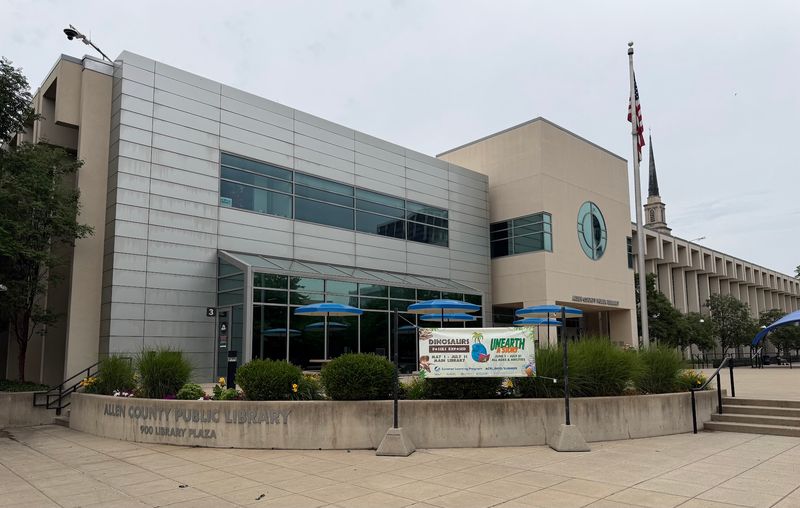
Anybody who has ever wondered about a great-great-grandparent should point the car toward Fort Wayne. The main branch here received a Carnegie grant in 1904 and grew into something genuinely national in scope.
Its Genealogy Center holds the second-largest genealogical collection in the United States and the largest inside any public library. That means over 350,000 printed volumes plus 513,000 items on microfilm and microfiche.
Digital access sits right alongside the paper. Major online subscription databases are available on site, so you can bounce between a scanned record and a bound county history in the same hour.
Researchers worldwide rely on a tool created here. The Periodical Source Index, better known as PERSI, indexes genealogy and local history periodicals from across the United States and Canada by subject.
What impressed me most was the help. Expert genealogists work on the floor, and beginners get real guidance instead of a shrug toward the shelves.
The center occupies a modern facility inside the downtown library, so the surroundings feel bright rather than dusty. Nearby attractions and places to eat make it easy to break up a long research session.
Bring names, dates, and patience. I watched someone find a document they had chased for years, and the look on their face said plenty.
Address: 900 Library Plaza, Fort Wayne, IN 46802
9. Eckhart Public Library in Auburn, Restored and Reopened
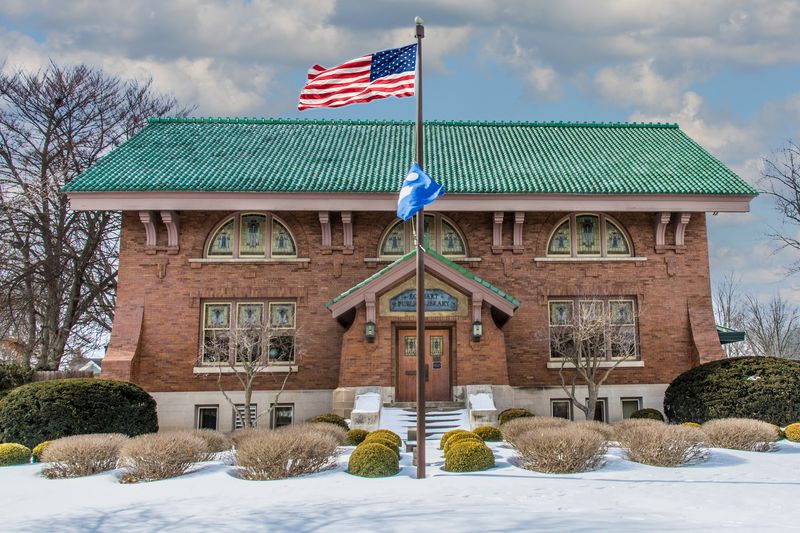
Auburn’s library nearly did not survive, and knowing that changes how you look at it. Built in 1911 and donated by Charles Eckhart, the two-story glazed brick building carries Bungalow and American Craftsman details.
Architecture fans get plenty to study. A gable roof sits above round arched windows, and the raised basement is faced with Bedford limestone.
Out front stands a historic cast iron fountain, a contributing feature that gives the whole property real curb appeal. I took more photos of that fountain than I planned to.
Fire tore through the building in 2017. What followed was a restoration I would call remarkable, since historic artwork, furniture, and shelving were all brought back rather than replaced with something generic.
Modern needs got attention too. The entrance was reconfigured, natural light was brought into the lower level, and the whole layout became more social, inclusive, and easier to move through.
My favorite decision was a small one. The circulation desk was relocated near the historic fireplace, which turns the busiest spot in the building into the coziest.
Auburn itself makes a pleasant weekend base, with walkable streets and northeast Indiana countryside just past town. Come for the building, stay for how comfortable it feels once you are inside.
Address: 603 S. Jackson St., Auburn, IN 46706
10. Attica Public Library, Doughboy Statue and Park Fountains
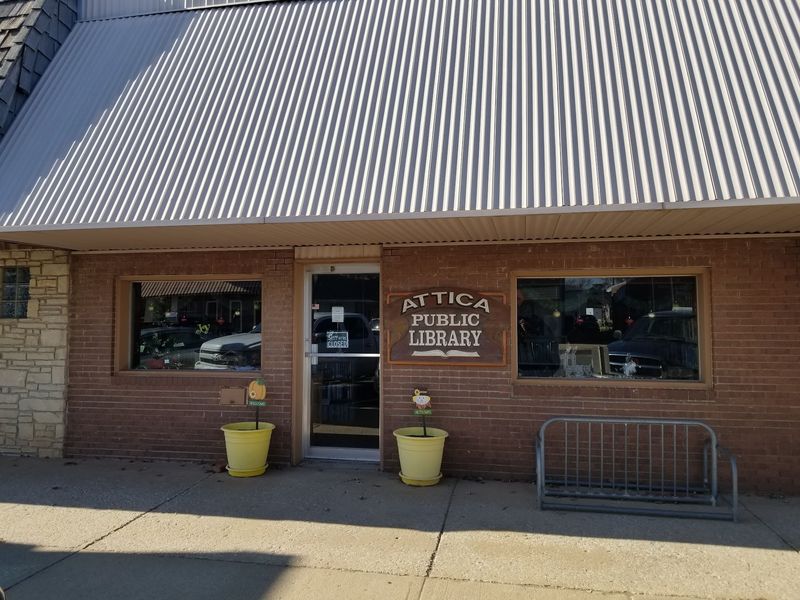
Attica gave me the most unexpected front lawn of the trip. The library sits on Washington Park, land donated for public use back in 1825, and the setting does as much work as the building.
Opened in 1904, it is a Neoclassical Carnegie library built with buff brick, part of Andrew Carnegie’s push to put books within reach of ordinary towns.
Out front, the Doughboy statue draws your eye first. Dedicated in 1927 to honor Fountain County’s World War I veterans, it shares the lawn with two tall Crane fountains.
The building has been updated carefully rather than aggressively. A major interior renovation arrived in 1988, followed by a complementary addition finished in 1995 using similar buff brick.
That brick choice matters more than it sounds. Old and new blend so smoothly that you have to hunt for the seam, and the classic look survived intact.
Practical improvements came with the work, including an accessible entrance and better restrooms, so the place functions for everyone who walks up the path.
Locals clearly treat it as a gathering spot, not just a place to return books. I ended my loop here, sitting on the lawn near the fountains, thinking about how much of Indiana hides in plain sight along small-town main streets.
Address: 305 South Perry St, Attica, IN 47918
