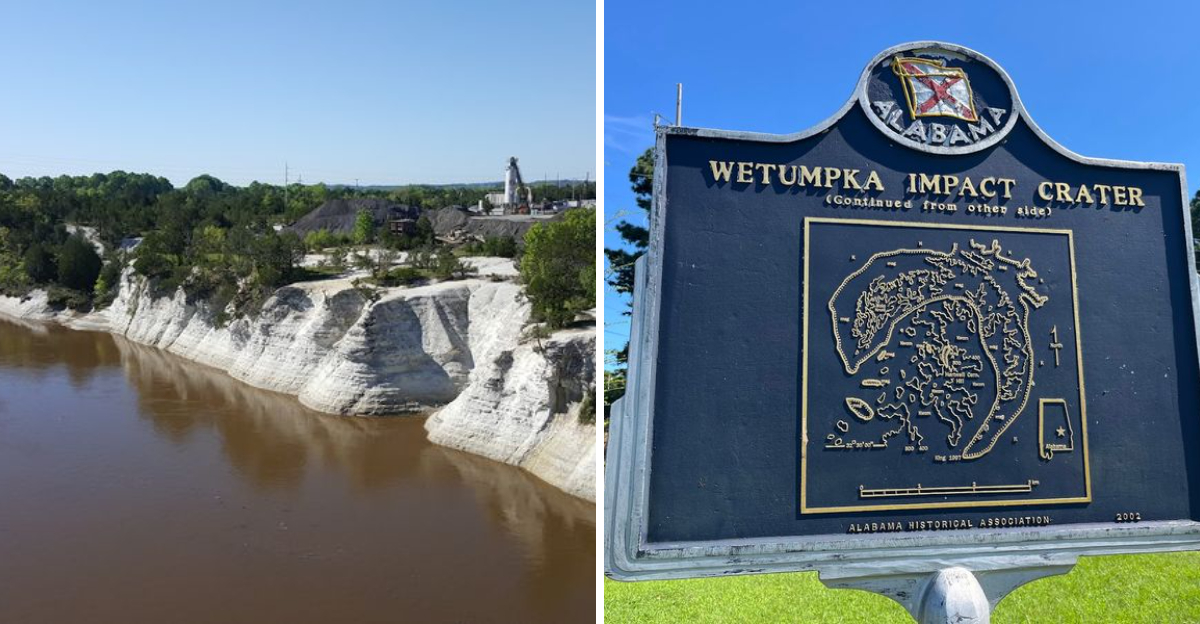
Alabama has a way of surprising people who think they already know what the state looks like. From glowing canyon walls to ancient meteorite craters, the natural and historical wonders here go far beyond what most travel guides bother to mention.
Local traditionalists have been quietly proud of these places for generations, passing down directions and stories like family heirlooms.
Some of these spots feel almost too extraordinary to be real, yet there they are, sitting right in the heart of the Deep South, waiting for anyone curious enough to show up and look around.
Whether you grew up here or are visiting for the first time, these eight places have a way of leaving a mark that sticks with you long after you head home.
1. Dismals Canyon
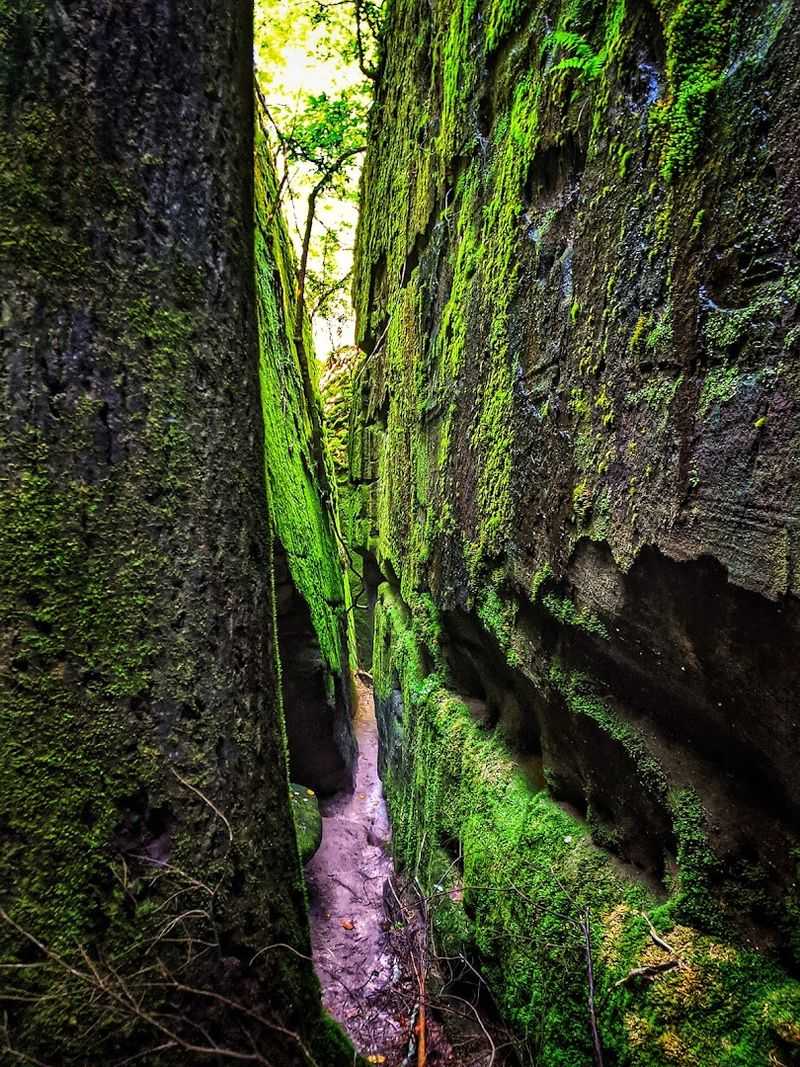
Most people have never heard of a glowing canyon in Alabama, but Dismals Canyon near Phil Campbell makes that very real. This 85-acre sandstone gorge is a National Natural Landmark, and it earns that title without any argument.
Moss-covered walls, winding streams, and layered rock formations make the daytime hike feel like something pulled from a storybook.
What truly sets this place apart is what happens after dark. The canyon walls come alive with “dismalites,” a rare species of bioluminescent glowworms that cast a soft blue-green light across the rock and water.
These tiny creatures exist in only a handful of places on Earth, and Dismals Canyon is one of the most accessible.
Night tours are available for those who want to experience the glow firsthand. Guides walk visitors through the canyon after sunset, and the effect is genuinely hard to describe without sounding like you are exaggerating.
Day hikes are equally rewarding, with ancient rock formations and shaded pools tucked throughout the trails.
The canyon is located at 901 County Road 8, Phil Campbell, AL 35581. A small admission fee covers both entry and trail access.
Nearby, the Bear Creek area offers additional outdoor recreation for families who want to extend the trip. Locals treat this place like a well-kept secret, and once you visit, you will completely understand why they feel so protective of it.
2. Cathedral Caverns State Park
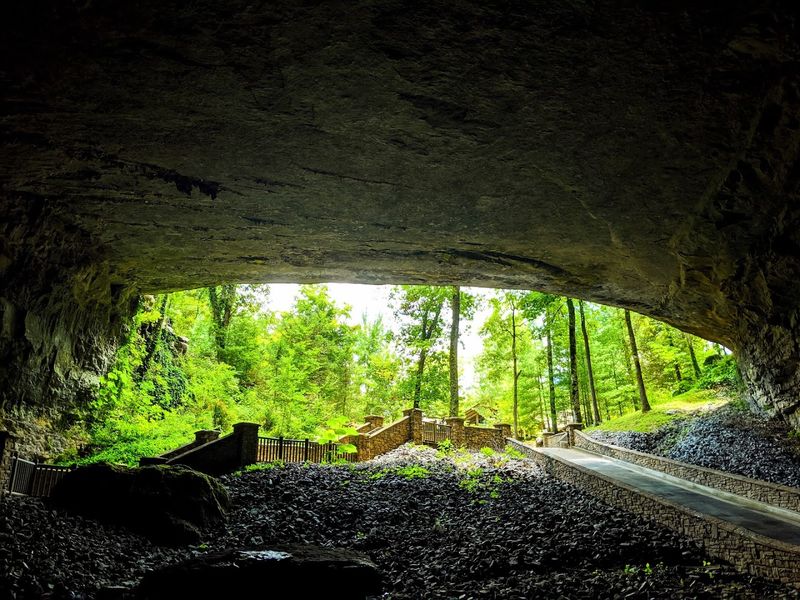
Few natural openings in the world match the sheer scale of Cathedral Caverns State Park near Woodville, Alabama. The entrance alone measures 25 feet high and 126 feet wide, making it one of the largest cave openings anywhere on the planet.
Walking toward it for the first time, the sense of scale hits you before you even step inside.
The interior is just as remarkable. A stalagmite named Goliath rises 45 feet tall with a circumference of 243 feet, making it one of the largest known stalagmites in the world.
A flowstone formation nicknamed the “frozen waterfall” stretches across one section of the cave and genuinely looks like water that stopped mid-motion millions of years ago.
The cave holds a steady temperature of 60 degrees Fahrenheit throughout the year, which makes it a welcome escape during Alabama’s hot summers. Guided tours run regularly and cover the cave’s geology, history, and the stories behind its most dramatic formations.
The park is located at 637 Cave Road, Woodville, AL 35776.
After exploring the cave, the surrounding grounds offer picnic areas and open space to relax. The town of Huntsville is about an hour away and has restaurants and museums worth visiting.
Cathedral Caverns is the kind of place that makes you feel small in the best possible way, and local families have been bringing their kids here for decades with good reason.
3. Little River Canyon National Preserve
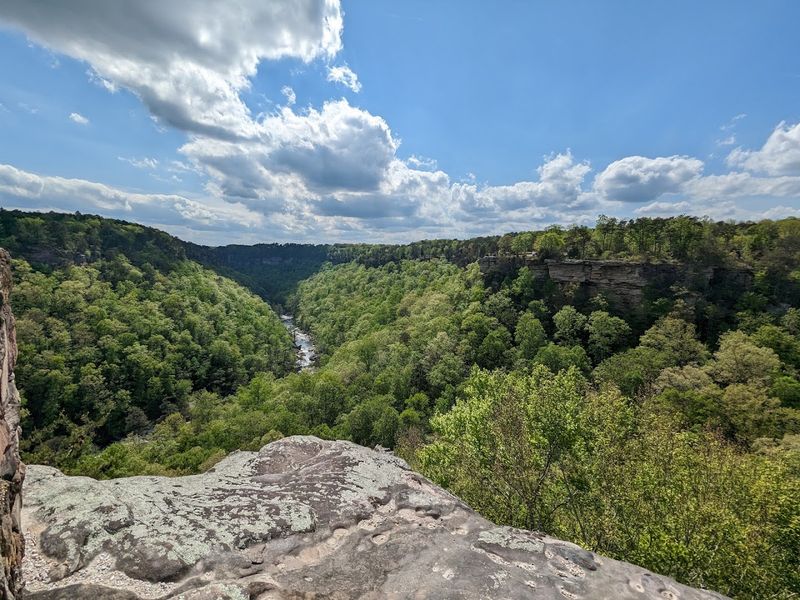
Little River Canyon National Preserve near Fort Payne holds a distinction that surprises most visitors when they first hear it. The Little River is one of the only rivers in the United States that flows almost entirely on top of a mountain rather than through a valley.
That quirk of geography creates a canyon that rivals anything you might expect to find further west.
The canyon itself is one of the deepest east of the Mississippi River, and the overlooks along the rim deliver views that are genuinely breathtaking on clear days. Little River Falls near the main entrance drops 45 feet and is easy to reach from the parking area.
During wetter seasons, Grace’s High Falls plunges 133 feet, earning its place as Alabama’s tallest waterfall.
Hiking, swimming, kayaking, and rock climbing are all popular activities within the preserve. The variety of terrain keeps the experience fresh no matter how many times you visit.
The preserve’s main visitor area is located at 4322 Little River Trail NE, Fort Payne, AL 35967.
The nearby city of Fort Payne has local diners and shops worth exploring after a day on the trails. DeSoto State Park is also close by and shares some of the same ridge terrain with additional campgrounds and trails.
Little River Canyon is the kind of place that locals bring out-of-town guests to when they really want to impress them, and it works every single time.
4. Neversink Pit
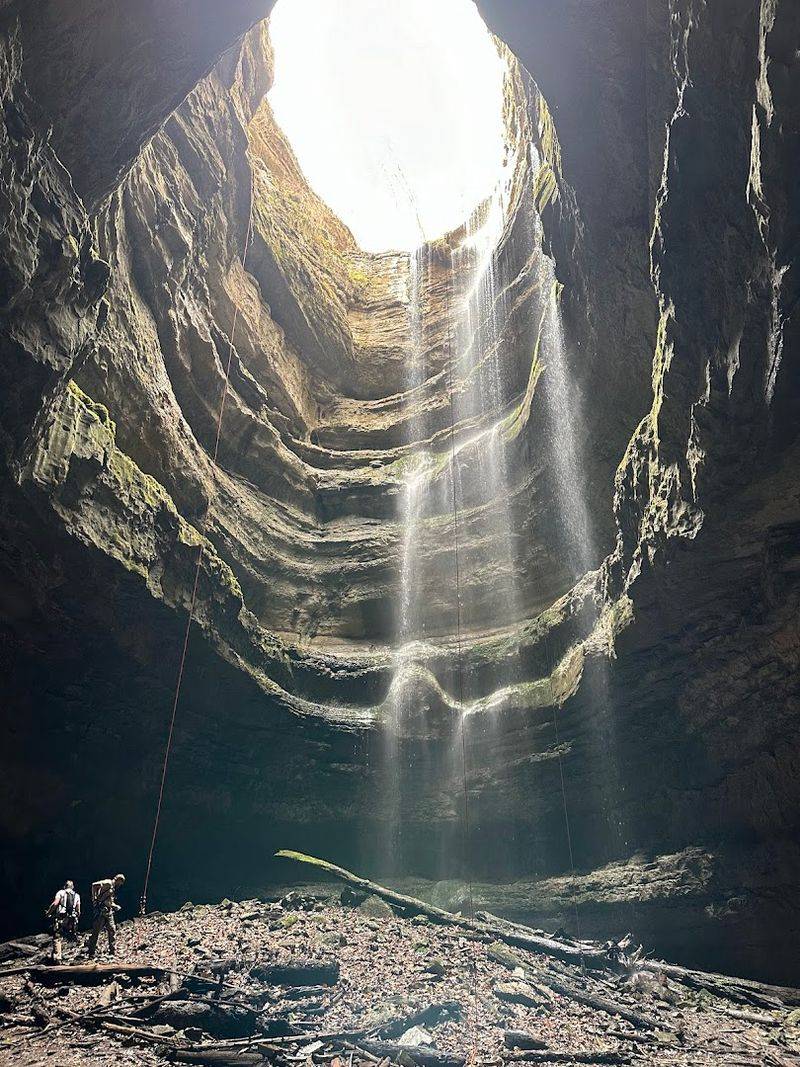
There is something quietly terrifying about standing at the edge of Neversink Pit for the first time. This natural limestone sinkhole near Fackler drops straight down 162 feet, roughly the height of a 16-story building, with no gradual slope to soften the view.
It is one of those places where your brain takes a moment to fully process what your eyes are seeing.
What makes Neversink Pit more than just a dramatic hole in the ground is the life growing inside it. Rare ferns, mosses, and wildflowers blanket the walls in dense green layers, thriving in the humid microclimate created by the pit’s depth.
After heavy rains, thin waterfalls trace down the moss-covered rock in long silver threads, adding movement to an already striking scene.
Photographers and rock climbers have long considered this one of Alabama’s most rewarding destinations. A free permit is required before visiting, which helps protect the fragile ecosystem from overuse.
The pit is located near Fackler in Jackson County, and accessing it involves a short hike through wooded terrain.
The surrounding area in northern Alabama offers additional outdoor attractions, including the Paint Rock River and several natural areas managed by conservation groups. Bringing a wide-angle lens is strongly recommended for photographers hoping to capture the full depth.
Neversink Pit is proof that Alabama’s geological surprises are not all above ground, and this one demands respect from the moment you arrive at its edge.
5. White Cliffs of Epes
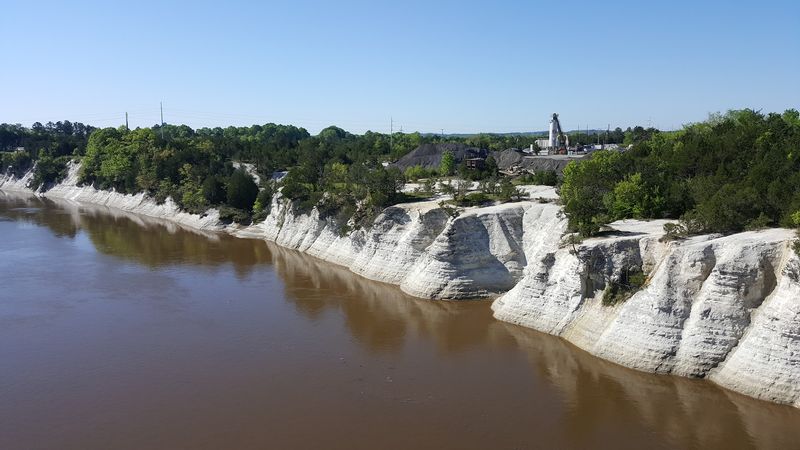
Along a quiet stretch of the Tombigbee River in Sumter County sits one of Alabama’s most unexpected visual surprises. The White Cliffs of Epes rise up to 150 feet high, their pale limestone faces catching sunlight in a way that makes them look almost luminous from a distance.
People who see them for the first time often stop mid-sentence just to stare.
These cliffs formed millions of years ago from compressed seashells deposited beneath an ancient ocean that once covered this part of North America. The calcium carbonate composition gives them that brilliant white color that stands out so sharply against the green riverbanks and blue water below.
On sunny days, the reflection on the river doubles the visual impact in a way that photographs struggle to fully capture.
The cliffs are located near Epes, AL 35460, along the Tombigbee River corridor. Accessing them by boat offers the most dramatic perspective, though some viewpoints are reachable by road.
The area around Epes is quiet and rural, which adds to the feeling that you have stumbled onto something the rest of the world has not discovered yet.
Locals in Sumter County have compared these cliffs to the famous white cliffs along the English coast, and while that comparison might seem bold, it does not feel entirely off once you are standing in front of them.
Nearby Demopolis offers restaurants and the historic Gaineswood mansion for those who want to round out the visit with additional Alabama history.
6. Noccalula Falls Park
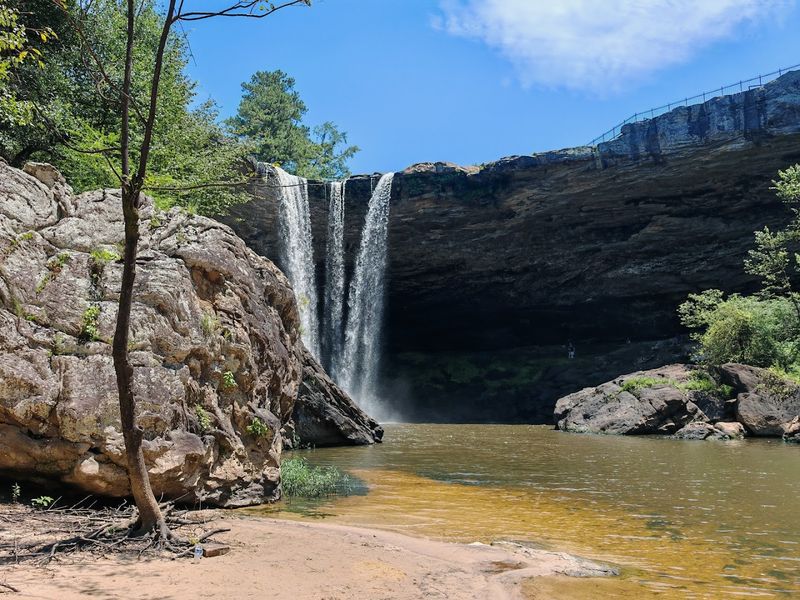
Ninety feet of falling water makes a sound you feel in your chest before you actually hear it. Noccalula Falls Park in Gadsden, Alabama, delivers that experience every single day, and it never gets old no matter how many times you visit.
The waterfall drops into the Black Creek ravine with a force that sends mist drifting across the viewing area on still mornings.
The park covers 250 acres and includes 15 connecting trails that wind through some genuinely varied terrain. Ancient caves, natural rock formations, an aboriginal fort, and a pioneer homestead are all accessible within the trail system, making this far more than just a waterfall destination.
History and geology sit side by side here in a way that rewards curious visitors.
A botanical garden and a small petting zoo are also part of the park, which makes it a strong choice for families with younger children. The canyon walls that frame the falls add a rugged backdrop that photographers consistently describe as one of the most dramatic settings in the state.
The park is located at 1600 Noccalula Road, Gadsden, AL 35904.
Downtown Gadsden is just a short drive away and offers local restaurants and the Gadsden Museum of Art for those looking to extend the day. The falls carry a Cherokee legend tied to a young woman named Noccalula, and interpretive signs throughout the park share that story with visitors.
It is the kind of place that feels layered, with something new to notice on every visit.
7. Natural Bridge of Alabama
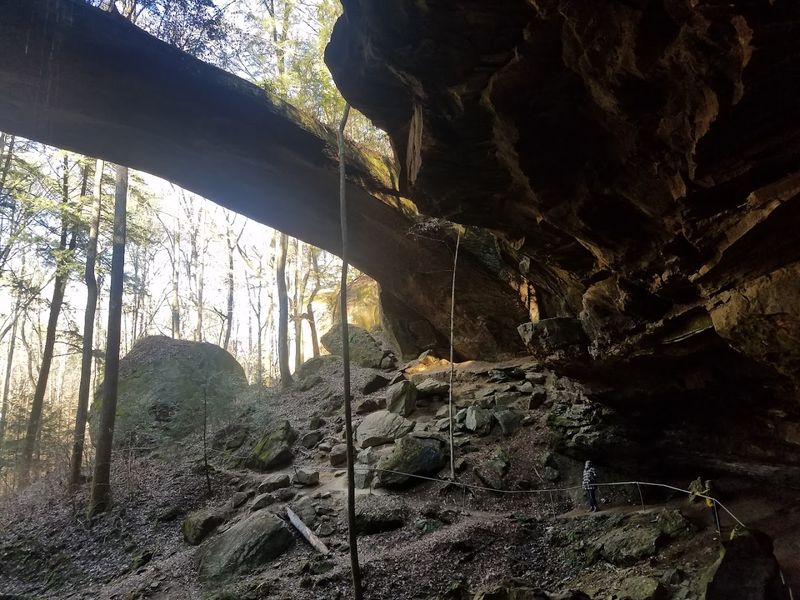
Calling something the longest natural bridge east of the Rocky Mountains is a bold claim, but the Natural Bridge near Haleyville, Alabama, backs it up without any trouble. This sandstone arch stretches 148 feet from end to end and stands 60 feet above the forest floor below it.
The scale is one of those things that photographs suggest but only a visit truly confirms.
Water carved this formation over millions of years, working patiently through layers of sandstone until the arch took shape. The result looks almost architectural, which is part of why visitors often describe it as feeling unreal when they first see it.
The surrounding forest adds to that effect, framing the bridge in green on all sides throughout most of the year.
Visitors can walk across the top of the arch and also explore the area beneath it, where interesting rock formations and shaded ground cover create a completely different perspective. The site is well-maintained and relatively easy to navigate, making it accessible for most age groups.
Natural Bridge is located at 7921 AL-13, Haleyville, AL 35565.
A small admission fee supports the upkeep of the property. The town of Haleyville is nearby for basic amenities, and the surrounding Winston County area has additional natural areas worth exploring for those who enjoy quiet, wooded landscapes.
Local families have been visiting Natural Bridge for generations, treating it as one of those places that never needs much introduction because the bridge speaks entirely for itself.
8. Wetumpka Impact Crater
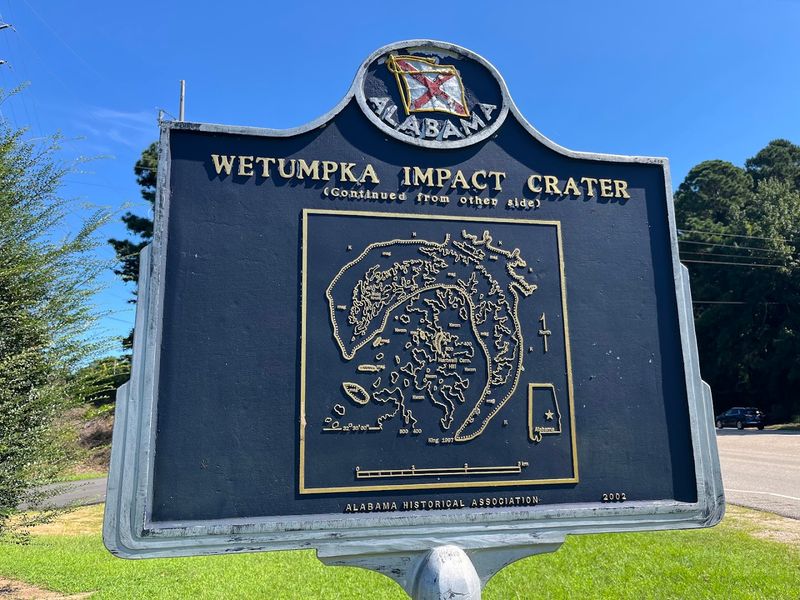
Somewhere around 80 to 83 million years ago, a meteorite slammed into what is now central Alabama and left a mark that is still visible today. The Wetumpka Impact Crater measures five miles wide and stands as one of the few above-ground impact sites in the entire United States.
The city of Wetumpka literally sits inside it, which is a detail that takes a moment to fully absorb.
From ground level, the crater’s rim appears as a gentle semicircle of hills curving around the city. It is subtle enough that many residents spent years living there without fully realizing what those hills actually represent.
Geological surveys and scientific research eventually confirmed what the landscape had been quietly showing all along.
The Wetumpka area has leaned into its cosmic history in recent years, with local signage and educational resources helping visitors understand the site’s significance.
The crater is considered one of only about six confirmed above-ground impact craters in the world, which puts this small Alabama city in remarkably rare geological company.
Downtown Wetumpka is located along the Coosa River at 228 Main Street, Wetumpka, AL 36092.
The Wetumpka Area Chamber of Commerce provides maps and information for visitors interested in exploring the crater’s visible features. Fort Toulouse and the nearby Coosa River area offer additional historical and natural attractions for those spending more than a few hours.
There is something genuinely humbling about standing inside a scar left by a rock from space, and Wetumpka delivers that feeling with zero exaggeration required.
