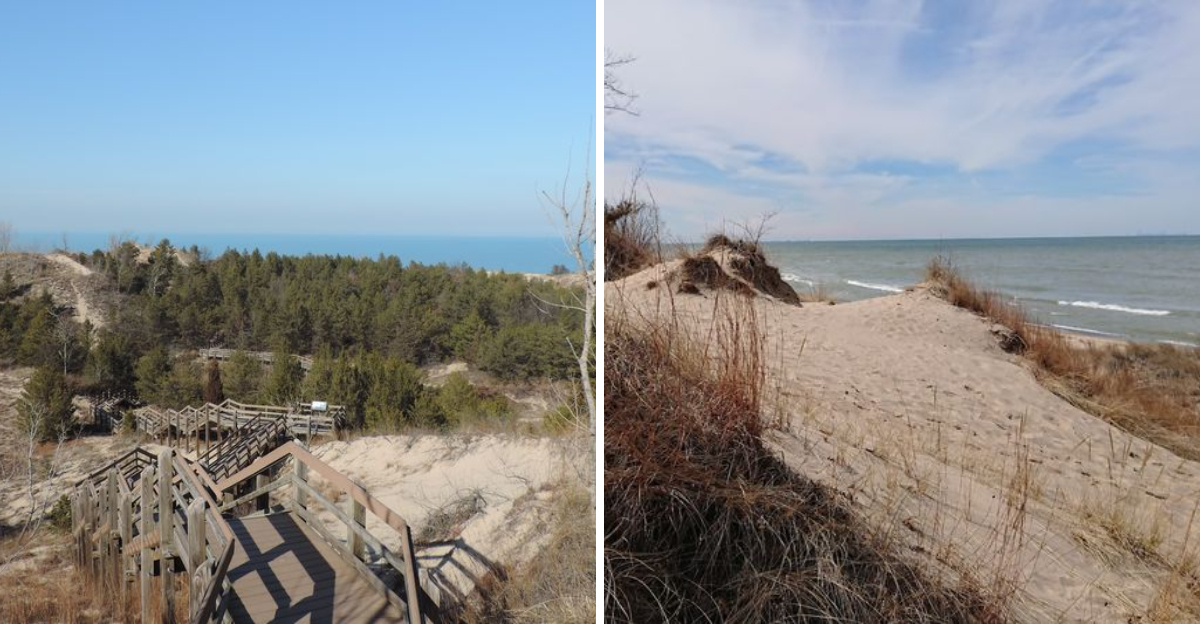
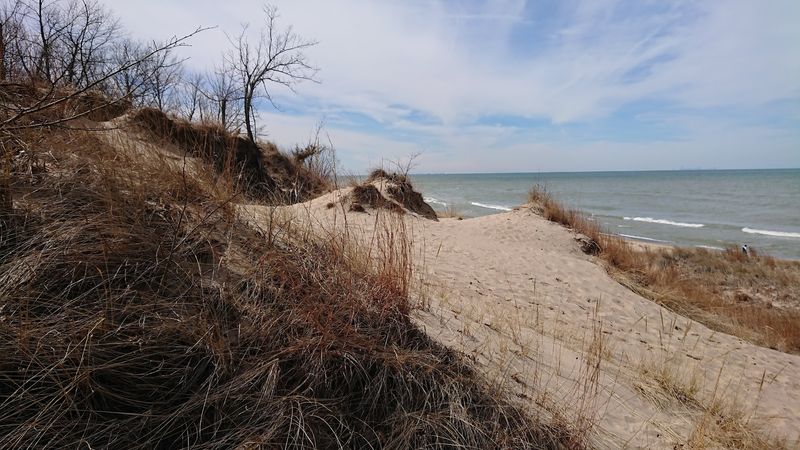
There is something about standing at the edge of a massive sand dune, looking out over Lake Michigan with the Chicago skyline glowing in the distance, that makes you forget you are still in Indiana.
This stretch of trails is one of those places that genuinely surprises people, even lifelong Hoosiers who thought they had already seen everything the state has to offer.
The landscape shifts constantly as you move through it, from soft sand climbs to wooded paths and open shoreline views. One of the most memorable challenges is a steep stair climb that tests your legs before rewarding you with wide, sweeping scenery that feels far bigger than expected.
The 270-Step Stair Climb That Changes Everything
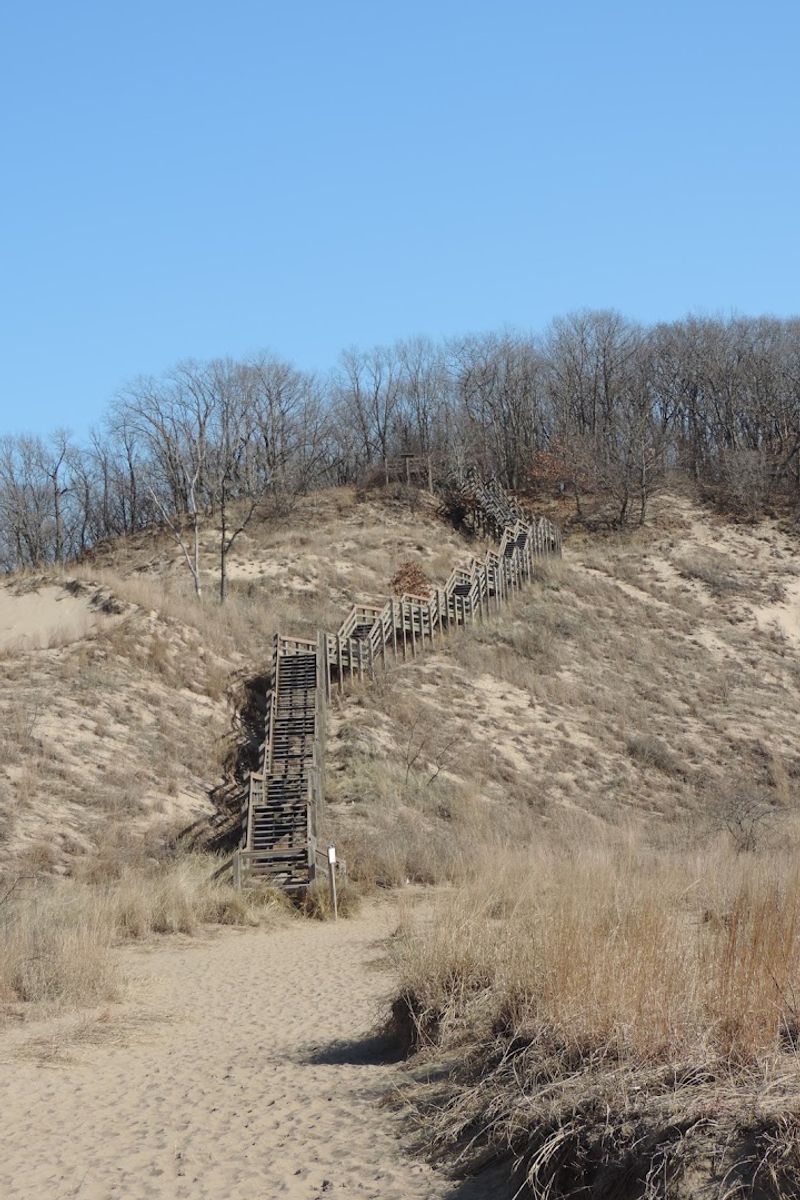
Most hikes ease you in gently. The Dune Succession Trail at West Beach does not bother with that courtesy.
Right in the middle of Loop 1, you hit a staircase that climbs 270 steps straight up the face of a towering sand dune, and your legs will feel every single one of them.
The climb covers roughly 0.6 to 0.9 miles total on Loop 1, but those stairs are the moment that sticks with every hiker who attempts it. It is rated strenuous for good reason.
The elevation gain is real, the sun can be intense on a clear day, and there are no shortcuts to the top.
But here is the thing about hard climbs: the reward matches the effort. When you reach the summit, you are greeted with a panoramic view of Lake Michigan that stretches as far as your eyes can carry you.
On clear days, the Chicago skyline appears on the horizon like something out of a dream, close enough to feel surreal from inside a national park in Indiana.
Bring plenty of water before you start. Wear sturdy shoes with grip because the wooden steps can shift with the sand beneath them.
Families with older kids and teenagers tend to love this challenge, and watching younger hikers conquer those final steps with total pride on their faces is genuinely one of the most wholesome things you will witness on a trail.
Spectacular Views Of Lake Michigan And The Chicago Skyline
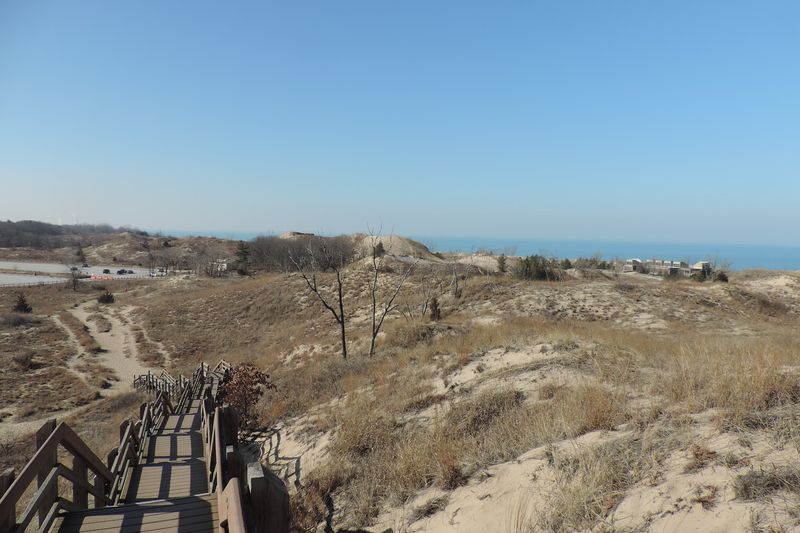
Few views in the entire Midwest hit as unexpectedly as the one waiting at the top of the West Beach dunes. You climb through sand and pine, your breath getting shorter with every step, and then suddenly the landscape opens up into something enormous and blue and breathtaking.
Lake Michigan from this vantage point looks almost oceanic. The water shifts in color depending on the time of day, moving from deep navy in the morning to a brilliant turquoise by midday.
The park sits along 15 miles of Lake Michigan shoreline, and from the top of the dunes, you feel the full scale of that stretch in a way that flat ground never allows.
What makes this view genuinely special is the Chicago skyline visible on the horizon. From inside a national park, inside Indiana, you can clearly see one of the most iconic city skylines in North America.
That contrast between wild dune landscape and urban silhouette is the kind of thing that makes you stop and just stare for a while.
Photographers tend to arrive early morning or late afternoon when the light is softer and the colors are richest. Sunrise hikes up the dune stairs are becoming more popular among locals who want that golden hour glow over the water.
It is the sort of view that earns its own reputation, and it absolutely lives up to it.
Three Interconnected Trail Loops For Every Skill Level
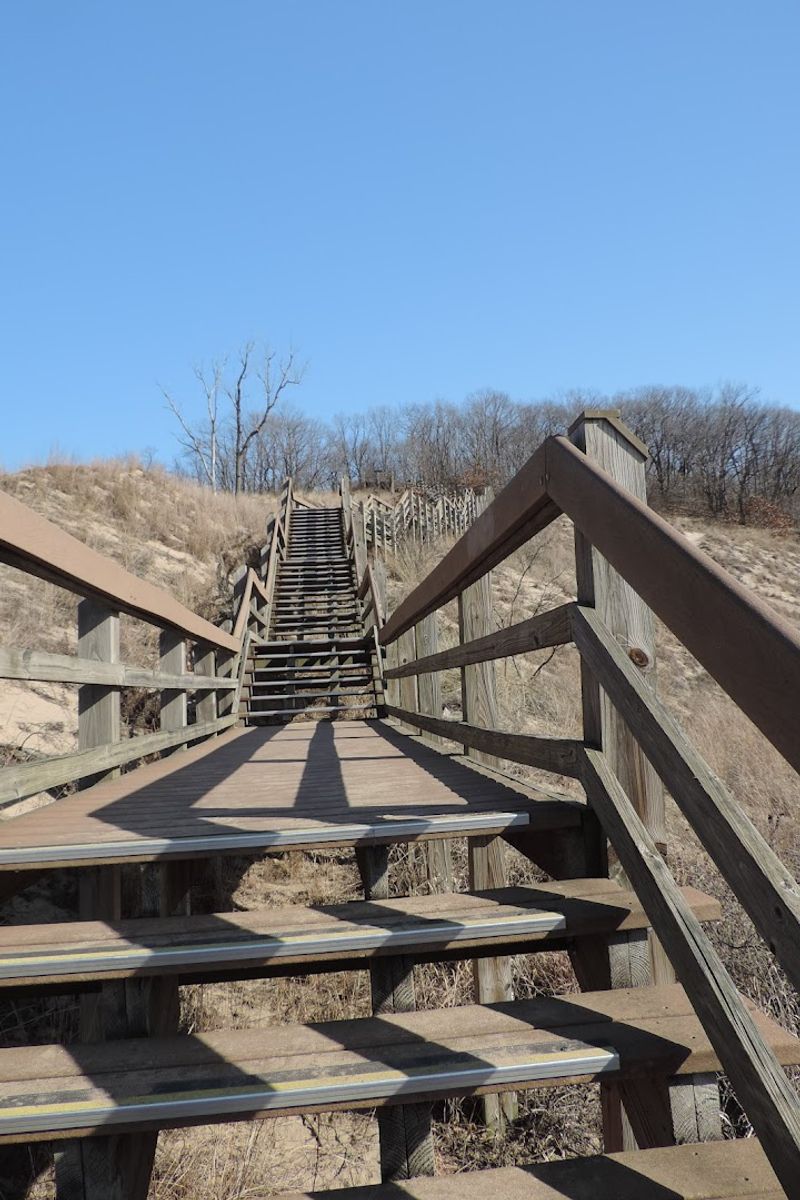
West Beach does not offer just one trail. It gives you three interconnected loops that you can hike individually or string together into a full 3.4-mile adventure, making it one of the most flexible trail systems in the region.
Loop 1, the Dune Succession Trail, runs 0.9 miles and is where the famous 270-step stair climb lives. It is the most demanding of the three but also the most dramatic.
Loop 2, the West Beach Trail, covers 1.2 miles through a flat area that was actually sand-mined back in the 1920s and is now being carefully restored as an oak savanna. That history is easy to feel as you walk through it.
Loop 3, the Long Lake Trail, stretches 2.2 miles at moderate difficulty. It follows the edge of Long Lake before heading back into the dunes, offering a completely different mood from the other two loops.
Birdwatchers especially love this section for the variety of species that gather near the water throughout the year.
When you combine all three, the hike takes anywhere from 45 minutes to about two and a half hours depending on your pace and how often you stop to take it all in. That range makes West Beach genuinely accessible, whether you are a casual walker looking for a short nature stroll or someone ready to push through a full morning of elevation and terrain variety.
Rare Eastern Prickly Pear Cacti Growing Wild In The Dunes
Cacti in Indiana sounds like a punchline. But it is completely real, and West Beach is one of the best places in the entire state to see it for yourself.
Eastern Prickly Pear cacti grow right here in the dunes, thriving in the sandy, sun-baked conditions that most plants would reject outright.
Spotting them for the first time genuinely stops you in your tracks. The flat, paddle-shaped pads are unmistakably cactus, and when they bloom in late spring and early summer, they produce bright yellow flowers that look almost tropical against the pale sand.
It is one of those details that makes Indiana Dunes feel like a place that refuses to follow the rules of what the Midwest is supposed to look like.
These cacti are native to the region and have adapted over centuries to survive the harsh dune environment where wind, heat, and drought are constant challenges. The sandy soil drains quickly, which mimics the dry conditions cacti prefer.
Finding them tucked between dune grasses and scrubby pines is a small but genuinely exciting discovery mid-hike.
If you are hiking with kids, making the cactus a scavenger hunt target is a great way to keep younger ones engaged on the trail. Point out the spines, talk about how they survive without much water, and watch their faces when they realize Indiana has actual cacti.
It never gets old as a trail moment.
A Living Classroom On Dune Ecology And Plant Succession
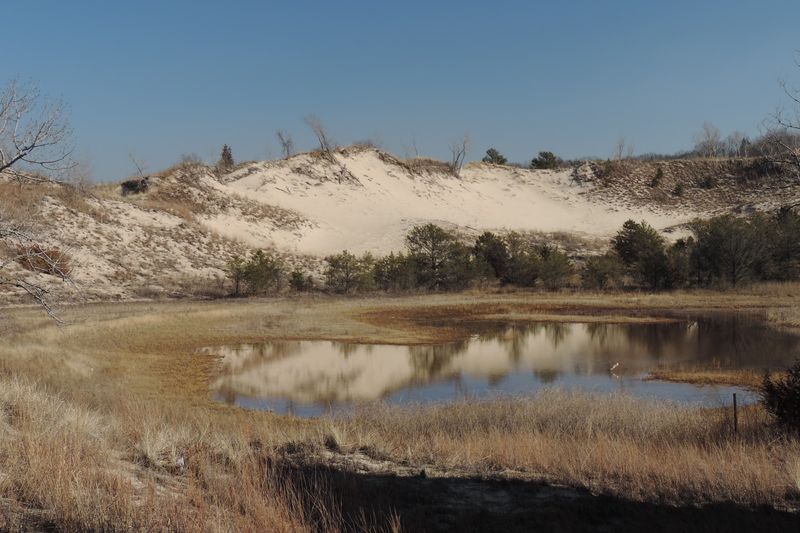
Indiana Dunes is recognized as the birthplace of ecology, and that is not a casual claim. Henry Chandler Cowles, a botanist who studied these very dunes in 1896, developed some of the most foundational ideas in ecological science by observing how plants change across different stages of dune development.
West Beach carries that legacy directly into every footstep you take on the Dune Succession Trail.
The trail is designed to walk you through the four stages of dune succession, from bare sand near the shoreline all the way to established forest further inland. Each stage supports completely different plant communities, and the contrast between them is visible and striking as you move through the landscape.
It feels less like a hike and more like walking through a textbook that is actually alive.
Teachers, naturalists, and curious hikers of all backgrounds find this aspect of West Beach genuinely compelling. The park does a thoughtful job of placing interpretive signage along the route so you understand what you are looking at without needing a science degree to appreciate it.
Jack pines in the pinery section of the trail are among the southernmost populations of their species in the entire world. That single fact reframes the whole experience.
You are not just hiking through pretty scenery. You are walking through one of the most ecologically significant landscapes in North America, right here in northwest Indiana.
Beach Access And Amenities That Make It A Full Day Out

One of the things that separates West Beach from a lot of other trail destinations is that the hike is just the beginning of what you can do there. After finishing the loops, you can walk straight to the beach and spend the rest of the afternoon swimming in Lake Michigan.
That combination of serious hiking and genuine beach time in one location is hard to beat anywhere in the region.
The facilities at West Beach are well maintained and genuinely useful. Year-round restrooms and potable water are available, which matters more than people realize when you are out in the dunes on a hot day.
Picnic tables are scattered throughout the area, making it easy to pack a lunch and settle in for a longer visit. Seasonal showers and lockers are also available during summer months, which is a real bonus after a sandy beach afternoon.
The beach itself is wide and beautiful, with the kind of soft sand that is more associated with ocean coastlines than freshwater lakes. On a clear summer day, the water is surprisingly clear and inviting.
Lifeguards are on duty in designated swimming areas during peak season, though pets are not allowed in those lifeguarded zones in summer.
West Beach is open daily from 6 a.m. to 9 p.m. Central Time, with hours that may shift seasonally.
A park pass is required for entry, which covers access to Indiana Dunes National Park as a whole and is well worth the investment.
Diverse Habitats That Pack An Entire Ecosystem Into One Hike
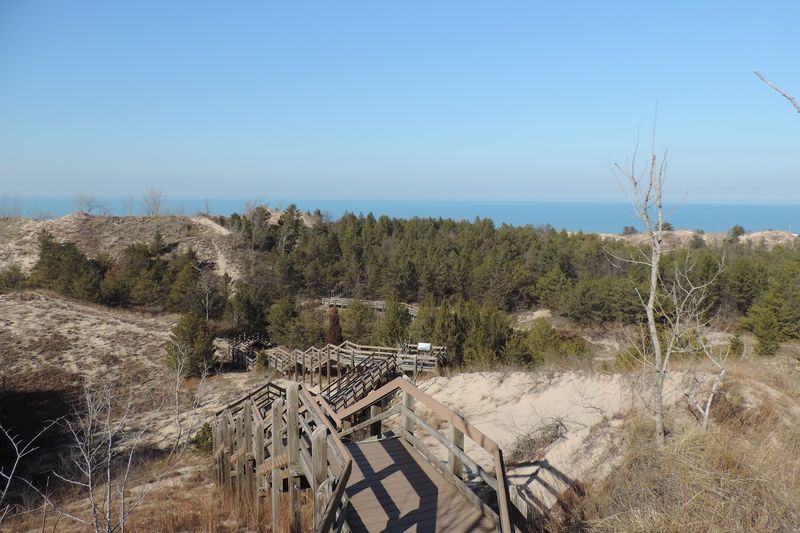
Most hikes take you through one type of landscape. West Beach takes you through several in a single outing, and the variety is genuinely impressive.
Within the span of 3.4 combined miles, you move through open sand dunes, a pinery of jack pines, oak savanna under active restoration, wetlands, prairies, and established forest. That kind of ecological range packed into one trail system is rare anywhere in the country.
The oak savanna section on Loop 2 has a fascinating backstory. The flat terrain there is a direct result of sand mining that happened in the 1920s, and what you see today is a careful, ongoing restoration effort by the national park.
Walking through it feels like watching recovery in real time, which adds a layer of meaning to an already interesting landscape.
Birdwatchers consistently rank Long Lake Trail as one of the better spots in northwest Indiana for sightings. The wetland habitat along the lake draws a wide variety of species throughout the year, and early morning hikes tend to be especially productive for anyone with binoculars in hand.
The biodiversity here is one of the reasons Indiana Dunes National Park carries the reputation it does. Scientists, students, and curious visitors have been coming to study and enjoy this landscape for well over a century.
Nearby, the Indiana Dunes Visitor Center at 1215 N. State Road 49, Porter, Indiana, offers exhibits and trail information that help put everything you experience at West Beach into a richer context.
