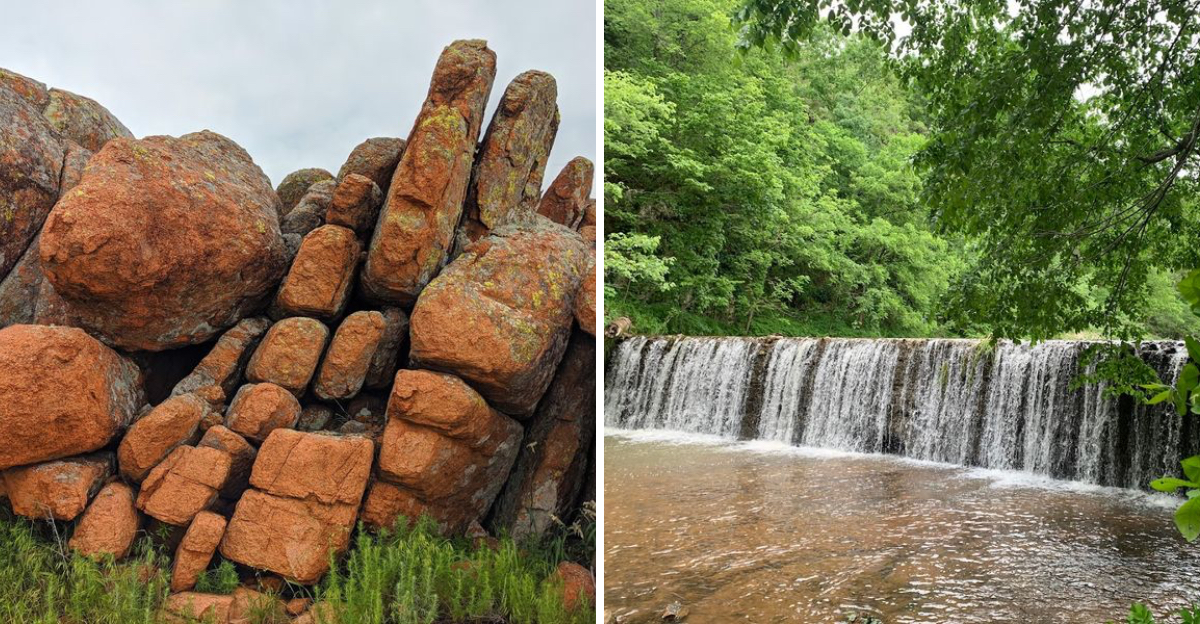
Oklahoma is supposed to be predictable. Flat land, wheat fields, maybe a red dirt road leading to a nice sunset.
That is what everyone expects. But drive a little farther off the main highways and the landscape starts to shift into something stranger, something that feels like you have left Earth entirely and landed on a different planet.
Ten road trip stops across the Sooner State offer exactly that experience. You can stand in a canyon carved by ancient waterfalls, the rock walls rising around you in shades of pink and orange that do not look real.
You can hike through a field of boulders stacked by nature into shapes that seem impossible. You can walk across ground that used to be an ocean floor, complete with fossils of creatures that swam here long before humans ever existed.
The variety surprises most visitors. Desert like mesas.
Glassy salt flats that stretch to the horizon. Sand dunes that belong in the Sahara but somehow ended up in the middle of cattle country.
Each stop offers its own brand of otherworldly beauty, and none of them require a passport or a spaceship.
1. Gloss Mountain State Park, Fairview, Oklahoma
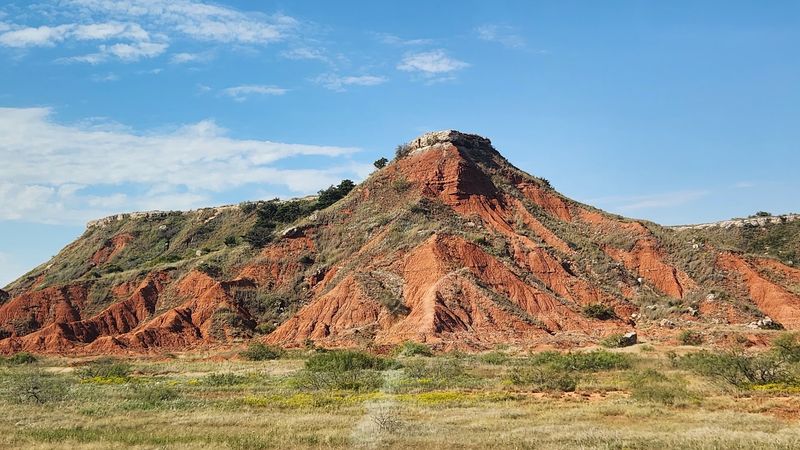
Sunlight hits the top of these red mesas and the whole ridge lights up like broken glass scattered across rust-colored rock.
That sparkle comes from selenite crystals embedded in the surface of the stone, and standing at the base of Gloss Mountain State Park in Fairview, Oklahoma, you will immediately understand how this place got its name.
The park sits along State Highway 15 and is easy to reach from the highway, making it a natural pit stop on any northwestern Oklahoma road trip.
Steel staircases and cables have been bolted into the rock face, giving you a safe route to climb straight up the mesa walls.
Once you reach the top, the view stretches out across miles of rolling red plains in every direction.
The crystals beneath your feet catch the light at every angle, and the effect is genuinely hard to describe without sounding like you are exaggerating.
Morning light is especially dramatic here, when low sun rakes across the mesa surface and the selenite practically glows.
The park is small and uncrowded compared to many Oklahoma state parks, which means you often get the whole ridge to yourself.
There are no elaborate facilities or long trails, just raw geology and open sky.
Bring sturdy shoes with good grip because the climb involves some steep sections and loose rock near the base.
Kids with a sense of adventure will love the physical challenge of the climb, and geology fans will spend far longer than expected crouching down to inspect the crystal formations up close.
Few places in the country feel this genuinely extraterrestrial for such a short hike.
2. Little Sahara State Park, Waynoka, Oklahoma
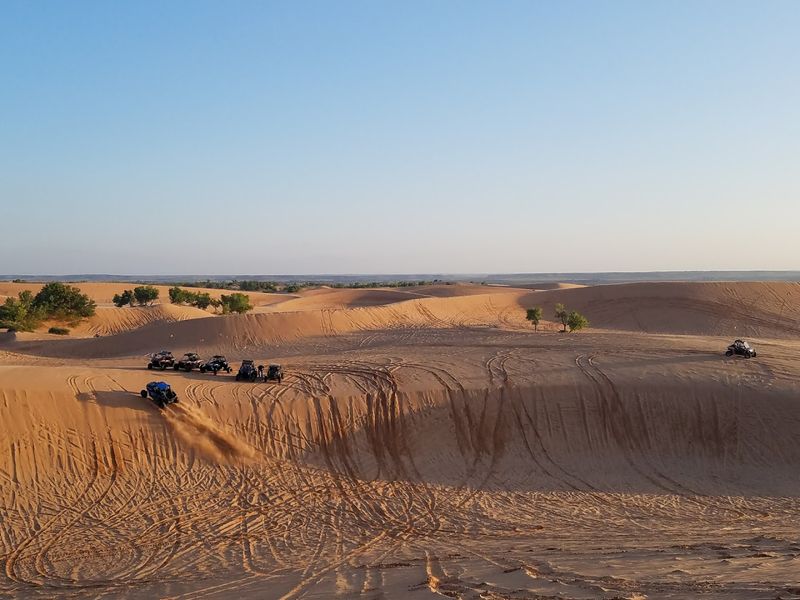
Standing at the crest of a 75-foot sand dune in the middle of the Great Plains is one of those experiences that genuinely rewires your sense of place.
Little Sahara State Park outside Waynoka, Oklahoma, covers about 1,600 acres of towering dunes that rise and shift with the wind like something transplanted from a North African desert.
The park sits along Main Street in Waynoka and is well-signed from the highway, so getting there is straightforward even without a detailed map.
ATV and off-road vehicle riding is the main draw here, and the park has designated areas where riders can tear across the dunes at full speed.
If motorized fun is not your style, sandboarding and sand sledding are equally popular and require nothing more than a rented board and a willingness to eat some sand on the way down.
The dunes themselves are constantly moving, which means the landscape literally looks different from one visit to the next.
Wind sculpts new ridgelines overnight, and footprints from yesterday are gone by morning.
The best time to visit is spring or fall, when temperatures are comfortable and the sand is not scorching underfoot.
Summer visits are still possible, but early morning is the only sensible window before the heat becomes intense.
Camping is available on-site, and falling asleep to the sound of wind moving across the dunes is an experience that belongs on any serious road tripper’s list.
Little Sahara is proof that Oklahoma keeps some of its most jaw-dropping landscapes tucked away in the most unexpected corners of the state.
3. Great Salt Plains State Park, Jet, Oklahoma
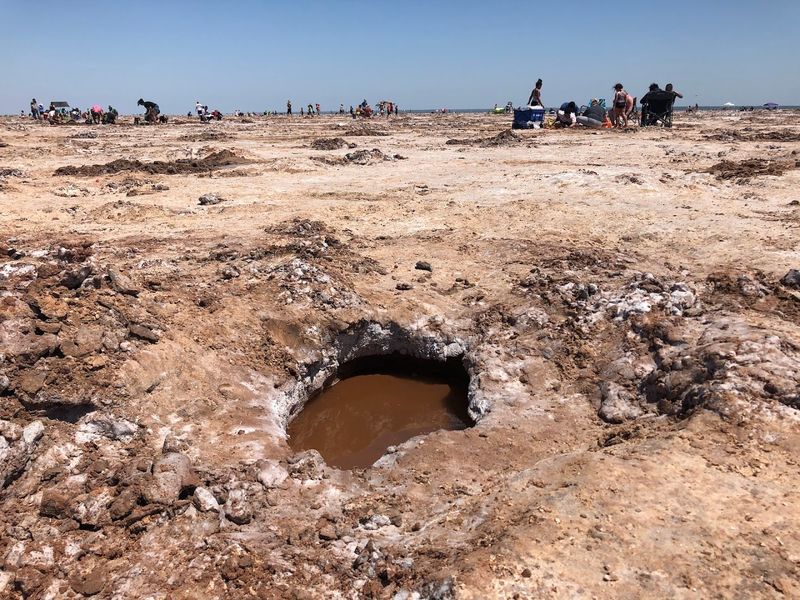
The ground here crunches underfoot, and the whole landscape shimmers with a white crust that stretches to the horizon like a frozen inland sea.
Great Salt Plains State Park near Jet, Oklahoma, sits on the remnants of an ancient shallow ocean, and the salt it left behind has created one of the most surreal environments in the entire state.
What makes this park genuinely one-of-a-kind is that it is the only place on Earth where the public can dig for hourglass selenite crystals directly from the ground.
These crystals form underground in the salt-rich soil and contain a rust-colored hourglass shape trapped inside clear mineral walls, which sounds impossible until you crack one open and see it for yourself.
The digging area is open to visitors who want to get on their knees and sift through the wet, salty earth in search of their own specimens.
Most people walk away with a small collection of crystals after just an hour of searching, and the process is oddly meditative.
Beyond the digging, the salt flats themselves are worth exploring on foot.
The landscape feels vast and empty in the best possible way, with almost no visual noise between you and the sky.
Birdwatchers should bring binoculars because the park sits along a major migratory flyway and attracts a remarkable variety of shorebirds that look completely out of context on a white salt flat in Oklahoma.
The park entrance is located along South Spillway Drive in Jet, and the drive in across the plains sets the mood perfectly before you even step out of the car.
4. Turner Falls Park and Collings Castle, Davis, Oklahoma
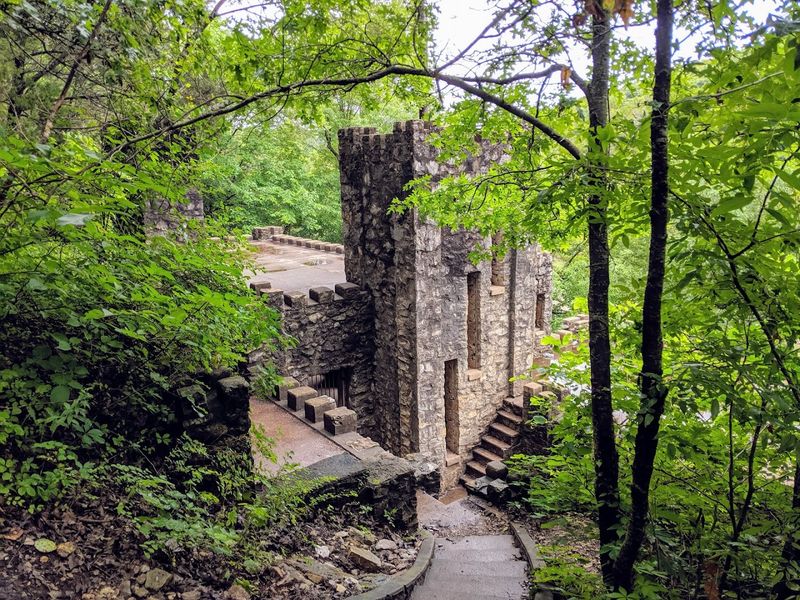
Somewhere between a fairy tale and a geology documentary, Turner Falls Park near Davis, Oklahoma, manages to combine a 77-foot waterfall with the stone ruins of an actual castle perched on the cliff above it.
The waterfall is the tallest in Oklahoma, and Honey Creek feeds it year-round, which means the pool at the base stays full and inviting even during dry stretches of summer.
Collings Castle is the structure that really sets this place apart from every other waterfall park in the state.
Built by hand from local stone in the early twentieth century, the castle sits on a rocky promontory overlooking the falls and the surrounding Arbuckle Mountains.
The walls are still standing, the arched windows still frame views of the valley below, and the whole structure has aged into something that looks genuinely ancient.
Walking through the ruins while the sound of the waterfall echoes off the canyon walls is an experience that lands somewhere between adventurous and deeply atmospheric.
The park is located along US-77 near Davis, and the entrance road winds through cedar-covered hills before the valley opens up below you.
Swimming in the natural pools beneath the falls is the most popular activity, and the water stays refreshingly cool even in peak summer heat.
Hiking trails connect the main waterfall area to smaller cascades and overlooks throughout the park.
Camping is available for those who want to stay after the day crowds leave, when the falls and the castle take on a completely different mood in the evening quiet.
Plan to spend at least half a day here because there is far more to explore than first appears.
5. Alabaster Caverns State Park, Freedom, Oklahoma
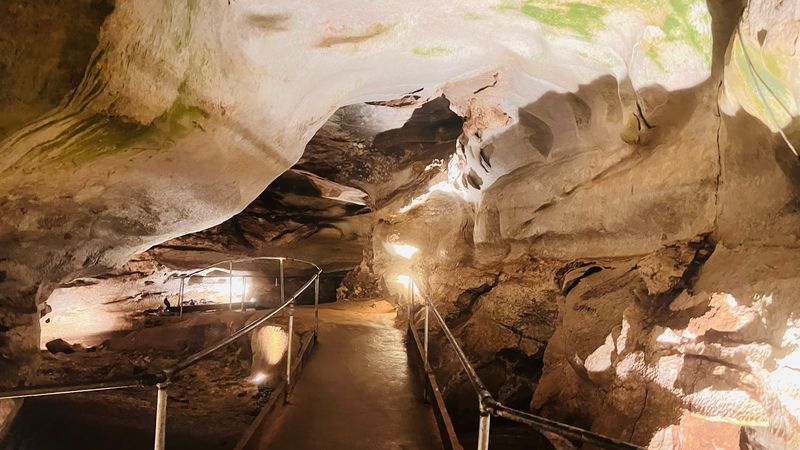
Underground Oklahoma is a different world entirely, and Alabaster Caverns State Park near Freedom, Oklahoma, is one of the most compelling entries into it.
This is one of the largest natural gypsum caves in the world that is open to the public, and the mineral formations inside are unlike anything you will find in a typical limestone cavern.
The cave walls are lined with alabaster, selenite, and other gypsum varieties in shades of pink, white, and translucent gray that glow softly under the tour lighting.
Guided tours lead visitors through the main cavern on a well-maintained walkway, pointing out specific formations and explaining the geology that created them over millions of years.
The cave maintains a constant cool temperature regardless of the season, making it a genuinely welcome stop on a hot Oklahoma summer day.
Beyond the main tour cavern, the park also has several smaller wild caves that more adventurous visitors can explore with a permit and appropriate gear.
These unlit passages require crawling and squeezing through tight spots, which is either thrilling or terrifying depending on your relationship with enclosed spaces.
The park is located along State Highway 50A outside Freedom in northwestern Oklahoma, a region of the state that most travelers drive through without stopping.
That oversight is their loss, because the landscape above the cave is also striking, with red cedar breaks and rolling cedar canyons surrounding the park entrance.
Bat flights at dusk are a seasonal bonus, when thousands of bats emerge from the cave mouth in a swirling column that is equal parts fascinating and humbling.
This is a stop that rewards curiosity in every direction you look.
6. Wichita Mountains Wildlife Refuge, Indiahoma, Oklahoma
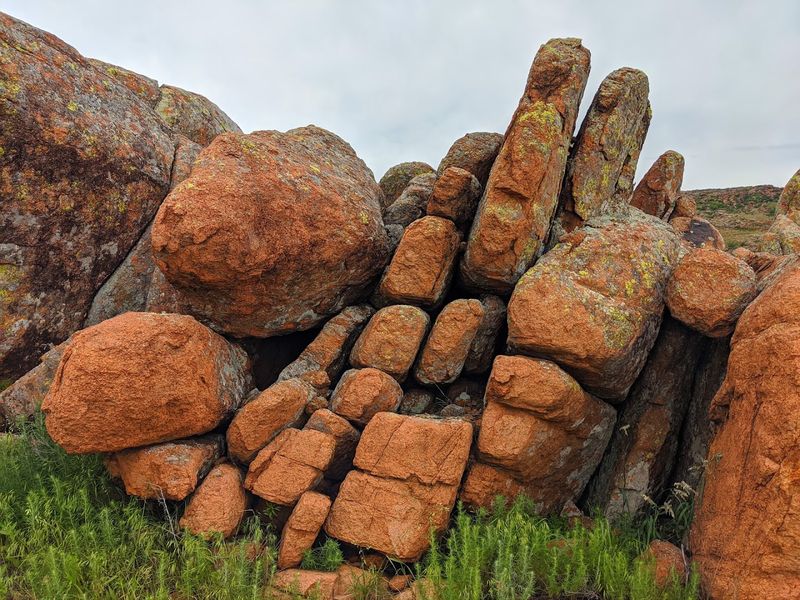
Nothing prepares you for the moment the Wichita Mountains appear on the horizon, erupting out of the flat southwestern Oklahoma prairie like something that was dropped there from space.
The Wichita Mountains Wildlife Refuge near Indiahoma, Oklahoma, protects some of the oldest exposed rock in North America, granite domes that formed roughly 500 million years ago and have been slowly worn into the rounded, boulder-strewn shapes you see today.
The refuge is managed by the U.S. Fish and Wildlife Service and covers nearly 60,000 acres of mixed terrain including prairie, wetlands, and rocky upland zones.
Bison, longhorn cattle, elk, and white-tailed deer all roam freely through the refuge, and seeing a herd of bison move across a boulder field with ancient granite peaks behind them is a scene that feels prehistoric in the best way.
Hiking trails range from easy lakeside walks to strenuous scrambles up boulder-covered summits like Mount Scott, which offers panoramic views of the entire refuge from the top.
Rock climbing is also popular here, and the granite surfaces provide excellent friction and a wide variety of routes for climbers at different skill levels.
Wildlife photography opportunities are exceptional throughout the year, but spring brings wildflower blooms that carpet the prairie between the granite outcrops in vivid color.
The refuge headquarters is located along Refuge Headquarters Road in Indiahoma, and the visitor center there is a good first stop for maps and wildlife sighting updates.
Sunrise and sunset paint the granite domes in shades of orange and purple that make it nearly impossible to put the camera away.
7. Natural Falls State Park, Colcord, Oklahoma
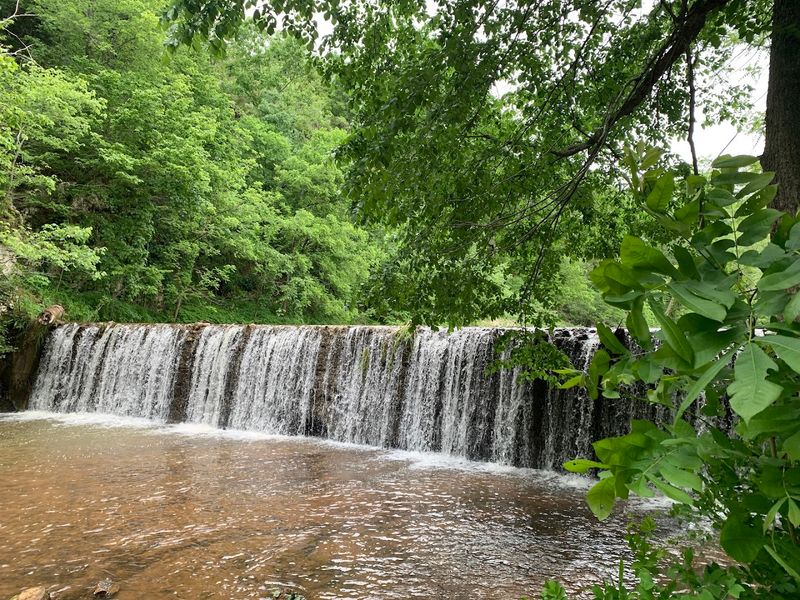
Humidity hits you like a warm curtain the moment you descend into the grotto at Natural Falls State Park near Colcord, Oklahoma, and the ferns pressing in from every side make it feel like you have wandered onto a film set for a jungle adventure movie.
The main waterfall drops 77 feet into a moss-lined pool surrounded by towering hardwoods and dense undergrowth that filters the light into soft green shades.
This park sits in the far northeastern corner of Oklahoma near the Arkansas border, tucked into the Ozark foothills where the landscape becomes dramatically wetter and more forested than the rest of the state.
The trail to the falls is paved and accessible, winding down a series of switchbacks from the parking area to the canyon floor below.
Even on a warm day, the air near the waterfall is noticeably cooler and thick with mist, which makes the whole experience feel like stepping into a completely different climate zone.
Photography here is exceptional in every season, but fall brings a color show that frames the white waterfall in deep reds and golds that seem almost artificially vivid.
Picnic areas are available near the trailhead for those who want to linger after the hike down and back up.
The park address is along East 578 Road in Colcord, and the drive through the surrounding hills is scenic enough to justify slowing down well before you arrive.
Birding is excellent in the forested areas surrounding the canyon, with species common to the Ozarks appearing here that you simply will not find in the drier parts of Oklahoma.
This is one of those places that earns a return visit before you have even made it back to the parking lot.
8. Black Mesa State Park, Kenton, Oklahoma
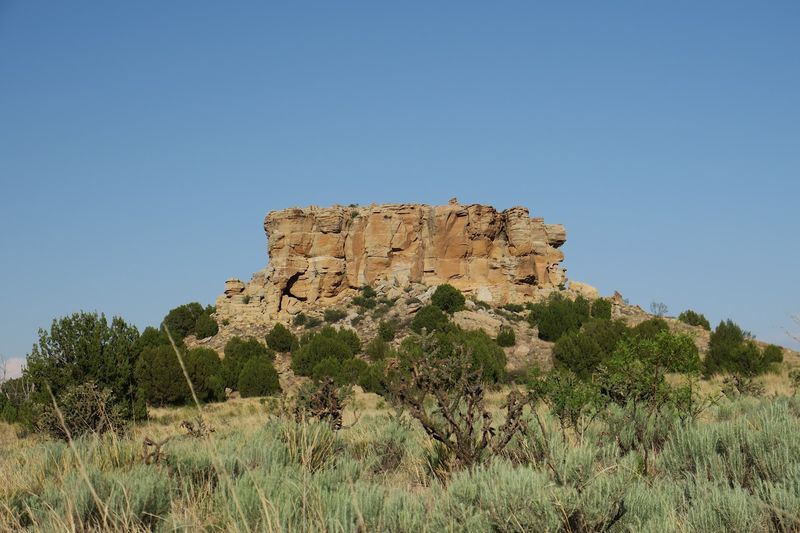
At the far western tip of the Oklahoma Panhandle, where the state narrows to a thin strip of high desert and the sky feels three times bigger than it does anywhere else, Black Mesa State Park near Kenton, Oklahoma, waits at the end of a long and rewarding drive.
The mesa itself is capped with black basalt lava rock that flowed here from volcanic activity in the region millions of years ago, giving the landscape a dark, dramatic surface that contrasts sharply with the pale desert soil below.
This is the highest point in Oklahoma, topping out at 4,973 feet above sea level, and the trail to the summit is a flat 4.2-mile one-way route across open mesa terrain.
The hike is not technically difficult, but the distance and the high desert sun demand preparation, so bring more water than you think you need and start early in the morning.
Juniper trees and native grasses push up through cracks in the lava rock along the trail, and the plant life here is more closely related to New Mexico flora than anything found in eastern Oklahoma.
Dinosaur tracks have been found in the rock formations of this region, which adds an extra layer of prehistoric weight to an already ancient-feeling landscape.
The park is located along North Highway 325 near Kenton, a small community that serves as the last outpost before the mesa trail begins.
Stargazing here is extraordinary because light pollution is essentially nonexistent this far from any city.
Camping at the park means waking up to a sunrise over the mesa that looks like it belongs on the cover of a geography textbook.
9. Blue Hole Park, Salina, Oklahoma
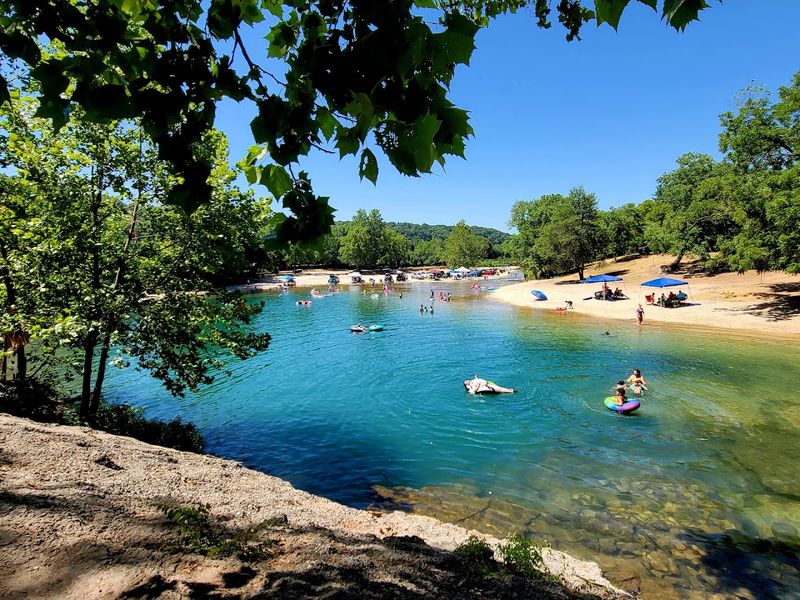
The color of the water at Blue Hole Park near Salina, Oklahoma, is the kind of turquoise that makes you stop mid-sentence and just point.
Fed by natural springs that push up through the limestone bedrock, the water maintains a vivid blue-green tone that stays consistent regardless of the season or recent rainfall, because it comes from deep underground rather than surface runoff.
The park is located along East 440 Road in Salina, a small town in northeastern Oklahoma that most travelers pass through without realizing what is waiting just off the road.
Swimming is the main draw, and the spring-fed pool is refreshingly cool even during the peak of an Oklahoma summer when the air temperature climbs into brutal territory.
The surrounding banks are lined with trees that provide shade along the water’s edge, and the whole setting has a tucked-away quality that makes it feel like a personal discovery even when other visitors are present.
Kayaking and paddling are popular here as well, and the calm, clear water makes it easy to see straight to the bottom even in the deeper sections of the spring.
The clarity of the water is genuinely remarkable, and floating on the surface while looking down at the rocky bottom through several feet of crystal-clear blue is a sensory experience that is hard to replicate.
Nearby Salina is also close to Lake Hudson and the Fort Gibson Lake area, which makes this corner of northeastern Oklahoma a strong base for a multi-day water-focused road trip.
Blue Hole is small, unpretentious, and completely unforgettable once you have seen that water color in person.
10. Osage Hills State Park, Pawhuska, Oklahoma
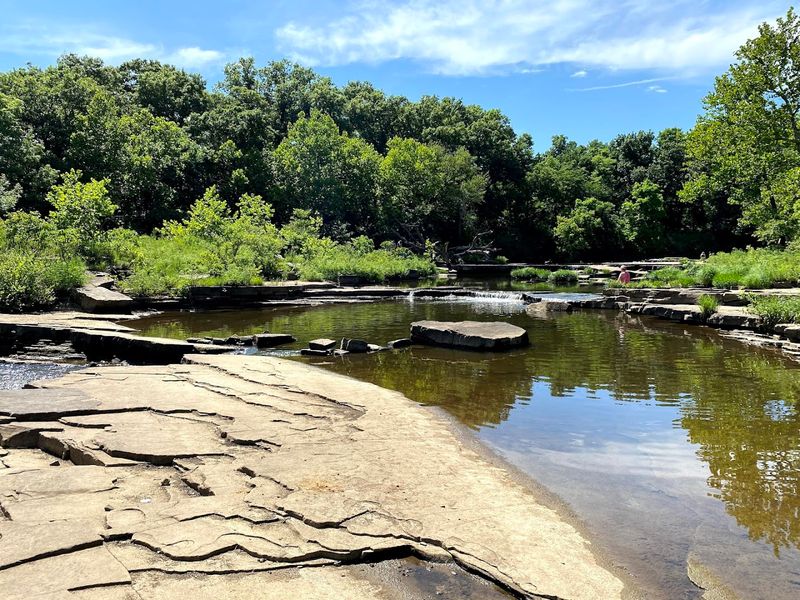
There is something quietly unsettling about the trees at Osage Hills State Park near Pawhuska, Oklahoma, the way their trunks spiral and split and reach in directions that seem to defy any reasonable explanation.
Combined with the sandstone boulders that appear to balance on narrow bases throughout the forest, the overall effect is a landscape that feels like it belongs in a fantasy novel rather than north-central Oklahoma.
The park sits along Osage Hills Park Road in Pawhuska and is one of the older state parks in Oklahoma, established during the New Deal era when the Civilian Conservation Corps built the stone structures and roads that still define the park today.
Hiking trails wind through the dense cross-timbers forest and past the boulder formations, with enough elevation change to make the walks feel genuinely adventurous without requiring serious fitness preparation.
A small lake within the park offers fishing and a peaceful spot to sit and watch the light change through the heavy tree canopy overhead.
The Osage Hills region sits within the traditional territory of the Osage Nation, and the landscape carries a deep historical and cultural weight that adds meaning to every walk through the trees.
Fall is especially atmospheric here, when the cross-timbers forest turns deep red and orange and the light filtering through the canopy creates a warm glow over the sandstone boulders.
The park is close enough to Pawhuska to make a combined visit practical, and the nearby Tallgrass Prairie Preserve adds another layer of natural wonder to the area.
Osage Hills rewards slow exploration and a willingness to wander off the main trail to find whatever strange rock formation is waiting just around the next bend.
