Missouri is full of surprises, and that means something wonderful in the best possible way. Road trips through the Show-Me State keep delivering moments that make drivers slow down, pull over, and just stare at whatever bizarre thing has appeared next to the highway.
Giant farm tools loom over quiet fields. Museums built entirely around human hair hide in plain sight.
Entire towns dedicate themselves to a single punchline, and concrete nuts the size of small cars sit proudly at the edge of town.
Some stops are funny enough to make a whole car laugh. Others are deeply strange, the kind of place that leaves visitors thinking for days after they leave.
A few are even a little unsettling, but always in a way that earns genuine respect. Nine wonderfully bizarre roadside attractions are scattered across Missouri, and every single one deserves a spot on your travel list.
If you love the kind of adventure that leaves you laughing, thinking, and just slightly confused, keep reading. This collection is exactly what you need for your next Missouri road trip.
1. Uranus, Missouri (The Whole Town)
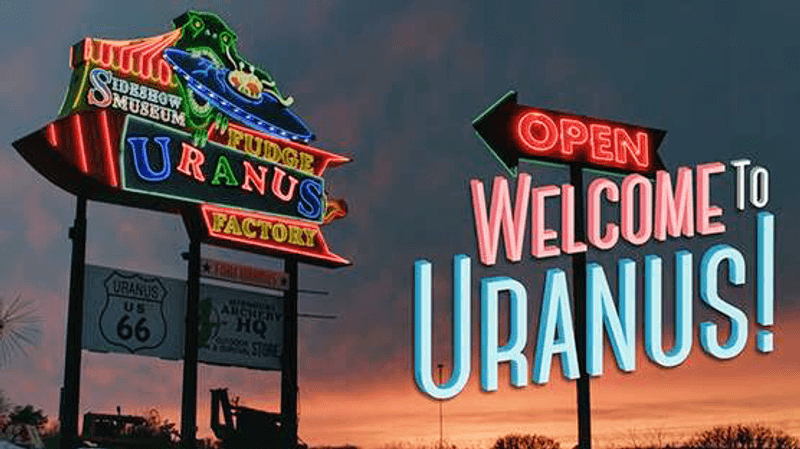
Somewhere along Highway Z near St. Robert, Missouri, there is an entire town built on one joke, and it is executed with breathtaking commitment.
Uranus, Missouri is not just a funny name on a map. It is a full western-themed attraction complex where every sign, every product, and every employee greeting leans hard into the pun.
The Uranus Fudge Factory is the crown jewel of this operation. Staff members shout a very enthusiastic welcome every single time someone walks through the door, and free samples make it impossible to leave empty-handed.
There is also the Uranus Sideshow Museum, which houses over 100 exhibits including two-headed animals and genuine circus artifacts. I spent way more time in there than I expected.
The Uranus City Jail facade is a must for photos. You can pose like you have been booked, and the results are always hilarious.
Guinness World Records certified the largest belt buckle in the world right here, which is exactly the kind of achievement this place deserves. There is also an escape room called Escape Uranus, and a mini-golf course called Putt Pirates.
Looming over everything is a 22-foot statue of the town founder, Louie Keen, who clearly understood that absurdity done well is an art form.
What gets me most about Uranus is how polished the whole thing feels. Nothing here is lazy or half-hearted.
Every detail reinforces the bit, and the result is a roadside stop that earns genuine admiration alongside the inevitable giggles.
2. The World’s Largest Goose (Maxie), Sumner, Missouri
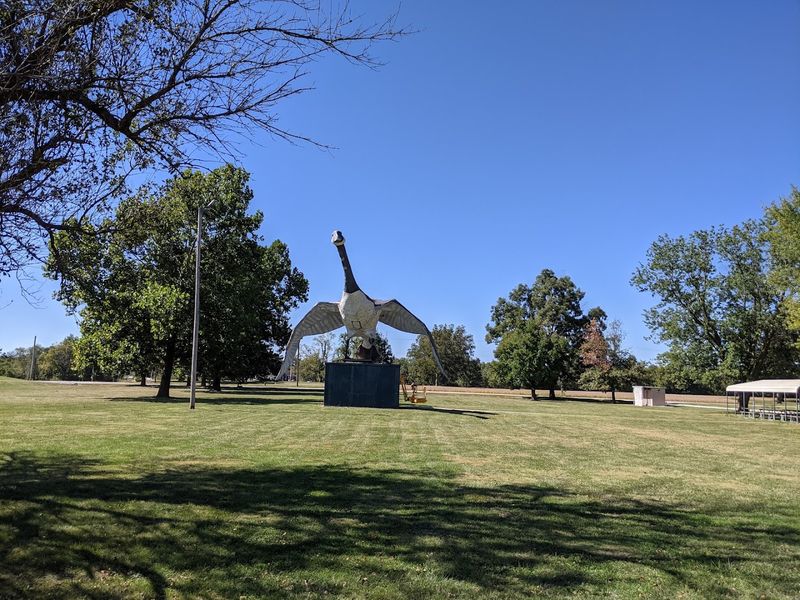
Standing beneath a 40-foot goose is not something most people put on their bucket list, but I am here to tell you it absolutely belongs there.
Maxie lives in Sumner, Missouri, a town of barely 100 people that has fully embraced its identity as the Wild Goose Capital of the World. The sculpture stretches 61 feet from wingtip to wingtip and is painted a brilliant, gleaming white that catches the light from miles away.
Pulling up to Maxie for the first time is genuinely disorienting. Your brain keeps trying to recalibrate the scale, and it keeps failing.
There is a small park area with picnic tables nearby, which is perfect for sitting down and processing what you are looking at. I found myself just staring upward for several minutes, which is apparently a common reaction.
The nearby Swan Lake National Wildlife Refuge is worth adding to the trip. You can see actual Canada geese there, and the size comparison between real birds and Maxie makes the sculpture even more absurd in the best way.
Sumner committed to this identity so completely that the giant goose became the town’s defining landmark. That kind of civic confidence is something I genuinely respect.
There are no admission fees, no gift shops, and no crowds. Just you, a vast Missouri sky, and a colossal waterfowl frozen in eternal flight above the flat prairie landscape.
If you are driving through northern Missouri and skip Maxie, you will regret it. The drive alone through the quiet farmland makes the detour worthwhile.
3. Leila’s Hair Museum, Independence, Missouri
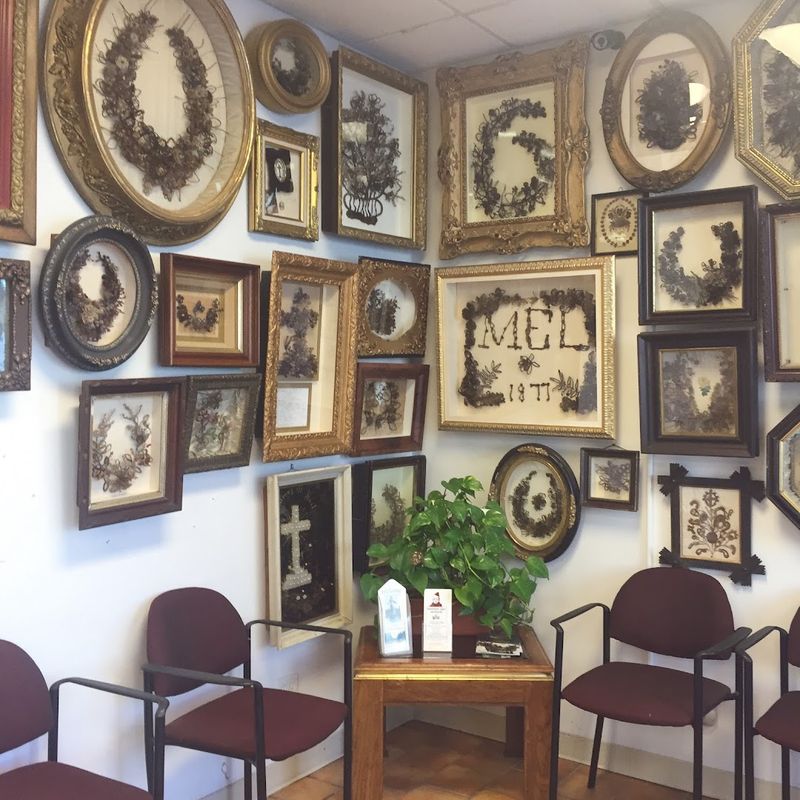
Before I walked into Leila’s Hair Museum on South Noland Road in Independence, Missouri, I thought I had a pretty good handle on what museums could be. I was wrong.
This is the only museum in the world dedicated entirely to hair art, and that fact alone should tell you something extraordinary is waiting inside.
The collection features wreaths, brooches, necklaces, and framed pictures all crafted from human hair. Many pieces date back to the 1800s, when Victorians used hair art as a form of mourning and sentimental memory-keeping.
The craftsmanship is genuinely stunning. Hair flowers created through painstaking Victorian techniques sit under glass like delicate botanical specimens, and you find yourself leaning in closer despite every instinct telling you otherwise.
What surprised me most was how emotionally layered the experience felt. These were not novelty items.
They were love letters made from strands of the people who mattered most to someone.
The museum is small and personal, which adds to the intimacy of the whole thing. You do not rush through Leila’s.
You slow down and look carefully at each piece.
The eerie quality of the collection is undeniable, but it sits right alongside genuine artistry and historical significance. That tension is what makes it unforgettable.
Independence, Missouri is already worth visiting for its other historical connections, but Leila’s Hair Museum is the stop that will stick with you longest. Pack your curiosity and leave your squeamishness at the door, because this place rewards the brave and the curious equally.
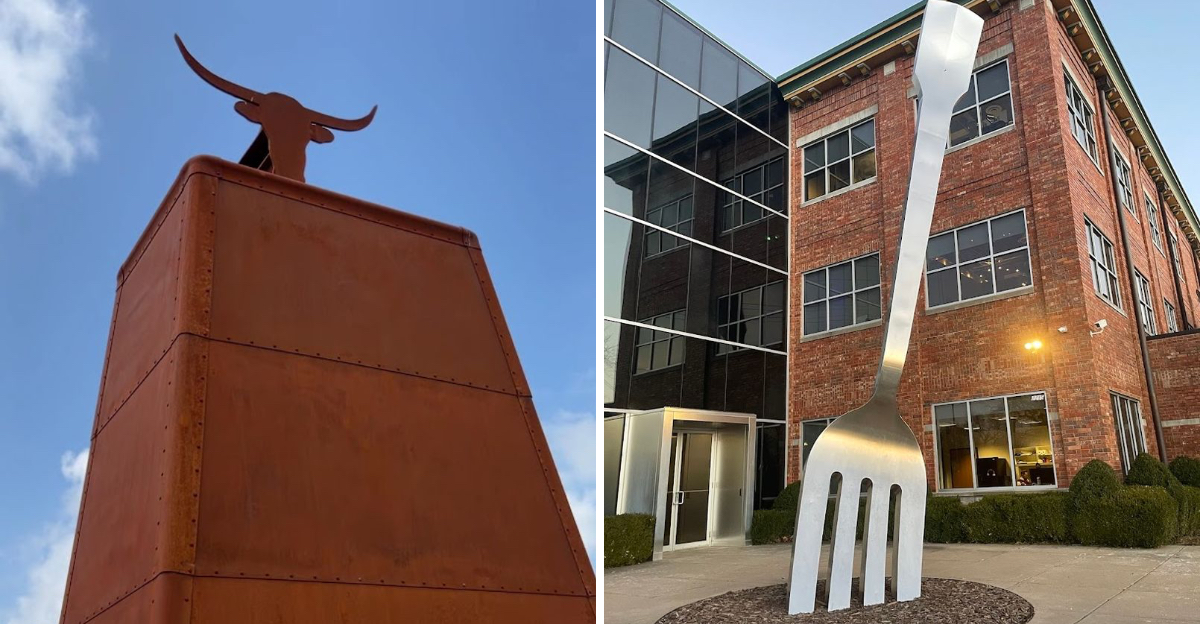
4. The World’s Largest Fork, Springfield, Missouri
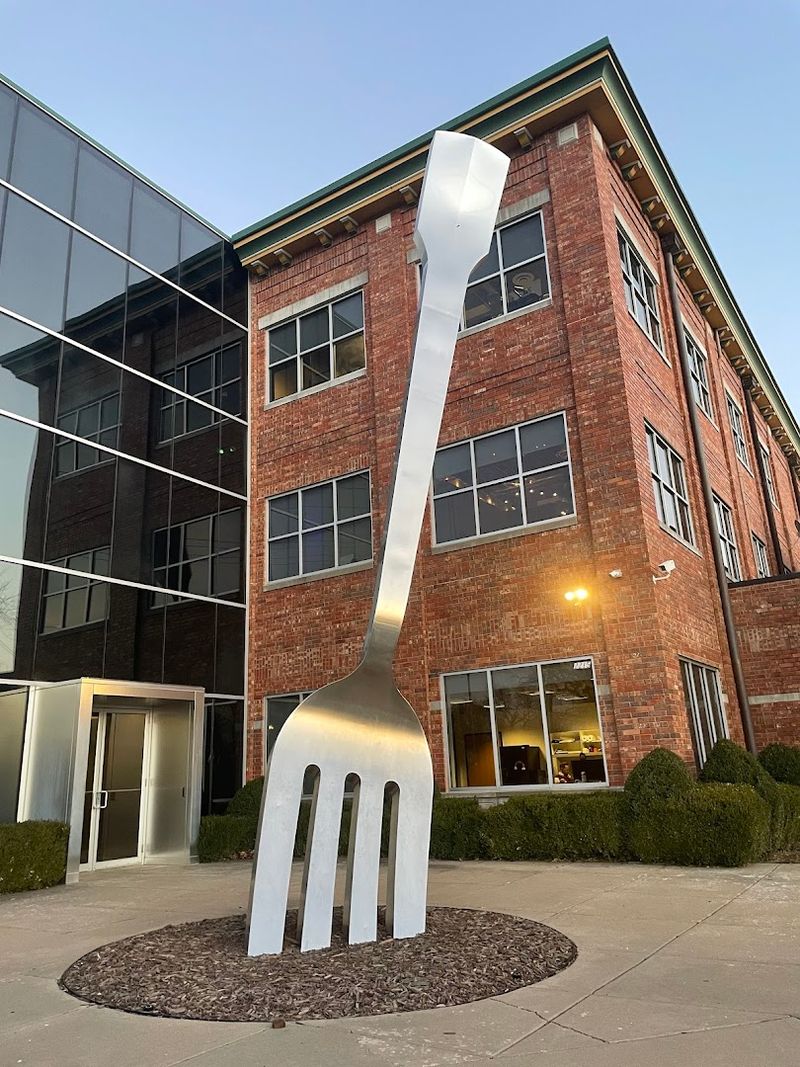
A 35-foot-tall, 11-ton stainless steel fork is standing upright in Springfield, Missouri, and I genuinely have no idea what to do with that information except love it completely.
The fork originally stood outside a restaurant that eventually closed. Rather than disappear into a scrapyard, it found a new home outside an advertising agency on South Glenstone Avenue, where it now serves absolutely zero practical purpose and maximum visual chaos.
Getting out of my car and walking toward it felt surreal. The fork is so tall that you have to tilt your head back to see the tines, and the stainless steel catches the sunlight in a way that makes it look almost regal.
Forced-perspective photos are the obvious move here. Pretend you are about to eat a tiny car, or pose like you are a giant about to dig into the city itself.
The comedy writes itself.
Springfield is a city with plenty going on, including great trails and a lively downtown, but the fork is what people remember. It has a gravitational pull that is hard to explain.
The fact that an ad agency now owns it feels quietly perfect. There is no better home for an object that exists purely to make people stop and stare.
Eleven tons of stainless steel shaped like a utensil, planted in Missouri soil, asking nothing from you except a moment of confused appreciation. That is the fork.
That is all the fork needs to be.
I drove past it three times just to make sure it was real. It was real every single time.
5. The Glore Psychiatric Museum, St. Joseph, Missouri
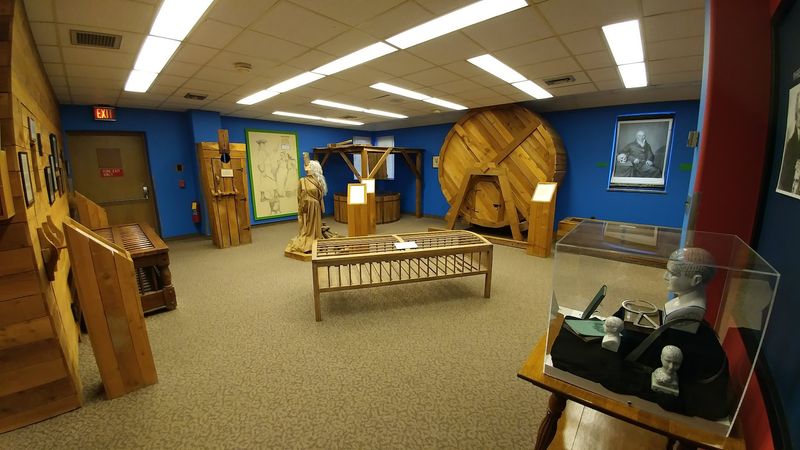
Not every bizarre roadside stop is funny, and the Glore Psychiatric Museum in St. Joseph, Missouri makes that point with quiet, unflinching clarity.
Housed in the former State Lunatic Asylum No. 2, this museum traces the history of mental health treatment in America through artifacts, recreations, and displays that range from fascinating to deeply sobering.
The building itself carries weight. Walking through rooms that once held patients changes how you hear the exhibits.
History feels less abstract when the walls are original.
One of the most talked-about displays is the stomach contents collection. In 1929, doctors removed over 1,400 metal objects, including nails, screws, buttons, and pins, from a single patient.
The collection is preserved and displayed, and it stops you cold.
Recreations of 19th-century asylum conditions show how far treatment has come, and how far it still had to go for most of that history. The antique restraint devices and early therapeutic equipment are displayed with context that makes them educational rather than exploitative.
I went in expecting something quirky and came out thinking about it for days. That is not a complaint.
That is exactly what a great museum should do.
The Glore is located at 3406 Frederick Avenue in St. Joseph, which sits in northwest Missouri near the Kansas border. It is well worth a full afternoon of your time.
If you want a roadside stop that challenges you and stays with you, this is the one. It is the kind of place that earns your respect the moment you walk through the door.
6. BoatHenge, Columbia, Missouri
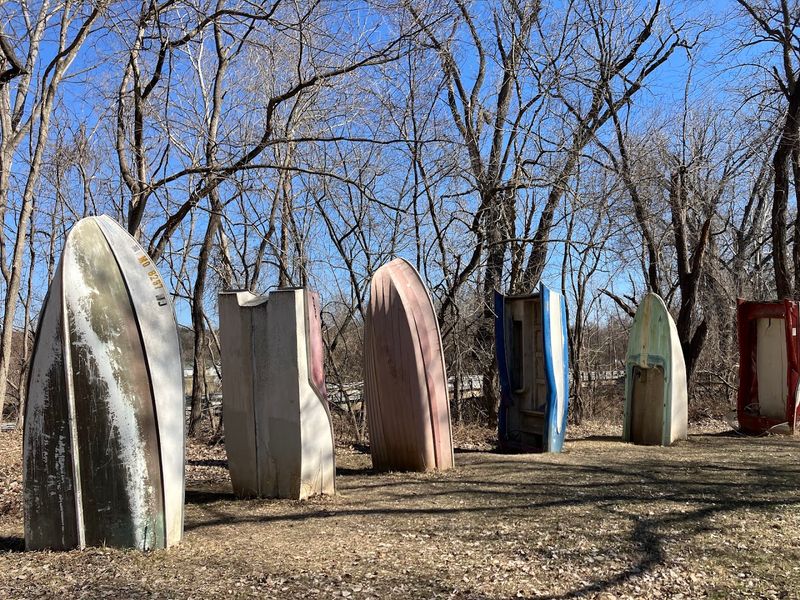
England has Stonehenge. Columbia, Missouri has BoatHenge, and I would argue the boats are more fun to stand next to.
Along the MKT Trail, a converted railroad corridor that winds through Columbia, a collection of retired boats have been planted nose-down into the earth. They stand upright, colorfully painted, like they are auditioning for the strangest art show in the Midwest.
The MKT Trail itself is a beautiful walking and biking path, so stumbling onto BoatHenge mid-ride feels like discovering a secret. One moment you are surrounded by trees and birdsong, and the next there are vertical boats.
Each boat is painted differently, which gives the installation a festive, chaotic energy. Some are striped, some are solid colors, and a few have patterns that look like they came from a very enthusiastic afternoon with leftover house paint.
Photo opportunities here are outstanding. Grip a steering wheel that is now pointing at the sky, or pose like you are surfing a stationary vessel.
The absurdity is built right in.
BoatHenge is a free outdoor art installation with no hours, no tickets, and no explanations offered. That last part is my favorite detail.
It simply exists and invites you to form your own theory about why.
Columbia is a lively university city in central Missouri with great food and culture, and the MKT Trail is already a local treasure. BoatHenge just makes the trail slightly more inexplicable and significantly more interesting.
Bring a bike, pack a snack, and let the upright boats do what they do best, which is confuse and delight you in equal measure.
7. The World’s Largest Cowbell, Belle, Missouri
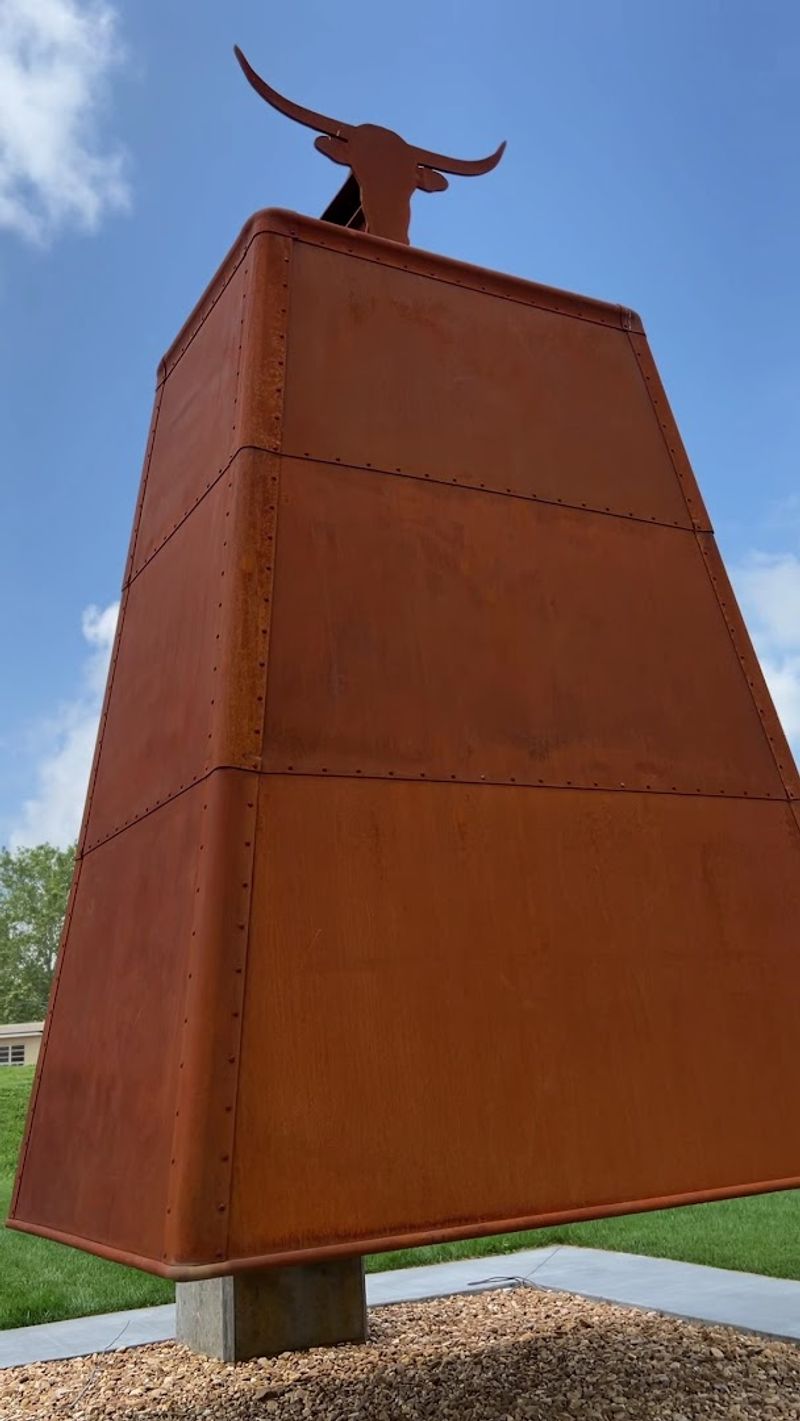
Belle, Missouri has a population of around 1,500 people, and at some point the community collectively decided that its legacy would be a 12-foot-tall steel cowbell. I respect that enormously.
The World’s Largest Cowbell stands in the downtown area of Belle, suspended from an over-engineered steel frame that looks built to last several centuries. A longhorn silhouette perches on top, giving the whole structure a certain agricultural grandeur that is hard to put into words.
The craftsmanship is genuinely impressive. The rusted steel finish gives it a weathered, intentional look that feels more like public art than roadside novelty, though it is absolutely both.
Access is free and available around the clock. I have read about people visiting at midnight under a full Missouri sky, and honestly that sounds like the correct way to experience a giant cowbell.
Belle sits in Maries County in central Missouri, roughly between Rolla and Jefferson City. It is the kind of small town that feels genuinely proud of itself, and the cowbell is the physical proof of that pride.
There is something quietly philosophical about a community choosing an agricultural instrument as its monument. It says: we know who we are, we know where we come from, and we are going to make it 12 feet tall.
The longhorn on top adds a layer of personality that pushes the whole installation from quirky to charming. Every time the wind moves through Belle, I like to imagine the world’s largest cowbell ringing just slightly, just enough to let the surrounding farmland know it is still there.
8. Jim the Wonder Dog Memorial, Marshall, Missouri
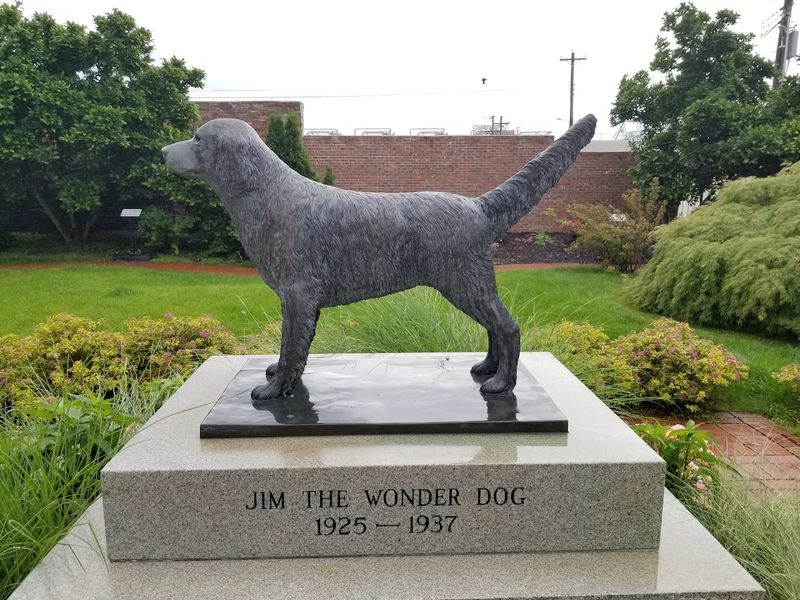
In the 1930s, a Llewellyn Setter from Marshall, Missouri became a national sensation because people believed he could understand multiple languages, predict horse race outcomes, and identify illnesses by scent alone. Marshall responded by building him a museum.
Jim the Wonder Dog was born in 1925, and his owner documented ability after ability that scientists could not explain and skeptics could not convincingly debunk. That unresolved mystery is a big part of what makes the memorial so compelling.
The memorial park and museum sit in Marshall, which is in Saline County in central Missouri. The park is quiet and thoughtfully designed, the kind of place you walk through slowly rather than rush.
Inside the museum, exhibits lay out Jim’s story with genuine care. You see the documentation, the testimonials, the historical records of a dog who drew crowds and baffled experts during his lifetime.
What I find most interesting is the way the story sits right at the edge of believable. Jim was real.
His owner was real. The people who witnessed his apparent abilities were real.
And yet the explanation remains elusive, which is exactly where the best stories live.
Marshall is a charming small city, and the Jim the Wonder Dog Memorial fits perfectly into its character. The town is proud of its unusual connection to a dog who made national headlines nearly a century ago.
Standing at the memorial, I kept thinking about how much we still do not understand about animal intelligence. Jim may or may not have been a canine clairvoyant, but the questions he raised are still worth asking.
9. The World’s Largest Pecan, Brunswick, Missouri
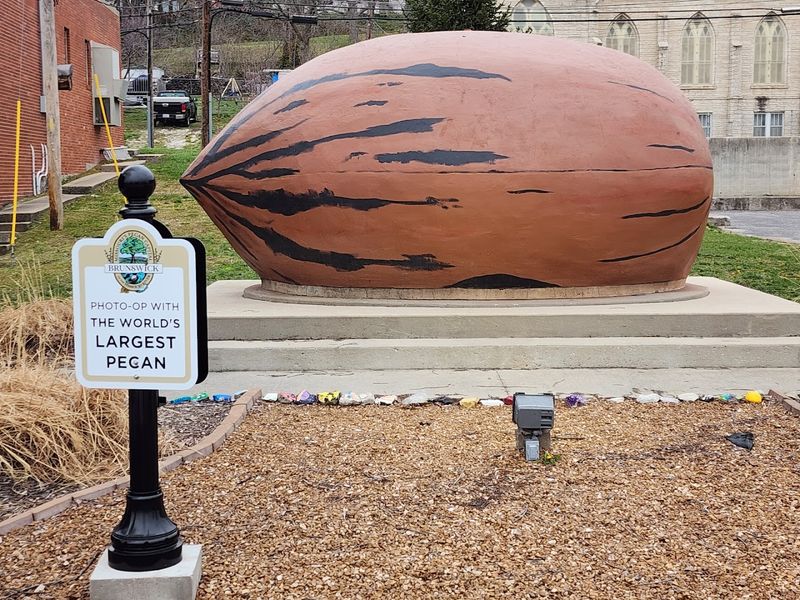
Brunswick, Missouri calls itself the Pecan Capital of Missouri, and to prove it, someone built a 12-foot-long, 6-foot-wide concrete and steel pecan and placed it at the edge of town in 1982.
That is the kind of civic confidence I find deeply admirable. Not a sign, not a festival banner, but a colossal nut on a platform, visible and undeniable.
Brunswick sits along the Missouri River in Chariton County, in the north-central part of the state. The surrounding landscape is flat and wide, which means the giant pecan has room to make its presence known without competition.
The sculpture sits in Pecan Park, and it is free to visit at any hour. Getting up close reveals the texture work on the surface, which actually resembles a real pecan shell in a way that is more impressive than you might expect from a 12-foot concrete nut.
Brunswick also hosts an annual Pecan Festival that features pecan-themed food and goose-calling competitions, because the town is also connected to wild goose migration and apparently committed to covering all its bases.
Nut puns are unavoidable here, and I fully encourage leaning into them. The photo opportunities practically write their own captions, and the absurdity of standing next to something this size and this specific is genuinely joyful.
The businessman who built the pecan wanted to put Brunswick on the map, and it worked. Decades later, people are still making the drive specifically to stand next to a giant concrete nut and feel the particular happiness that only Missouri roadside attractions can provide.
