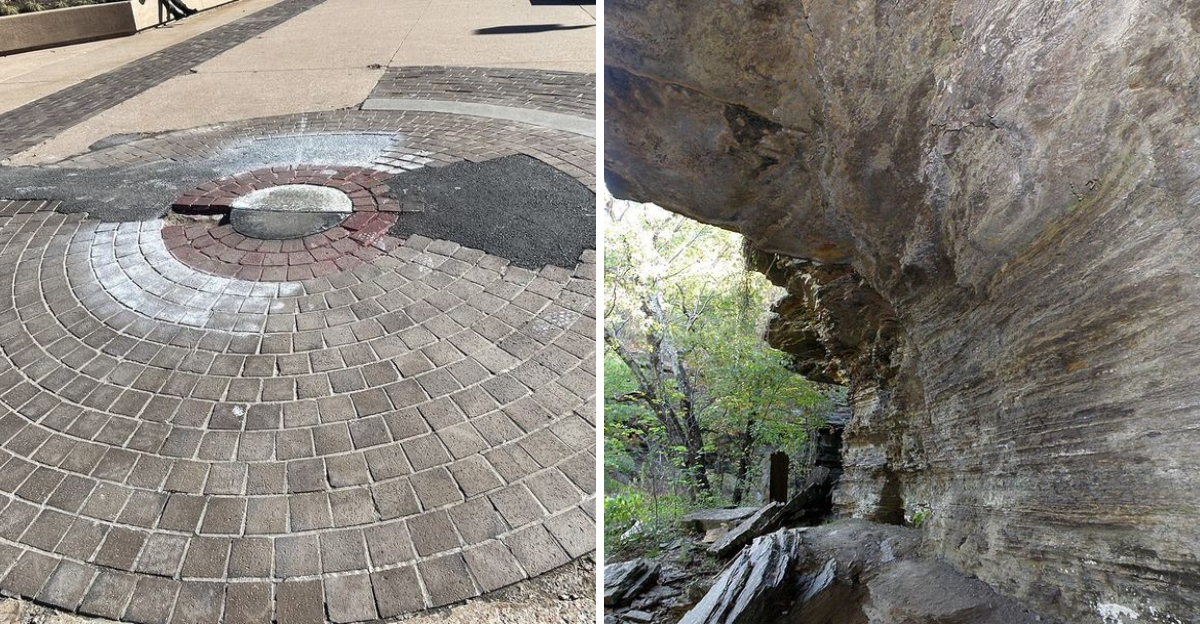
Oklahoma has a way of keeping secrets buried deep in its red dirt, its dark skies, and its winding back roads. I’ve traveled across this state more times than I can count, and every single trip has handed me something I couldn’t fully explain.
From a concrete circle in Tulsa that throws your voice back at you like a megaphone, to shadowy figures lurking near the panhandle’s ancient mesa, the Sooner State is packed with genuinely bizarre corners that leave even the most logical minds scratching their heads.
Buckle up, because these nine phenomena are about to make you question everything you thought you knew about Oklahoma.
1. The Center of the Universe, Tulsa
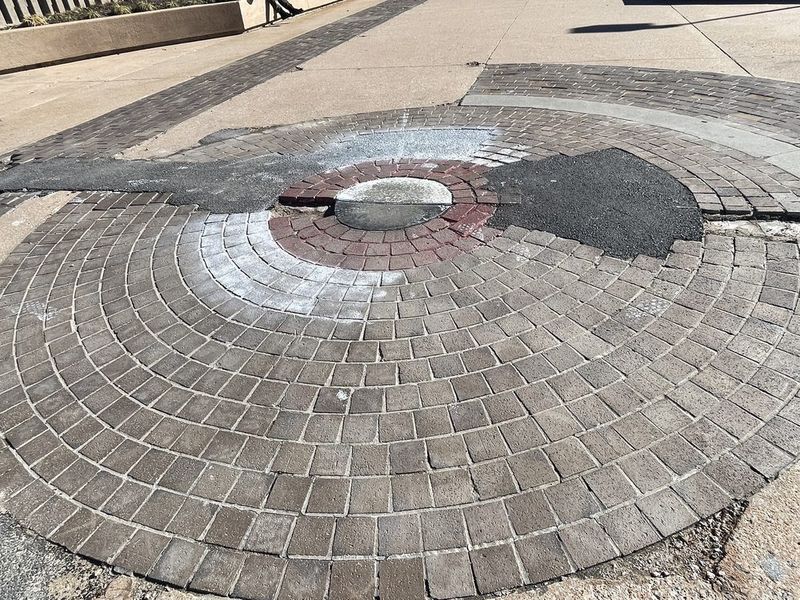
Standing in a plain concrete circle on a pedestrian bridge in downtown Tulsa, Oklahoma, I whispered a single word and heard it thunder back at me like I had shouted into a canyon.
That is the Center of the Universe for you. Located at 1 S Boston Ave, Tulsa, OK 74103, this small, unassuming circle is one of the strangest acoustic anomalies I have ever personally experienced.
When you stand inside the ring and speak, your voice bounces back noticeably louder than you projected it. Meanwhile, anyone standing just a few feet outside the circle hears almost nothing.
The effect is widely believed to come from the unusual acoustics created by the surrounding bridge design and nearby concrete structures, which reflect sound back toward the center of the circle.
Even though researchers generally consider it an acoustic phenomenon rather than a true mystery, experiencing it in person still feels strange enough to leave most visitors doing a double take.
Locals treat it with a mix of pride and playful mystery. Some say it is just clever urban architecture.
Others are convinced something stranger is at work beneath the bridge.
I spent nearly twenty minutes standing there, testing it with different tones and volumes. Every single time, the sound returned to me amplified and clear, while my travel companion standing five feet away heard almost nothing.
The bridge itself sits near the BOK Center arena and is easy to visit on foot. There are no tickets, no hours, and no crowds on a quiet weekday morning.
Whatever the science behind it, the Center of the Universe earns its dramatic name every single time you open your mouth inside that circle.
2. The Hornet Spooklight, Quapaw
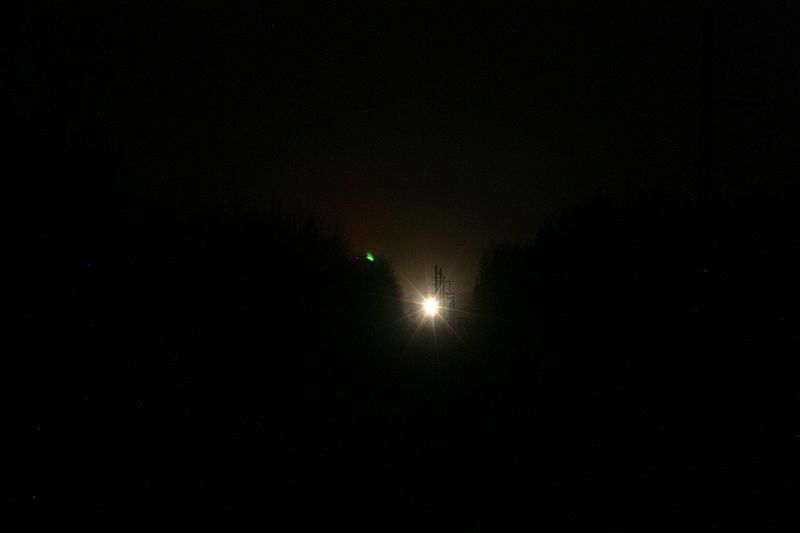
Few things unsettle a traveler quite like watching a glowing ball of light drift silently down a gravel road with no explanation attached to it.
The Hornet Spooklight, also called the Joplin Spooklight, has been doing exactly that near Quapaw, Oklahoma, since the late 1800s. The light appears on E 50 Rd, Quapaw, OK 74363, close to the Missouri state border.
Eyewitnesses describe a bobbing, pulsing orb that ranges from softball-sized to basketball-sized. It shifts colors between orange, white, and yellow, and it moves with an eerie sense of purpose along the road.
Scientists have suggested swamp gas, glowing minerals, and refracted headlights from distant highways as possible culprits. Each theory has been tested and each one has fallen short of fully accounting for what people consistently report seeing.
The U.S. Army Corps of Engineers actually investigated the phenomenon in the 1940s and confirmed the light was real.
They just could not explain it.
I visited on a moonless night and parked at the edge of the road with the engine off. The darkness out there is absolute, and the quiet is the kind that makes your ears ring.
After about thirty minutes of waiting, I caught a faint glow bobbing in the distance. It lasted maybe forty seconds before fading.
My camera caught nothing useful.
That stretch of road near the Oklahoma-Missouri border has been drawing curious travelers for over a century, and the Spooklight shows no signs of retiring anytime soon.
3. Shaman’s Portal, Beaver
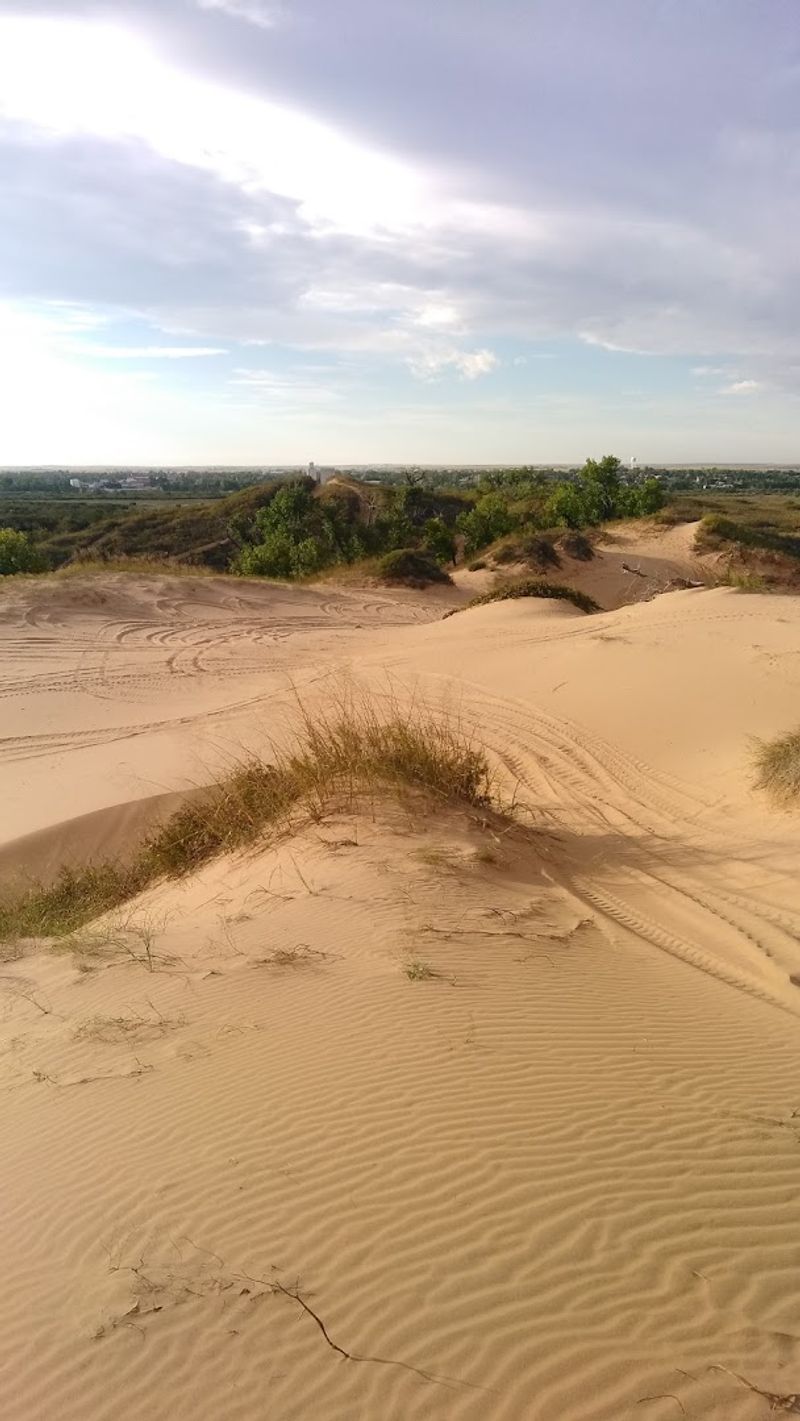
Beaver Dunes State Park sits quietly in the Oklahoma Panhandle near Beaver, OK 73932, and on the surface it looks like a simple stretch of golden sand dunes perfect for off-road vehicles and weekend camping.
Dig a little deeper into local history, though, and you find a place that has earned the unsettling nickname “the Bermuda Triangle of Oklahoma.”
For centuries, indigenous oral traditions and later settler accounts have described people becoming disoriented, losing time, or simply vanishing in the shifting sands of this area. The stories are remarkably consistent across generations and cultural backgrounds.
Some researchers point to unusual electromagnetic readings in the dunes. Others speculate about underground mineral deposits that could interfere with navigation equipment and human perception.
I camped near the park boundary on a still evening, and I will admit the dunes have a quality that is hard to name. The landscape looks identical in every direction once the light fades.
My compass gave me two different readings within ten minutes while I was standing in the same spot. That could have been user error, but it stuck with me long after I left.
The area around Beaver Dunes Park Rd has no shortage of local guides willing to share stories around a campfire about strange occurrences over the years.
Whether you chalk it all up to disorienting terrain or something more layered, the Shaman’s Portal is a place that earns its reputation through atmosphere alone, even before the strange part begins.
4. Magnetic Hill, Springer
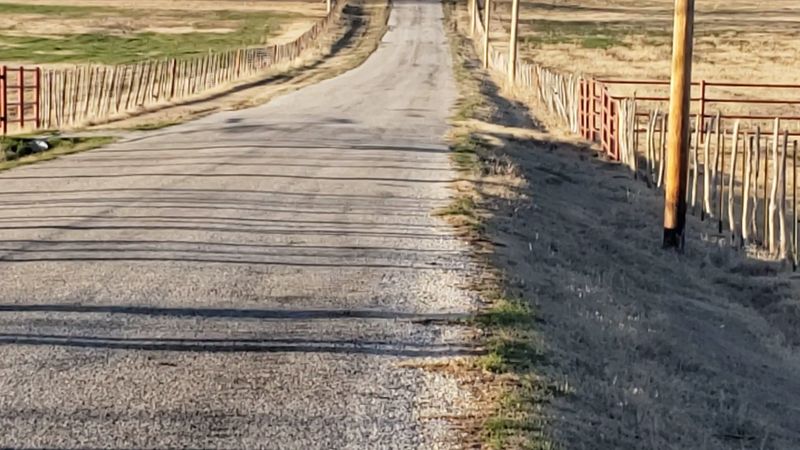
Put your car in neutral, take your foot off the brake, and watch your vehicle slowly creep uphill on its own. That is the promise of Magnetic Hill near Springer, Oklahoma, and it delivers every single time.
Located along Pioneer Rd, Springer, OK 73458, this stretch of road has been drawing curious drivers for decades. The hill appears to slope upward in the direction your car moves, yet the car rolls forward without any engine power.
Skeptics are quick to call it an optical illusion created by the surrounding landscape. The argument goes that the surrounding terrain creates a false visual horizon, making a gentle downhill slope look like an uphill climb.
That explanation is probably correct. But knowing the science does not make the experience any less disorienting when you are sitting in the driver’s seat watching your speedometer climb while your engine is off.
I stopped there on a bright afternoon and tried it three times in a row. Each time, my car rolled steadily forward for about forty feet before the road leveled out and stopped it naturally.
Local families have been sharing ghost stories about this hill for generations. The most popular version involves the spirit of a farmer who pushes stalled vehicles out of harm’s way.
Whether you believe in the paranormal version or the geological one, Magnetic Hill is a genuinely fun stop on any road trip through south-central Oklahoma. The drive through the surrounding countryside alone is worth the detour.
5. The Heavener Runestone, Heavener
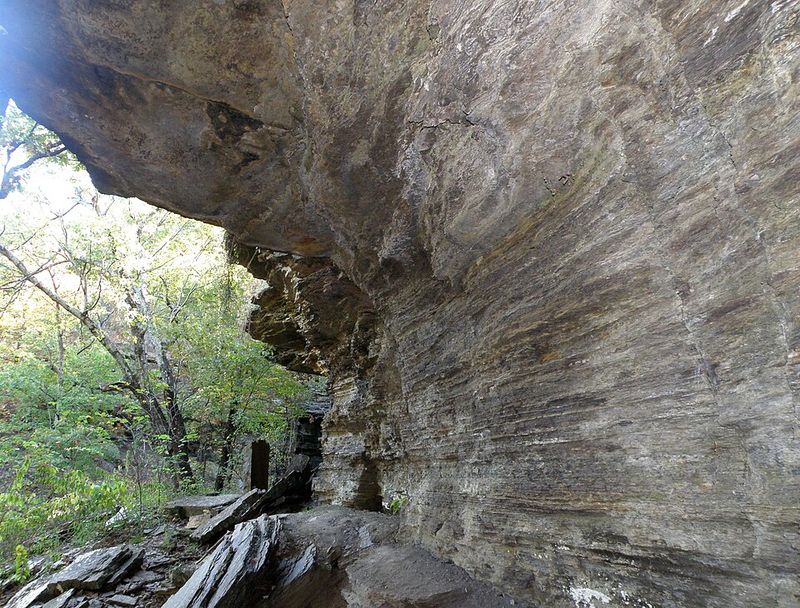
Carved into a massive sandstone slab inside Heavener Runestone Park, these eight runic symbols have been quietly rewriting assumptions about pre-Columbian history in North America since they were first widely documented.
The Heavener Runestone sits at Heavener Runestone Park Rd, Heavener, OK 74937, tucked into a sheltered ravine in the Ouachita Mountains of eastern Oklahoma. The carvings are deep, deliberate, and unmistakably runic in style.
Over the years, some fringe theories have suggested the carvings could be linked to Norse explorers who reached North America long before Columbus.
Mainstream historians and archaeologists, however, remain highly skeptical of those claims, and there is no accepted scientific consensus connecting the stone to Viking exploration.
The debate has never been settled. Linguistic analysis of the runes has produced multiple conflicting translations, and the geological dating of the stone itself has not produced a definitive answer either.
Supporters of the Norse-origin theory often point to other carved stones discovered around the region as part of the debate. Critics, however, argue those findings are inconclusive and do not provide definitive evidence about the runestone’s true origin.
I walked down into the ravine on a cool morning and stood face to face with the slab. The carvings are genuinely impressive in person, far larger and deeper than photographs suggest.
The park itself is well maintained and free to visit. Local guides are enthusiastic and knowledgeable, and the surrounding forest trail adds a beautiful natural frame to the whole experience.
Whatever their origin, these carvings represent one of the most thought-provoking historical puzzles I have encountered anywhere in the American interior.
6. The Parallel Forest, Lawton
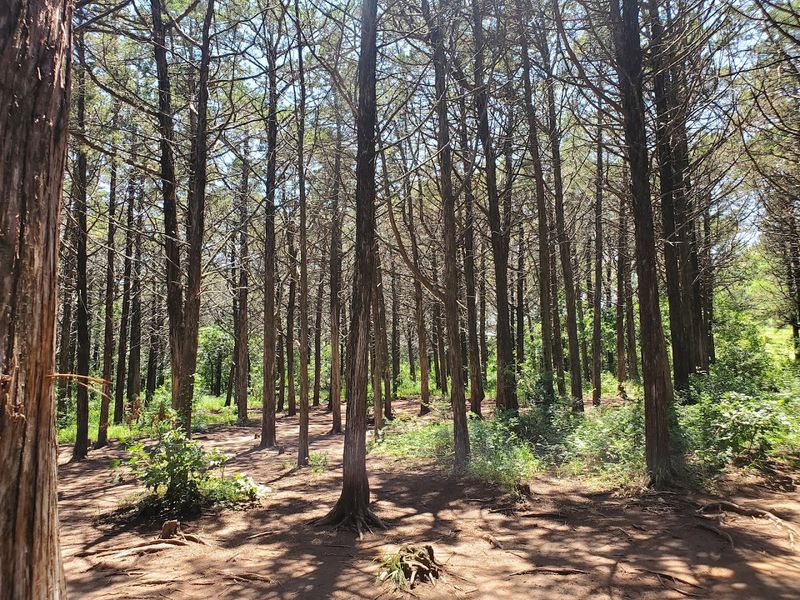
Somewhere in the Wichita Mountains near Lawton, Oklahoma, there is a forest that feels like it was designed by a mathematician having a very strange dream.
The Parallel Forest, accessible via Parallel Forest Trail, Lawton, OK 73505, consists of more than 20,000 red cedar trees planted in an exact grid pattern, each one spaced precisely six feet from the next in every direction.
The trees were planted as part of a government conservation project in the 1930s, intended to stabilize soil and prevent erosion. The crew that planted them followed their instructions a little too precisely, and the result is one of the most visually surreal natural spaces in the entire state.
Walking through it is genuinely disorienting. Every direction looks exactly the same.
The repeating columns of trees stretch to the horizon in perfect symmetry, and your depth perception starts playing tricks on you within minutes.
Locals have layered the forest with folklore over the decades. Stories about compasses spinning, time feeling distorted, and shadows moving between the trunks have become part of the area’s identity.
I hiked through on a cloudy afternoon when the light was flat and even, which made the grid effect even more pronounced. There were no landmarks to orient myself by, and I genuinely had to use my phone’s GPS to find my way back out.
The Wichita Mountains Wildlife Refuge surrounding the forest adds another layer of wild beauty to the visit. Bison and longhorn cattle roam freely just beyond the tree line.
7. The Oklahoma Octopus, Lake Tenkiller
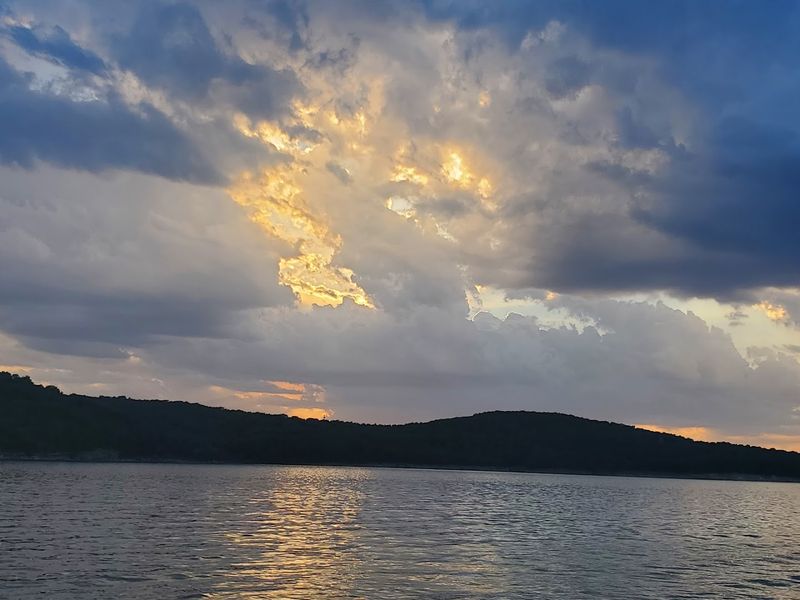
No creature in Oklahoma folklore inspires quite the same mix of fascination and unease as the legendary beast said to lurk beneath the surface of several of the state’s largest freshwater lakes.
The Oklahoma Octopus is most frequently associated with Lake Tenkiller State Park, Vian, OK 74962, though sightings have also been reported at Lake Thunderbird and Lake Oologah over the years.
Fishermen and recreational divers have described encounters with a large, reddish-brown creature with long, grasping limbs that moves through the deeper channels of these lakes. The descriptions are remarkably octopus-like, which is exactly what makes the reports so puzzling.
Freshwater octopuses do not exist anywhere on Earth. The biology simply does not work in landlocked, freshwater environments far from any ocean.
And yet the stories have persisted for generations, predating the internet and modern media by decades.
Some researchers suggest the sightings could involve large catfish, snapping turtles, or unusual underwater debris. None of those explanations fully satisfy the people who claim firsthand encounters.
I kayaked a section of Lake Tenkiller on a still morning, peering down through the dark green water into the deeper channels below. The lake is genuinely beautiful, with forested limestone bluffs rising from the shoreline.
It is also deep in places, and the visibility drops off quickly past the shallows. Whatever is down there, or is not down there, the lake keeps its secrets well.
Lake Tenkiller alone is worth a visit for its scenery, even if the octopus never makes an appearance.
8. The Hum of Enid, Enid

Imagine waking up at 2 a.m. to a low, steady vibration that seems to come from inside the walls, or possibly from inside your own skull, and not being able to find any source for it.
That is the experience that a number of residents in Enid, Oklahoma, have reported over the years. Downtown Enid, OK 73701, sits at the center of the reports, though accounts have come from neighborhoods spread across the city.
The phenomenon is often compared to the famous Taos Hum in New Mexico, a low-frequency sound that plagued that community for years without ever being fully explained. Enid’s version follows a similar pattern.
Investigators have examined local industrial facilities, natural gas infrastructure, and geological features beneath the city. No single source has been identified that accounts for the sound’s behavior or its selective audibility.
Not everyone can hear it. That selective quality is one of the most puzzling aspects.
Some people in the same household report the hum clearly while others hear absolutely nothing, even under the same conditions at the same moment.
I spent two nights in Enid specifically to experience it. The first night was quiet.
The second night, around 3 a.m., I caught what I can only describe as a faint vibration that seemed to originate just below the range of normal hearing.
Whether it was the Hum or just my imagination working overtime in a dark hotel room, I honestly cannot say with confidence.
Enid itself is a charming and welcoming city with great history. The Hum just adds an extra layer of intrigue to any overnight stay.
9. Black Mesa Shadow People, Kenton
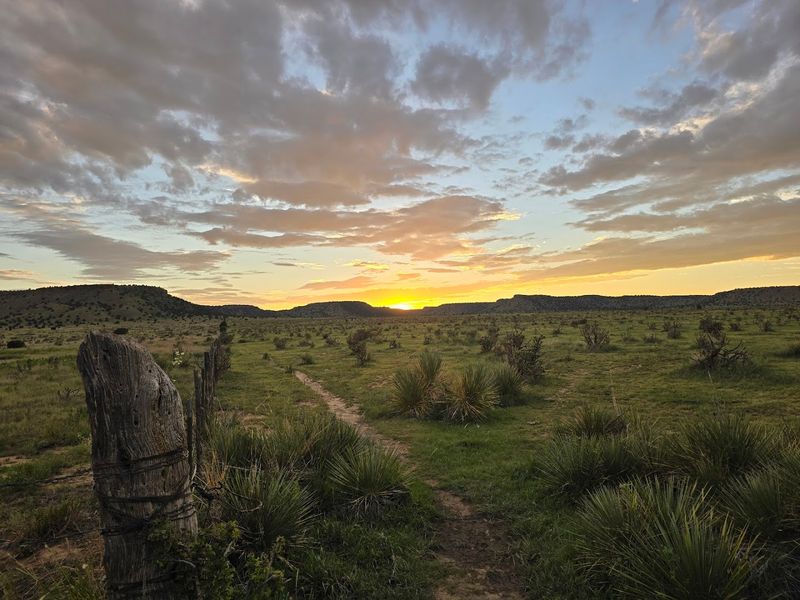
At the far western tip of the Oklahoma Panhandle, where the state touches both Colorado and New Mexico, Black Mesa rises from the surrounding plains like a table set for something ancient and unexplained.
Black Mesa Nature Preserve near Kenton, OK 73946, sits in one of the most remote corners of the entire country. The nearest town is tiny, the roads are long and empty, and the night sky above is some of the darkest in the continental United States.
That extreme darkness is what makes the reports coming out of this area so interesting. Hikers and campers have described seeing dark, humanoid shapes moving along the mesa trails and ridgelines, shapes that vanish the moment you look directly at them.
The “Shadow People” phenomenon has been reported in locations across the world, but the Black Mesa version is particularly striking because the absence of light pollution means that visual conditions out there are genuinely exceptional. Nothing is obscured by the orange haze of city glow.
Skeptics suggest that extreme darkness can cause the human visual system to generate its own imagery, a known phenomenon called pareidolia applied to shadow and peripheral vision. That is a reasonable argument.
I hiked the mesa trail at dusk and stayed through the first hours of full darkness. The Milky Way overhead was staggering, a dense river of light that made the dark ground below feel even darker by contrast.
And yes, I saw shapes at the edge of my vision more than once. Whether they were real or not, Black Mesa is a place that earns every story told about it.
