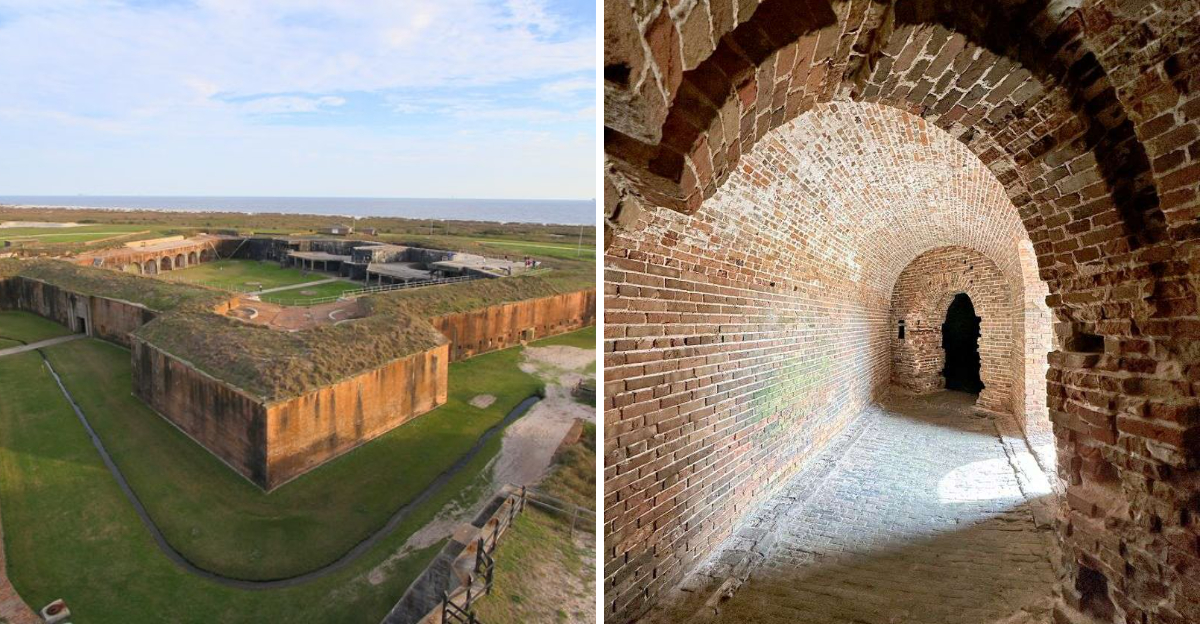
Fort Morgan sits at the very tip of the Alabama coast, where Mobile Bay meets the Gulf of Mexico, and it carries the weight of American history in every worn brick.
Built in 1834 and tested by four major wars, this massive pentagonal fortress still stands strong enough for visitors to wander its cannon ports, climb its staircases, and slip into its shadowy underground tunnels.
I find it hard not to feel something when walking through a place where soldiers once braced for bombardment, where the echoes of the Civil War are literally baked into the walls.
Whether you are a history enthusiast, a curious traveler, or a parent looking for something genuinely memorable, Fort Morgan offers an experience that is hard to match anywhere along the Gulf Coast.
Witness the Legacy of the Battle of Mobile Bay
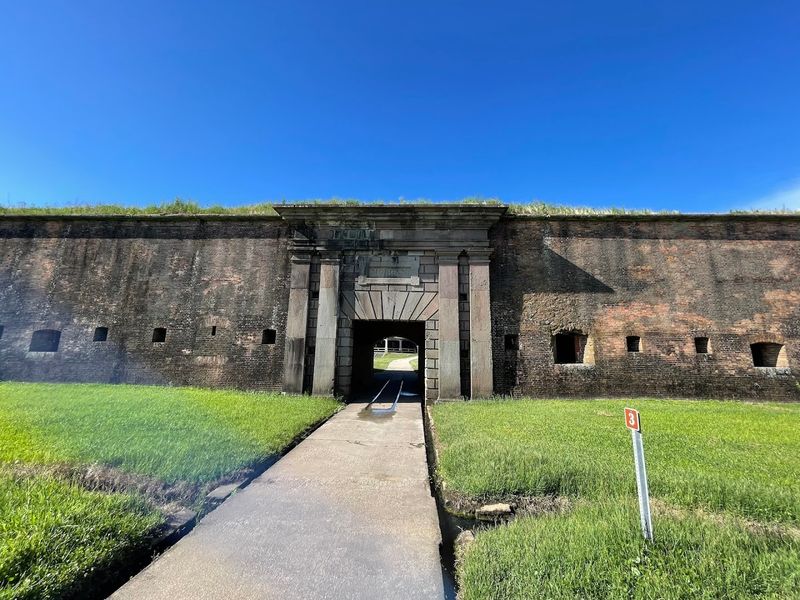
Few moments in American military history carry as much raw drama as the Battle of Mobile Bay in August 1864.
Union Admiral David Farragut, facing a minefield and Confederate fire, reportedly shouted the now-famous words, “Damn the torpedoes, full speed ahead!” That command became one of the most quoted lines in U.S. military history, and it happened right here.
Fort Morgan was at the center of that battle. Confederate forces held the fort while Union ships pushed through the bay under heavy fire.
The siege lasted two full weeks before the fort finally surrendered, making it one of the last major Confederate strongholds in the Gulf region to fall.
Standing near the water today, it is almost impossible not to picture that scene. The bay looks peaceful now, with dolphins occasionally surfacing and pelicans gliding overhead.
But the scarred brick walls and original cannon emplacements remind you that this was once a place of incredible violence and courage.
Visiting gives you a firsthand look at why this battle mattered. Closing Mobile Bay to Confederate supply ships was a strategic turning point that helped tip the war toward Union victory.
Fort Morgan is located at 110 AL-180, Gulf Shores, AL 36542, and is open daily from 8 AM to 4:30 PM. The site brings that chapter of history to life in a way no textbook ever quite manages to do.
Marvel at the Sheer Scale of 19th-Century Military Architecture
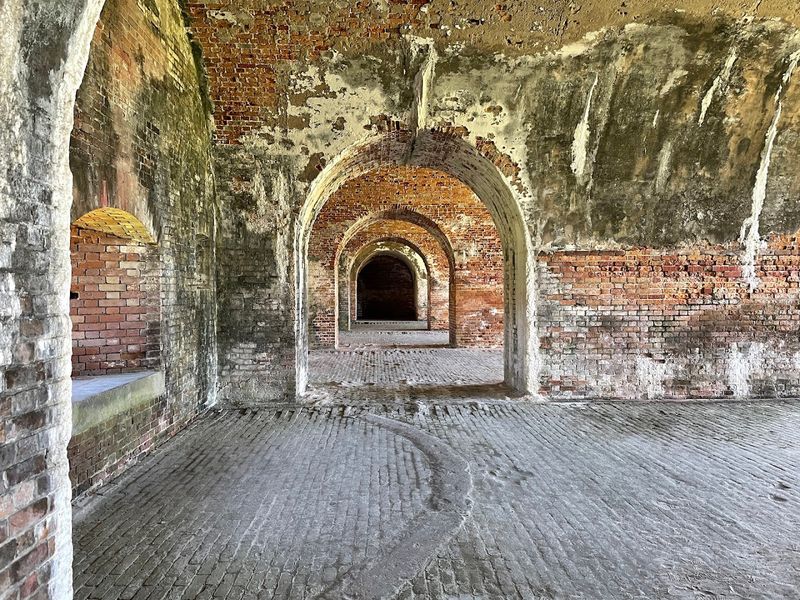
Completed in 1834, Fort Morgan required somewhere between 40 and 46 million bricks to build. That number alone stops most people in their tracks.
When you actually stand inside the fort and look up at those thick arching walls, the scale of that construction effort becomes very real and very impressive.
Scholars have described Fort Morgan as one of the finest examples of 19th-century military architecture in the New World. The pentagonal design was intentional, allowing defenders to cover every angle of approach without leaving blind spots.
The arched entryways, the vaulted casemates, and the sweeping ramparts all reflect a level of engineering precision that is remarkable for its era.
What makes the architecture so engaging is that it still functions as it was designed. You can walk through the same passageways soldiers used, look out from the same cannon ports, and climb the same ramparts where sentries once kept watch over the Gulf.
The structure has survived hurricanes, bombardments, and nearly two centuries of coastal weather.
Architecture fans and casual visitors alike tend to spend more time here than they planned. The visual detail rewards slow, attentive exploration.
If you want to see more historic coastal architecture in the area, Fort Gaines on Dauphin Island, located at 51 Bienville Blvd, Dauphin Island, AL 36528, sits directly across the bay and offers an interesting comparison to Fort Morgan’s design and scale.
Explore a Multi-War Historical Site Spanning Over a Century
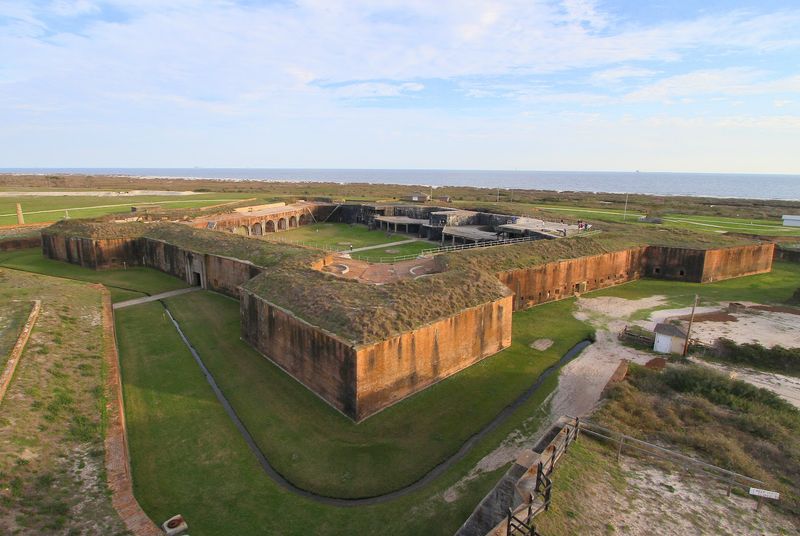
Most historic forts tell the story of one war. Fort Morgan tells the story of four.
Originally built on the site of Fort Bowyer, which played a role in the War of 1812, Fort Morgan itself was active during the Civil War, the Spanish-American War, World War I, and World War II. That kind of layered history is genuinely rare.
Each military era left its mark on the site. You can see the older masonry sections from the 1800s alongside concrete battery additions built for the World Wars.
The contrast between those periods is striking and gives the site a depth that keeps visitors exploring long after they expected to leave.
World War II additions include reinforced gun batteries that were positioned to guard the Gulf against potential enemy naval threats. Those massive concrete structures still loom over the landscape, weathered but largely intact.
Seeing them alongside 19th-century brick arches in the same visit is a genuinely unusual experience.
For families, teachers, and anyone who enjoys connecting the dots of American military history, this site offers something beyond a single-era snapshot. The fort grounds are wide open for self-guided exploration, and the variety of structures means there is always something new to notice.
Nearby, the Gulf State Park at 20115 State Hwy 135, Gulf Shores, AL 36542, offers additional outdoor space for visitors who want to extend their day along the coast.
Walk Through a Half-Mile Maze of Brick Tunnels and Hidden Passages
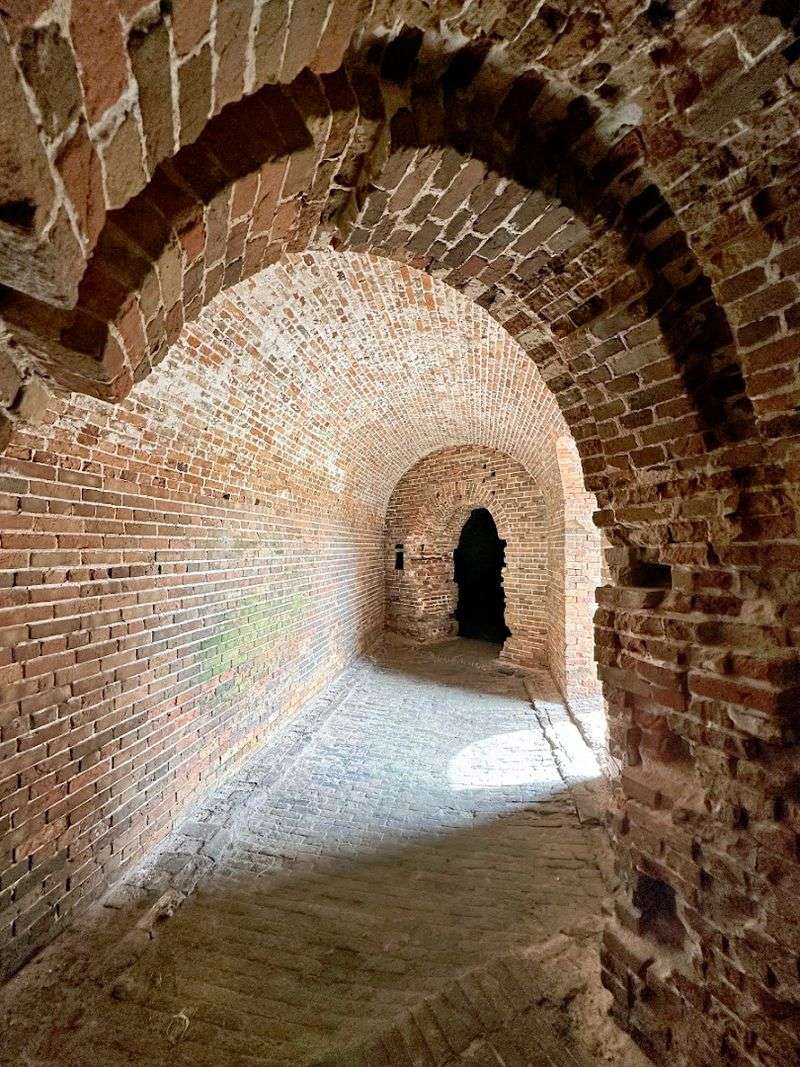
Somewhere between history lesson and genuine adventure, the tunnels at Fort Morgan occupy a category all their own. The fort contains roughly a half-mile of brick passages winding through its interior walls.
These were not decorative. They were built for real tactical purposes, allowing soldiers to move covertly, protect gunpowder stores, and shelter personnel during bombardments.
The postern tunnel, which connects to the sally port, is one of the most atmospheric sections of the entire site. Moving through it, you notice how the temperature drops noticeably, sometimes 10 to 15 degrees cooler than the outside air.
The brick curves overhead, the light gets thin, and the sounds from outside disappear almost completely. It is the kind of place that makes history feel physical rather than abstract.
Children especially tend to love this part of the visit. The tunnels feel exploratory in a way that is hard to manufacture, and the sense of discovery is genuine.
Adults often find themselves moving slowly and quietly, almost instinctively, as if the space demands a certain kind of attention.
Bringing a small flashlight is a smart move, particularly if you want to examine the brickwork closely or take photographs in the darker sections.
Experience the Eerie Atmosphere of Underground Chambers and Night Walks
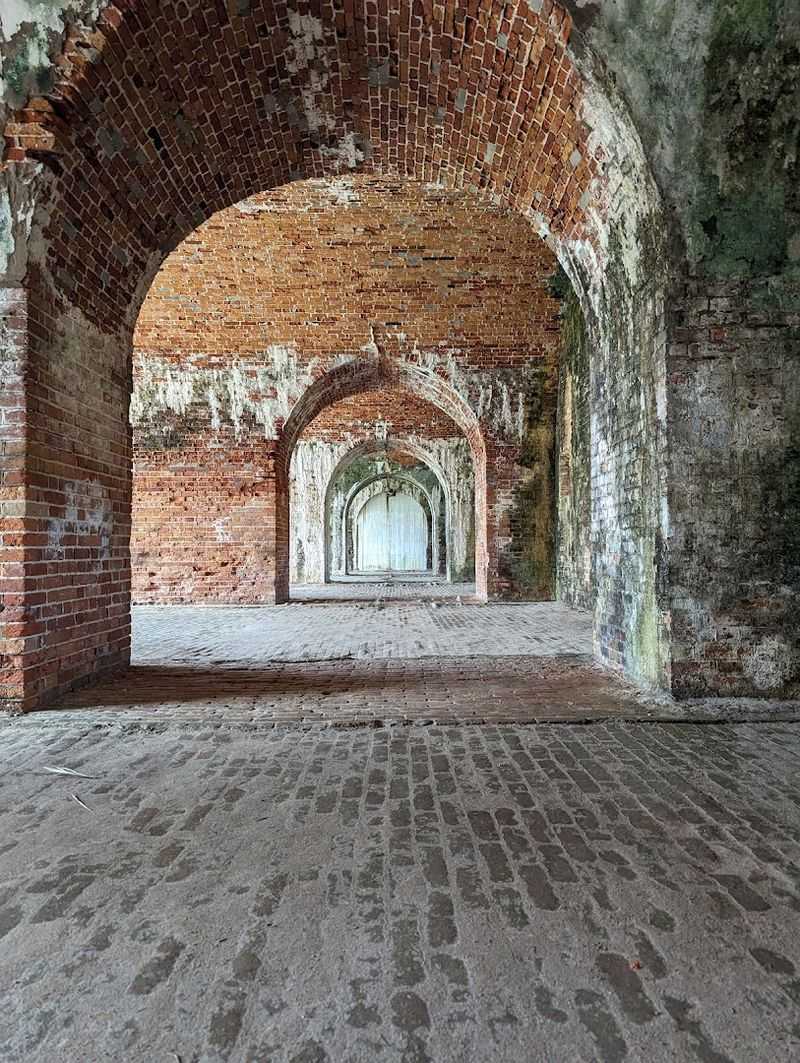
There is something about Fort Morgan after the afternoon light fades that shifts the mood entirely. The fort has developed a quiet reputation among locals for unexplained sounds and what some describe as a lingering presence in certain chambers.
Whether you believe in that kind of thing or not, the atmosphere is undeniably striking once the crowds thin out.
Seasonal night walks and special event programs are offered at the site, and they draw visitors who want to experience the fort in a completely different light.
Moving through the underground chambers by lantern or flashlight, with the Gulf wind audible above and the brick walls pressing close, is not something you forget easily.
The cooler tunnel temperatures make the experience feel genuinely removed from the outside world.
Local lore includes stories of spectral soldiers and faint footsteps echoing through empty passages. Fort Morgan has been featured in regional ghost tour discussions, and the Civil War history of the site gives those stories a weight that purely invented haunted attractions simply cannot replicate.
Whether the appeal is historical, atmospheric, or something harder to explain, the night experience here is distinctive.
For visitors who want to round out an evening after a daytime fort visit, The Original Oyster House at 701 AL-59, Gulf Shores, AL 36542, is a well-known local seafood spot offering views of the Intracoastal Waterway and a relaxed coastal atmosphere that fits the mood of a day spent exploring military history.
Discover History Up Close at the Fort Morgan Museum
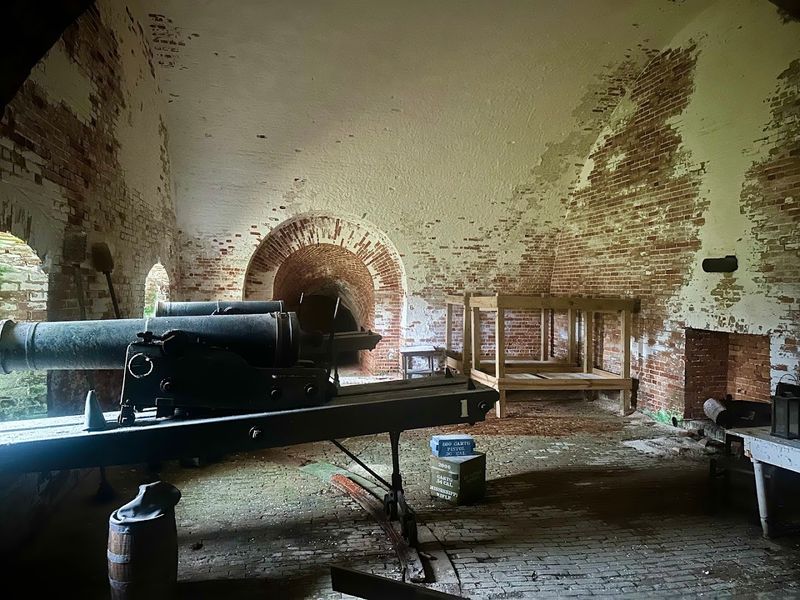
The museum at Fort Morgan punches well above its size. Compact but thoughtfully arranged, it covers the military history of Mobile Point from 1814 all the way to 1945.
That span of over 130 years is represented through uniforms, weapons, personal items, and documents that were recovered from the site or donated by families connected to its history.
Civil War artifacts form the emotional core of the collection. Seeing a soldier’s uniform or a handwritten letter from that period, knowing it came from this exact location, creates a connection that generic museum displays rarely achieve.
The weapons on display include period-accurate rifles and artillery components that help visitors understand the mechanics of the battles fought here.
Beyond the Civil War materials, the museum addresses the fort’s roles in the Spanish-American War and both World Wars. That broader timeline helps visitors understand how the site evolved from a masonry fortress into a modern coastal defense installation over the course of a century.
The progression is genuinely fascinating to trace.
Admission to the museum is included with site entry, and no reservation is required. The gift shop near the museum entrance carries books, maps, and educational materials for those who want to continue learning after the visit.
For more regional history, the Gulf Shores Museum at 244 W 19th Ave, Gulf Shores, AL 36542, offers a complementary perspective on the area’s cultural and coastal heritage that pairs well with a Fort Morgan visit.
Engage with Living History Programs and Military Reenactments
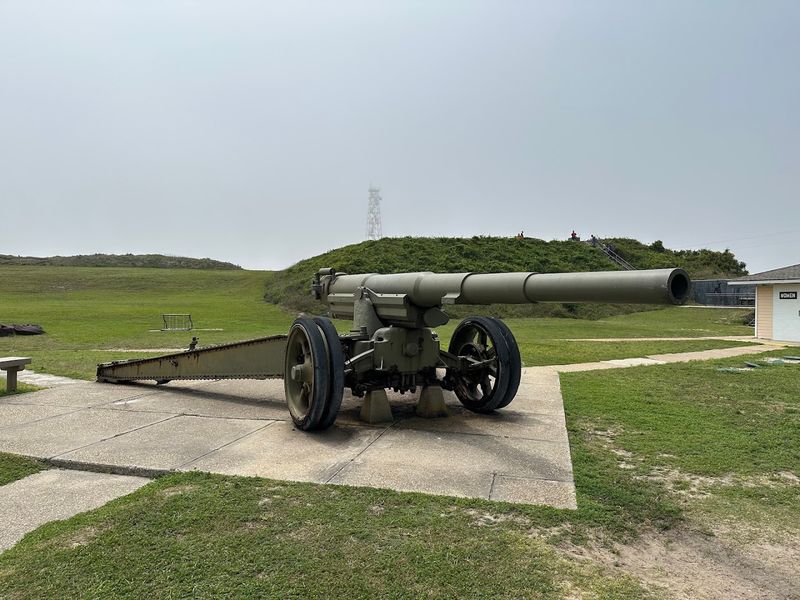
History comes alive in a completely different way when the people interpreting it are dressed in period uniforms, loading replica cannons, and demonstrating the daily routines of 19th-century military life.
Fort Morgan hosts living history programs and reenactments throughout the year, and they draw participants and spectators who take the experience seriously.
These events cover multiple eras of the fort’s active history. Civil War demonstrations are the most common, but programs addressing the Spanish-American War period and World War II are also part of the calendar.
Watching a cannon demonstration within the actual fort walls, surrounded by original brickwork that survived real bombardments, gives the performance a grounding that staged environments simply cannot replicate.
Families with school-age children find these programs especially valuable. Kids who might glaze over during a standard museum walkthrough tend to engage completely when a reenactor explains how a musket works or demonstrates battlefield communication.
The interactive format makes abstract history concrete in a way that sticks.
For a full day out, the Flora-Bama Lazy River area and nearby Gulf State Park Trail System at 20115 State Hwy 135, Gulf Shores, AL 36542, offer outdoor activities that complement a morning spent at the fort with the family.
