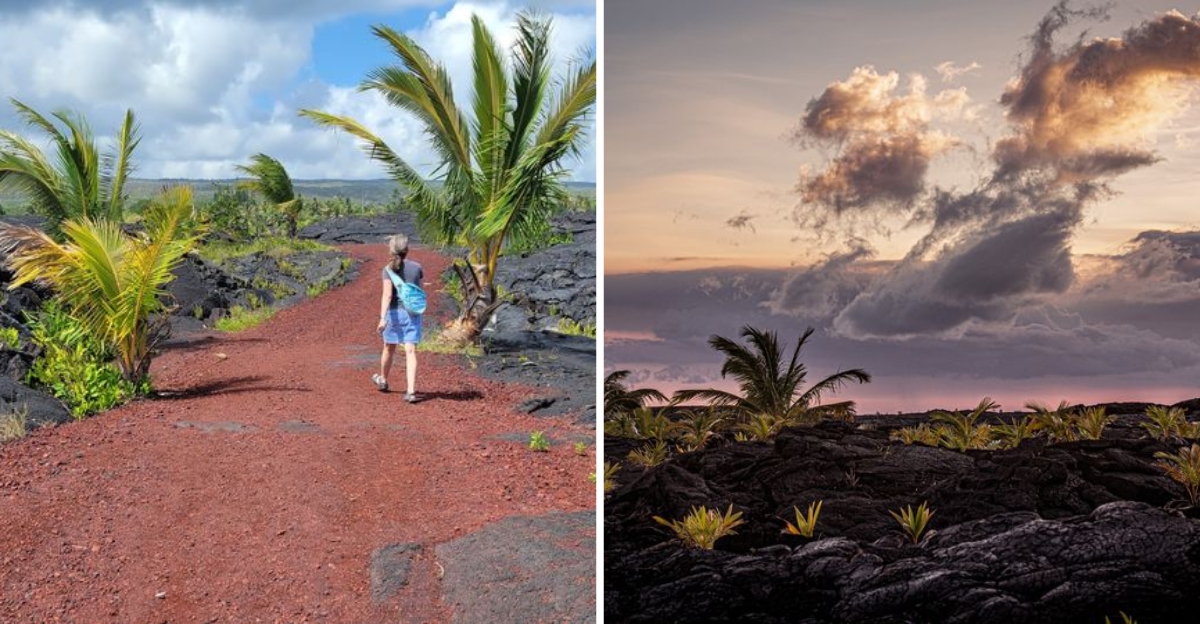
Deep black sand stretched out before me, meeting the vivid blue Pacific in a way that made every other shoreline I had ever visited feel oddly ordinary.
Hawaii has a beach at the end of a highway where the landscape looks sculpted by something far beyond human hands.
Dark volcanic rock, young coconut palms pushing through lava cracks, and ocean spray exploding against jagged cliffs.
That beach carries the weight of a real story, a 1990 lava flow that buried an entire town and then, slowly, gave birth to something brand new.
I walked along that black sand, the heat still faintly rising from the rock beneath my feet, and felt like I was standing on ground that was still being made.
Coming here felt less like visiting a beach and more like witnessing the Earth quietly, powerfully, rewriting itself.
Where Fire Met the Sea: A Land Reborn from Lava
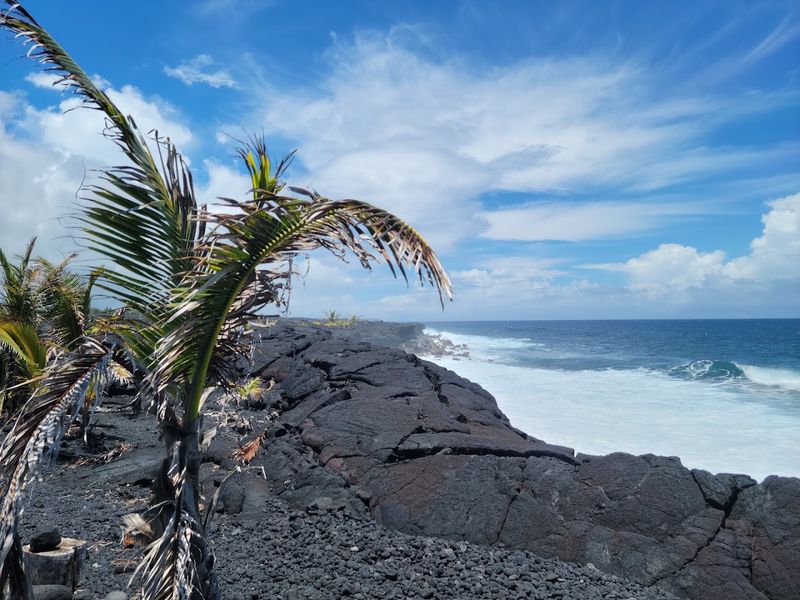
In 1990, K?lauea volcano changed everything at Kalapana.
Lava from the Pu?u ???? vent poured down the hillside, burying the original Kaim? Black Sand Beach and the surrounding neighborhood under 50 to 80 feet of molten rock.
An entire community, homes, roads, and a beloved palm-fringed shoreline, vanished beneath hardened lava in a matter of months.
What makes this place so extraordinary is what happened next.
The relentless Pacific Ocean began its slow, patient work, crashing against the new lava and grinding it into fine black particles.
A new beach started forming almost immediately, raw and restless, born directly from destruction.
The sand here is not soft or ancient.
It is made of tiny lava fragments, sometimes sharp underfoot, always shifting with the tides.
Some days the beach is wide and dramatic.
Other days it nearly disappears, swallowed back by the waves that created it.
This constant cycle of formation and erasure makes Kaim? one of the most genuinely dynamic shorelines anywhere on Earth.
There is something deeply humbling about standing on ground that is younger than many people reading this.
The lava beneath your feet is still, in geological terms, fresh.
The Big Island is the youngest landmass in the Hawaiian chain, and Kaim? is one of its most vivid reminders that this island is not finished growing.
It is still building itself, one wave and one lava fragment at a time, making every visit feel like a front-row seat to creation itself.
The Trail Across the Moon: Getting to the Beach
The walk to Kaim? is genuinely unlike any other beach approach I have ever taken.
The trail begins near the end of Highway 130 in the Kalapana area, where the road simply stops, swallowed by that same 1990 lava flow.
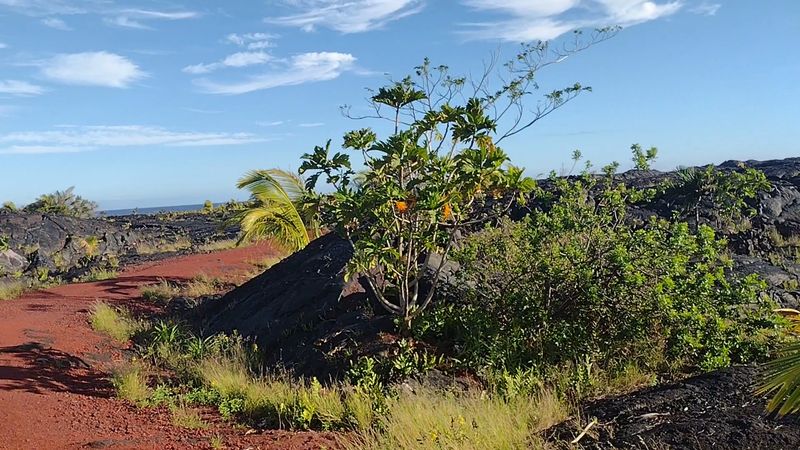
From there, the Kaim? Beach Eco-Path leads across a flat, barren expanse of hardened lava toward the ocean.
It is a short journey, roughly a quarter mile or about 300 meters, taking somewhere between 10 and 15 minutes at an easy pace.
But every single step feels different.
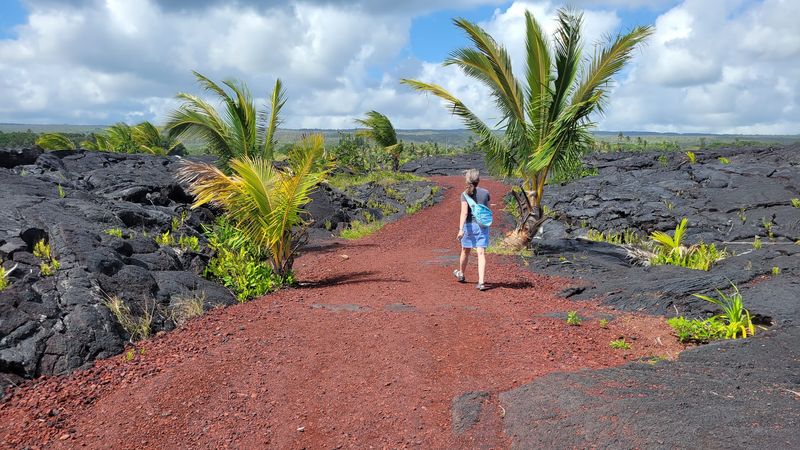
The familiar green of Hawaii gives way almost immediately to a stark, moon-like terrain of black and dark grey rock, broken only by the occasional daring fern or young palm tree pushing up through a crack.
The path itself is marked with red cinder gravel, which someone clearly put a great deal of effort into laying across the uneven lava surface.
Wearing sturdy closed-toe shoes is genuinely important here, not just a suggestion.
The lava surface can be uneven and sharp in places, and the dark ground absorbs heat aggressively under the midday sun.
Bringing water is equally smart, since there is virtually no shade along the trail.
The exposed stretch can feel surprisingly warm even on a mild Hawaiian afternoon.
Despite all that, the walk never feels like a hardship.
The strangeness of the landscape pulls you forward with real curiosity.
By the time the ocean comes into view, framed by jagged black cliffs, the short hike feels completely worth every careful step.
Coconut Palms and Courage: How Life Reclaims the Lava
One of the most quietly moving things about Kaim? is watching life push back.
Scattered across that seemingly inhospitable lava field, hundreds of young coconut palms, breadfruit trees, ti plants, and papaya trees are doing exactly that.
They are cracking through solid rock, finding moisture in porous lava, and growing toward the sun with stubborn, cheerful persistence.
These trees did not arrive by accident.
After the 1990 eruption wiped out the beloved coconut groves that once lined the original Kaim? beach, local residents and volunteers began a long, patient replanting effort.
They carried seedlings out across the lava field and tucked them into crevices, hoping to bring back the green that had been lost.
That effort is still visible and still growing today.
Visitors are often invited to participate in the replanting.
Seeing a coconut nestled into a crack in fresh lava, already sprouting a small green shoot, feels almost impossibly hopeful.
It is one of those small details that sneaks up on you and suddenly feels like the whole point of the trip.
The contrast is visually striking too.
Against all that dark, dramatic rock, each patch of green reads like a small act of defiance.
Some of the palms planted in the years after the eruption are now tall enough to produce coconuts, which means this restoration effort is genuinely working.
It is a living, breathing reminder that communities and ecosystems can rebuild, not perfectly or quickly, but steadily, and with real beauty emerging along the way.
Raw Power on the Shore: Why This Is Not a Swimming Beach
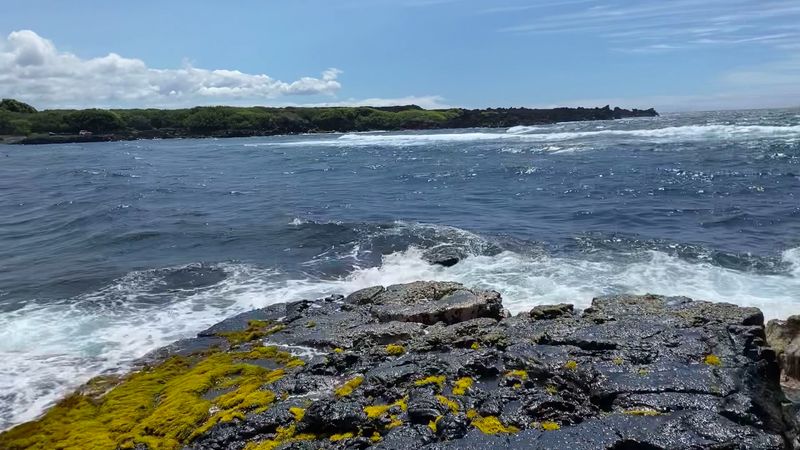
The first time I saw the surf hit those black lava cliffs, my jaw dropped a little.
The waves at Kaim? do not gently lap at the shore the way they might at a calm bay beach.
They arrive with serious force, slamming into the rocky edges and sending white spray shooting upward in tall, dramatic bursts.
It is genuinely spectacular to watch.
But that same power makes swimming here a firm no. The currents are strong and unpredictable, the drop from shore to waterline can be a sudden 6 to 10 feet of jagged lava rock, and there are no lifeguards anywhere nearby.
Locals are clear about this, and the landscape itself communicates it pretty plainly if you pay attention.
Even reaching the actual sand, when it is present, requires carefully picking your way down rough lava edges.
The black sand itself can vanish entirely for days or weeks, depending on tidal patterns and wave action, before reappearing overnight as if nothing happened.
This unpredictability is part of what makes Kaim? feel so alive and untamed compared to most beaches.
There is also something unexpectedly satisfying about a beach you cannot swim at.
It removes the usual beach-day checklist entirely and replaces it with pure observation.
You end up noticing things you would normally walk past, the texture of the lava, the sound of black rocks tumbling in the surf, the way the mist from a big wave catches the light.
Kaim? rewards patience and attention in a way that few places really do.
A Photographer’s Dream: Light, Contrast, and Volcanic Drama
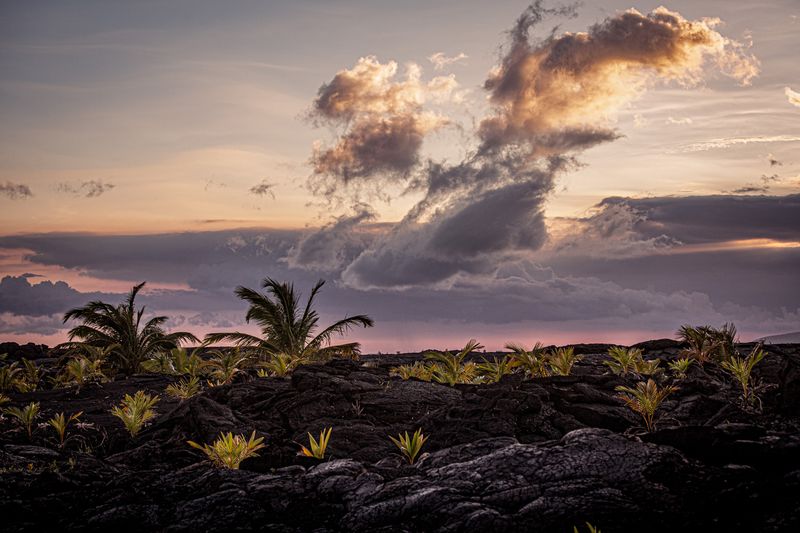
Honestly, I lost track of time at Kaim? because my camera kept finding new things to point at.
The visual contrasts here are extraordinary in a way that feels almost deliberately composed.
Deep black sand, vivid green palms, brilliant blue water, and a sky that turns molten orange at sunset create a color palette that genuinely does not exist at most beaches on Earth.
The textures are just as compelling as the colors.
Smooth pahoehoe lava with its rippled, rope-like surface sits right beside rougher, chunkier formations.
Tiny ferns catch the light in the cracks.
The ocean surface shifts from deep navy to turquoise depending on the angle and the time of day.
Sunrise and sunset visits offer the most dramatic light.
The low sun rakes across the lava field and throws every ripple and ridge into sharp relief, making the landscape look even more otherworldly than it does at midday.
Sunset in particular turns the whole scene into something that genuinely looks painted, with the dark foreground contrasting against a sky full of warm color.
Weekday visits tend to mean fewer people, which makes a real difference for photography and for the overall feeling of the place.
There is something special about having this dramatic coastline nearly to yourself, just the sound of the waves, the warmth of the rock underfoot, and the sensation that you have stumbled onto something the rest of the world has not quite found yet.
Kaim? rewards those who make the drive to the end of the road.
Uncle Robert’s and the Living Community of Kalapana
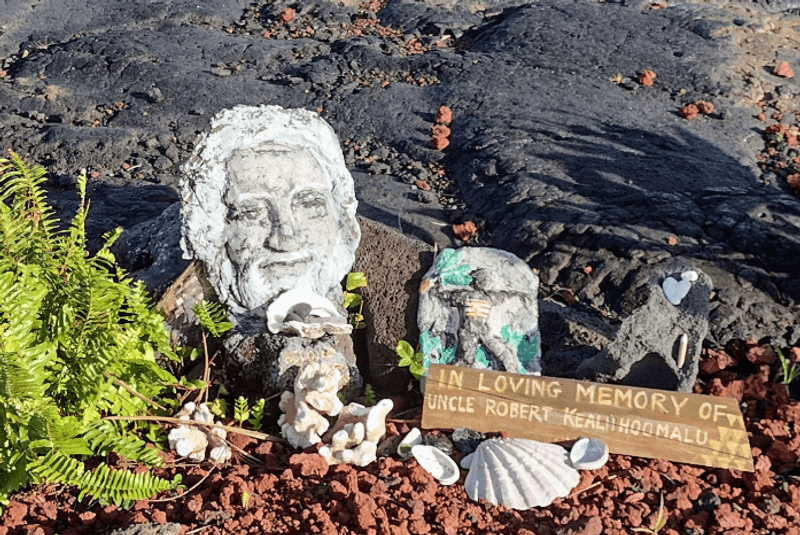
Kaim? Black Sand Beach has no restrooms, no snack stands, and no rental chairs.
That is simply the reality, and knowing it ahead of time makes the experience much smoother.
But just a short walk back from the beach trail, the Kalapana area offers something genuinely warm and worth stopping for.
Uncle Robert’s is the heart of it.
Part roadside market, part gathering place, part community hub, this spot near the end of Highway 130 brings together food vendors, smoothie stands, local crafts, and a real sense of neighborhood pride.
On Wednesday evenings, the area hosts a lively night market with food stalls and live music that draws both locals and visitors together in a way that feels completely unpretentious and welcoming.
Saturday mornings bring a farmers market running until around noon, where you can find local produce, homemade goods, and the kind of casual, friendly conversation that makes you feel like you have been welcomed into something genuine rather than just sold something.
Fresh fruit after a hike across black lava is, for the record, an excellent life decision.
The community around Kalapana carries a resilience that is almost palpable.
This is a neighborhood that lost almost everything to lava and then rebuilt, not just physically but culturally.
The market vendors, the replanted trees, the maintained trail, all of it reflects people who chose to stay and create something meaningful from what remained.
Visiting Kaim? and then spending a little time at Uncle Robert’s gives the whole trip an extra layer of meaning that a simple beach visit rarely provides.
