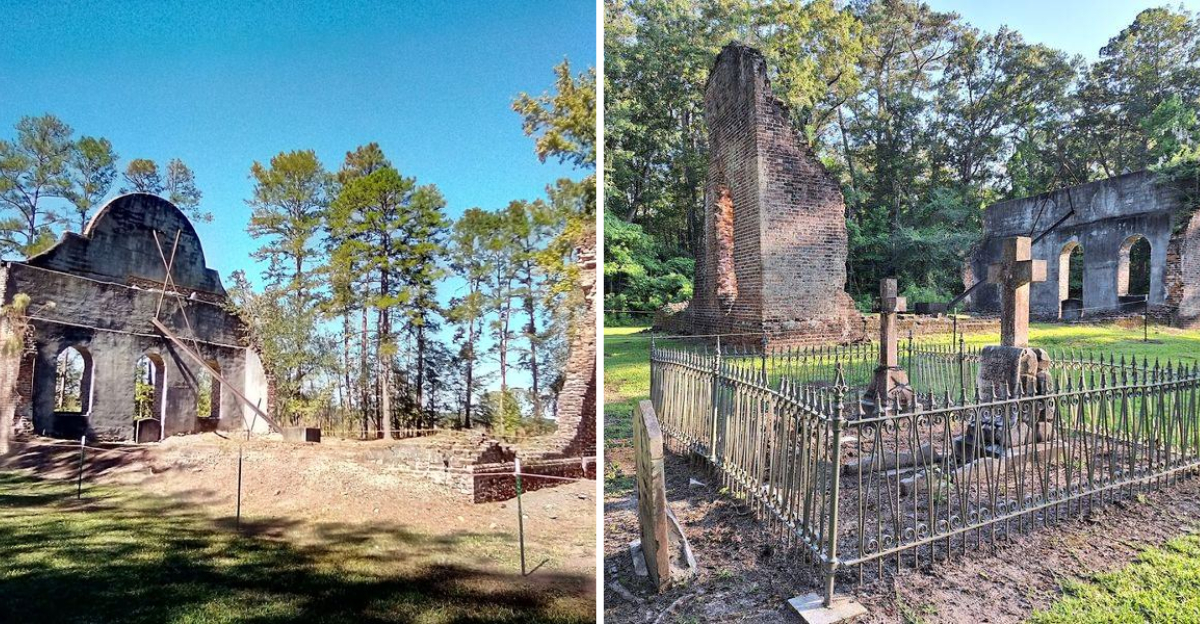
Some buildings just cannot catch a break. This chapel in South Carolina burned not once, not twice, but three separate times.
Each time the congregation rebuilt, and each time the flames came back. The last fire left nothing but a shell and a story that would not end.
The minister who preached there in the early days apparently decided his work was not finished. Locals whisper about seeing him walking the grounds at night, carrying a lantern long after electricity was invented. He does not speak.
He does not threaten. He just walks, lighting the path to a chapel that no longer has a roof.
People who live nearby say you can sometimes hear the creak of the floorboards under his feet when there is no one else around. South Carolina has plenty of ghost stories, but this one feels different. There is something patient about him, like he is waiting for something that has not come yet.
Maybe he just loved that chapel too much to leave it alone in the dark.
The First Chapel and the Preacher Who Left His Mark
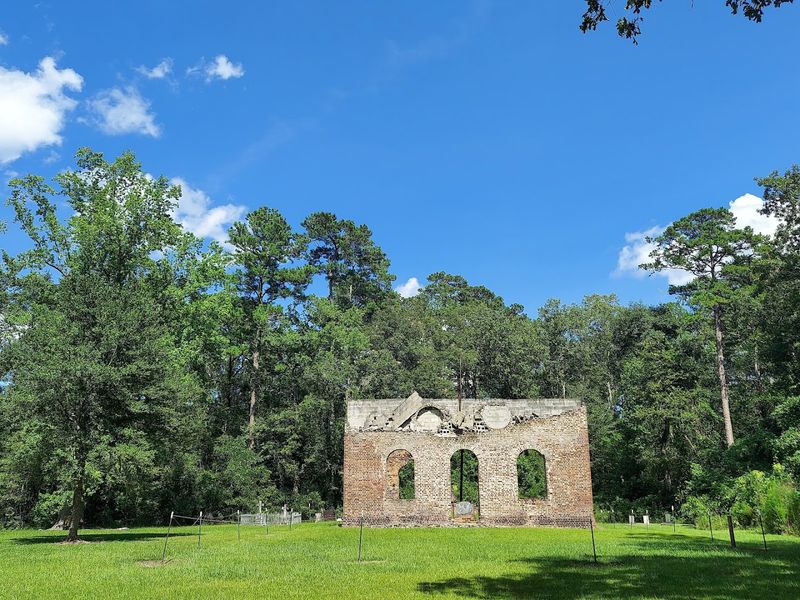
Long before brick and mortar replaced wood and prayer, a modest wooden chapel rose from the South Carolina lowcountry in 1725. It was called a Chapel of Ease, a term used for churches built to serve parishioners who lived too far from the main parish church to attend regularly.
The name sounds almost apologetic, but the building itself carried real spiritual weight.
In 1737, a young John Wesley, the man who would go on to found the Methodist movement, preached two sermons from that very pulpit. Think about that for a second.
A figure whose influence eventually spread across continents once stood in this small, swampy corner of South Carolina and spoke to a congregation gathered among the trees. The wooden chapel was replaced by a brick structure in 1754, but the echo of those early sermons seems to cling to the soil.
Visiting this site knowing that history changes how you look at the crumbling walls. It is not just decay.
It is the residue of something that once burned bright, spiritually and literally. The ground here has held centuries of voices, and that first wooden chapel was where it all began.
Three Fires and a Reputation That Would Not Pass
Most historic buildings survive one disaster. Pon Pon Chapel of Ease survived three, sort of.
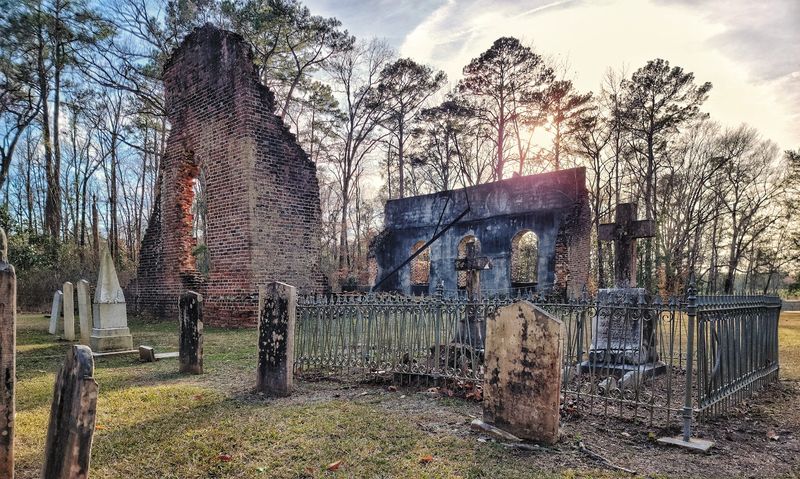
The brick chapel built in 1754 burned around 1801, earning the site its enduring nickname, The Burnt Church. That name stuck the way nicknames do when they carry a story too good to let go.
The community rebuilt between 1819 and 1822, which says something about how much this place meant to the people of Colleton County. But by 1832, the structure was reduced to ruins again, either by fire or another catastrophic event, and this time nobody rebuilt.
The county seat had moved, and parishioners had scattered to other parts of the region. The chapel was simply left to the elements.
Then Hurricane Gracie tore through in 1959, doing further damage to what little remained. A partial collapse in July 2020 brought down part of the front facade that visitors had admired for years.
Each disaster peeled away another layer, but the core of the place, those stubborn brick walls rising from the earth, kept holding on. Three fires, two hurricanes, two centuries, and the ruins are still here.
That kind of persistence feels less like coincidence and more like intention.
The Legend of the Minister and His Lantern
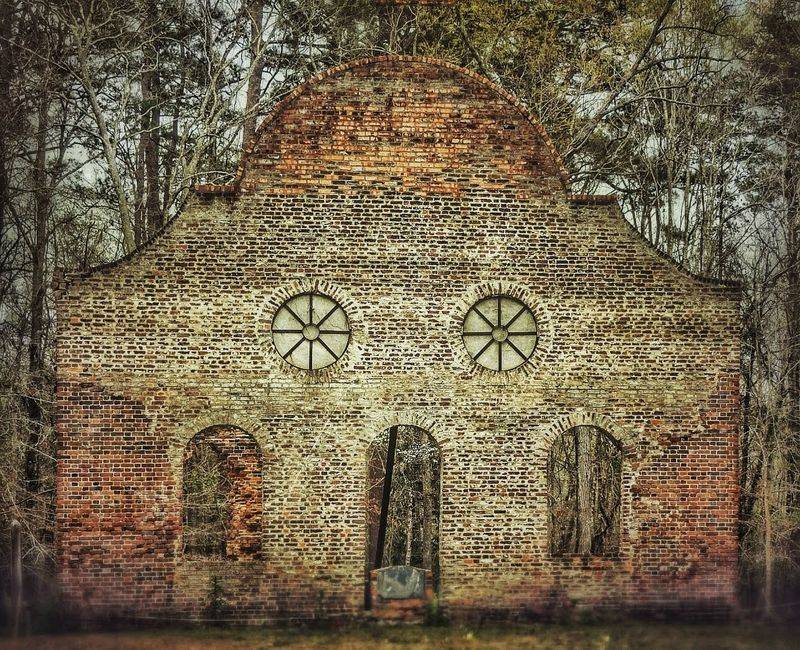
No verified historical record confirms the story, but that has never stopped a good legend from breathing. Around Colleton County, some people will tell you that on certain nights, a faint light moves through the ruins of Pon Pon Chapel of Ease.
The figure, they say, is a minister, still making his rounds, still tending to his flock long after the last service was held.
Local legends like this one tend to grow in places where history runs deep and the losses feel personal. A chapel that burned repeatedly, a congregation that eventually dissolved, a site left alone for nearly two centuries, these are the ingredients that turn grief into ghost stories.
The minister with the lantern might be a way of saying that some devotion does not end just because the building does.
Whether you believe it or not, standing inside those ruins at dusk, when the light goes golden and the shadows stretch long across the old gravestones, the legend does not feel ridiculous. It feels like the kind of thing a place earns after three hundred years of surviving the unsurvivable.
The lantern story is not just spooky folklore. It is the site’s way of staying alive in the imagination.
The Graveyard That Outlasted the Church
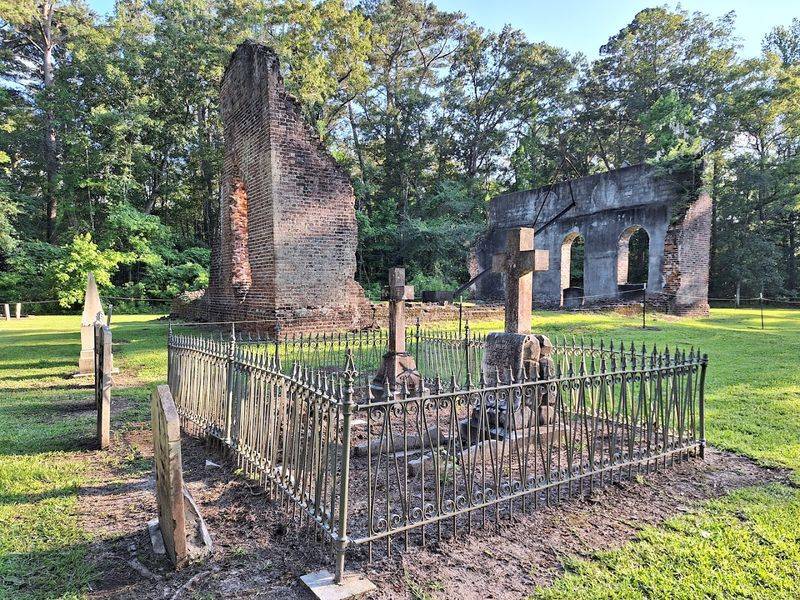
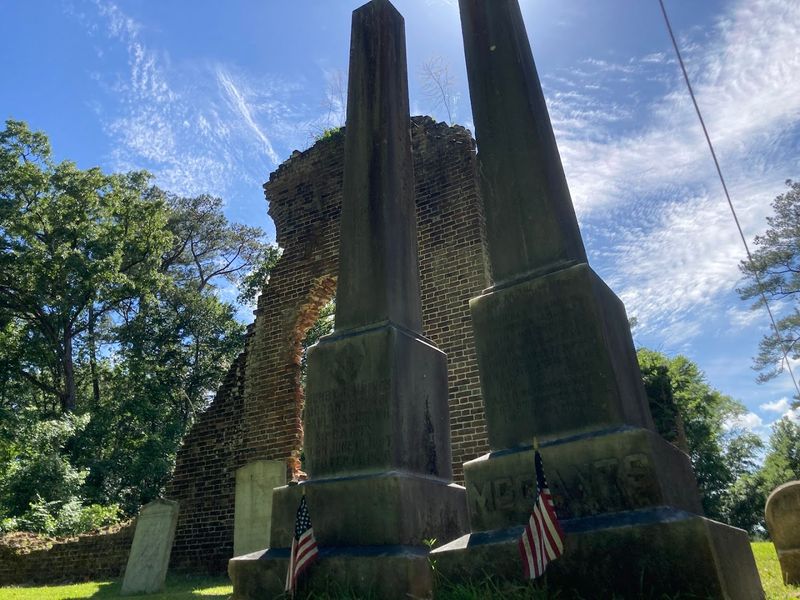
Behind the chapel ruins, a small cemetery holds its ground with quiet dignity. The gravestones range from barely legible slabs of the early 1800s to markers that stretch into the early twentieth century, which means the burial ground outlasted the congregation by generations.
Some visitors say reading the inscriptions is the most affecting part of the visit.
One reviewer mentioned pausing over the stones and wondering whether the descendants of those buried here even know this place exists. It is a fair question.
The names carved into the old markers belonged to real families, real lives, real losses that someone once felt deeply enough to commission a stone in memoriam. Time has a way of dissolving those connections, and standing here makes you feel the weight of that erasure.
The grounds around the cemetery are generally kept tidy, and the site is open to visitors during daylight hours. Benches and a couple of picnic tables make it easy to sit quietly and just absorb the atmosphere.
Wildlife is active here too. Deer have been spotted stepping through the tall grass near the edges of the property.
The graveyard is not a sad place, exactly. It feels more like a pause, a moment where history asks you to slow down and pay attention.
John Wesley’s Unexpected South Carolina Stop
John Wesley arrived in the American colonies in 1736 as a Church of England missionary, full of ambition and theological conviction. His time in Georgia was famously complicated, but his brief journey into South Carolina left a quieter mark.
In 1737, he preached two sermons at the wooden Pon Pon Chapel of Ease, an obscure stop on a journey that would eventually shape global Christianity.
Wesley returned to England not long after and went through a profound spiritual transformation. By the 1740s, he was leading the movement that became Methodism, a tradition that now claims tens of millions of followers worldwide.
The little wooden chapel in Colleton County had no way of knowing it was hosting a preview of history in the making.
That connection gives the site a significance that goes well beyond South Carolina. For visitors with an interest in religious history, standing where Wesley once stood is genuinely moving.
The original wooden structure is long gone, replaced first by the brick chapel and then by ruins, but the ground remains the same. There is something quietly remarkable about a place this remote holding that kind of story inside it.
It rewards the visitors who come prepared to look past the crumbling walls and into the deeper layers of what happened here.
What Visiting the Ruins Actually Feels Like
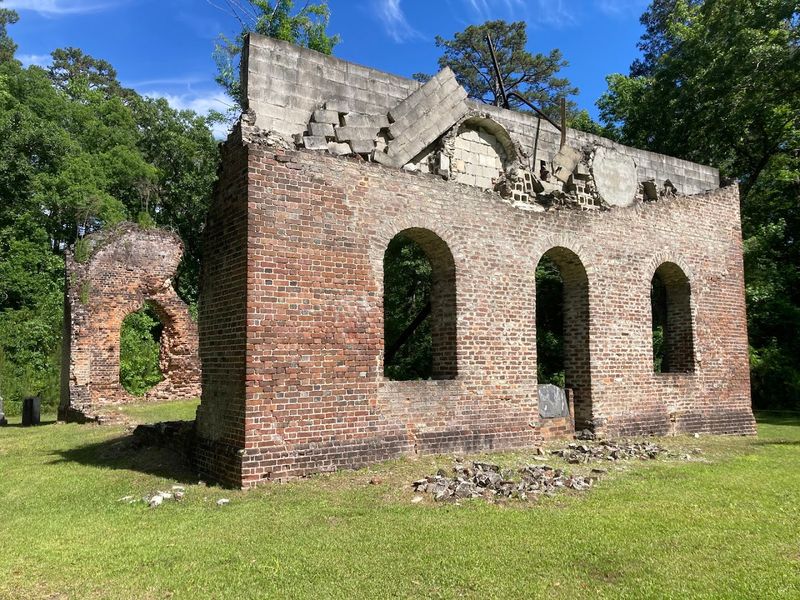
Pulling off Parkers Ferry Road for the first time, the site appears almost without warning. A gate blocks vehicle access, but a small opening beside it lets visitors walk in on foot.
The ruins sit a short distance from the road, framed by trees and low vegetation, and the first impression is of something genuinely old and genuinely still.
Security ropes mark the boundary around the most fragile sections of the walls. Signs remind visitors not to cross them, and it is worth taking that seriously.
The walls are unstable in places, and the partial collapse of 2020 is a visible reminder that this structure is actively deteriorating. Staying behind the ropes is not just a rule, it is how the place survives long enough for the next visitor to see it.
The atmosphere inside the open grounds is hard to put into words without sounding dramatic. Quiet is the first thing you notice.
Then the texture of the old brick, the way the light filters through the open roof where there once was a ceiling. A couple of reviewers described feeling something they could not quite name, and that tracks.
Some places have an emotional frequency that does not need explanation. Pon Pon Chapel of Ease is one of them.
Admission is free, and the site is open daily from 8 AM to 6 PM.
Preservation, Deterioration, and Why It Still Matters
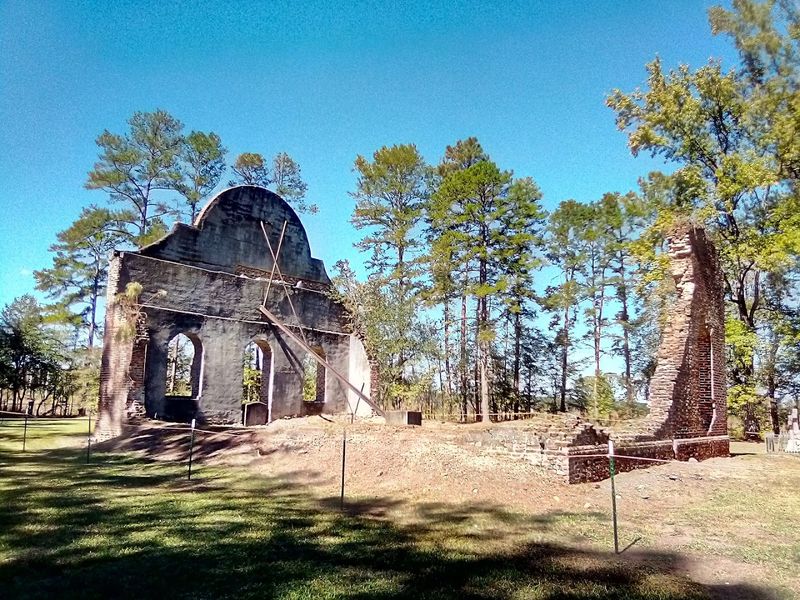
The Colleton County Historical and Preservation Society acquired the ruins in 1970, and two years later the site was added to the National Register of Historic Places. Those are meaningful milestones, but they have not stopped the slow erosion of the structure.
Hurricane Gracie in 1959, ongoing storm damage over the decades, and the 2020 partial collapse have all taken bites out of what remains.
Visitors who have returned multiple times note that the chapel looks noticeably different from visit to visit. The front facade, which once gave the ruins a dramatic, almost cathedral-like presence, has largely fallen.
Renovation work was underway as recently as January 2026, with the site temporarily closed and no-trespassing warnings posted at the gate. The effort to preserve what remains is real, even if the pace of deterioration sometimes feels faster than the pace of repair.
Why does it still matter? Because places like this are irreplaceable.
Once the walls are gone, the connection to 1725, to John Wesley, to three fires and two centuries of South Carolina life, goes with them. The ruins are not just a photo opportunity or a roadside curiosity.
They are a physical record of something that happened here, something that shaped people and communities in ways still worth understanding. Losing them would be losing a voice that cannot be re-recorded.
Address: Parkers Ferry Rd, Round O, SC 29474
