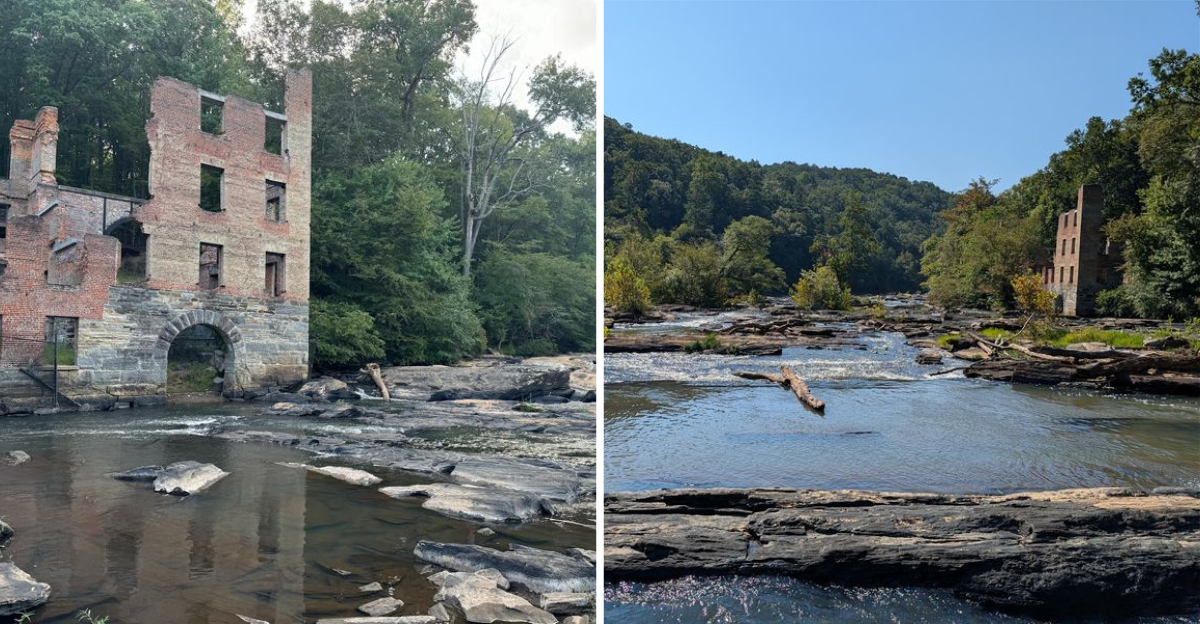
That water was loud, the trail dropped between mossy boulders, and then the trees opened up to reveal a five?story brick shell standing in the Georgia woods. I had been hiking a trail near Atlanta when I rounded a bend and found the remains of a mill burned by Union troops in July 1864 and never rebuilt.
The building sits along the rapids, and ivy climbs where windows used to be, its walls still holding faint marks from more than a century and a half of weather and time. What stuck with me most was how quiet it felt, even with the water crashing just below the ruins.
The mill had been a thriving operation during the Civil War, producing cloth and yarn for the Confederacy, and its destruction was part of a larger campaign to cut off supply lines to the South.
I stood at the edge of the foundation, trying to imagine the sound of the machines and the shouts of workers, now replaced by the hum of insects and the rush of the river.
Less than half an hour from downtown, this is one of those places that makes history feel close enough to touch.
A Five-Story Giant Rising From Sweetwater Creek
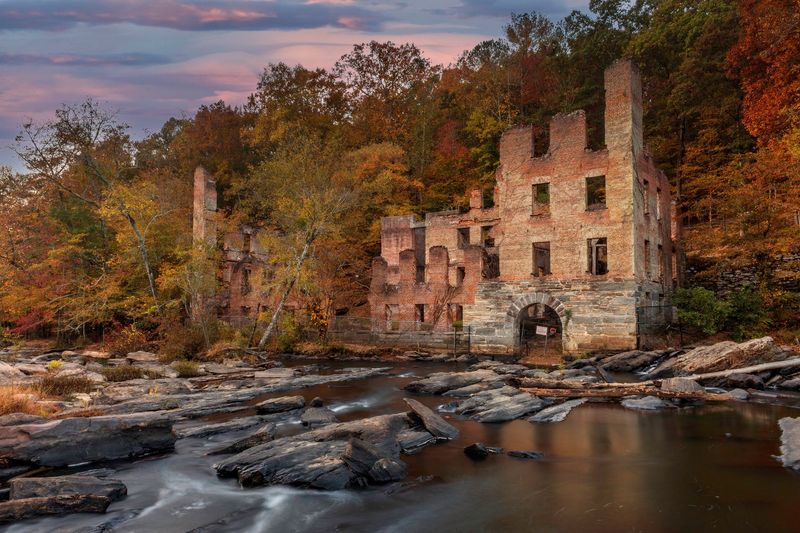
Back in 1849, when this mill first started running, it was taller than any building in Atlanta. That fact rearranged my whole mental picture of the region.
Originally called Sweetwater Mill, the five-story, water-powered textile factory spun yarn and wove fabric using the force of Sweetwater Creek. In 1857 or 1858, the owners renamed it the New Manchester Manufacturing Company, borrowing the name from Manchester, England, then the beating heart of the British textile trade.
Bricks for the building were made just across the creek, and enslaved laborers built the structure itself, though they did not work inside the mill. Roughly 100 to 150 workers, mostly women and children, lived in a small factory town nearby and bought goods at a company store.
Seeing the height of the remaining walls in person helps all of that click. Look up from the base and you can count the rows of window openings where daylight once poured onto spinning machines.
The mill turned steady profits through the 1850s, and business actually improved in the early Civil War years. Standing among the bricks, that prosperity feels strangely recent.
July 1864 and the Fire That Ended Everything
History moves fast in this spot, and the dates are worth knowing before you go.
By the Civil War, the New Manchester factory had switched to producing uniforms, tent cloth, and other supplies for the Confederacy. That made it a target during General William T.
Sherman’s campaign through Georgia.
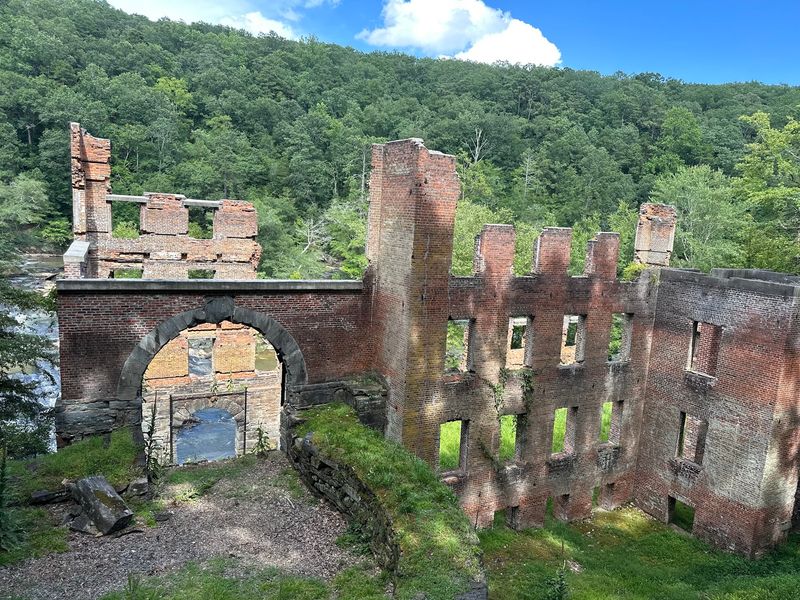
Union cavalry arrived on July 2, 1864, shut the mill down, and arrested every employee. A week later, on July 9, soldiers stripped the machinery belts and set the factory ablaze along with the company store and nearby buildings.
Then came the part that I find hardest to shake. About 100 residents of New Manchester, mainly the women who worked the looms and their children, were marched to Marietta and shipped north of the Ohio River.
They were held as refugees in camps in Kentucky or Indiana and forbidden from returning south until the war ended.
Traces of that summer are still visible. Graffiti believed to have been scratched by Federal soldiers can be spotted on the brickwork, small marks that turn a dry date into something human.
The Ghost Town Nobody Came Back To Rebuild
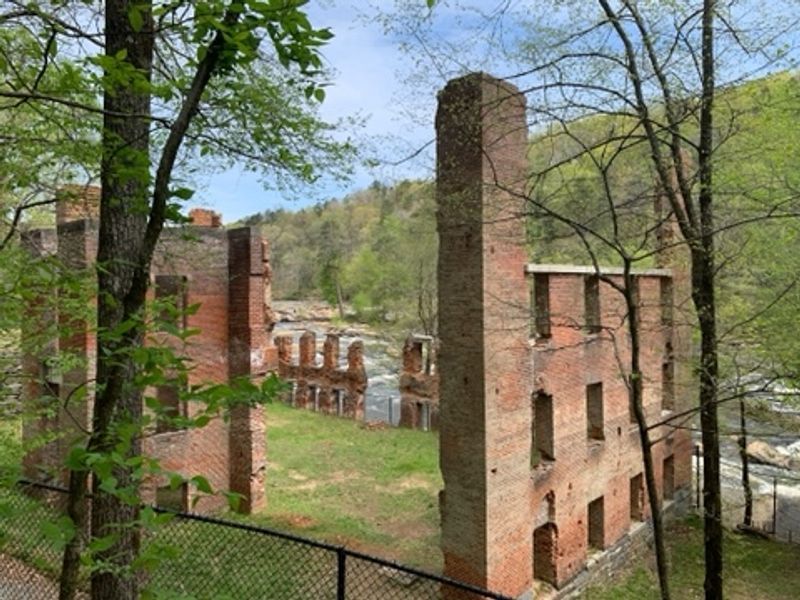
Most burned mills in the South got patched up and restarted. New Manchester never did, and that is exactly why it looks the way it does today.
After the war, the factory sat abandoned. Brick walls slowly cracked, mortar loosened, and Georgia’s thick foliage crept in from every direction until trees grew where floors once shook with machinery.
The little town went with it. The store, the post office, the workers’ houses, and the lumber mill all faded away, leaving a genuine ghost town beneath the leaf litter.
One detail I love: much of the metal machinery that collapsed into the foundation during the fire stayed buried there for decades. It was finally hauled out in 1942 during a World War II scrap drive, so pieces of a Confederate-era mill may have ended up in a completely different war.
Walking the site with that in mind changes the mood. Instead of a sad wreck, the ruins feel like something the forest adopted and kept safe.
Take your time here. The overgrowth is half the story.
Hiking the Red Trail Straight to the Bricks
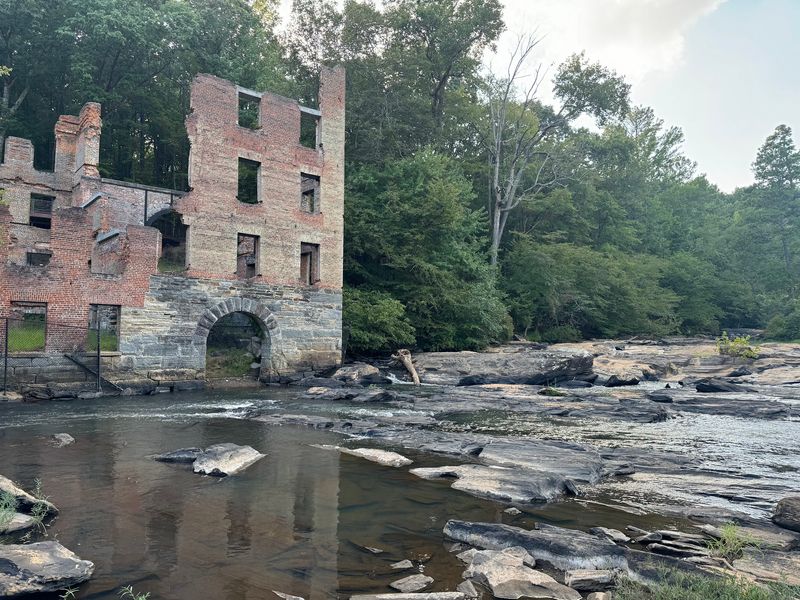
Ask anyone at the visitor center how to reach the ruins and they will point you toward the Red Trail. It is the right answer.
The route runs roughly one mile in one direction, following Sweetwater Creek past rocky bluffs and stretches of whitewater. Shade covers most of it, which matters a lot in a Georgia summer.
The walk itself is the warm-up act, and it is a good one. Water tumbles over slabs of rock, ferns crowd the path, and there is a footbridge with long views up and down the creek that had me stopping twice on the way back.
Then the trail delivers you to the mill. A viewing platform wraps near the ruins, and honestly it looks like something built for a national park rather than a spot twenty-odd minutes from Atlanta.
Wear sturdy shoes, because the footing turns rocky and uneven in places. Bring water too, more than you think you need.
Weekend mornings fill up fast, so arriving early gets you both a parking spot and a much quieter trail.
How the Ruins Were Saved From Falling Apart
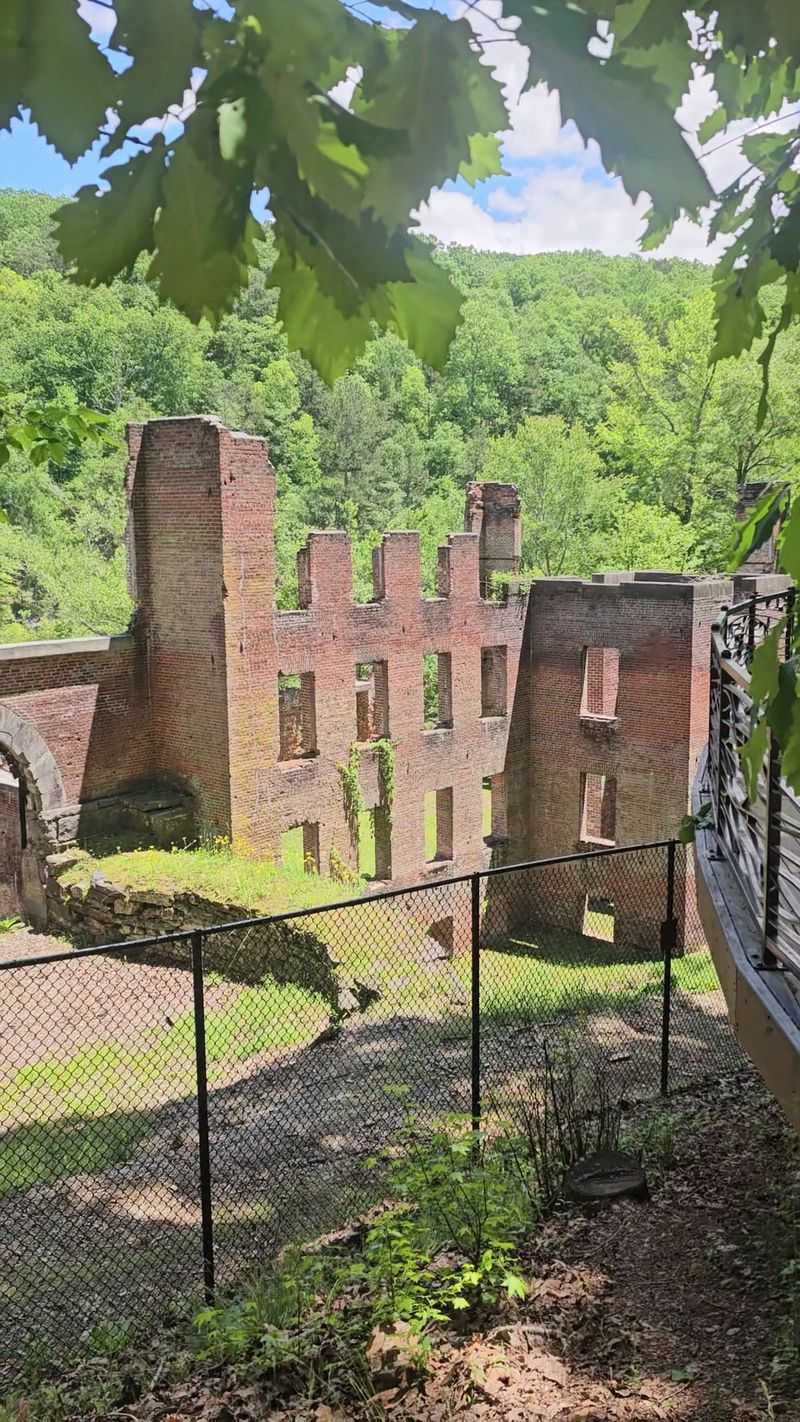
Ruins do not stay standing on their own, and these came close to losing the fight.
Between 2016 and 2017, a major stabilization project went to work on the mill. Crews repointed mortar joints, added protective caps along horizontal surfaces, braced fragile brick sections, and installed new steel supports to hold everything steady.
Thanks to that effort, the ruins officially reopened to visitors in the fall of 2017. Without it, there is a real chance the walls would have kept crumbling into rubble.
There is one rule worth knowing in advance. Access to the inside of the mill is generally limited to guided hikes, school field trips, and special events, which protects both the structure and the people looking at it.
Viewing the exterior on your own is completely open, and the outside angles are impressive enough that I never felt shortchanged.
If getting closer appeals to you, check the park’s program schedule before your visit and plan around a ranger-led hike.
Movie fans get a bonus here too. Parts of The Hunger Games films were shot in this park, and the resemblance is obvious once you notice it.
More Than a History Stop, What Else Fills a Day Here
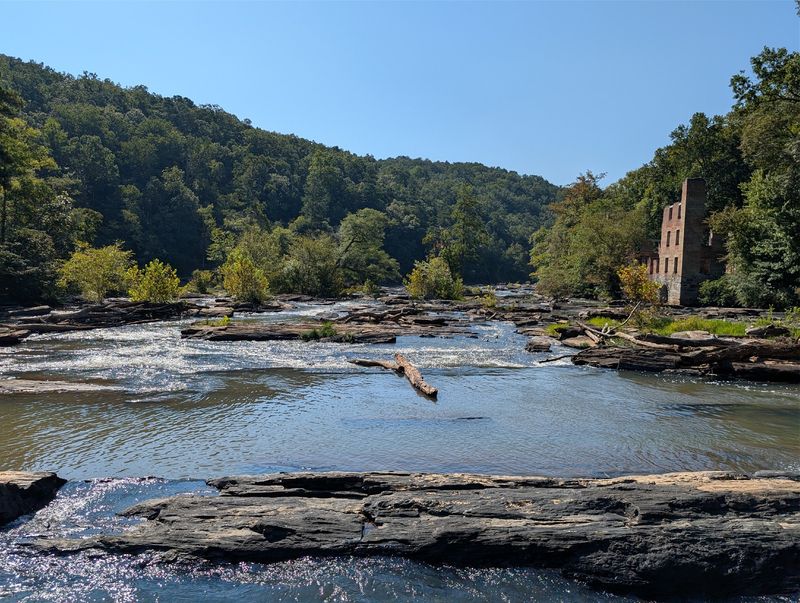
Plenty of people come for the mill and end up staying much longer. Guilty as charged.
Sweetwater Creek State Park opened in 1972, partly to protect these ruins along with the land around them. Beyond the Red Trail, the 5.2-mile White Trail loop and the Yellow Trail wander through hardwood forest, stream coves, and rugged rocky ground.
The 215-acre George Sparks Reservoir is the calm counterpoint to all that rushing water. In warmer months the park rents fishing boats, canoes, kayaks, stand-up paddleboards, and pedal boats, so you can trade hiking boots for a paddle without leaving.
Fishing, picnicking, and birding fill out the rest of the list, and ranger-led interpretive programs are worth catching if the timing works.
Start at the visitor center, which won awards for its environmentally responsible design. Inside you will find exhibits on local history and wildlife plus trail maps that save a lot of guesswork.
My advice: pack snacks, grab a map, and leave your schedule loose. This is not a quick photo stop kind of place.
Ancient Rock, Mountain Plants, and the Fault Beneath It All
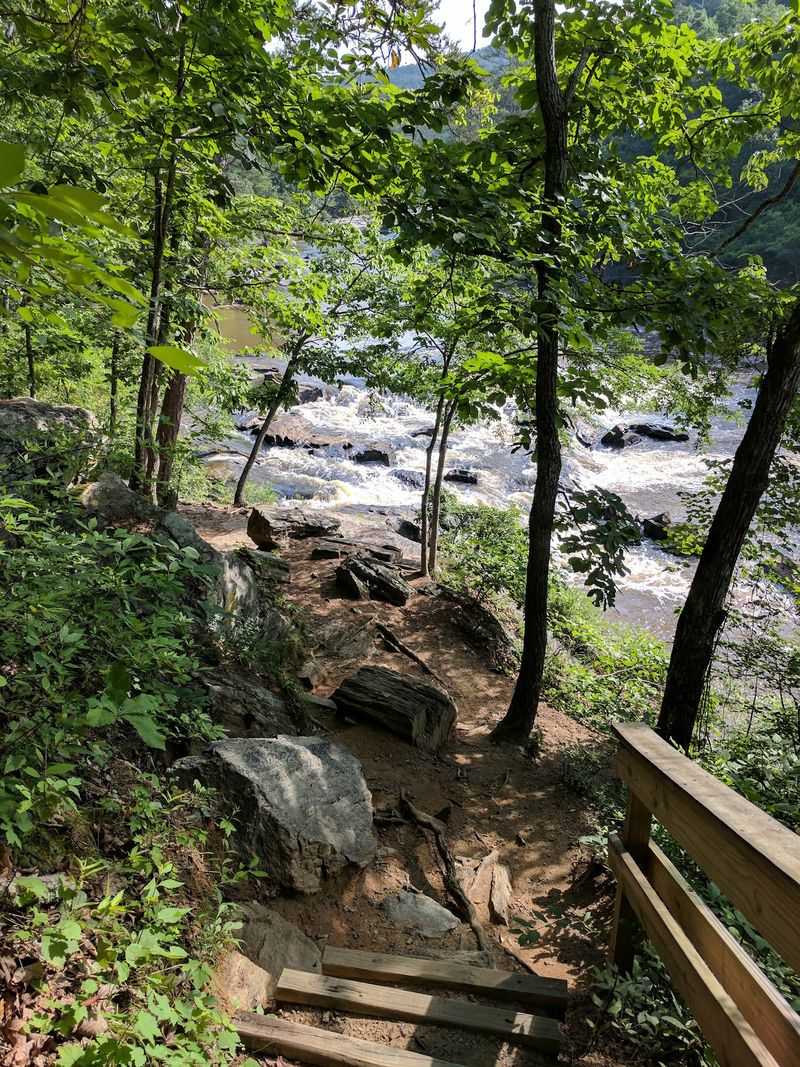
Something felt off to me on my first hike, in a good way. The terrain looked like north Georgia, not metro Atlanta.
There is a geological reason. The Brevard Fault runs through here, and its influence gives the park steep grades and pushes Sweetwater Creek into fast, noisy rapids over exposed rock.
The story stretches back more than 450 million years, through sediment building up, rock being squeezed and metamorphosed, folding, uplift, and long stretches of erosion. All of that shaping is why the mill’s original owners considered this creek prime water power in the first place.
Plant life followed the terrain. Ferns, magnolias, wild azaleas, and mountain laurel grow along these slopes, species you would normally expect farther north in the Appalachians.
Wildlife shows up readily along the quieter trails, and birders do especially well in the mixed forest. Each season shifts the palette, so repeat visits never feel repetitive.
Geology, plants, and ruined brick all sit in the same frame here, which is a rare combination.
Address: 1750 Mt Vernon Rd, Lithia Springs, GA 30122
