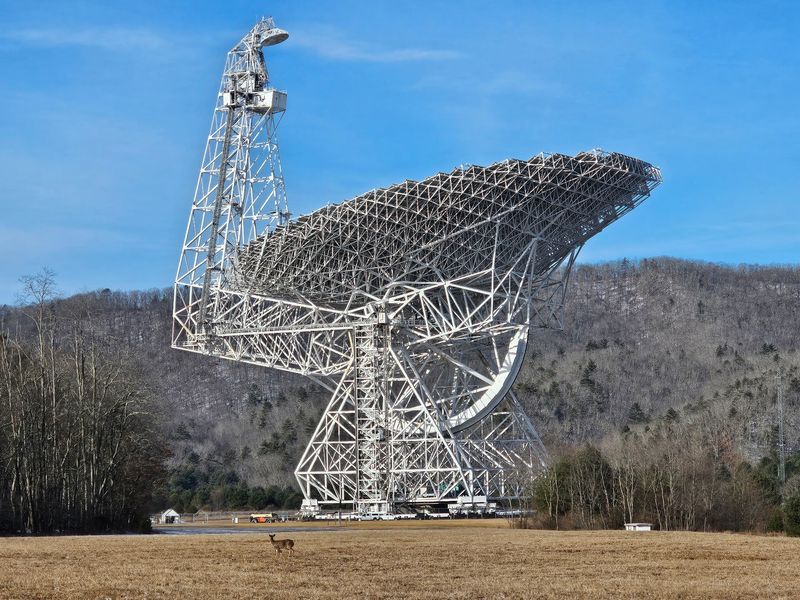
Tucked deep in the Allegheny Mountains of West Virginia, there’s a place so quiet that cell phones fall silent and microwaves are practically outlawed. Rising above the trees stands a gleaming white giant taller than the Statue of Liberty, listening patiently to whispers from billions of miles away.
Most folks passing through never expect a small mountain town to hold one of the most powerful scientific instruments on Earth. Once you stand beneath it, though, you understand why people drive for hours just to feel that small under something so grand.
A Gleaming Giant Rising From The Allegheny Mountains
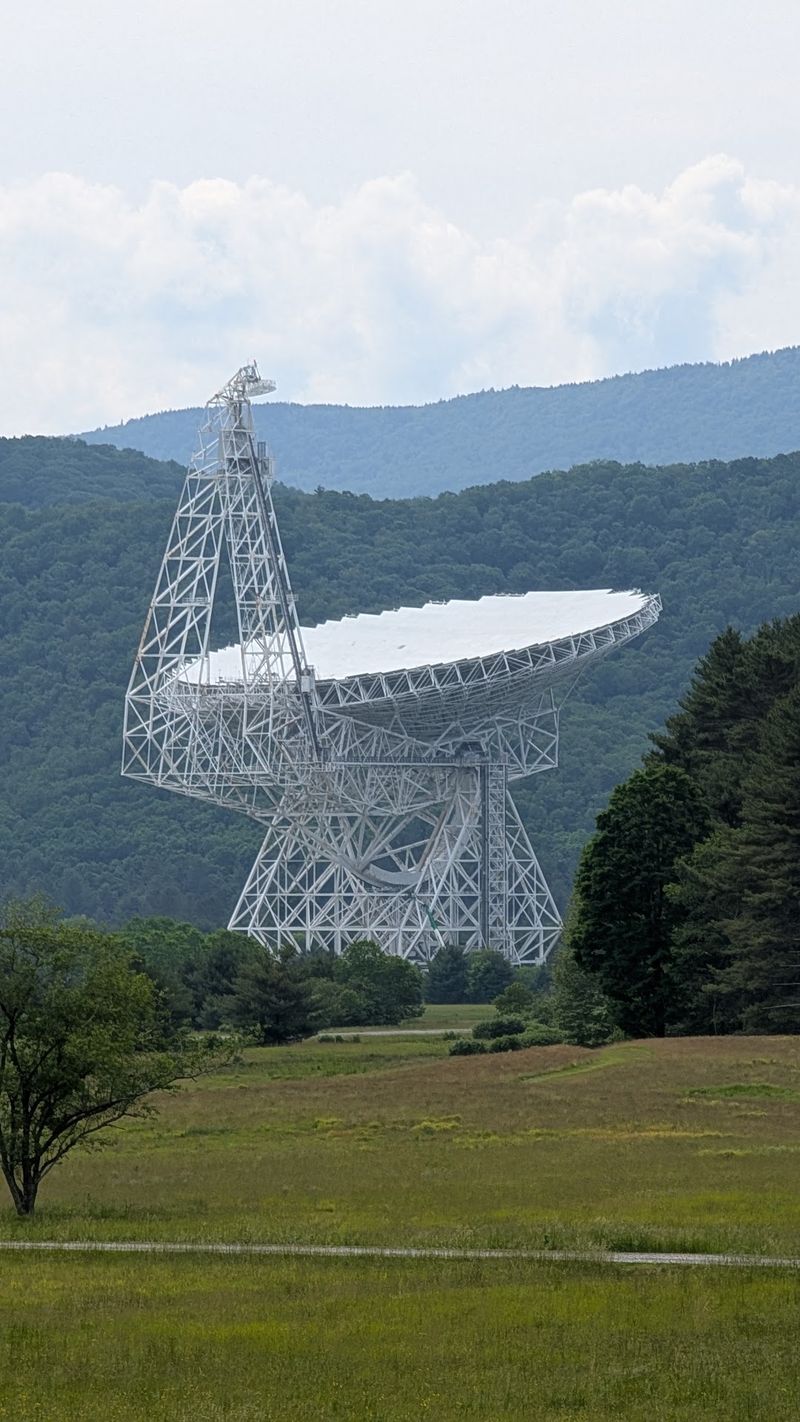
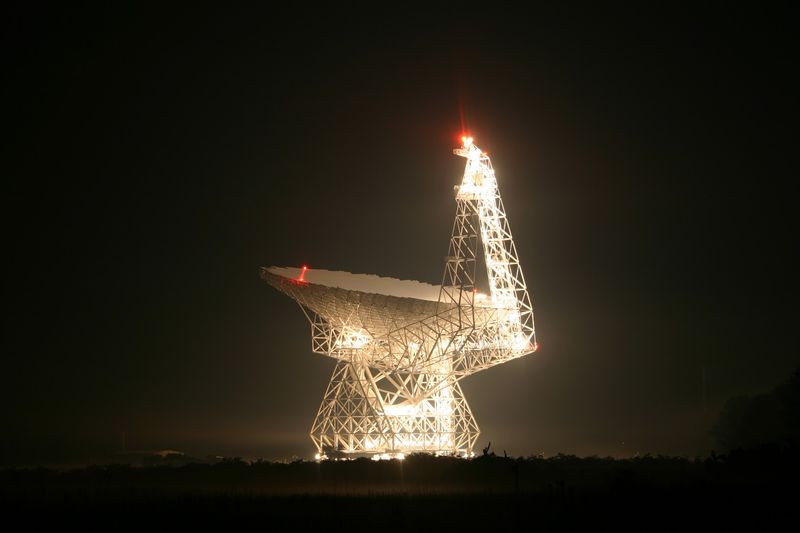
Picture rounding a bend on a quiet mountain road, and there it is, impossibly big and impossibly white against the green ridgeline. The Robert C.
Byrd Green Bank Telescope stands about 485 feet tall, which puts it roughly 60 percent taller than the Statue of Liberty.
Locals fondly call it the “Great Big Thing,” and honestly, that nickname fits. Weighing close to 17 million pounds, the structure feels less like a machine and more like a mountain someone decided to build by hand.
Sitting in Pocahontas County, near the tiny community of Green Bank, the telescope anchors a valley known as Nature’s Mountain Playground. The scenery alone would draw visitors, but the dish makes the whole scene unforgettable.
Reviewers often say you cannot grasp its true size until you stand directly under it, staring straight up. From a couple of miles out, it looks manageable.
Up close, it humbles you.
For a state proud of its landscapes and its history, this record-breaker is a genuine source of Mountain State pride.
The World’s Largest Movable Ear On The Sky
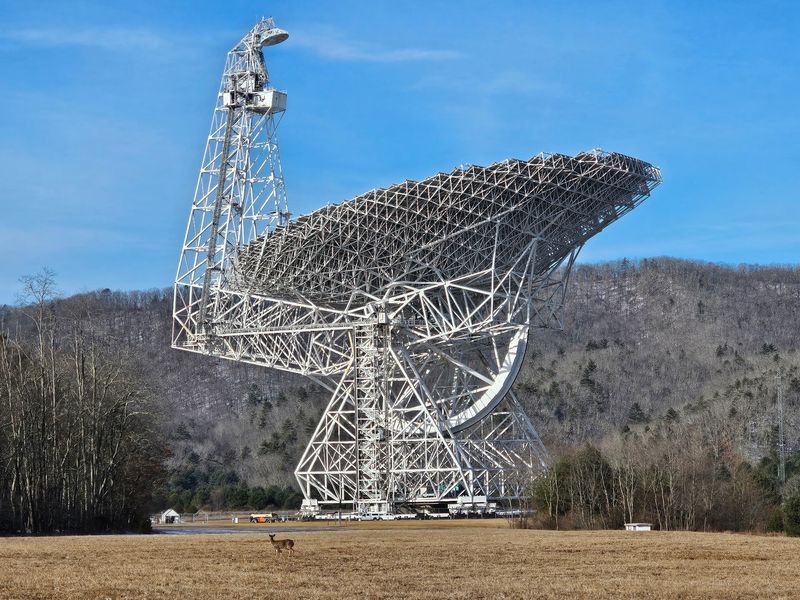
Size grabs the headlines, but sensitivity is what makes scientists fall in love with this instrument. As the world’s largest fully steerable radio telescope, it can swing to point almost anywhere in the sky and catch faint signals from billions of light-years away.
Its dish stretches about 328 feet across, covering roughly 2.3 acres of collecting area. That is a lot of surface working to gather signals far too weak for the human ear.
What really sets it apart is a clever “off-axis” design. Instead of putting the receiver right in the middle of the dish where it would block incoming waves, engineers moved it aside, giving the telescope an unblocked view.
The payoff is what astronomers call a clean beam, meaning crisp, interference-free listening across a wide range of frequencies. From meter-length waves down to millimeter wavelengths, it covers an impressive stretch.
Visitors who take the guided tour often mention how clearly the staff explain all of this. Even folks who never fancied themselves science types walk away genuinely fascinated.
Life Inside The National Radio Quiet Zone
Ever been somewhere so quiet your phone simply gives up? Around Green Bank, that silence is the whole point.
The telescope sits within the 13,000-square-mile National Radio Quiet Zone, a protected region set up back in 1958.
Spanning parts of West Virginia, Virginia, and a sliver of Maryland, the zone strictly limits radio transmissions. The reason is beautifully simple: everyday signals from our gadgets would drown out the faint cosmic whispers the telescope hopes to catch.
Within roughly a 10-mile radius, cell phones, Wi-Fi routers, and even microwave ovens are heavily restricted. There is reportedly a dedicated “radio policeman” who tracks down stray interference.
Visitors are often charmed and a little startled by the disconnection. Many mention that cell coverage basically vanishes for miles, forcing everyone to actually look up and around.
That enforced quiet, backed by state law, turns the valley into a rare sanctuary. For retirees craving peace and curious travelers alike, it feels like stepping into a calmer, slower version of the world.
A Dish That Adjusts Itself One Panel At A Time
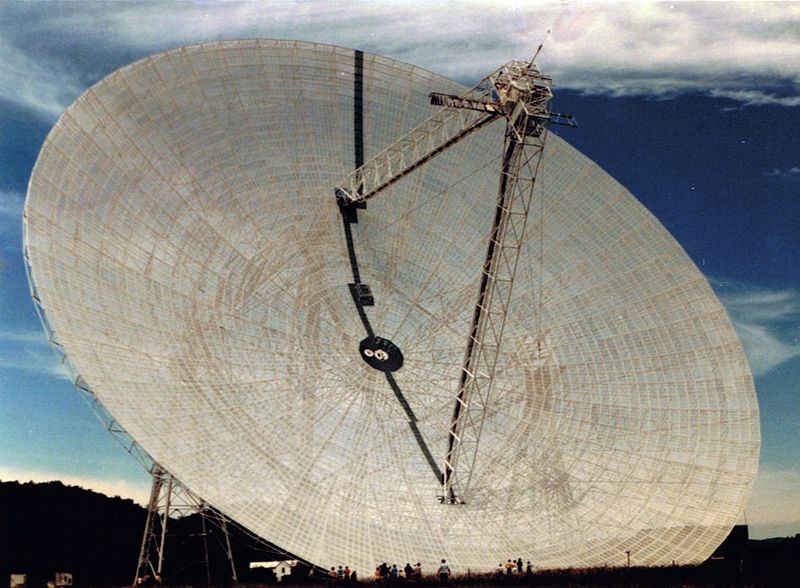
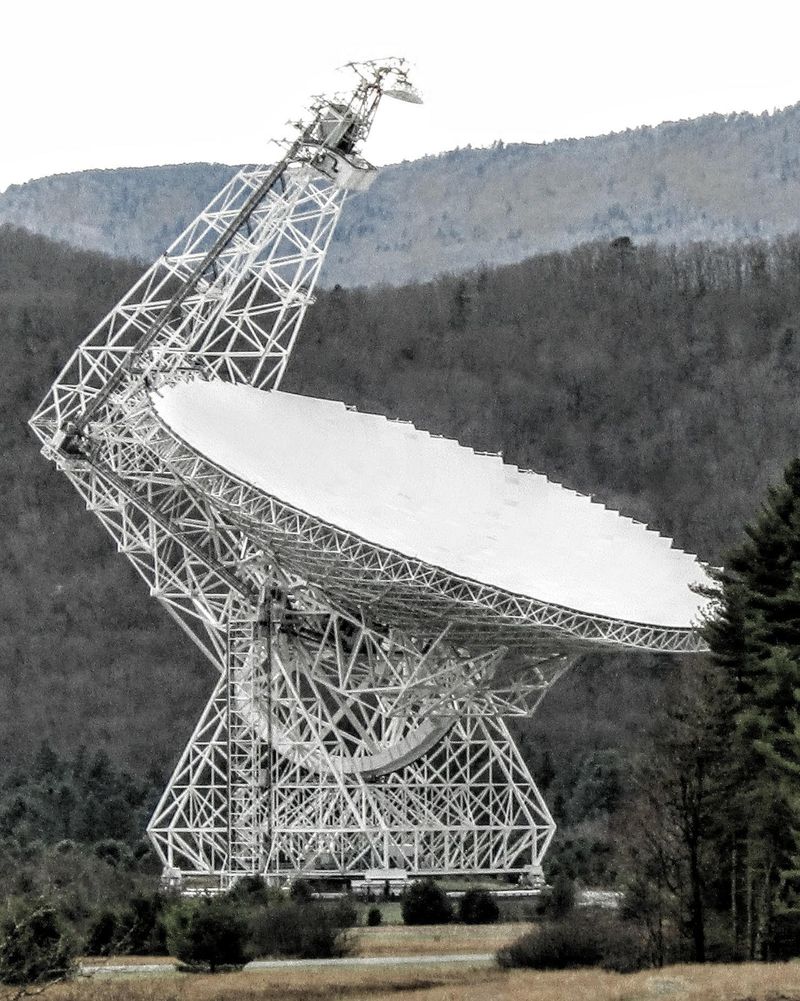
Steering something this heavy with hair-thin accuracy sounds impossible, yet that is exactly the daily job here. The dish is not one solid sheet of metal but a living surface made of 2,004 separate panels.
Hidden beneath those panels sit around 2,209 tiny motors called actuators. Minute by minute, they nudge each panel into position, quietly correcting for gravity, temperature swings, and gusts of mountain wind.
Why bother with all that fuss? Because gravity gently warps a structure this large as it tilts to follow objects across the sky.
Left uncorrected, the dish would lose its perfect shape.
The actuators keep the surface shaped to within better than 50 micrometers, thinner than a human hair. That precision lets the telescope work cleanly even at its highest frequencies.
It is the kind of engineering detail that makes tour guests shake their heads in disbelief. Reviewers frequently praise how knowledgeable the guides are at breaking these ideas down.
A dish that literally breathes and reshapes itself feels like science fiction, yet it hums along quietly every single day.
Six Decades Of Pioneering Discovery
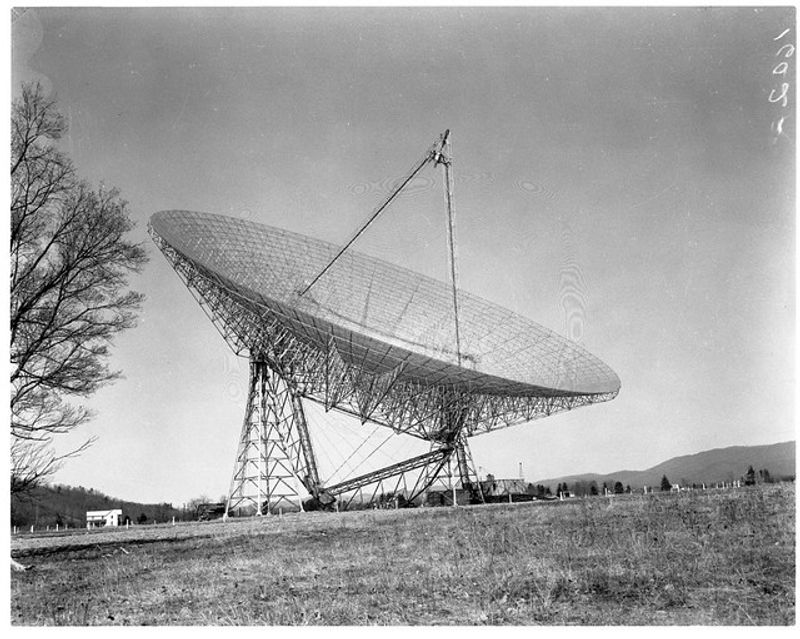
Long before the giant dish arrived, this valley was already making history. The site was founded as the National Radio Astronomy Observatory in 1956, with the grounds dedicated in October 1957.
The first 85-foot Tatel Telescope was completed in 1958, kicking off a legacy of instruments planted across the peaceful fields. An earlier 300-foot telescope later collapsed in 1988, which cleared the path for something far more advanced.
Groundbreaking for the Robert C. Byrd Green Bank Telescope came in 1991.
It was dedicated in 2000, began regular science operations in 2001, and reached full operation by 2003.
The name honors the late Senator Robert C. Byrd, whose efforts were key to securing funding.
In 2016 the site became the independent Green Bank Observatory, still partly backed by the National Science Foundation and partnered with West Virginia University.
Reviewers often mention how much they enjoy seeing several telescopes on site, each with its own story. Walking among these machines feels like strolling through decades of human curiosity, all rooted right here in the Mountain State.
From Cosmic Molecules To Distant Neutron Stars
The list of discoveries born here reads like a greatest-hits album of space science. Back in 1969, the telescope helped detect the first organic polyatomic molecule floating in interstellar space, and in 2016 it spotted the first “handed” molecule out there too.
Those finds matter because they hint at the chemical building blocks of life scattered across the galaxy. Pretty heady stuff for a dish in rural West Virginia.
Pulsars, those rapidly spinning neutron stars that act like cosmic lighthouses, are another specialty. The telescope helped detect the most massive neutron star known and contributes to projects timing pulsars to catch ripples called gravitational waves.
It has also mapped enormous clouds of hydrogen gas, including a superbubble sitting some 23,000 light-years away. Working with radar, it maps asteroids, comets, and planets in stunning detail.
The valley even hosted the famous start of the modern search for alien signals, when Frank Drake began listening in 1961. Today it joins the Breakthrough Listen effort, keeping that hopeful question alive: are we truly alone?
A Small Town With A Giant Heart For Science
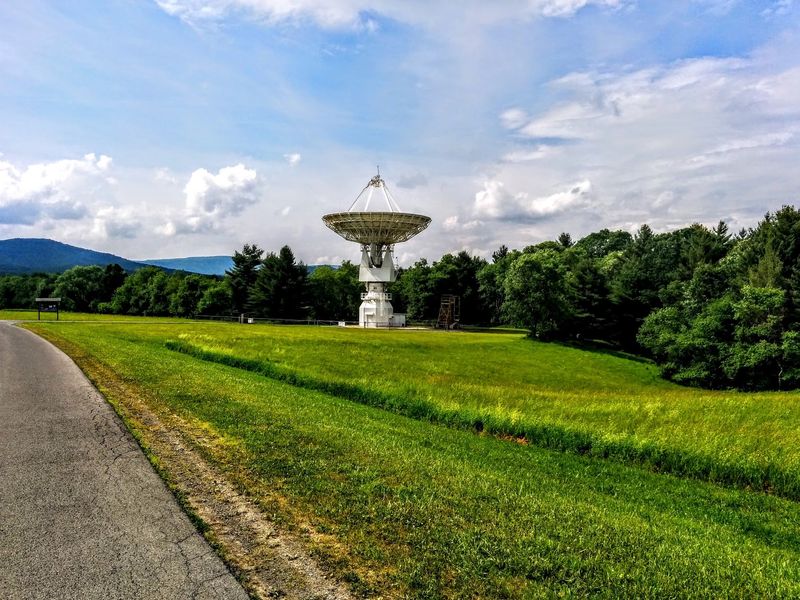
For a community of only about 141 residents as of the 2020 census, Green Bank punches remarkably above its weight. The whole town’s identity is woven around the observatory sitting in its backyard.
Many locals treasure the blend of untouched mountain beauty and cutting-edge technology. Nearby draws like Snowshoe Mountain and the Cass Scenic Railroad State Park round out a valley made for hiking, biking, fishing, and paddling.
Families especially love the Green Bank Science Center, where hands-on exhibits keep kids and grown-ups equally busy. Visitors often say the interactive displays are fun for everyone, even a group where nobody was under 30.
The famous solar system walking path draws steady praise too, laid out to proper scale along the trails. Folks mention spotting deer, flying kites on the open grounds, and soaking in the deep quiet.
Guests describe the staff as friendly and genuinely knowledgeable, patient with every question. When the big dish shifted position mid-tour, one visitor was thrilled just to watch it move.
It is small-town pride and big science sharing one peaceful valley.
Planning Your Visit To The Great Big Thing
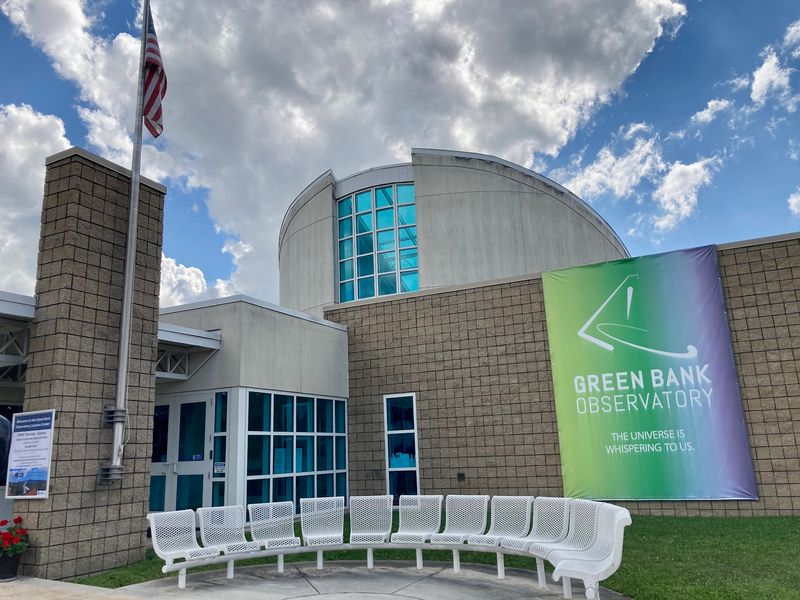
Thinking of making the trip? A little planning goes a long way in the Quiet Zone.
Guided bus tours have been offered for around 10 dollars each, and reviewers note they include a short film and up-close views of several telescopes.
Tours have run at set times through the day, with visitors wishing they started even earlier and lasted later than mid-afternoon. Arriving early gives you plenty of time to walk the grounds too.
One quirky rule to remember: no digital devices past certain points, since your phone could interfere with the science. The gift shop sells disposable film cameras for exactly this reason, and shoppers love its many kid-friendly finds.
Walking the grounds and enjoying the observation deck is often free, and the loop trail makes a lovely hour-long stroll. A small cafe offers coffee, drinks, and light bites when hunger strikes.
You will find it at 155 Observatory Road, Green Bank, WV 24944, holding a warm 4.7-star reputation across many visits.
Peaceful, affordable, and genuinely awe-inspiring, it is a Mountain State treasure well worth the drive.
