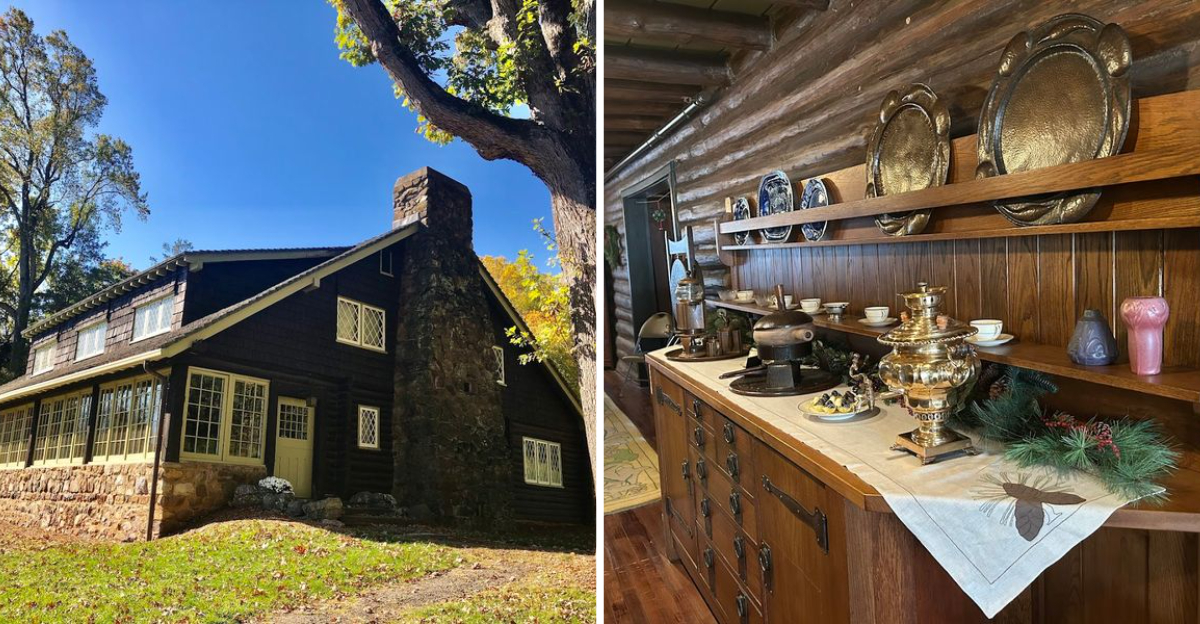
On 30 acres in Morris County sits a log cabin mansion that the undisputed leader of the American Arts and Crafts movement built as the heart of his utopian dream.
He originally planned a self-sufficient farming community here, but when financial troubles hit, the “clubhouse” became his family’s home.
Today, it stands as a National Historic Landmark, restored to its 1910s appearance with many of the original furnishings still inside.
Come wander through the copper fireplaces and chestnut log walls, and see why this is one of New Jersey’s most important architectural treasures.
The Log House: A Mansion Made From the Forest Itself
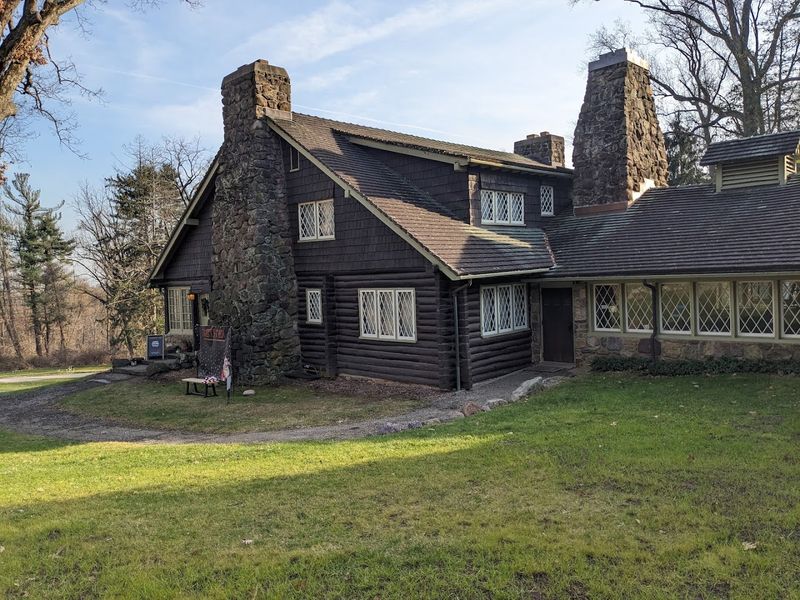
Standing in front of the Log House for the first time, you get the feeling that the building grew straight out of the earth rather than being constructed on top of it.
Built between 1908 and 1911, this 5,000-square-foot residence used hewn chestnut logs sourced directly from the property itself.
Local stone fills the gaps between the logs, giving the structure a texture that feels both ancient and deliberate.
The design was intentional in every sense. Gustav Stickley believed that a home should reflect its natural surroundings rather than fight against them.
Every beam, every surface, and every corner of this building tells that story clearly.
What makes the Log House truly remarkable is its scale. It was originally conceived as a communal gathering space, complete with a kitchen capable of feeding one hundred people.
Walking through it today, you can still feel that generous, open-armed spirit baked into the walls. It is less a house and more a living philosophy carved from the landscape of New Jersey.
Gustav Stickley: The Visionary Behind the Chestnut Walls
Gustav Stickley was not just a furniture maker. He was a philosopher, a publisher, a social critic, and a designer who believed deeply that beauty and simplicity should go hand in hand.
Born in 1858, he grew up working with wood and eventually became one of the most influential figures in American design history.
His furniture, often called Mission or Craftsman style, stripped away the fussy ornamentation of the Victorian era. What remained was honest, sturdy, and quietly beautiful.
Stickley wanted everyday people to live with well-made things, not just the wealthy elite.
Craftsman Farms was his grandest personal statement. He purchased the land in 1908 with a vision of creating a farm and school for boys, a place where young people could learn to work with their hands and live close to nature.
Financial challenges eventually changed those plans, but the estate he left behind became something even more lasting. His ideas shaped how Americans think about home design for generations to come.
The Arts and Crafts Movement: A Rebellion Built With Bare Hands
Few design movements in history came from such a raw, emotional place. The Arts and Crafts movement emerged in the late 1800s as a direct pushback against the cold, machine-made uniformity of the Industrial Revolution.
Craftsmen, artists, and thinkers on both sides of the Atlantic believed that handmade objects carried a dignity that factory production simply could not replicate.
In America, the movement gained serious momentum between 1900 and 1929. Simple forms, natural materials, and visible craftsmanship became the guiding principles.
Homes built in this style featured low-pitched roofs, overhanging eaves, exposed rafters, and wide front porches held up by tapered columns.
Visiting Craftsman Farms puts you right at the center of that cultural moment. The estate is not just a museum about furniture.
It is a place where the entire spirit of a movement became physical. Every room demonstrates what it looked like when someone truly committed to the idea that a well-made object is a form of respect for the person who will use it every day.
The Guided Tour Experience: One Hour That Feels Like Time Travel
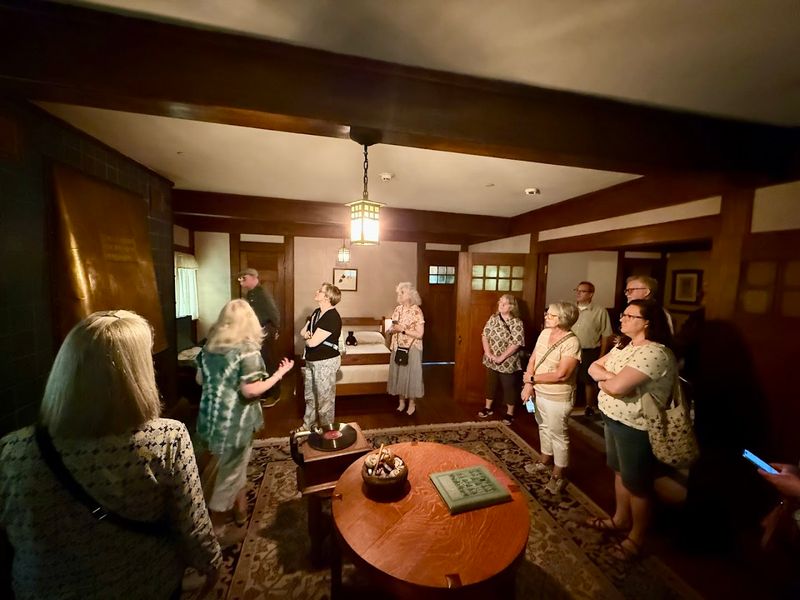
Stepping into the Log House with a knowledgeable guide changes everything about the visit. The tour runs about an hour, beginning with a short introductory video shown in the restored kitchen.
From there, the group moves through the main floor and up to the second-floor bedrooms, each space filled with original and period-appropriate pieces.
The guides here are genuinely passionate. They bring each room to life with context and detail that you simply cannot get from a printed placard.
You learn about the family who lived here, the financial struggles that reshaped the original plans, and the specific choices that went into every design decision.
What makes the experience feel special is how personal it becomes. This was not a grand estate built for show.
Stickley and his family actually lived here, raised children here, and entertained guests here. Standing in the dining room, imagining meals shared around that long table, the history stops feeling distant.
It becomes something warm and entirely relatable. Tours run on Fridays, Saturdays, and Sundays from 11 AM to 3 PM.
The Kitchen: Built to Feed a Small Village
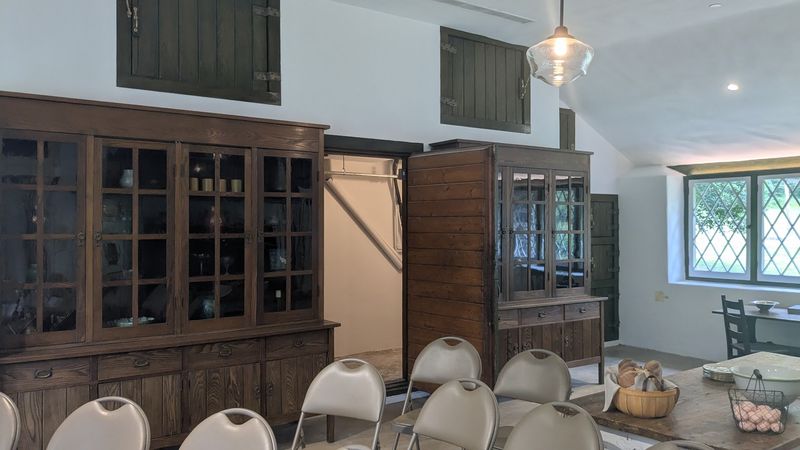
Most historic house kitchens feel like afterthoughts. The kitchen at Craftsman Farms is something else entirely.
Originally designed to feed one hundred people, this space was built with the ambition of a commercial operation and the warmth of a family home all at once.
The room anchors the tour experience in a surprisingly grounded way. Food and community were central to Stickley’s vision for the property.
He imagined boys learning to farm the land and then gathering together for shared meals, a lifestyle rooted in cooperation and honest labor.
Even though those original plans never fully materialized, the kitchen survived and was eventually restored. Today it serves as the starting point for guided tours, where the introductory video plays and visitors get their first real sense of the scale of Stickley’s ambitions.
The proportions of the room tell the story better than any exhibit label could. Big, practical, and thoughtfully built, it is a kitchen that was always meant to bring people together rather than simply prepare food.
The Craftsman Shop: Handmade Goods Worth Taking Home
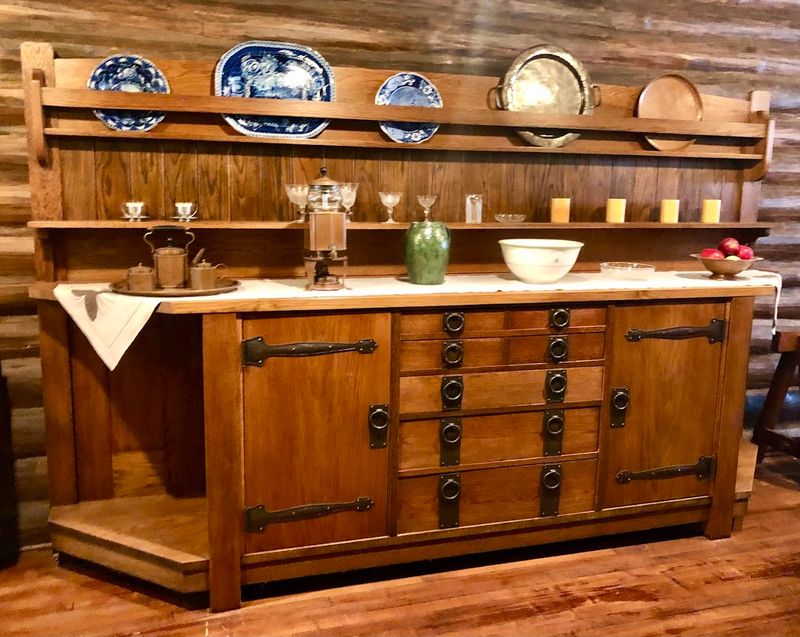
Wandering into the Craftsman Shop feels like a natural extension of everything the museum stands for. The shelves are stocked with handcrafted goods from a variety of artists, books about the Arts and Crafts movement, and design objects that would look genuinely beautiful in any home.
This is not a gift shop filled with generic magnets and postcards. Every item feels chosen with intention.
You can find housewares, textiles, and pieces that reflect the same values Stickley championed over a century ago. Quality over quantity.
Craft over convenience.
Spending a few minutes browsing here after the tour is a surprisingly satisfying experience. Your eyes are already trained to appreciate honest materials and simple forms, so everything on the shelves suddenly looks more appealing than it might have an hour earlier.
The shop is open on the same days as the museum, Fridays through Sundays, and it is easy to leave with something you did not plan to buy. Consider that fair warning and also a very pleasant kind of problem to have.
The Furniture: Mission Style That Changed American Homes Forever
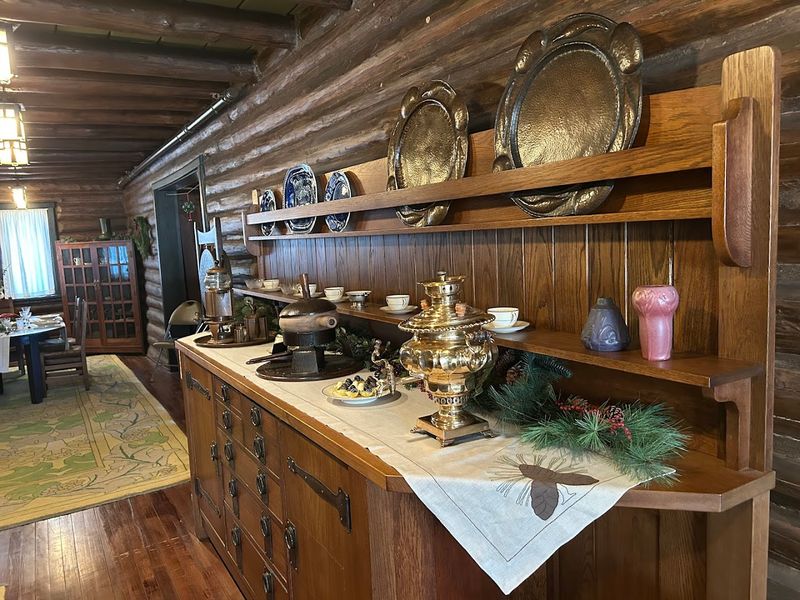
Few pieces of furniture carry the quiet authority of a genuine Stickley original. The Mission style that bears his legacy is defined by straight lines, visible joinery, and a respect for the natural grain of the wood.
No gilding, no unnecessary curves, nothing added just for decoration.
Inside the Log House, furniture pieces are displayed as they would have appeared when the Stickley family lived here between 1908 and 1915. Some items are original.
Others are faithful reproductions that demonstrate just how enduring the design language truly is. A piece on loan from the Metropolitan Museum of Art is among the highlights.
What surprises many visitors is how modern these pieces still feel. Pick up any design magazine today and you will spot the Craftsman influence in clean lines and natural materials.
Stickley was not simply responding to his era. He was building a visual vocabulary that would outlast him by more than a century.
Sitting with these objects in their original setting makes that legacy feel tangible and genuinely alive.
The History of Preservation: How a Mansion Almost Disappeared
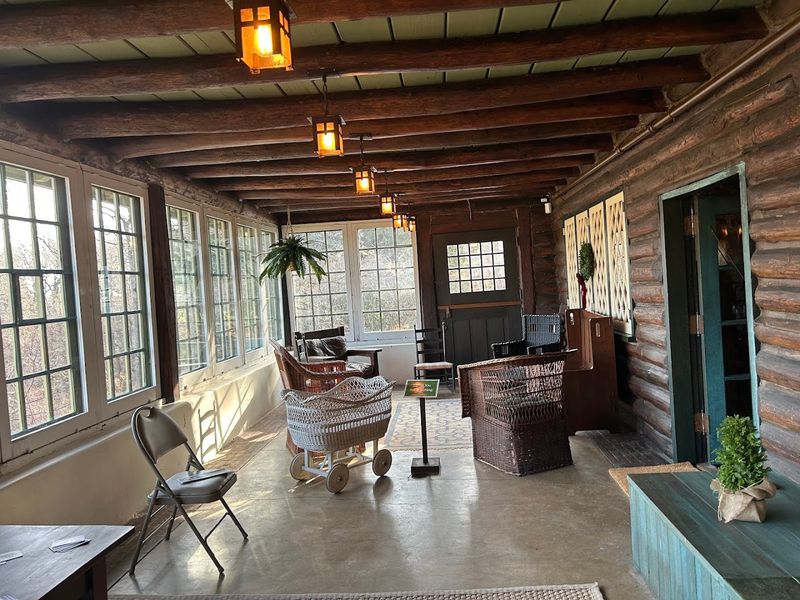
Not every important place gets saved. Craftsman Farms came dangerously close to being lost entirely.
After Gustav Stickley’s bankruptcy in 1915, the property changed hands. Major George and Sylvia Wurlitzer Farny purchased it in 1917, and it remained with their family for decades.
By 1989, the estate’s future was genuinely uncertain. Development pressure was mounting, and without intervention, the Log House and its thirty acres could easily have been replaced by something far less interesting.
The Township of Parsippany-Troy Hills acted decisively, acquiring the property through eminent domain to ensure it would remain intact.
That act of preservation made everything that followed possible. The museum opened, the restoration work began, and a place that might have vanished became one of New Jersey’s most distinctive cultural landmarks.
Thinking about how close it came to disappearing makes the visit feel even more meaningful. You are not just touring a well-preserved house.
You are walking through a place that people fought to keep standing, and that effort deserves real appreciation.
Planning Your Visit: What to Know Before You Go
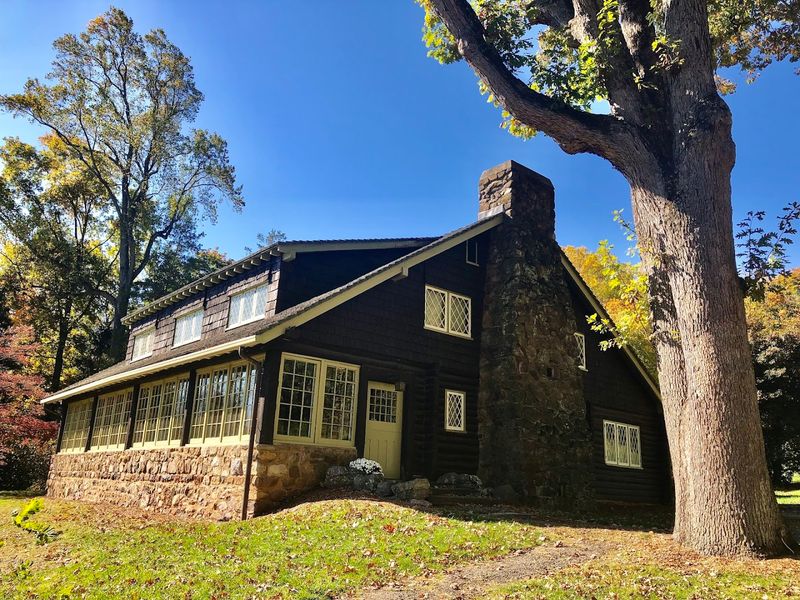
Getting to Craftsman Farms is straightforward, sitting right off Route 10 in Morris Plains. The address is easy to plug into any map app, and parking is available on site.
The setting feels surprisingly tucked away given how close it sits to a major road.
Tours run on Fridays, Saturdays, and Sundays from 11 AM to 3 PM. Reservations can be made directly through the museum’s website, which is a smart move since group sizes are kept manageable.
The Craftsman Shop keeps the same hours, so you will have time to browse before or after your tour.
The museum is a good fit for history enthusiasts, design lovers, woodworkers, architecture fans, and anyone curious about how one person’s philosophy shaped an entire era of American home life. Children who are ten and older tend to get the most out of the experience.
Bringing comfortable walking shoes is worthwhile if you plan to explore the grounds.
Address: 2352 NJ-10, Morris Plains, NJ
