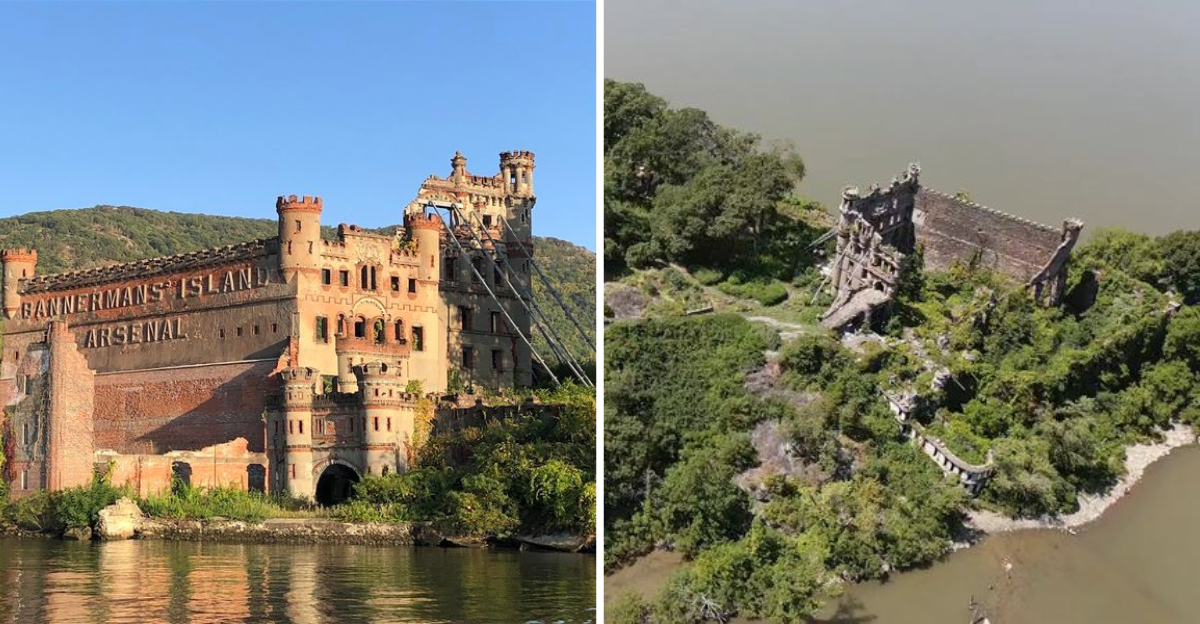
Crumbling stone towers rise out of the water like something pulled from a fantasy novel, wrapped in ivy and mystery. This New York ruin looks so ancient and otherworldly that it feels like a lost civilization once thrived there. A Scottish immigrant businessman built it starting in nineteen o one to store military surplus weapons, designing every turret himself with no professional architect.
Cannon barrels became structural decorations. An explosion, a fire, and a wall collapse all left their marks.
What stands today is a hauntingly beautiful ruin that has survived more than most buildings ever face. The boat ride out takes about fifteen minutes, and the moment the ruins come into view is unforgettable.
The Island That Was Already Mysterious Before the Castle Arrived
Long before Francis Bannerman ever set foot on Pollepel Island, the place already had a reputation for being deeply unsettling. Native American tribes reportedly avoided it, believing the island was haunted by spirits.
Dutch sailors who navigated the Hudson River had their own superstitions about the place, steering clear whenever possible.
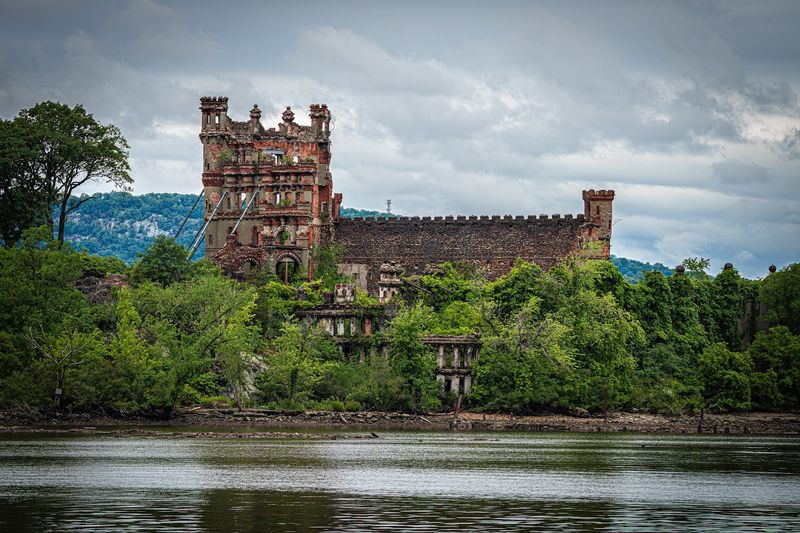
The island sits in a narrow, dramatic stretch of the Hudson River known as the Hudson Highlands. The water moves fast there, the cliffs rise steeply on both banks, and the wind can shift without warning.
It is the kind of place that feels charged with something you cannot quite name.
Pollepel is a Dutch word, and the island’s name appears on maps going back centuries, which tells you how long people have been aware of it and cautious around it. When Bannerman purchased it in 1900, he was buying not just land but an island with a long, layered past.
That eerie foundation only adds to how surreal the ruins feel today when you approach by boat and the stone walls slowly emerge from the treeline.
Francis Bannerman VI: The Man Who Built a Castle Without an Architect
Francis Bannerman VI was not your typical businessman. A Scottish immigrant who built one of the most successful military surplus companies in American history, he had a flair for the dramatic and an eye for detail that bordered on obsessive.
After buying up roughly 90 percent of U.S. military surplus following the Spanish-American War, he needed somewhere outside New York City to store an enormous stockpile of weapons and ammunition safely.
He chose Pollepel Island and immediately got to work designing the buildings himself, sketching plans on scraps of paper. No professional architect was involved.
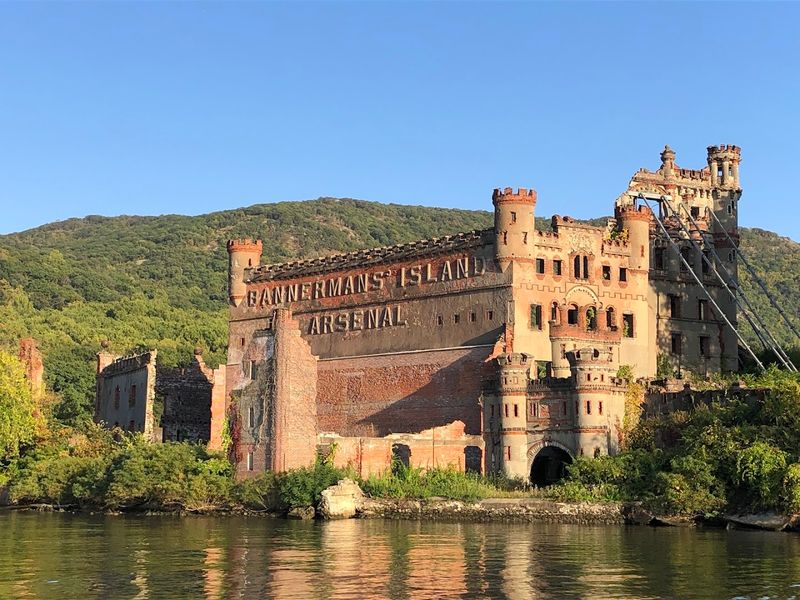
The result was a wildly eclectic structure inspired by Scottish castle architecture, complete with turrets, crenellations, ornate gables, and decorative balustrades.
He even used actual cannon barrels as both structural and decorative elements throughout the building. The words “Bannerman’s Island Arsenal” were cast directly into the facade, functioning as a massive advertisement visible from passing boats and trains.
Bannerman worked on the complex from 1901 until his death in 1918, constantly adding and refining. The buildings were a direct expression of his personality: ambitious, unconventional, and impossible to ignore.
What the Arsenal Actually Stored and Why It Eventually Exploded
Most people picture a castle and think of royalty, grand halls, and candlelit banquets. Bannerman’s castle was stuffed with something far more volatile: cannons, rifles, shells, powder, and leftover military hardware from multiple wars.
The sheer scale of the inventory was staggering, and keeping it on a remote island was genuinely the safest option available at the time.
The danger caught up with the island in 1920, two years after Francis Bannerman died. A portion of the stored munitions detonated in a building adjacent to the main arsenal, causing significant structural damage.
It was a dramatic reminder of exactly what kind of place this was.
The Bannerman family continued to own and use the island after Francis passed, but the explosion left its mark. Repairs were made, and operations continued for a time, but the momentum had shifted.
A storm in 1950 sank the ferryboat that connected the island to the mainland, effectively cutting off regular access. The family stepped away after that.
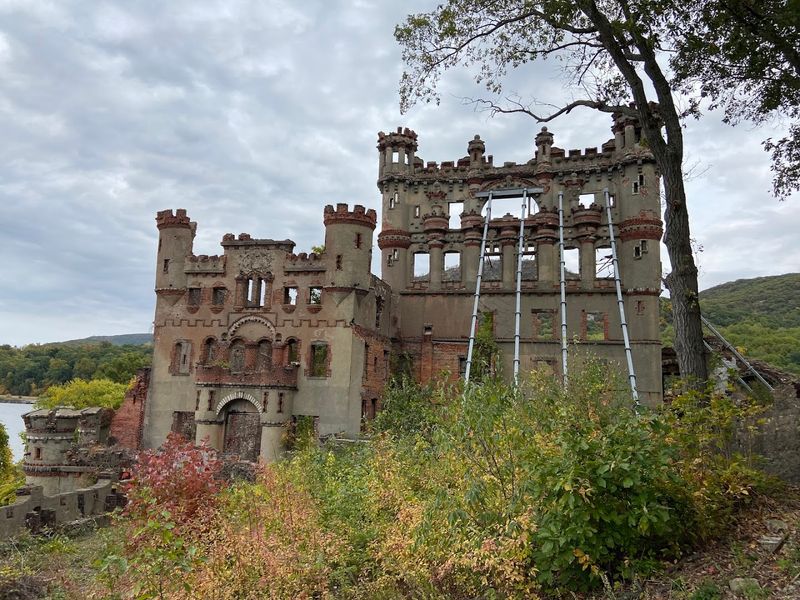
New York State acquired the island in 1967, and then in August 1969, a fire tore through the buildings, collapsing the roofs and floors and leaving behind the ghostly stone shell visible today.
How the Ruins Got Their Lost-Civilization Look
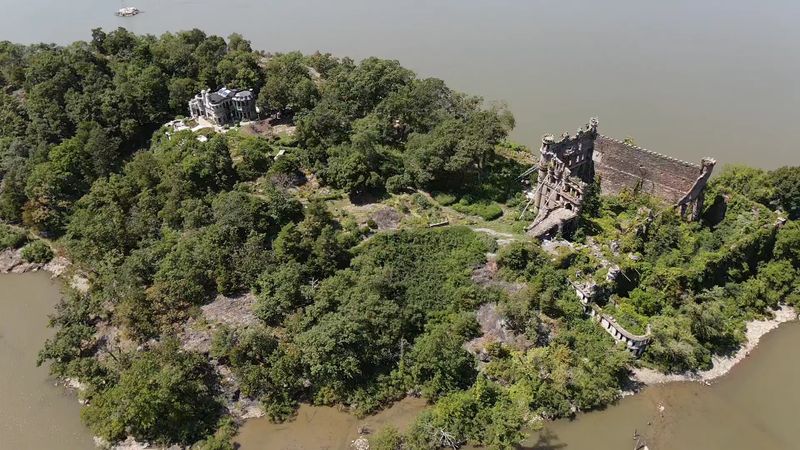
There is something about Bannerman Castle that does not look like a typical American ruin. The turrets, the carved stonework, the elaborate decorative details layered over a crumbling skeleton make it feel genuinely ancient, like something you would find buried in a Scottish highland or a forgotten corner of Eastern Europe.
That effect is not accidental.
Because Bannerman designed the buildings himself, pulling from Scottish castle aesthetics and his own imagination, the architecture never followed conventional rules. The proportions are slightly off in places, the ornamentation is unusually dense, and the overall effect is more theatrical than functional.
When fire and time stripped away the roofs and interiors, what remained were these dramatic, expressive stone walls that look older than they actually are.
Nature has done the rest. Vines and trees have pushed through cracks, softening the hard edges and pulling the structure back toward the earth.
A significant section of the front and east corner walls collapsed in 2009, adding another layer of dramatic decay. From the water, the whole scene looks like something a vanished people left behind centuries ago, not a warehouse built by a Brooklyn businessman just over a hundred years back.
Taking the Boat Tour Out to the Island
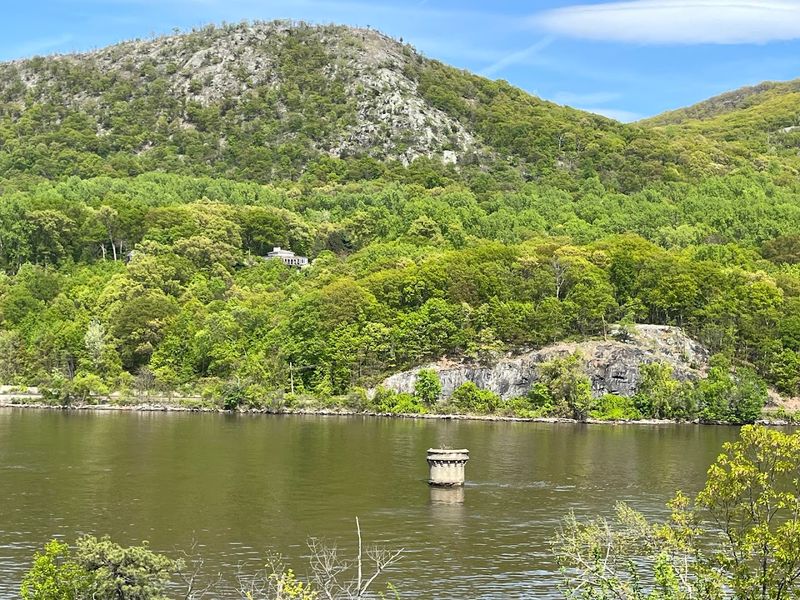
Getting to Bannerman Castle is part of the experience, and it sets the mood perfectly. Tours depart from the Beacon waterfront, which sits conveniently right next to the Metro-North train station.
The boat ride takes roughly 15 to 30 minutes depending on the tour, and guides share history about the Hudson River, the surrounding landscape, and the Bannerman family as you cruise out.
The moment the island comes into view from the water is genuinely unforgettable. The ruins grow larger and more detailed as you approach, and the scale of the stone walls becomes clear in a way that photos simply cannot capture.
There is a dock on the island, and from there you climb up to meet your island guide for a walking tour through the grounds.
The tour covers the castle ruins, the smaller summer residence Bannerman built for his family, the island’s gardens, and a compact but informative museum. After the guided portion, visitors get free time to explore on their own.
Some trails are rocky and uneven, so comfortable shoes with good grip make a real difference. The island also has a small snack stand and a gift shop, which is a welcome surprise given how remote the whole setting feels.
The Gardens, the Residence, and the Details Most Visitors Miss
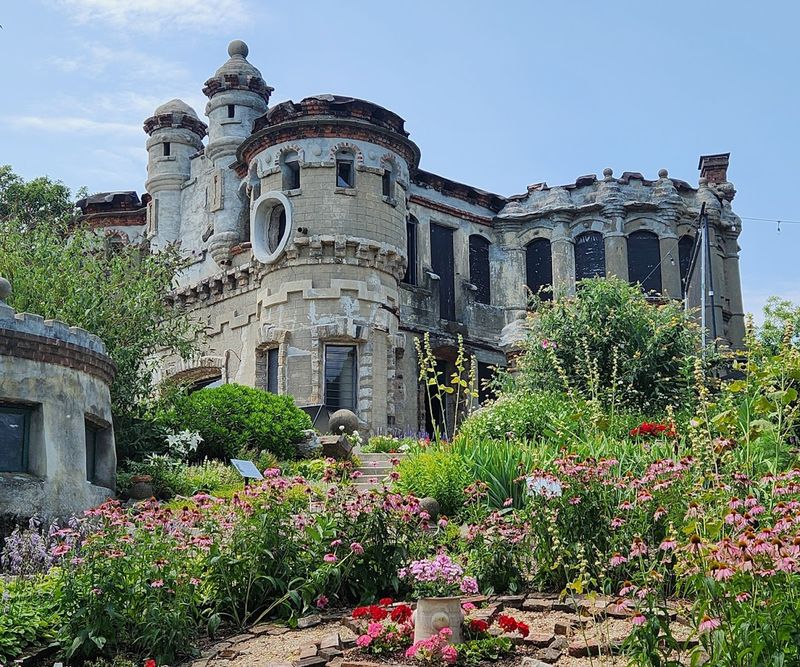
Most people come for the castle walls, but Pollepel Island holds several quieter surprises that reward curious visitors who wander off the main path. Near the island’s highest point sits the remains of Bannerman’s summer residence, a smaller and more ornate structure he built as a family retreat.
It is far more intimate than the massive arsenal and gives a completely different sense of who Bannerman was as a person.
Down the south slope from the residence, there are the remnants of a formal garden and an old well that was dug but never actually produced usable water. The reason is fascinating: the Hudson River is tidal all the way past Albany, and the water is brackish and undrinkable as far north as Poughkeepsie.
So the well was ultimately pointless, which is a surprisingly human detail in an otherwise grand project.
There is also a section called Wee Bay on the island’s southern edge, not part of the standard tour route but absolutely worth finding on your own. The harbor wall remnants along the south and east sides of the island sit partially submerged in the river, adding one more layer of texture to an already layered place.
These small discoveries are what make the island feel genuinely alive.
Preservation Efforts and Why This Place Still Stands
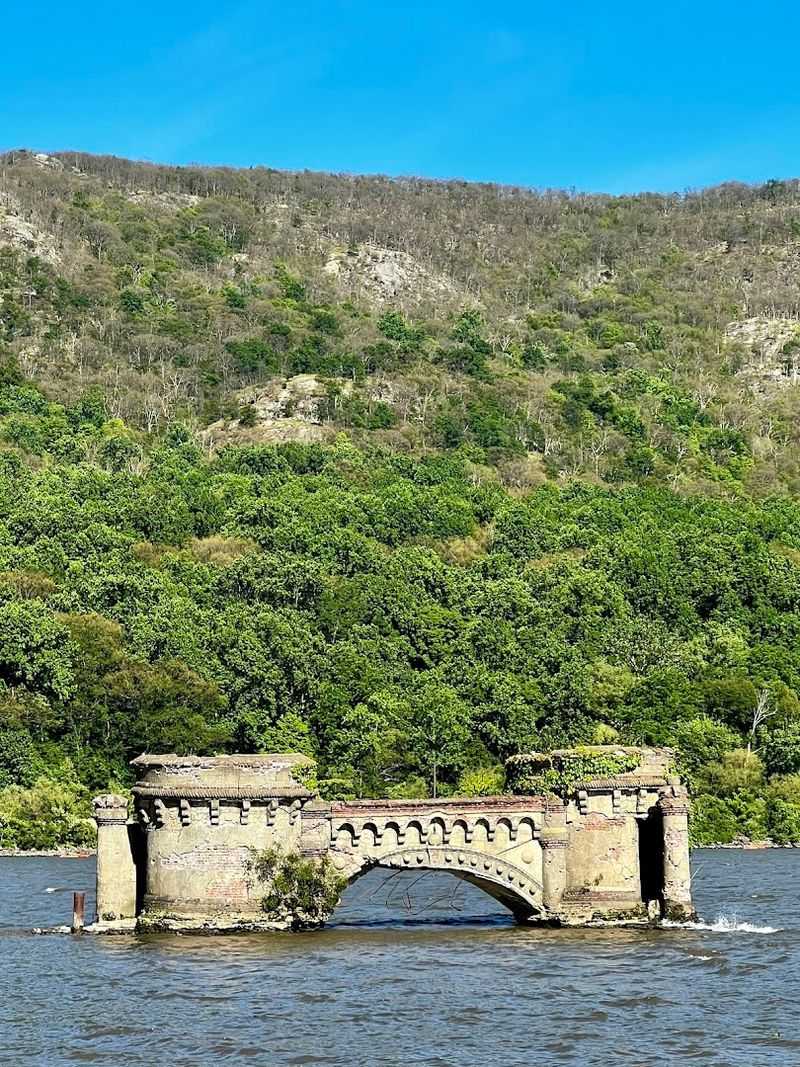
Bannerman Castle should not still be standing. Between the 1920 munitions explosion, the 1969 fire, decades of neglect, and the 2009 wall collapse, the odds were stacked heavily against it.
The fact that visitors can still take a boat out and walk near those walls today is largely thanks to the Bannerman Castle Trust, a non-profit organization dedicated to preserving the island and making it accessible to the public.
The Trust works alongside the New York State Office of Parks, Recreation and Historic Preservation, which owns the island as part of Hudson Highlands State Park Preserve. Stabilization studies have been completed, temporary supports have been installed at critical points in the main structure, and ongoing fundraising keeps the preservation work moving forward.
Volunteers contribute a significant amount of the labor, which makes visiting feel like an act of support as much as tourism.
Beyond the physical preservation, the Trust keeps the island culturally alive by hosting concerts, theatrical performances, and movie nights on the grounds. The annual production of Dracula performed among the ruins has become particularly popular and sells out well in advance.
Bannerman Castle is not just being preserved as a historical artifact; it is being kept as a living, breathing destination that genuinely earns its place in the Hudson Valley.
Address: Pollepel Island, Beacon, NY 12508
