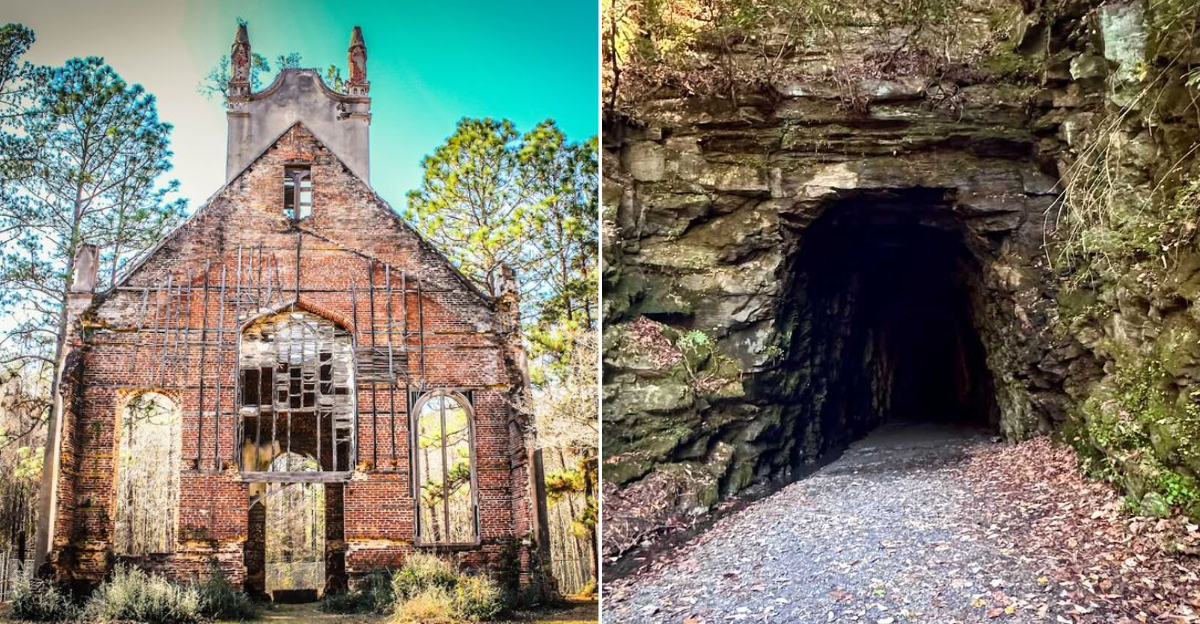
The kudzu is winning. That green monster has swallowed whole buildings, buried main streets, and turned old brick into soft, mossy mounds.
South Carolina’s forgotten ruins are not being torn down. They are being gently reclaimed by the forest, one vine at a time.
A riverside settlement where prosperity turned to dust now hides under a canopy of ancient oaks. A colonial chapel, gutted by fire, stands hollow and silent, its walls draped in Spanish moss.
An entire 18th-century town has vanished, its 325 acres of streets and homes now a quiet woodland.
No bulldozers. No demolition crews. Just nature slowly taking back what was once hers.
So which abandoned South Carolina ruins rest beneath overgrown forests, waiting for you to wander their forgotten paths?
Read on to discover the places where history is being swallowed by the wild, one leaf at a time.
1. Old Sheldon Church Ruins (Yemassee)
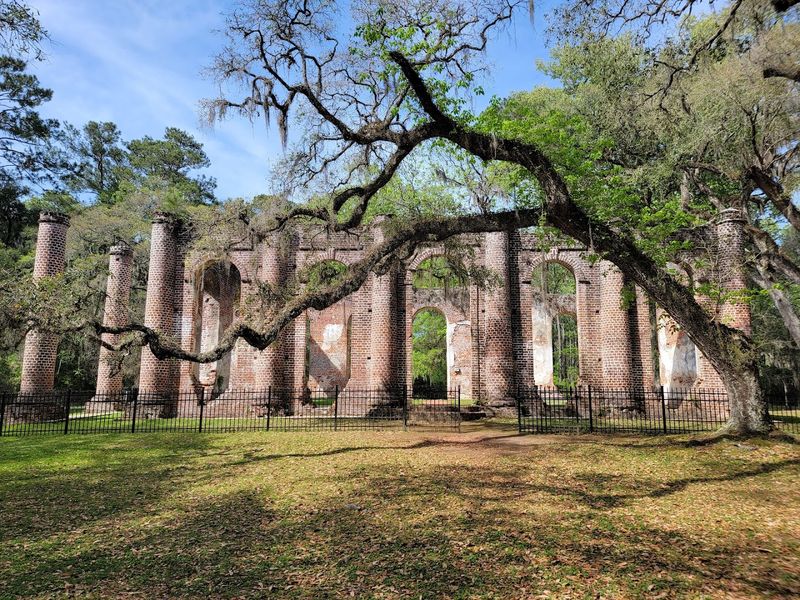
You know that feeling when a place is so quiet it almost makes you lower your voice without thinking? That is exactly what happens here, because these old brick columns rise out of the Lowcountry woods like something half remembered.
Even before you reach the fence, the Spanish moss and oaks start doing most of the storytelling for you.
Old Sheldon Church Ruins sits at Old Sheldon Church Road, Yemassee, SC 29945, and even the drive out feels like a lead-in to something solemn. The church was burned during the Revolutionary War, rebuilt, then burned again during the Civil War, which somehow makes the surviving shell feel even more stubborn and moving.
You are looking at arches, broken walls, and a skeletal frame that still holds onto a strange kind of grace.
Because the site is protected and fenced, you experience it from a little distance now, but honestly that does not weaken the mood at all. It almost adds to it, like the ruin is asking for space while the forest keeps closing in around it.
In South Carolina, there are prettier places, sure, but very few that stay with you in quite this deep, hushed way.
2. Colonial Dorchester State Historic Site (Summerville)
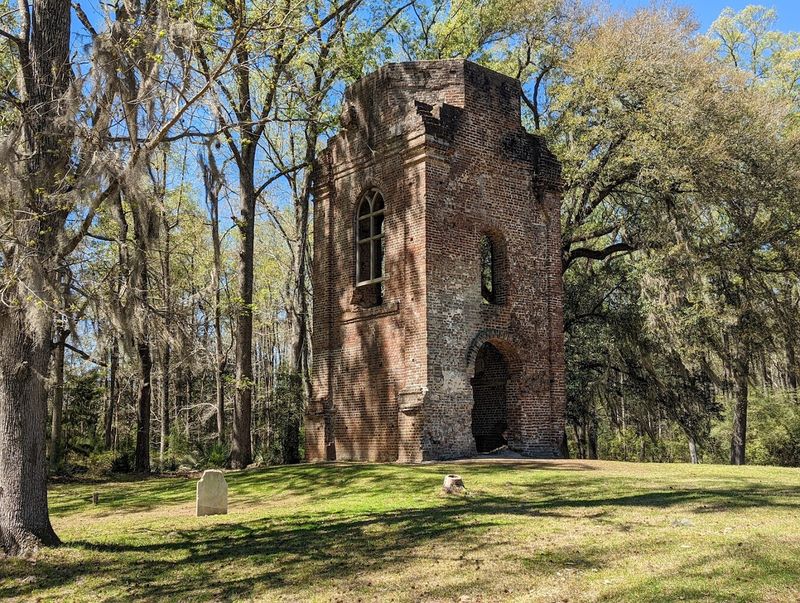
What gets me here is how easy it would be to miss the weight of the place if you only gave it a quick glance. At first, you see open grounds, old masonry, and quiet trees, and then it starts to sink in that this was once a busy trading town.
The stillness feels almost sneaky that way.
Colonial Dorchester State Historic Site is at 300 State Park Road, Summerville, SC 29485, tucked near suburban life but somehow holding onto its own separate rhythm. You can walk past the bell tower of St. George’s Anglican Church, the tabby walls of Fort Dorchester, and old foundations that look like they are being slowly folded back into the earth.
I like that nothing here feels staged for effect, because the ruin and the landscape do the work on their own.
The tabby fort especially has that weathered, rough texture that makes you want to stand there a minute and really notice it. You are not just seeing pieces of old South Carolina architecture, you are seeing a whole town reduced to hints and outlines.
There is something oddly tender about that, like the site is fading but not gone, and nature is being patient with it.
3. Stoney-Baynard Plantation Ruins (Hilton Head Island)
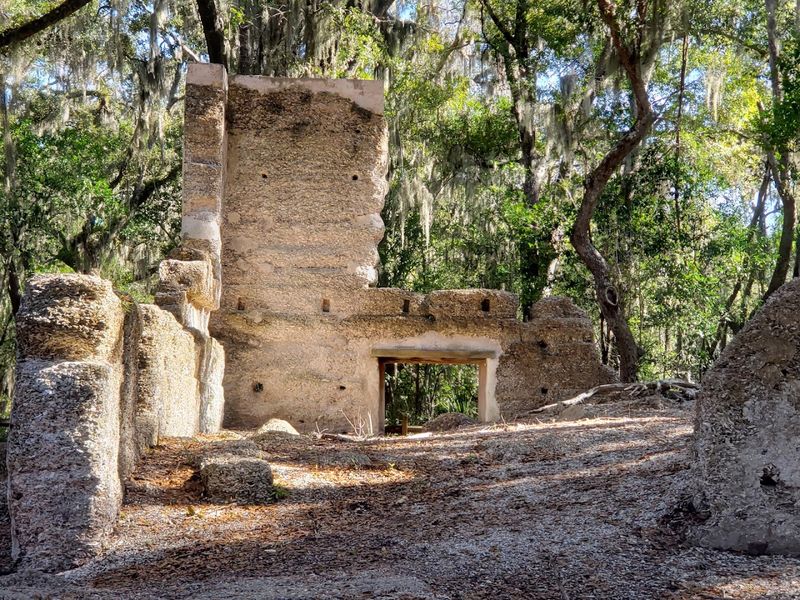
This one feels a little stranger than you expect, mostly because it sits inside a polished resort area and still manages to feel completely apart from it. You walk through the trees, and suddenly these pale tabby walls appear like the remains of a story the island never fully let go.
That contrast is what makes it memorable.
The Stoney-Baynard Plantation Ruins are along Baynard Park Road, Hilton Head Island, SC 29928, inside Sea Pines, where the forest and the pathways soften the whole approach. What remains of the plantation house is a crumbling shell from the early nineteenth century, with thick walls, open window spaces, and that rough oyster-shell texture tabby always gives old South Carolina ruins.
Local lore says William Eddings Baynard still wanders here, and honestly, even if you do not believe in ghosts, the place definitely leans in that direction.
I would not call it scary so much as deeply unsettled, like the land remembers more than it wants to explain. The trees crowd close, the light slips through in patches, and the ruin feels both exposed and hidden at the same time.
It is one of those places where you catch yourself slowing down without meaning to, just to take in the feeling.
4. Prince Frederick’s Chapel Ruins (Georgetown County)
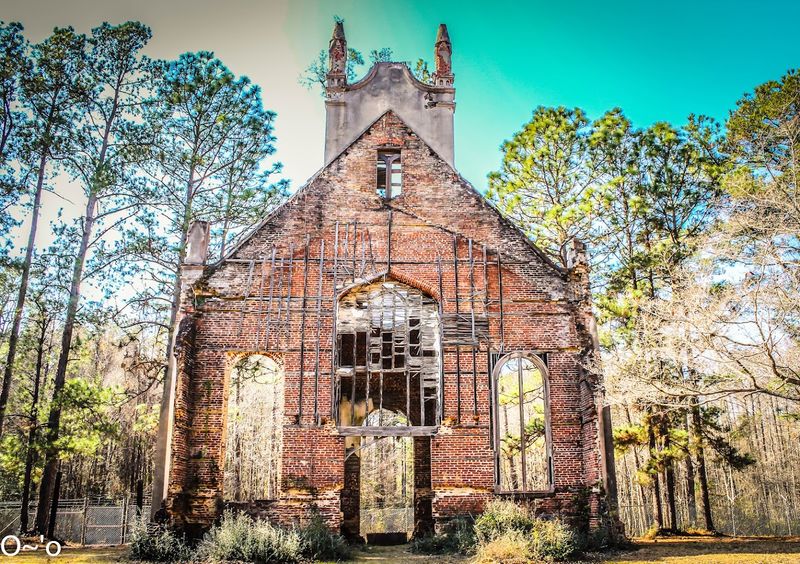
Some ruins feel dramatic right away, and this one absolutely knows how to make an entrance even while hiding behind trees. You catch sight of the tall facade and empty window openings, and for a second it looks like a church that forgot the rest of itself.
That unfinished feeling is the whole mood here.
Prince Frederick’s Chapel Ruins is at 1043 Prince Frederick Road, Georgetown, SC 29440, in a wooded stretch that makes the site feel more remote than it really is. Built in a Gothic Revival style and never fully completed, the chapel now stands as a hollowed steeple and facade, fenced off and partly screened by brush.
I actually think the distance helps, because you end up taking in the outline, the silence, and the way the ruin seems to float between history and forest.
You are not wandering through rooms or climbing staircases here, and that is probably for the best. The power of this place comes from standing outside it, looking through the openings, and imagining what was intended but never finished.
Near the coast of South Carolina, where so much history survives in fragments, this one feels especially poignant because it was incomplete almost from the beginning.
5. Castle Pinckney (Shutes Folly Island)
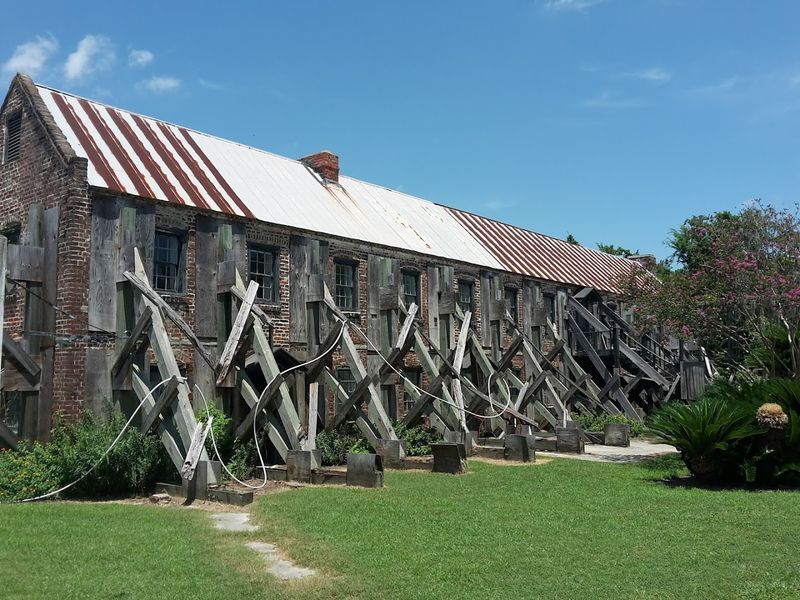
If there is a place on this list that really gets by on pure atmosphere, it is this one sitting out in Charleston Harbor like a rumor. You cannot just wander up to it on foot, which makes it feel even more mysterious, because the whole fort is tucked into an island that looks half swallowed by green.
The distance adds a lot.
Castle Pinckney stands on Shutes Folly Island, Charleston, SC 29401, and the setting does almost all the haunting for free. This early fortification later carried a much darker history as a Civil War prison, and now its brick walls sit crumbling under thick overgrowth while boats pass in the wider harbor.
I think that contrast is what sticks with you most, because Charleston moves around it while the fort remains stranded in its own quieter timeline.
From afar, you mostly see broken brick, tangled vegetation, and a low silhouette that is easy to overlook if you do not know what you are seeing. But once you do know, it is hard not to keep staring.
South Carolina has plenty of waterfront beauty, yet this little island ruin feels less like scenery and more like a sealed memory sitting just offshore.
6. Boynton House (Donnelley Wildlife Management Area)
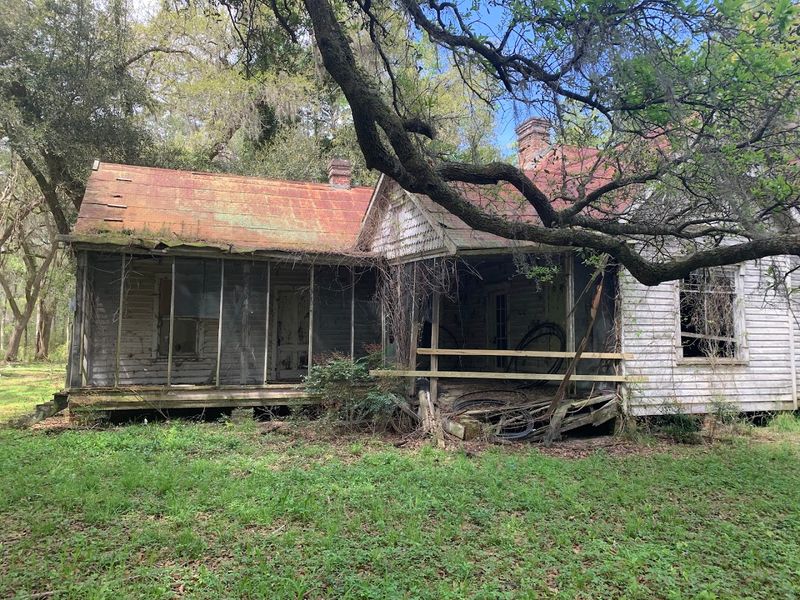
This is the kind of place that makes you feel like you have stepped into a Southern Gothic novel without any warning at all. One minute you are moving through a vast wildlife area, and the next there is this decaying mansion looking back through the trees like it has been waiting.
It is eerie, but in a strangely beautiful way.
Boynton House sits within Donnelley Wildlife Management Area at 585 Donnelley Drive, Green Pond, SC 29446, surrounded by the flat, quiet sweep of the Lowcountry. The old Victorian mansion is badly weathered now, with broken openings, sagging surfaces, and a general sense that the forest has been taking it piece by piece for years.
People love to mention the bats, which only adds to the mood, but even without that detail, the place already feels wonderfully haunted.
What I like most is how the landscape refuses to treat the house like a separate attraction. Palmettos, grasses, and towering trees press right up against it, so the building feels absorbed into the refuge rather than preserved from it.
You do not come here for polished interpretation or neat edges. You come because the ruin still has personality, and because South Carolina does overgrown melancholy incredibly well in spots like this.
7. Andersonville (Beneath Lake Hartwell)
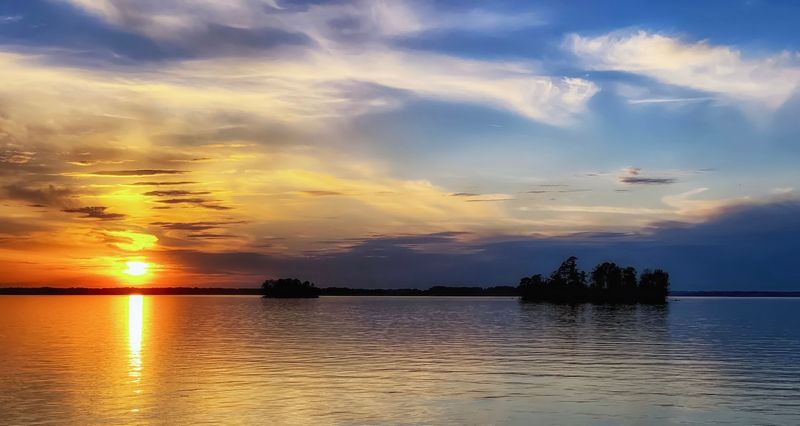
This one is different, because you are dealing with a place that usually stays hidden under water, which gives it a completely different kind of ghost story energy. Most of the time, you are standing near an ordinary stretch of lake and knowing there is a town below.
When drought drops the water, that knowledge suddenly becomes visible.
The remains of Andersonville are associated with the Lake Hartwell area near Old Andersonville Road, Townville, SC 29689, where the flooded community occasionally reappears in fragments. Brick walls, chimneys, and foundations can emerge from the lakebed when conditions are low enough, and the effect is honestly unsettling in a way photographs barely capture.
Instead of forest slowly swallowing a ruin, you get water revealing it for a little while and then taking it back.
I think that temporary quality is what makes this one so compelling, because you cannot count on seeing the same thing twice. It also changes how you imagine abandonment, since the town was not left behind in the usual sense so much as submerged and erased from everyday view.
In South Carolina, where overgrowth usually hides the past, Andersonville feels especially strange because the lake itself becomes the curtain lifting and closing again.
8. Stumphouse Tunnel (Oconee County)
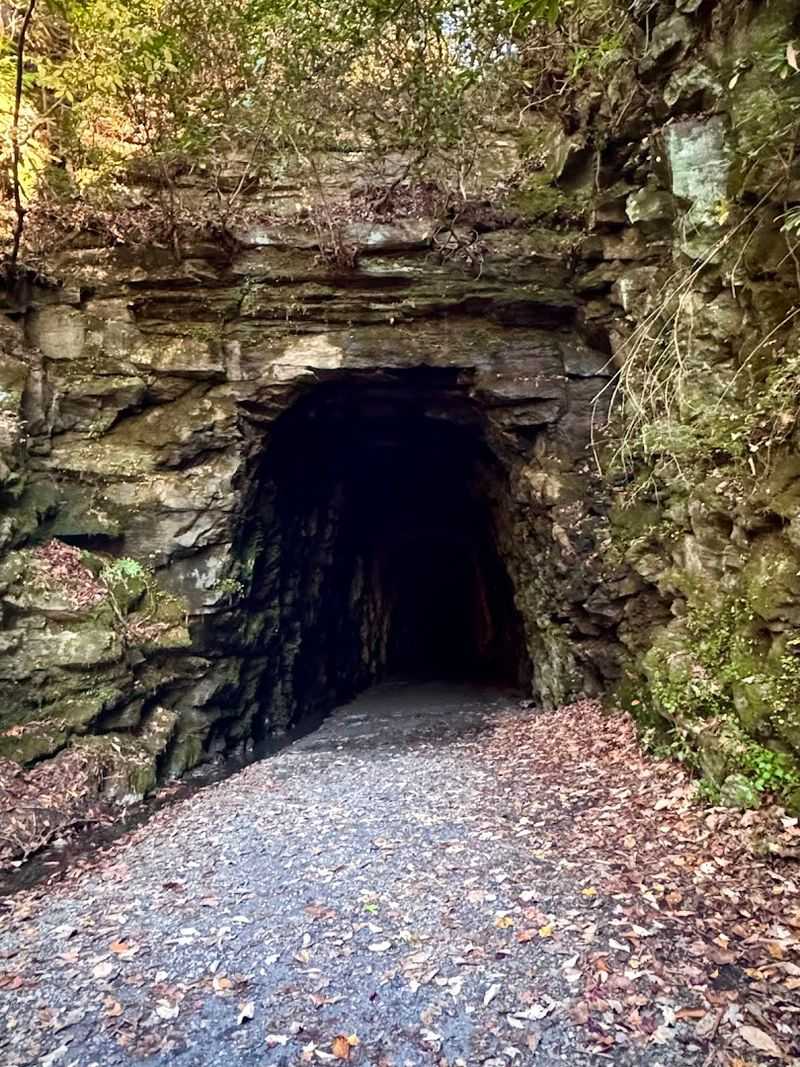
By the time you get to this one, the air itself feels different, and that is before you even step near the tunnel mouth. Cool mountain shade, wet stone, and moss take over the scene so completely that the whole place feels like nature has been collaborating with the ruin for a very long time.
It is such a strange, satisfying stop.
Stumphouse Tunnel is at 109 Stumphouse Tunnel Road, Walhalla, SC 29691, tucked into the Blue Ridge foothills in the far western part of the state. The tunnel was carved for a railroad that never came together, and what remains is a dark, unfinished passage boring into the mountain while the surrounding forest keeps softening its edges.
Even with visitors around, the place still holds onto an abandoned mood because the tunnel seems to absorb sound and light almost immediately.
I love that it feels both engineered and wild at once, with stonework giving way to dripping walls, ferns, and cool air that hangs in place. You are standing inside an old ambition that was simply left there, and the mountain has been taking care of it ever since.
South Carolina ruins are often coastal or Lowcountry in feeling, so this moody mountain setting adds a whole different flavor.
