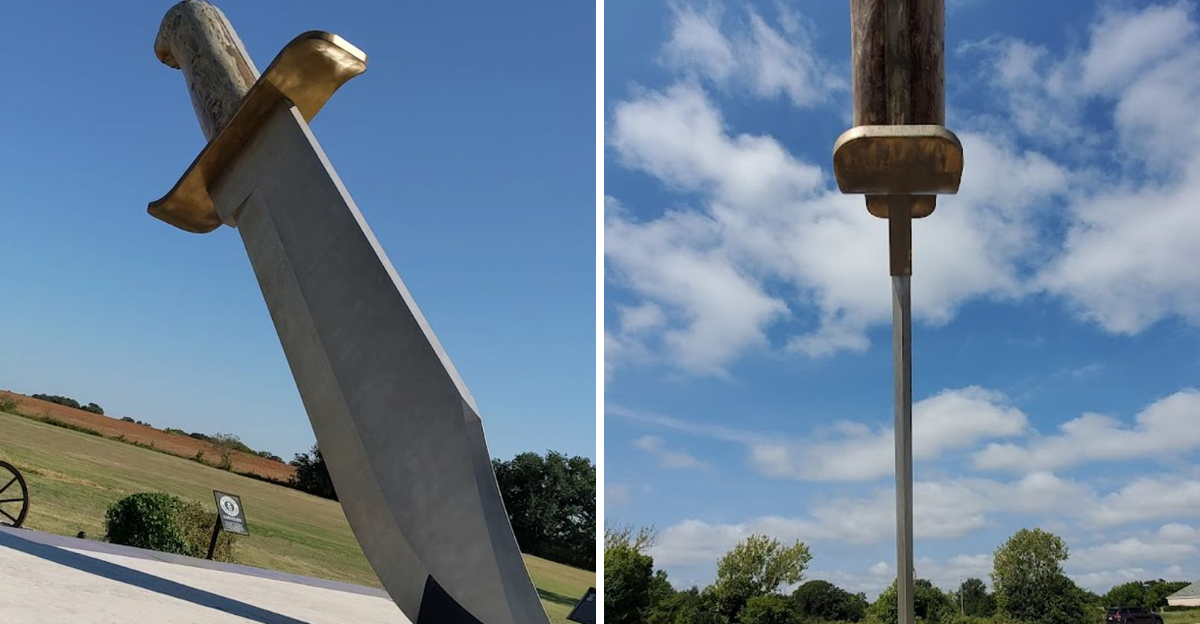
You have seen oversized roadside attractions before, a giant ball of yarn or a big fiberglass cow. This one is different.
The knife looms over you, absurdly huge, like something a movie giant would use to cut a sandwich. It is over twenty feet tall and weighs more than a car, which is ridiculous and wonderful.
The backstory is pure accident, a knife factory built it as a promotion, then the factory closed, but the blade stayed. Now it just stands there, rusting slightly, daring you to take a photo with it.
It is strange, it is hilarious, and it delivers exactly what the hype promised.
A Monument Born From Local Pride and One Big Idea
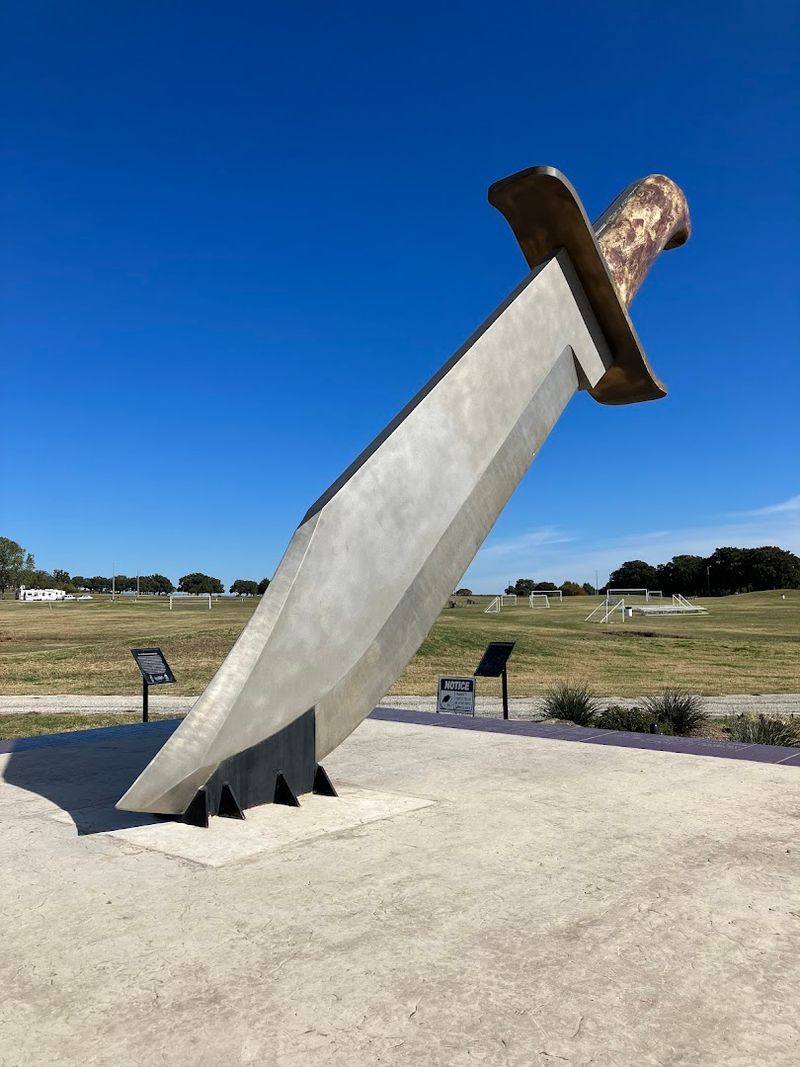
Some of the best ideas in Texas history started with a rancher and a dream. The World’s Largest Bowie Knife exists because of Bob Hadley, a local rancher and bronze sculptor who pitched the concept to the Bowie Chamber of Commerce as a way to put the city on the map.
He believed a landmark this bold would draw visitors from across the state and beyond.
The project caught fire. Funded entirely through private donations, the knife cost somewhere between $150,000 and $170,000 to build, with a single anonymous donor contributing a remarkable $100,000.
That kind of community investment tells you everything about how much the people of Bowie believed in this vision.
The monument was unveiled on April 4, 2016, and just four days later, Guinness World Records officially certified it as the largest Bowie knife in the world. For a small North Texas city, that is an extraordinary achievement.
It is not just a quirky roadside stop built on impulse. It is a carefully planned, community-funded tribute to local identity, and you can feel that intention the moment you stand in front of it.
The pride baked into this project is real, and it shows in every polished inch of the blade.
The Numbers That Make Your Jaw Drop
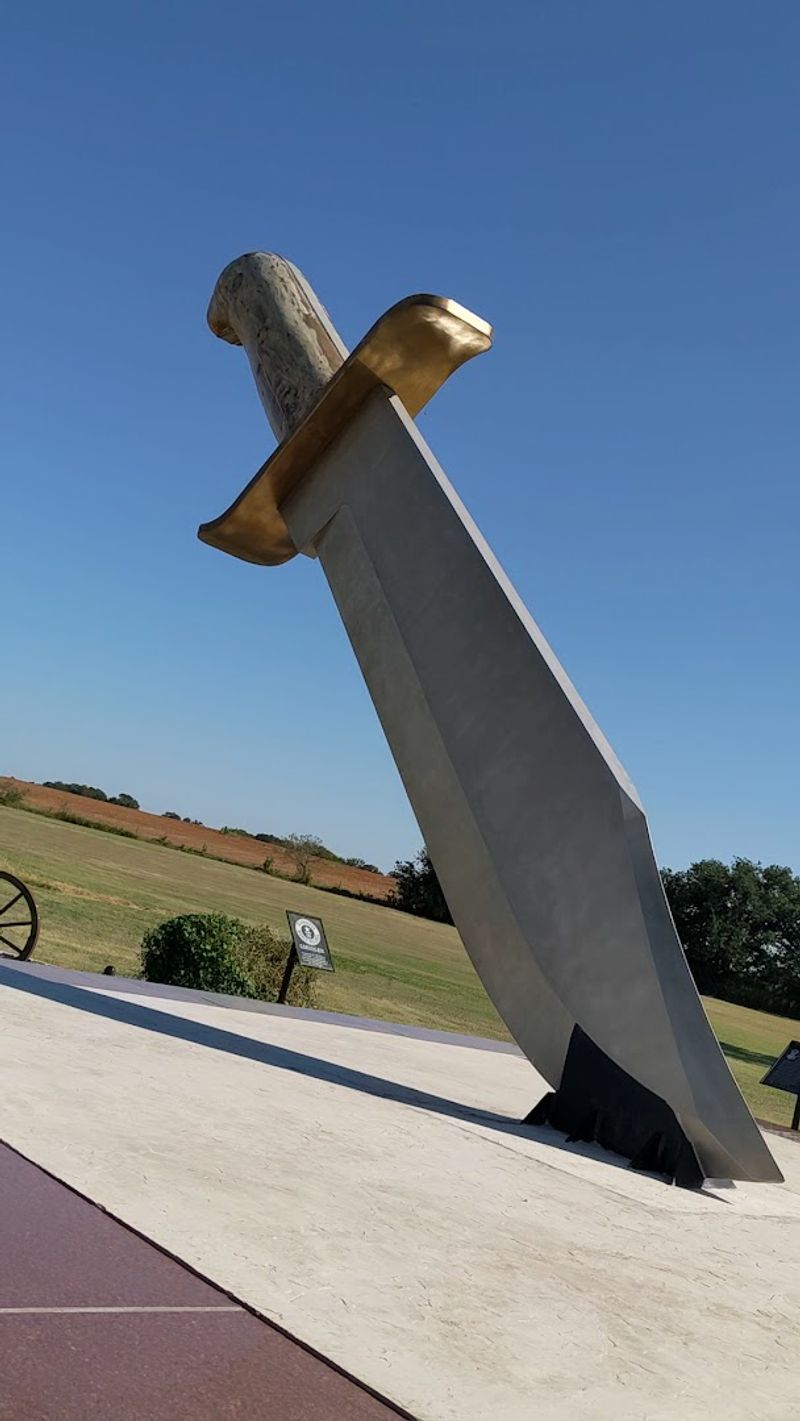
Numbers do not always tell the full story, but in this case, they absolutely do. The entire monument stretches 20 feet and 6 inches long.
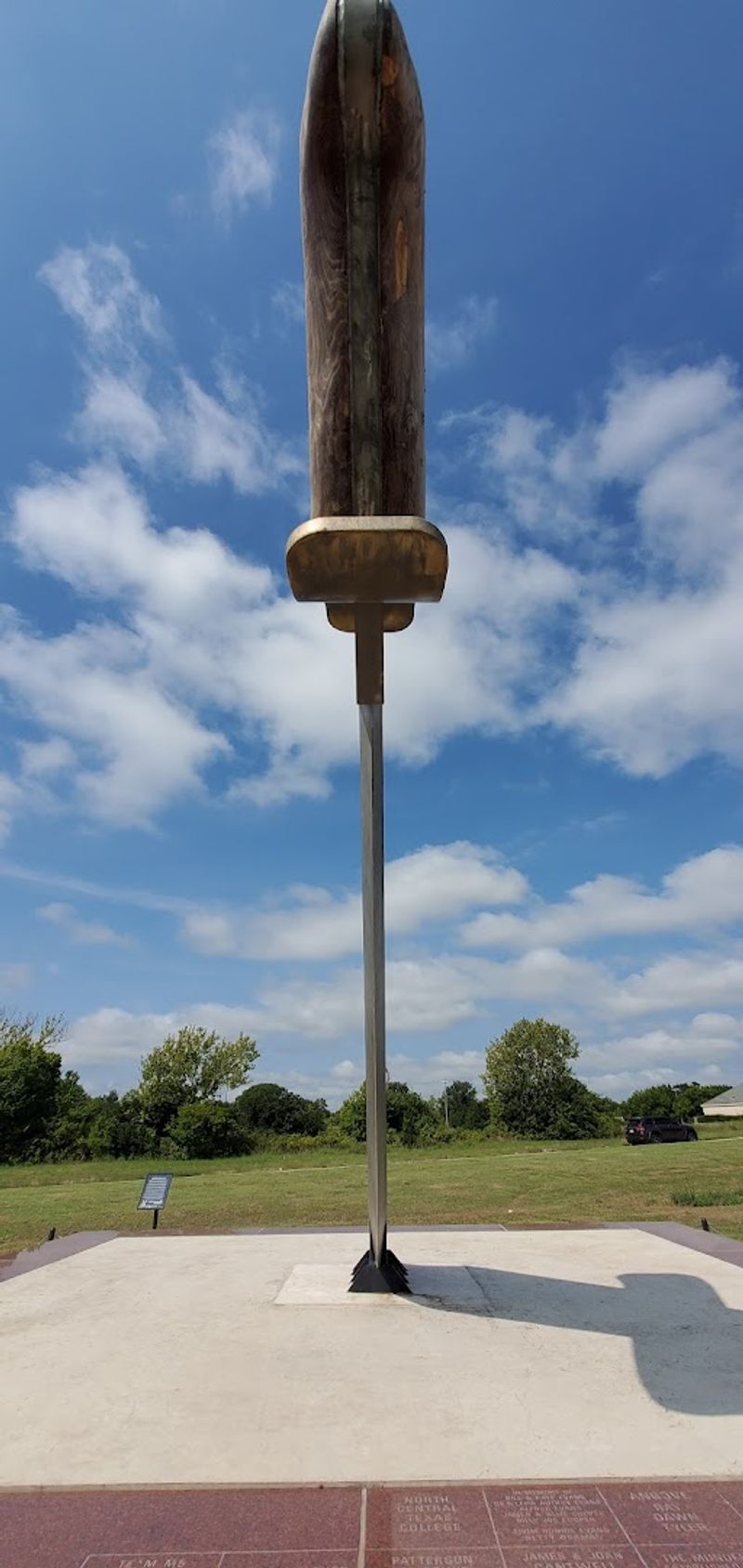
The blade alone measures 14 feet and 5 inches, forged entirely from stainless steel and hollowed out to manage the weight while keeping that striking, razor-clean silhouette.
Even hollowed out, the whole structure tips the scale at 3,000 pounds. That is 1.5 tons of knife sitting in a North Texas park, looking effortlessly cool.
The hilt is crafted from brass, and the handle comes from a local bois d’arc tree, also called Bodark, which gives the piece a grounded, regional character that feels intentional and meaningful.
Engineers did not just build big for the sake of it. The structure was designed to survive winds up to 90 miles per hour, withstand an inch or two of ice accumulation, and hold steady through seismic activity.
Texas weather is no joke, and the people behind this monument knew it. Seeing something this massive and knowing it was built to last through almost anything adds a quiet layer of respect to the whole experience.
It is not just a novelty. It is serious craftsmanship dressed up in a very dramatic package.
Pelham Park and the Setting That Frames Everything Perfectly
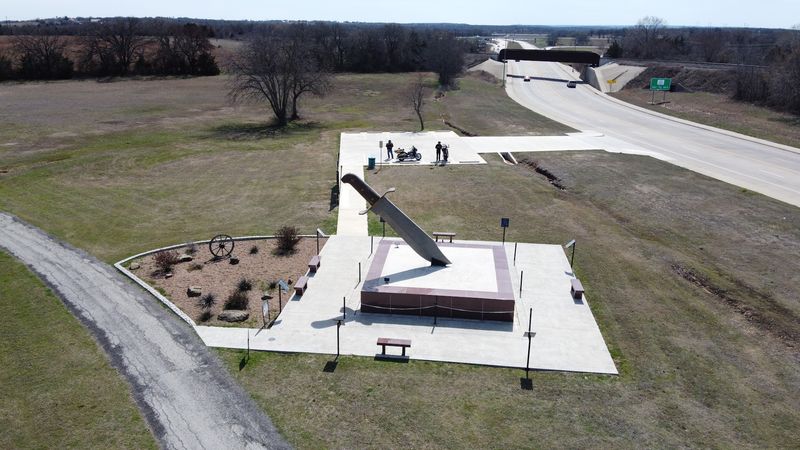
Context matters when you visit a landmark, and Pelham Park delivers a setting that actually complements the monument rather than competing with it. The open green space around it gives the blade room to breathe, and that matters more than you might think.
There is free, easy parking right there, and the site is fully handicapped accessible. That level of thoughtful planning is something you notice and appreciate, especially when so many roadside stops are awkward to navigate.
You can pull in, park without stress, and walk right up to the monument without any hassle.
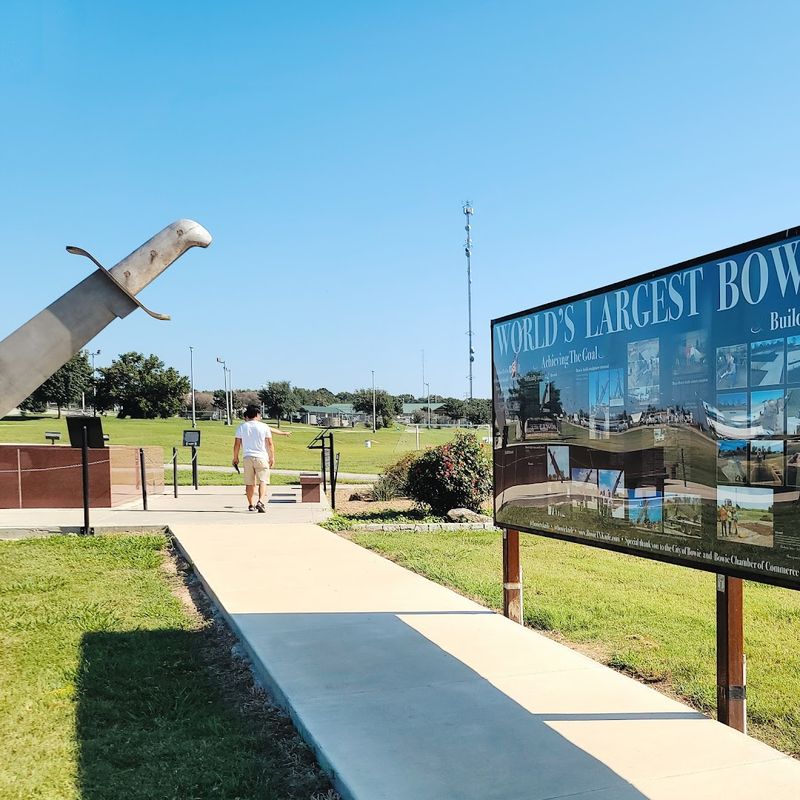
Explanatory plaques around the site tell the story of Jim Bowie and the knife that carries his name. Reading them adds real depth to what you are looking at.
The digital guestbook option is a fun, modern touch that lets you leave your mark without leaving anything behind. The park itself feels calm and well-maintained, which makes the whole stop feel more like a genuine destination than a quick photo grab.
You could easily spend thirty minutes here just absorbing the place, the history, and the surprising sense of calm that comes with it.
Jim Bowie and the Legend Behind the Blade
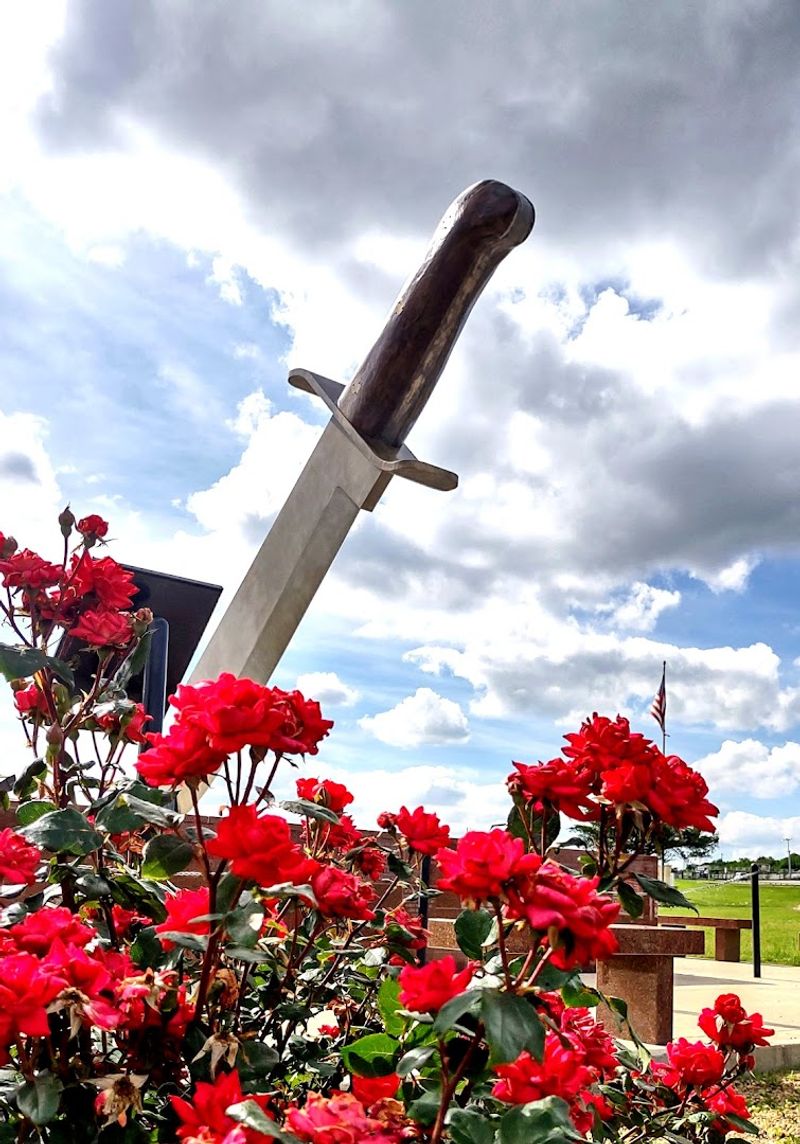
Before there was a 20-foot steel monument, there was a man and a myth that grew larger than life. Jim Bowie was an American frontiersman, land speculator, and soldier whose name became permanently attached to a style of fighting knife in the early 1800s.
He is perhaps best remembered for his role at the Battle of the Alamo in 1836, where he died defending the fort alongside a small group of Texan rebels.
The Bowie knife itself became iconic not just because of Jim Bowie’s reputation, but because of its practical design. Long, single-edged with a clipped point and a crossguard, it was built for both utility and combat.
Frontiersmen across the American West carried variations of it for generations.
The city of Bowie, Texas, was named in his honor, and that connection gives this monument a layer of historical weight that elevates it beyond a simple novelty. Reading the plaques at the site, you get a real sense of who Jim Bowie was and why his legacy stuck around.
It is one of those rare moments where a roadside attraction actually teaches you something. The giant knife is the hook, but the history is the part that lingers with you long after you have driven away.
Texas Made It Official: The Bowie Knife Gets State Recognition
If there was any doubt about how seriously Texas takes its relationship with the Bowie knife, the state government settled that question in 2021.
On May 30 of that year, Governor Greg Abbott signed Texas Senate Concurrent Resolution 7, officially designating the Bowie knife as the Official Knife of the State of Texas.
That is not a small thing.
Texas has an official state bird, a state flower, and a state dish. Adding an official state knife to that list says something real about how deeply the Bowie knife is woven into the cultural fabric of the Lone Star State.
For the city of Bowie, it felt like a validation of everything the monument was built to celebrate.
Visiting the World’s Largest Bowie Knife after learning this fact adds a whole new dimension to the experience. You are not just looking at a giant novelty item anymore.
You are standing in front of a symbol that the state of Texas formally recognized and honored. That kind of context transforms a photo stop into something that actually means something.
It is the sort of detail that makes you want to share the story with everyone in the car, and probably a few people back home too. Texas does not do things halfway, and this monument is proof of that.
What Makes This Roadside Stop Actually Worth Your Time
Not every roadside attraction earns its reputation. Some are smaller than advertised, poorly maintained, or surrounded by nothing that makes the detour feel worthwhile.
The World’s Largest Bowie Knife is genuinely different, and that difference is obvious the second you arrive.
The monument is described by many visitors as one of the nicest-looking world’s largest items in all of Texas. That is a meaningful distinction in a state that has no shortage of oversized novelties.
The clean lines, the reflective steel, and the craftsmanship of the handle all combine to make this something you actually want to photograph rather than just document and move on from.
The free parking, accessible design, and well-placed informational plaques make the visit smooth and genuinely educational. There is no admission fee, no long walk from a distant lot, and no confusing layout to navigate.
You just show up, look up, and let the scale of the thing settle over you. For road trippers cutting through North Texas on US 81, this is the kind of stop that costs you twenty minutes and gives you a memory that sticks around for years.
Good roadside stops are rarer than people think, and this one belongs in a category all its own.
Planning Your Visit to Bowie, Texas
Bowie, Texas sits in Montague County in the northern part of the state, roughly 90 miles northwest of Fort Worth. If you are driving US 81 between Wichita Falls and the Dallas-Fort Worth area, the monument is practically on your route.
There is no excuse to skip it.
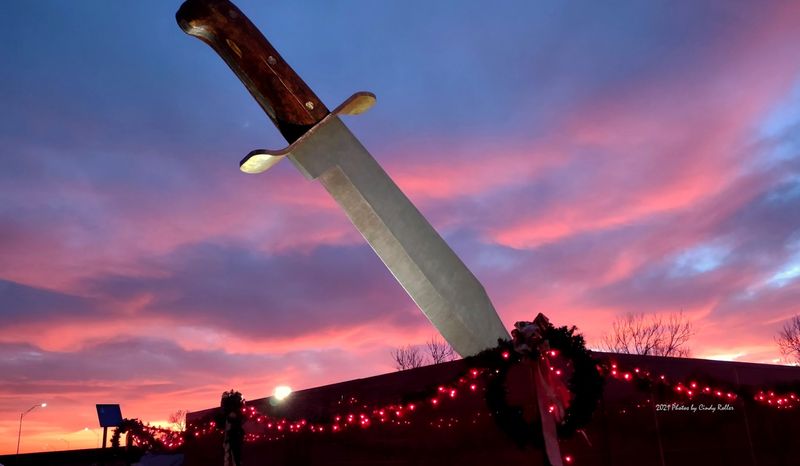
The site is open and accessible any time of day, which makes it great for early morning stops when the light hits that stainless steel blade in a particularly dramatic way. Sunrise visits have a quality to them that midday crowds cannot quite match.
That said, the park is comfortable and welcoming at any hour.
Bowie itself is a small city with a friendly, unpretentious character. While the knife is the main draw, the surrounding area has its own quiet charm worth a slow look around.
The monument at 1555-1699 E Wise St is easy to find and impossible to miss once you are close. Plug in the address, roll down the windows, and let the flat North Texas landscape carry you there.
Road trips are about the moments that surprise you, and this one has a way of doing exactly that. You will leave with photos, sure, but more than that, you will leave with a genuine appreciation for what a small Texas town can pull off when it sets its mind to something.
Address: 1555-1699 E Wise St, Bowie, TX 76230
