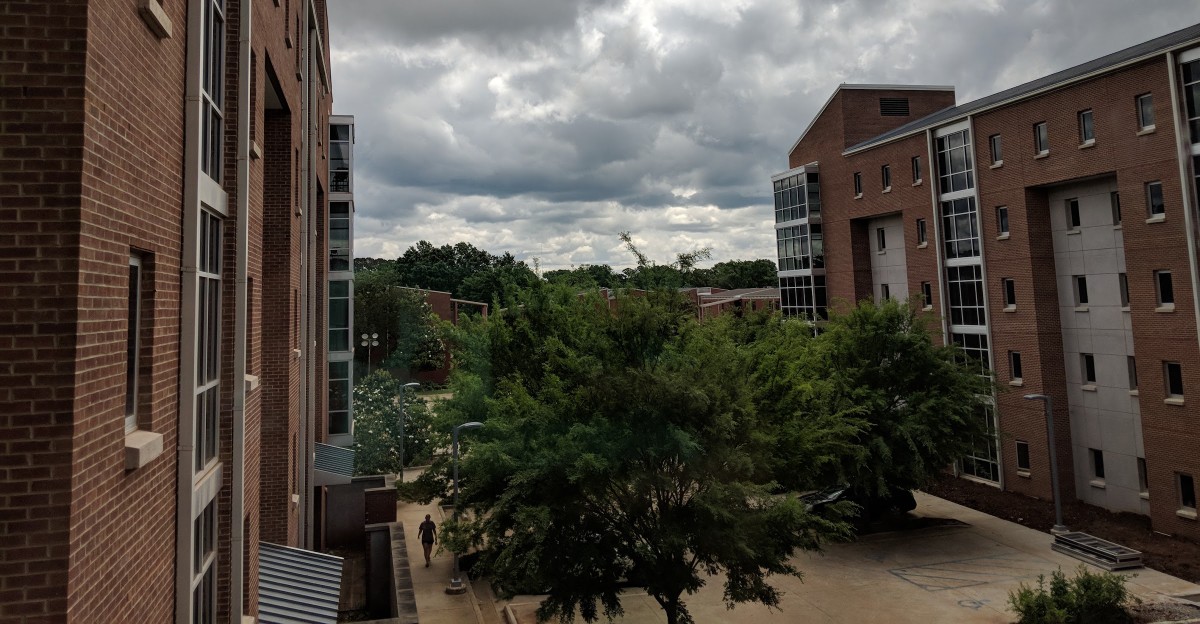
“What’s your major?” At most colleges, that question gets fairly predictable answers. Here, things can get considerably more interesting.
Someone might be studying plasma. Someone else might be working on satellites.
Another student may be focused on the weather moving across the region. This Alabama university feels closely tied to Huntsville’s reputation as the Rocket City, but the campus is not all serious engineering and laboratory work.
There is also plenty of ordinary college life happening around it, including disc golf and casual conversations between classes. Then a long-running best-value ranking enters the picture.
Suddenly, the campus has another story to tell.
Rocket City Roots Run Straight Through Campus
Huntsville earned the Rocket City name honestly, and the university sits right in the thick of that story. Its campus neighbors Redstone Arsenal and anchors Cummings Research Park, the second largest corporate research and technology park in the United States.
That address matters more than it might sound. Faculty and students work alongside experts from NASA’s Marshall Space Flight Center, the U.S.
Army, and the Missile Defense Agency, often on the same projects at the same time.
Visitors notice the effect quickly. Conversations overheard between buildings lean toward propulsion, software, and sensors, and the surrounding streets are lined with companies doing similar work.
For a traveler, the takeaway is that this is not a campus sealed off from its city. Research here feeds directly into the industries that keep North Alabama humming, and the flow goes both ways.
The university, located at 301 Sparkman Drive NW, Huntsville, AL 35899, operates as a leading public research institution, which explains the steady construction and the constant updates to labs and classrooms.
Plan a weekday visit if the goal is to feel that energy, since campus offices generally run from 8:15 in the morning until 5 in the evening, Monday through Friday.
Weekends are quieter, which suits photographers who prefer empty walkways and long shadows across the lawns. Either way, the connection between school and city stays obvious.
Best Value in Alabama, Eight Years and Counting
Eight consecutive years is a long streak for any ranking, and that is exactly how long SmartAsset, an online financial services provider, has named this university the best value school in Alabama, including in the 2023 list.
The math behind that title looks at scholarships awarded, tuition, living costs, student retention, and what graduates earn once they start working.
Graduates here post the highest median starting salary in the state at 62,200 dollars, a number that explains a lot about why families keep the school on their shortlists.
More than 70 percent of those graduates stay in Alabama once they enter the workforce, which quietly strengthens the whole state’s talent pool.
Nearly two thirds of undergraduates receive some type of financial aid, and the retention rate sits at 79 percent, a sign that students who start here tend to stick around.
Prospective students touring campus often ask about scholarships first, and admissions staff are used to that question during weekday visits.
What stands out to a casual visitor is how practical everything feels. Buildings are functional, labs get used hard, and the focus lands on what students can actually do after graduation.
Value, in this case, means a real return rather than a glossy brochure promise. That reputation did not appear overnight.
Labs Where Fusion, Hypersonics, and Cybersecurity Collide
Seventeen research centers and institutes operate under this one university, and the topics they tackle read like a list of tomorrow’s headlines.
Cybersecurity, hypersonics, atmospheric science, astronomy, astrophysics, optical systems, artificial intelligence, severe weather, plasma fusion, and space propulsion all have dedicated homes here.
Four programs rank among the top ten federally funded programs in the country, covering aerospace and aeronautical engineering, computer and information sciences, atmospheric science and meteorology, and astronomy and astrophysics.
The College of Engineering is the largest of the six colleges, with more than 3,000 students enrolled across aerospace, civil, electrical, mechanical, and other disciplines.
History here includes some genuine firsts. Scientists at this university developed Consort and Joust, the first non government rocket programs in the United States, discovered the first high temperature superconductor, and carried out the first experiment aboard the Soviet Mir space station.
Specialized facilities keep that streak alive, including the Autonomous Tracking Optical Measurement Laboratory and the Charger-1 Pulsed Power Generator, which studies nuclear fusion for spacecraft propulsion.
Most labs are not open to walk in traffic, so arranging a visit through the university ahead of time is the smarter move.
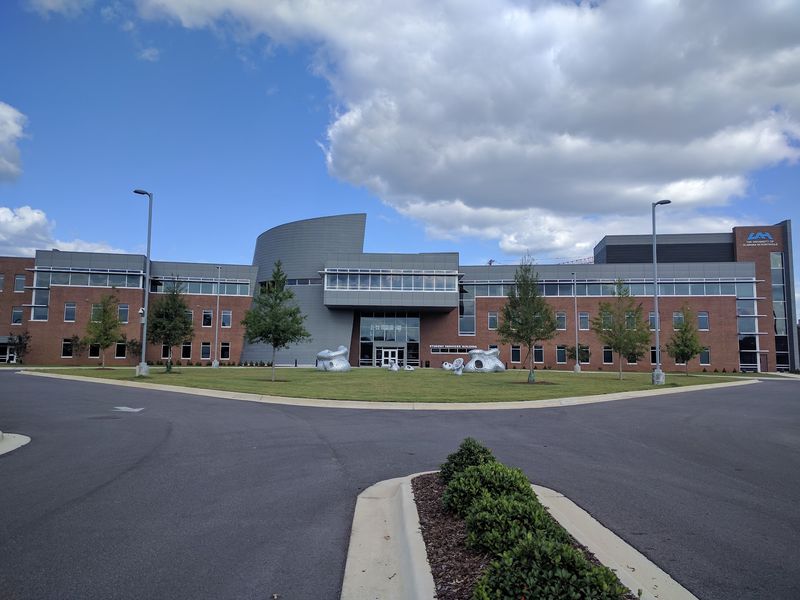
Even from the outside, the scale of the research buildings tells the story. Over 100 areas of study give students plenty of room to find their lane.
A Campus Built for Both Studying and Slowing Down
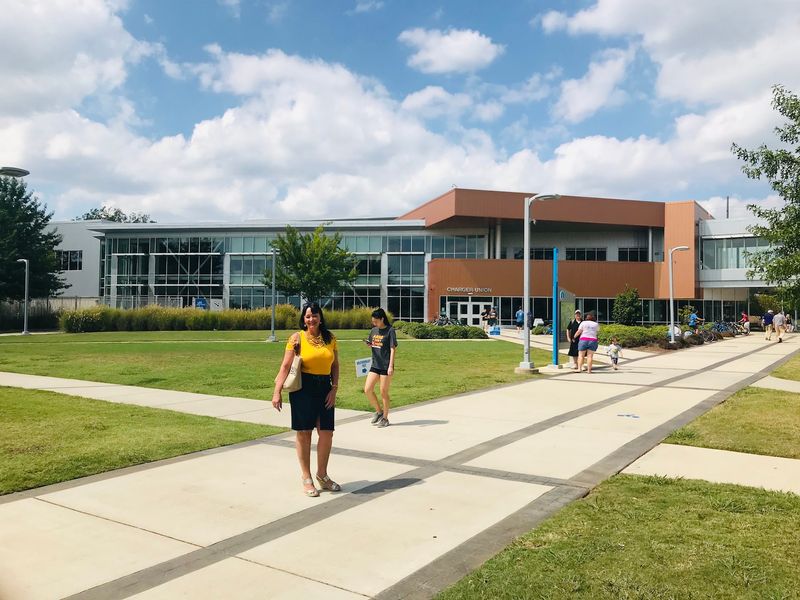
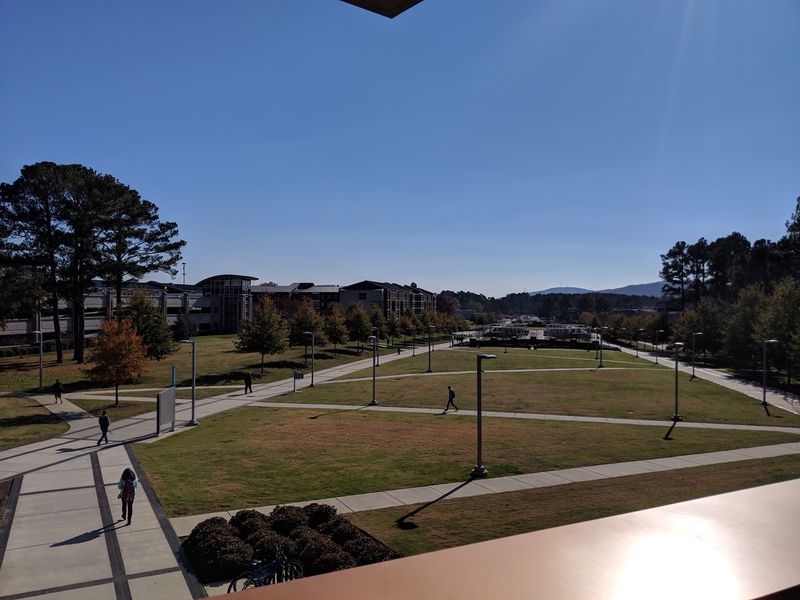
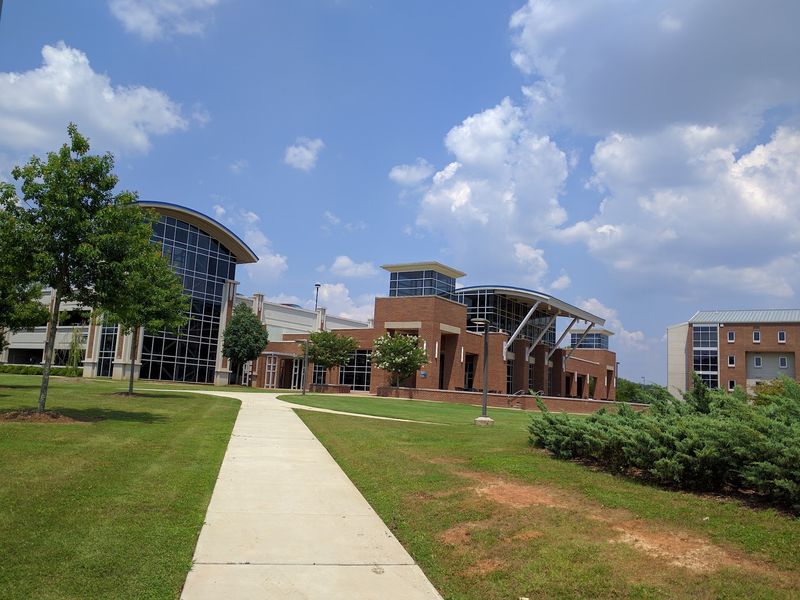
Clean sidewalks, newer buildings, and a layout that makes sense on the first try. That combination shows up in visitor impressions again and again.
The campus is open and walkable, with scenic stretches of lawn and plenty of shaded spots for sitting with a book or a laptop.
Charger Union serves as the social center of everything, offering dining options, study areas, and a venue for student events throughout the year.
Hands on learning spaces are part of the draw too, including hospital simulation rooms used by the nursing program, which happens to be the largest single major on campus.
Outdoor fun gets its due as well. A disc golf course winds through part of the grounds, giving students an easy way to clear their heads between classes.
Construction is a near constant presence, which locals treat as a good sign rather than a nuisance. Facilities keep getting refreshed and expanded.
One piece of trivia worth knowing involves the UAH Foundation, which actually predates the independent university. It began life in 1956 as the Research Sites Foundation.
Visitors driving in should budget a little extra time, since parking areas fill up fast during weekday class hours. Arriving before mid morning tends to make the whole experience smoother and calmer.
The Saturn V on the Skyline Is Not a Backdrop, It Is a Neighbor
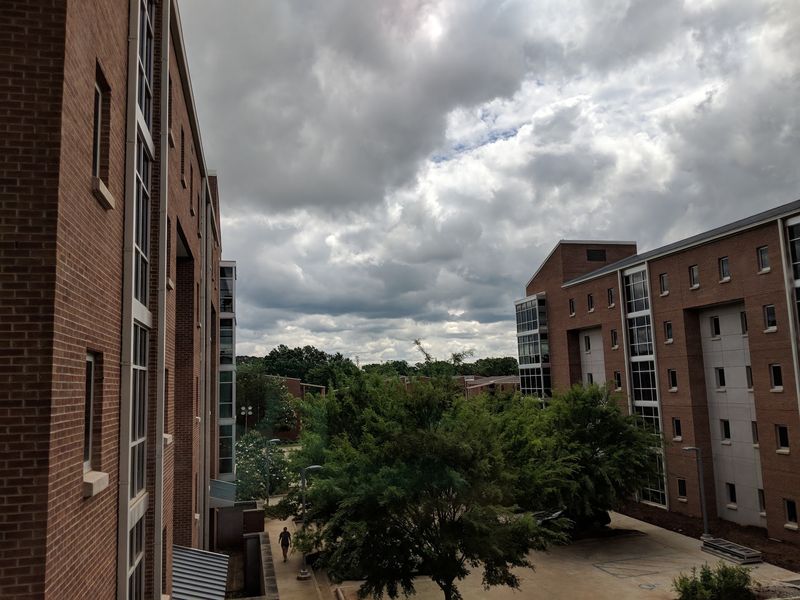
Look up from certain spots on campus and the towering NASA Saturn V rocket at the U.S. Space and Rocket Center rises above the treeline.
That view is not a coincidence. The center sits practically next door, and it holds the title of largest space museum in the world along with being Alabama’s top paid tourist attraction.
As a Smithsonian Affiliate and the official visitor center for NASA’s Marshall Space Flight Center, it houses rockets, artifacts, and hardware from the Apollo Program, including an authentic Saturn V moon rocket.
Interactive science exhibits and Space Shuttle displays fill out the rest, making it an easy half day addition to any campus trip.
Much of America’s space program was shaped in this very area, which gives the exhibits a weight that goes beyond display cases and placards.
Current work gets attention too, particularly Huntsville’s role in developing the Space Launch System, the most powerful rocket built for missions aimed at Mars.
Pairing a university visit with a stop here creates a natural before and after story. Students study propulsion in the morning, then the hardware sits waiting a few minutes down the road.
Bring comfortable shoes. The scale of that rocket does not register properly until it is directly overhead.
Nearly 200 Student Groups and a Campus That Actually Talks to Each Other
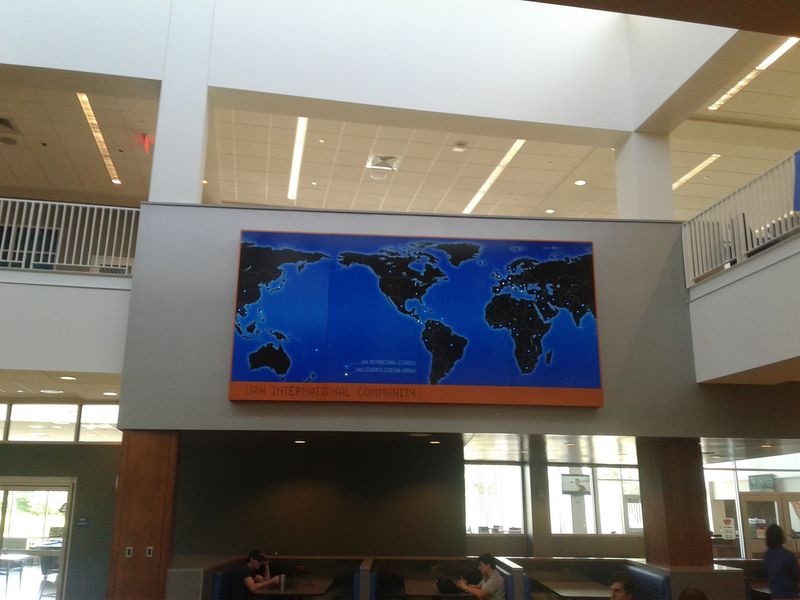
Space Hardware Club members build equipment that competes in NASA’s Artemis Student Challenges and other international STEM competitions. That alone says something about how students spend their free hours.
Close to 200 student organizations operate here, covering more than 115 degree programs and interests far beyond the labs.
Engineering gets most of the attention, sure, but the College of Arts, Humanities, and Social Sciences holds its own, and nursing remains the largest single major on campus.
Week of Welcome events help new arrivals meet people early, which matters at a school where academic workloads can get heavy fast.
Student led tours run Monday through Friday and cover residence halls, the Salmon Library, and the University Fitness Center.
Those tours are the best way for a visitor to see daily life rather than just architecture. Guides answer questions about admissions, financial aid, and housing along the way.
The atmosphere leans close knit rather than sprawling, partly because so many students share overlapping interests and internships nearby.
Charger pride shows up on hoodies, bumper stickers, and the occasional hand painted banner near the union.
Booking a tour in advance is wise, since group sizes stay manageable on purpose. Weekday mornings tend to offer the liveliest snapshot of campus rhythm and conversation.
Huntsville Itself Makes the Trip Worth Stretching Out
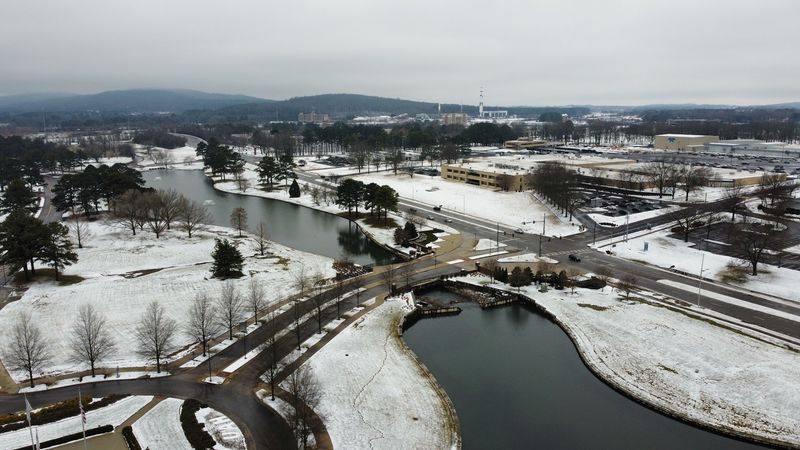
A campus visit rarely fills an entire weekend, and Huntsville makes sure the extra hours do not go to waste.
Downtown offers a mix of dining and entertainment, while MidCity brings newer gathering spaces into the picture.
Live music finds a home at Mars Music Hall and the Orion Amphitheater, both of which pull crowds from across North Alabama.
Lowe Mill Arts and Entertainment fills a historic cotton mill with working studios, galleries, and performance spaces, and wandering its floors takes longer than most people expect.
Outdoor time comes easy here too. Monte Sano State Park delivers ridge top views and hiking trails, and Big Spring Park gives the city center a calm green pocket with water and walking paths.
History lovers can head up to Burritt on the Mountain, a living history museum and historic mansion with wide panoramic views over the valley.
Families often add the EarlyWorks Family of Museums, which keeps younger visitors busy with hands on exhibits.
What ties it all together is how naturally the city balances its scientific side with its cultural one. Rocket engineering and art studios coexist without friction.
Give the trip two days if possible. The university explains the city, and the city explains the university right back.
