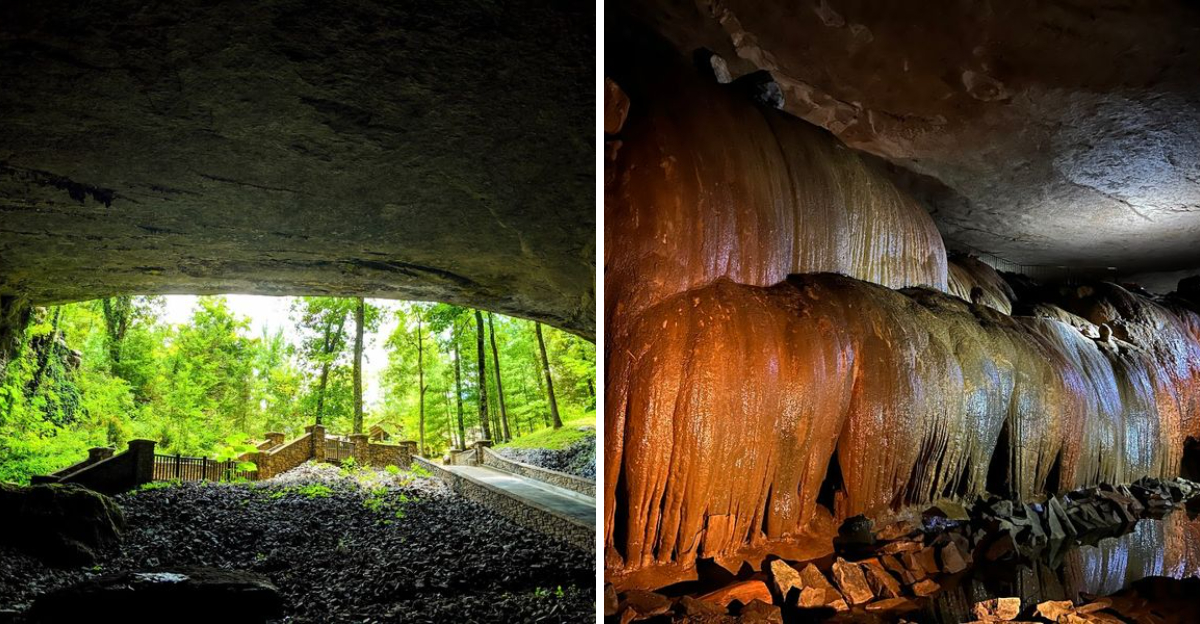
Most people drive through Marshall County, Alabama without realizing one of the country’s most impressive underground landscapes is hidden beneath the hills nearby. This cave system in Woodville, Alabama feels enormous from the moment you arrive, with a massive natural entrance that immediately gives you a sense of the scale waiting inside.
Beyond the entrance, the cavern opens into a world of towering formations, dramatic rock textures, and cool underground passageways that feel almost unreal in person. The lighting and sheer size of the chambers create an atmosphere that is both peaceful and awe-inspiring at the same time.
For anyone who has never explored Alabama beneath the surface, it offers an unforgettable introduction to the state’s natural beauty and geological history.
Goliath, the Giant Stalagmite You Will Not Forget
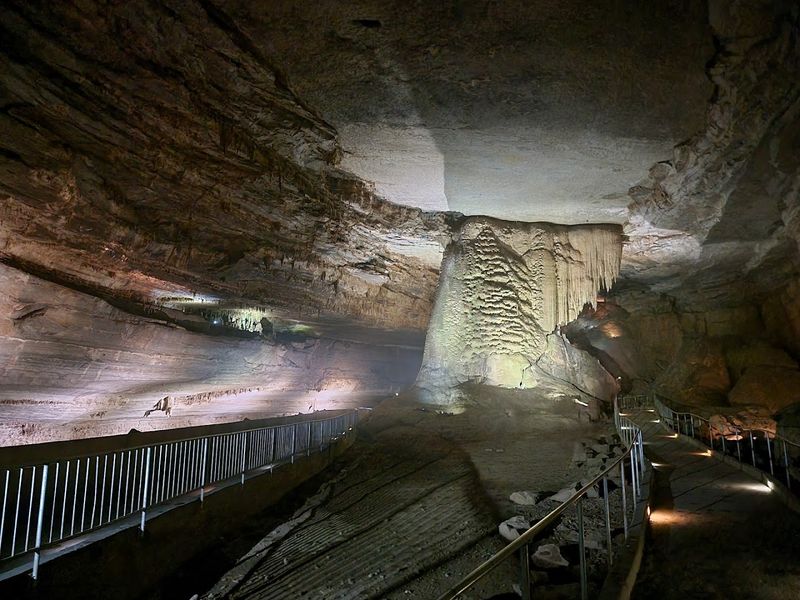
Some geological formations earn a name, and Goliath earns every letter of it. Rising 45 feet from the cave floor with a circumference of 243 feet, this stalagmite is one of the largest in the world.
It looks less like a rock formation and more like something out of a fantasy novel, the kind of structure that makes visitors go quiet for a moment just to take it in.
Stalagmites grow upward from the cave floor as mineral-rich water drips down over thousands and thousands of years. The fact that Goliath reached this scale is a testament to how long Cathedral Caverns has been quietly building its underground world.
Geologists trace the cavern’s formation back to Mississippian-era limestone laid down roughly 320 to 350 million years ago.
Your tour guide will point out details about Goliath that you would never notice on your own, from the subtle color variations in its surface to the way light plays across its ridges. Most visitors say photos simply do not capture how overwhelming it feels to stand next to something so enormous.
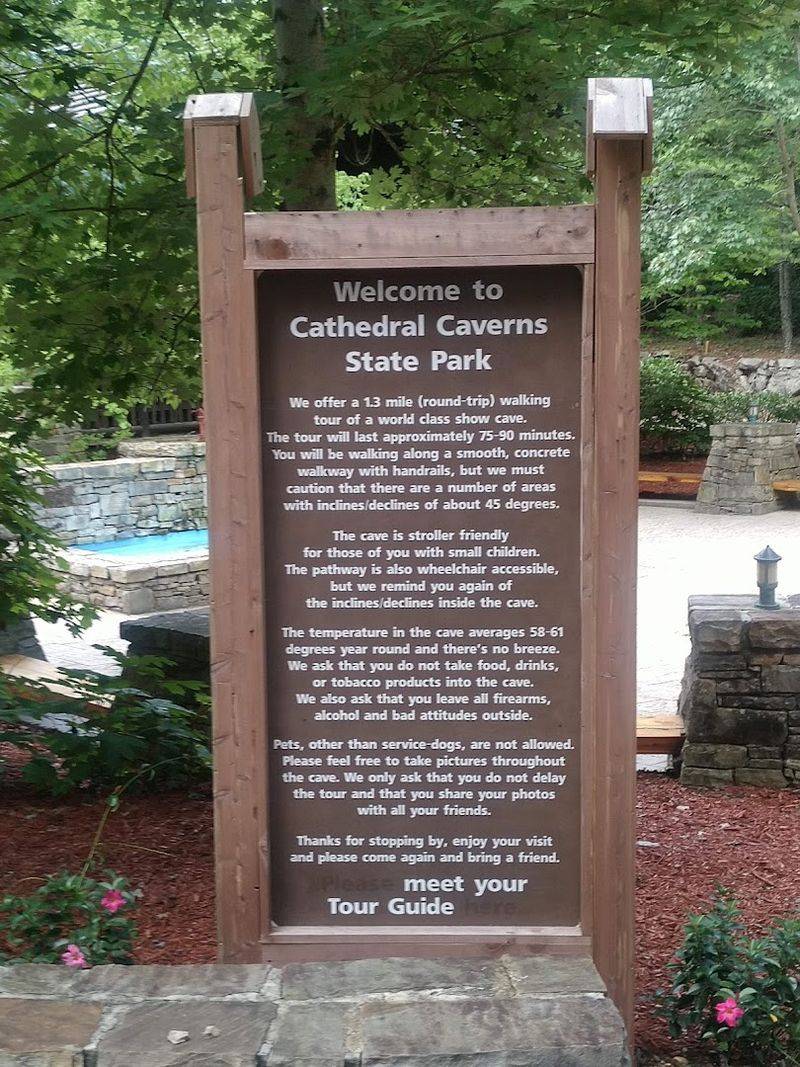
The 90-minute guided tour covers 1.3 to 1.5 miles on a paved, well-lit path, so you can take your time soaking in formations like Goliath without rushing.
A Frozen Waterfall Made Entirely of Stone
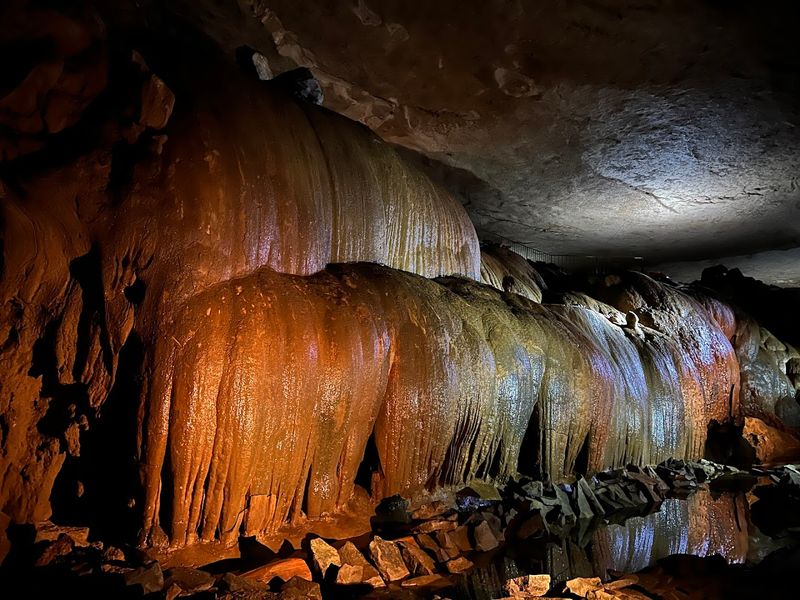
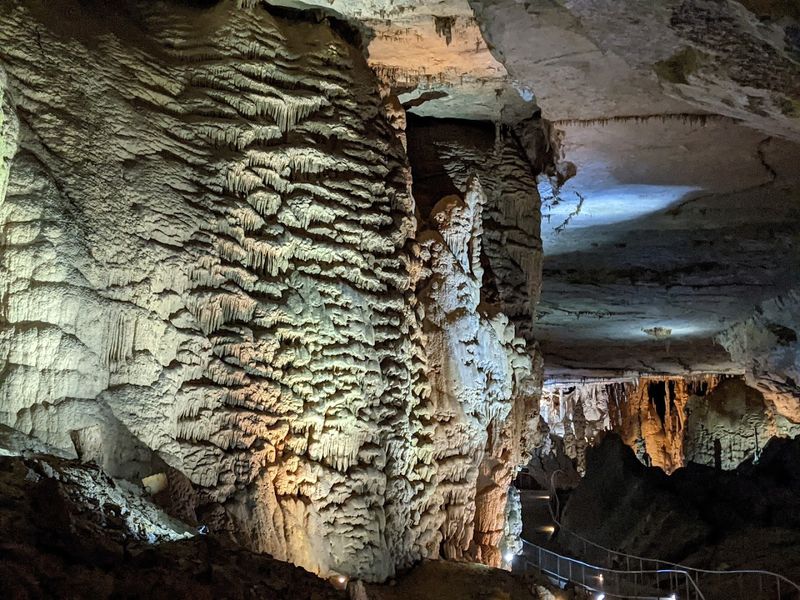
Imagine a waterfall that stopped mid-flow millions of years ago and hardened into solid rock. That is exactly what Cathedral Caverns offers with its famous Frozen Waterfall, a dramatic flowstone formation stretching 32 feet tall and 135 feet long.
It does not trickle or move, but it looks like it should, with rippled layers of mineral-stained stone cascading downward in waves that feel almost alive.
Flowstone forms when thin sheets of water spread across cave surfaces and deposit calcium carbonate over long stretches of time. The result is a smooth, layered texture that mimics the movement of water with remarkable accuracy.
The Frozen Waterfall is one of the largest formations of its kind in any publicly accessible cave in the United States.
Seeing it in person is a completely different experience from looking at photographs. The scale is hard to grasp until you are actually standing in front of it, looking up at something that dwarfs most buildings you walk into daily.
It is one of several formations along the tour route that consistently draws gasps from visitors of all ages. If you are planning a family outing, Cathedral Caverns pairs well with a stop at nearby Cathedral Caverns Gem Mine on the park grounds, where kids can sift through gravel to find real gemstones to take home as souvenirs.
It is a hands-on activity that rounds out the underground experience beautifully.
The Stalactite Forest That Gave the Cave Its Name
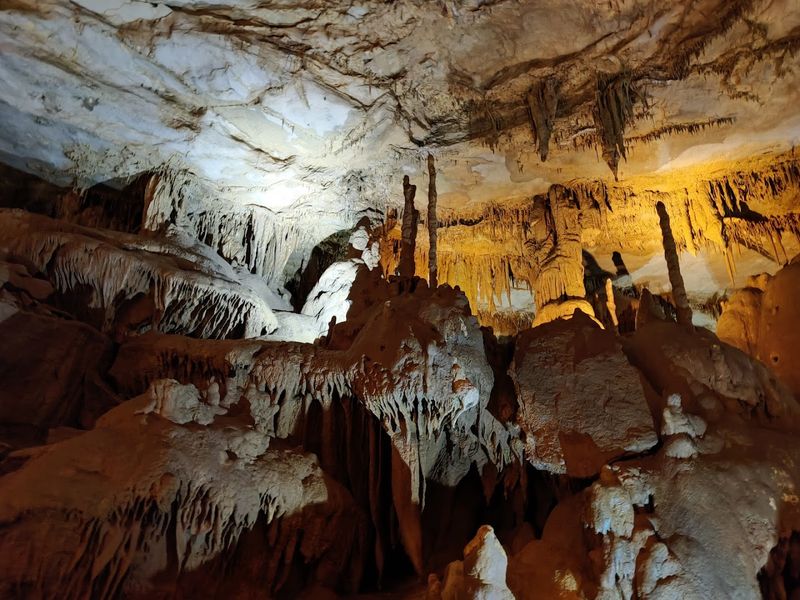
Walk far enough into Cathedral Caverns and you reach a section so dense with hanging stalactites that it genuinely resembles the vaulted ceiling of a grand cathedral. This is where the cave earned its name, and the comparison is not an exaggeration.
Hundreds of stone formations hang at varying lengths, some slender and sharp, others thick and tapered, creating a canopy of ancient geology overhead.
Stalactites form from the ceiling downward as mineral-laden water drips slowly over centuries. Each one in Cathedral Caverns has been growing for an almost incomprehensible amount of time.
The variety of shapes and sizes in this section makes it one of the most visually rich parts of the entire tour, and guides typically spend extra time here explaining the differences between formation types.
The lighting installed throughout the cave is designed to highlight these features without disrupting the natural environment. It keeps the atmosphere authentic while making sure you can actually see and appreciate what surrounds you.
Children especially tend to light up in this section, pointing out shapes they see in the stalactites the way you might find animals in clouds. The cave temperature stays a consistent 58 to 60 degrees Fahrenheit year-round, so bringing a light jacket is a smart move regardless of the season.
If you visit during summer, that cool air feels like a genuine gift after the Alabama heat outside.
The Entrance That Defies Belief
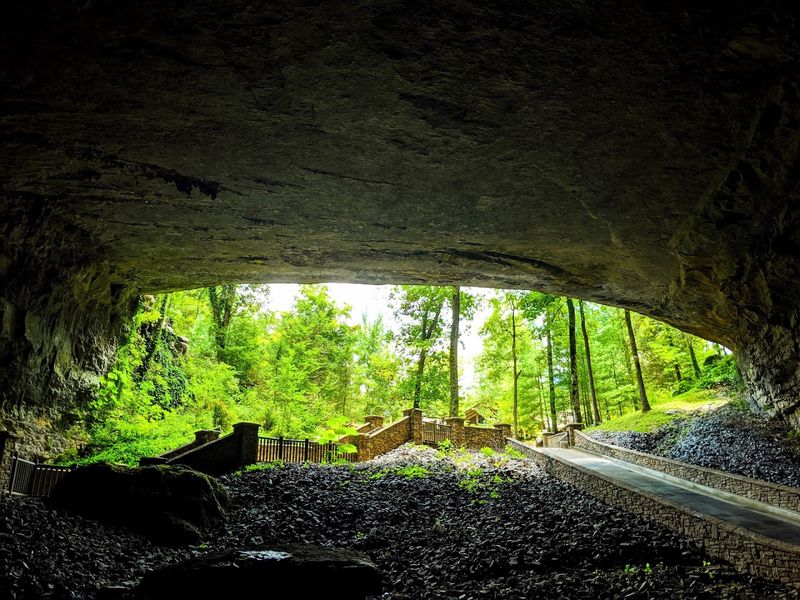
Nothing quite prepares you for the moment you walk toward Cathedral Caverns and see that entrance for the first time. It measures 126 to 128 feet wide and 25 feet high, making it one of the widest commercial cave entrances anywhere in the world.
That is not a typo. The opening is so broad that entire buildings could fit inside it without touching the walls.
Before it became a state park, locals knew this place simply as Bat Cave. A man named James Gurley saw its potential and developed it as a tourist attraction in the 1950s.
By 2000, Alabama had claimed it as an official state park, and in 1972 it earned National Natural Landmark status, a recognition reserved for places of truly exceptional geological significance.
The cave earned its current name from the cathedral-like atmosphere inside, where stalactites hang like stone chandeliers and the air carries a cool, quiet weight. Standing at the mouth of this cavern, you get the immediate sense that something ancient and extraordinary is waiting inside.
Cathedral Caverns State Park is located at 637 Cave Rd, Woodville, AL 35776, and tours run daily from 9 AM to 5:30 PM. Buying tickets in advance online is strongly recommended, especially on weekends when tour groups fill up fast.
The Big Room and the Improbable Stalagmite
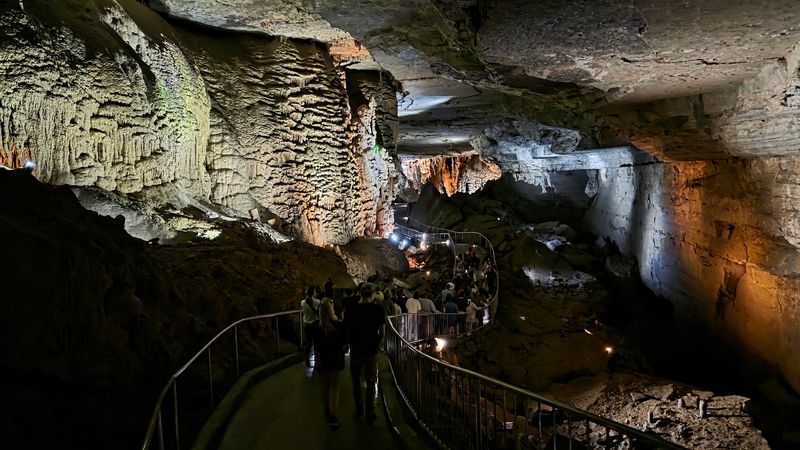
The Big Room at Cathedral Caverns is exactly what its name promises. Measuring 792 feet long and 200 feet wide, this main chamber is large enough to hold a football field inside it.
Walking through it feels less like exploring a cave and more like wandering through an underground arena, one built entirely by nature over millions of years without any human assistance.
Inside this chamber, you will also encounter one of the cave’s most unusual residents: the Improbable Stalagmite. It stands 27 feet tall but has a base only 3 inches in diameter, and it grows at a 45-degree angle.
By all geological logic, it should have toppled long ago. The fact that it has survived intact makes it one of the most talked-about formations on the tour.
Guides love pointing out the Improbable Stalagmite because it sparks genuine curiosity and usually triggers a round of questions from the group. It is a reminder that nature does not always follow the rules we expect it to.
The paved path through the Big Room makes it manageable for nearly everyone, and staff have even used golf carts to help visitors with mobility challenges navigate certain sections. After your tour, the park’s hiking trails offer a great way to stretch your legs above ground.
The Green Trail is a moderately challenging option that rewards you with tree-framed views of the surrounding landscape.
Mystery River and a Prehistoric Shark Tooth in the Ceiling
Somewhere beneath the cave floor, water is still moving. The Mystery River flows through portions of Cathedral Caverns, adding a living, active element to an environment that might otherwise feel entirely frozen in time.
You can hear it in certain sections before you see it, a soft rush of water echoing off limestone walls that have stood for hundreds of millions of years.
Look up in the right spot and your guide will point out something that sounds almost too wild to be real: a prehistoric shark tooth embedded in the cave ceiling. It is estimated to be around 400 million years old, a fossil remnant from a time when this part of Alabama was submerged beneath a shallow inland sea.
Holding that thought while standing underground is the kind of perspective shift that stays with you long after the tour ends.
Archaeological evidence adds another layer of depth to the experience. Excavations near the cave entrance have uncovered signs of Native American occupation dating back to approximately 7000 BCE, meaning humans have been drawn to this place for thousands of years.
The cave is not just a geological wonder but a genuine piece of human history. For visitors who want to explore more of the region’s natural landscape, Lake Guntersville State Park at 1155 Lodge Dr, Guntersville, AL 35976 is about 20 miles away and offers trails, water access, and sweeping views of one of Alabama’s most beloved lakes.
A Full State Park Experience Beyond the Cave
Cathedral Caverns is not just a cave tour with a parking lot. The surrounding state park offers a genuinely full outdoor experience that gives visitors plenty of reasons to stay longer than they originally planned.
Hiking trails wind through the wooded landscape above the caverns, ranging from easy walks to moderately challenging routes with rewarding views through the trees.
Gem mining is one of the most popular activities for families. Kids and adults alike sift through gravel sluices searching for real stones to keep, and the park gift shop sells bags of mining rough so you can try your luck multiple times.
Picnic areas are spread throughout the grounds, making it easy to pack a lunch and turn the whole outing into a relaxed full-day event.
Camping options range from primitive sites to modern campsites with hookups, and the park also offers tiny cabins for those who prefer something more comfortable than a tent. Guests who have stayed overnight consistently praise the cleanliness of the bathhouses and the attentiveness of the camp hosts.
If you want to grab a meal nearby after your visit, Bucks Pocket State Park is a short drive away, and the town of Guntersville has several local dining spots worth exploring. The whole Cathedral Caverns experience, from the underground tour to the trails and camping, makes it one of the most well-rounded state park destinations in Alabama.
