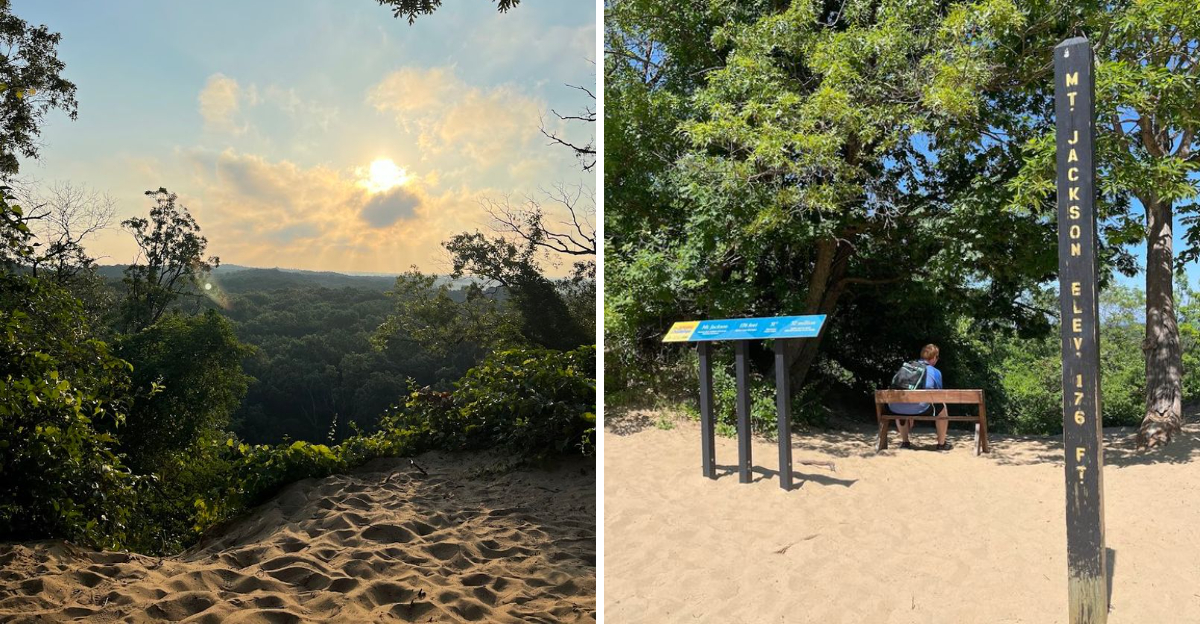
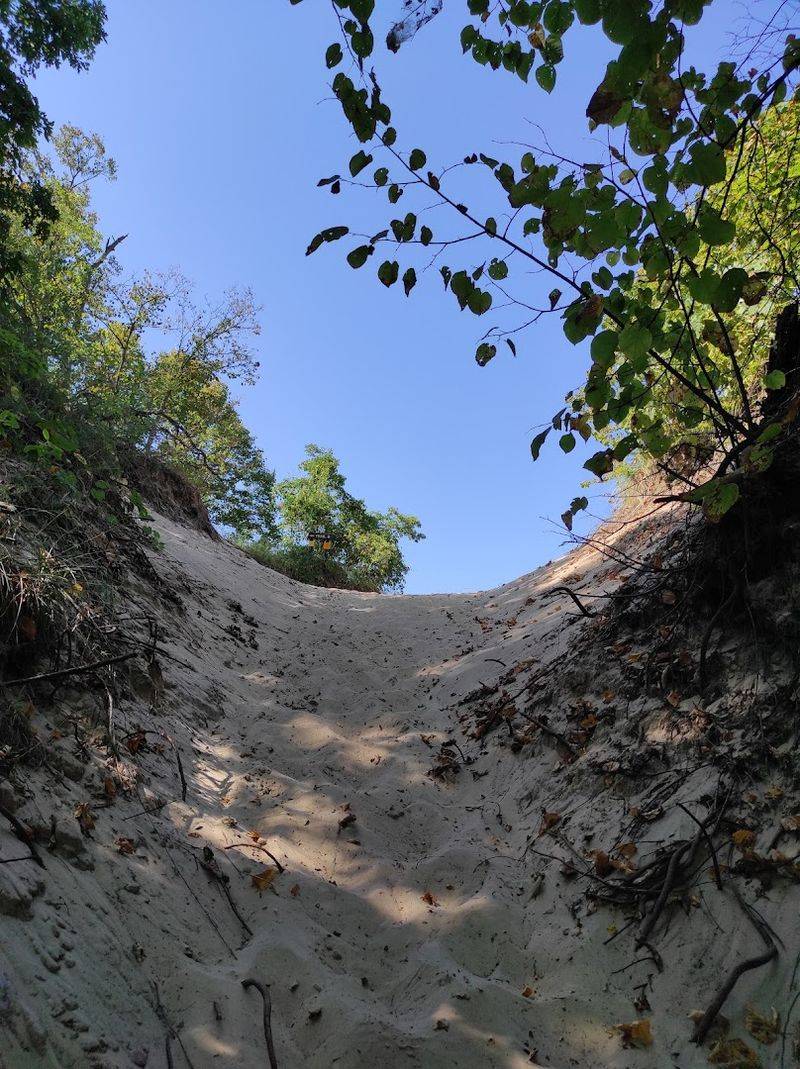
There is something about this dune trail that gets into your head before you even start climbing. I grew up in Indiana knowing the dunes were out there, but actually standing at the base of a towering stretch of shifting sand for the first time made me realize how different this landscape feels from anything else in the state.
The ground never really stays still. Every step forward sinks, slides, and reshapes itself, turning what looks like a short climb into a real test of endurance.
It is the kind of terrain that forces you to slow down, adjust your pace, and pay attention to every movement. This dune is part of a well-known challenge route within a larger state park near the lakeshore, often used as the opening climb in a more demanding hiking experience.
Even on its own, though, it stands out as one of the most physically rewarding short hikes in the area.
The Sand Resistance Workout You Cannot Replicate in a Gym
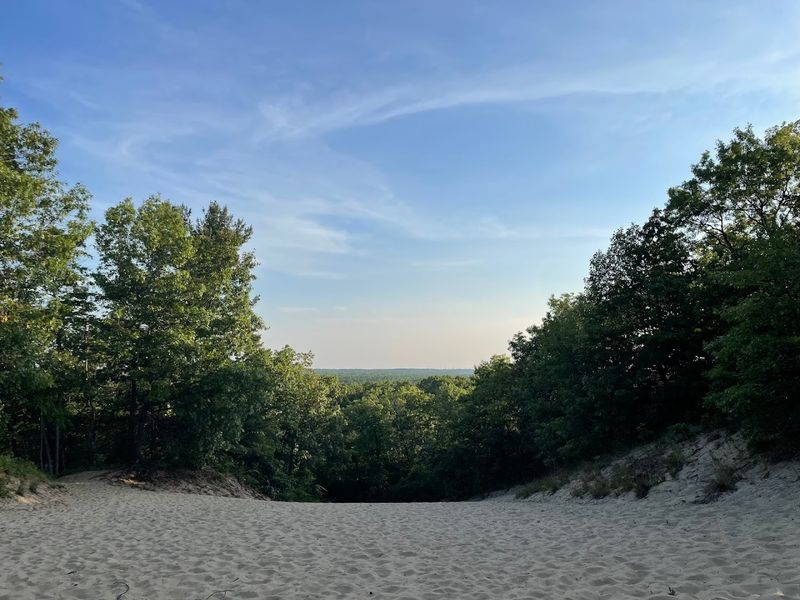
Forget the treadmill. Mount Jackson Trail, located at 1600 North 25 East, Chesterton, IN 46304, offers a lower-body workout that no piece of gym equipment can honestly replicate.
The loose, deep sand on the ascent pulls at your feet with every step, creating resistance that fires up your calves, hamstrings, and glutes in ways flat ground simply cannot.
Fitness trainers often talk about variable resistance training, and that is exactly what this dune delivers naturally. Your muscles have to constantly adjust to the shifting surface beneath you.
One moment the sand holds firm, and the next your foot sinks three inches, forcing a completely different muscle group to compensate.
This kind of unpredictable terrain builds what fitness coaches call stabilizer strength. It is the kind of functional fitness that translates into better balance and coordination in everyday life.
Hikers who regularly tackle sandy dune climbs often report noticeably stronger legs after just a few visits.
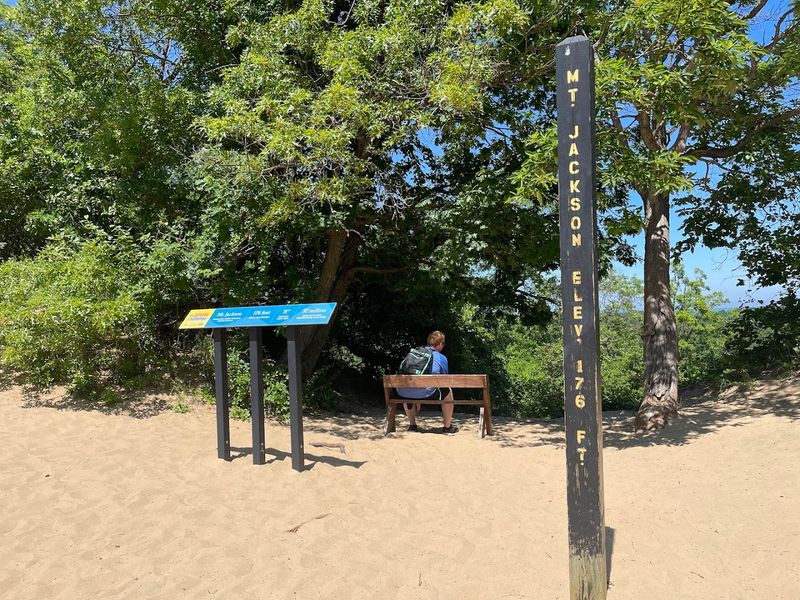
Mount Jackson stands 176 feet above Lake Michigan, and while that might not sound overwhelming on paper, the sandy grade makes every single foot of that elevation feel earned. You will breathe harder than you expect.
Your heart rate will climb faster than on a paved trail of the same distance. That challenge is the whole point, and reaching the top feels genuinely satisfying.
Starting Point of the Famous 3 Dune Challenge
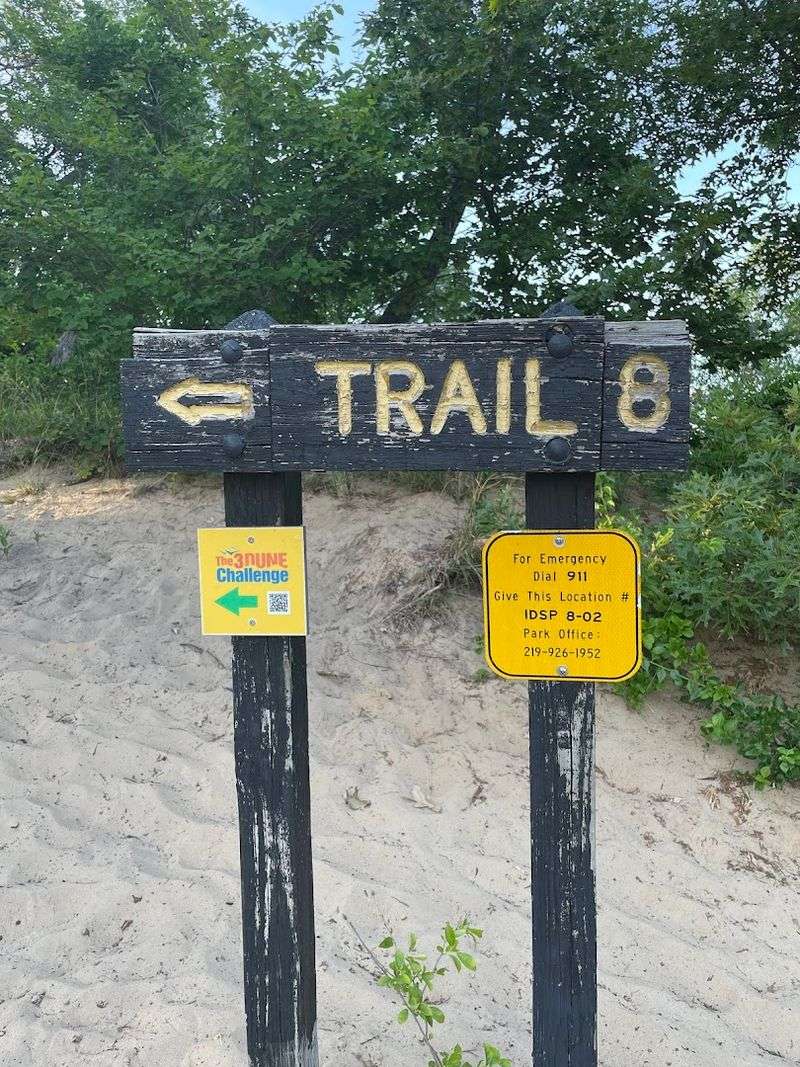
Mount Jackson holds a special place in Indiana outdoor culture as the first dune you tackle in the 3 Dune Challenge. This well-known local test of endurance covers approximately 1.5 miles and asks you to summit three of Indiana’s tallest dunes: Mount Jackson, Mount Holden, and Mount Tom.
The total vertical climb across all three adds up to 552 feet, which is a serious accomplishment for any hiker.
Starting with Mount Jackson is strategic. At 176 feet above Lake Michigan, it is the smallest of the three, which makes it the ideal warm-up.
Your body gets a feel for the sand, your breathing adjusts, and your confidence builds before you face the steeper climbs ahead. Many hikers describe Mount Jackson as challenging but manageable, which is exactly the right kind of opening act.
The trailhead for the challenge sits near the State Park’s Nature Center, accessible via Trail 8. That starting point has become something of a gathering spot for locals who return to the challenge again and again, trying to beat their own times or simply enjoy a familiar route in a new season.
Completing the full challenge earns you a certificate from Indiana Dunes State Park, which has turned this trail system into a genuine bucket-list item for Hoosiers. Mount Jackson is where that story begins, and every step up its sandy face sets the tone for everything that follows.
Views That Reward Every Ounce of Effort
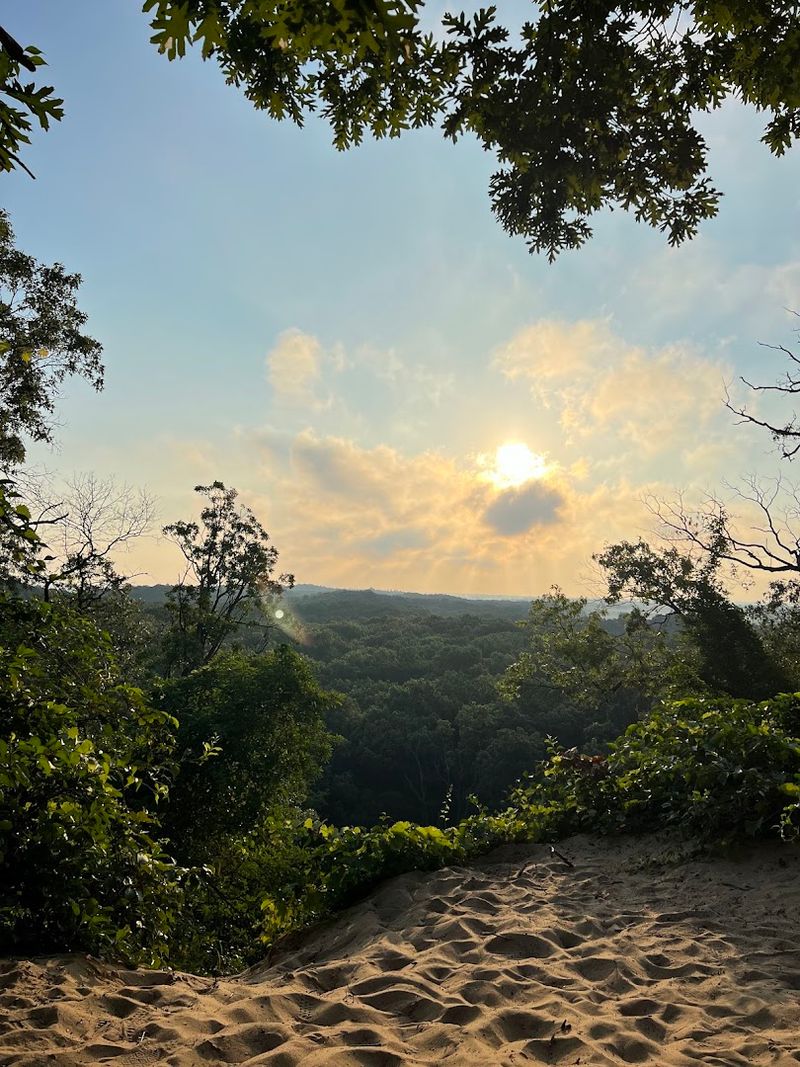
Reaching the top of Mount Jackson feels like breaking the surface after holding your breath underwater. The effort fades almost immediately when you turn around and take in what is in front of you.
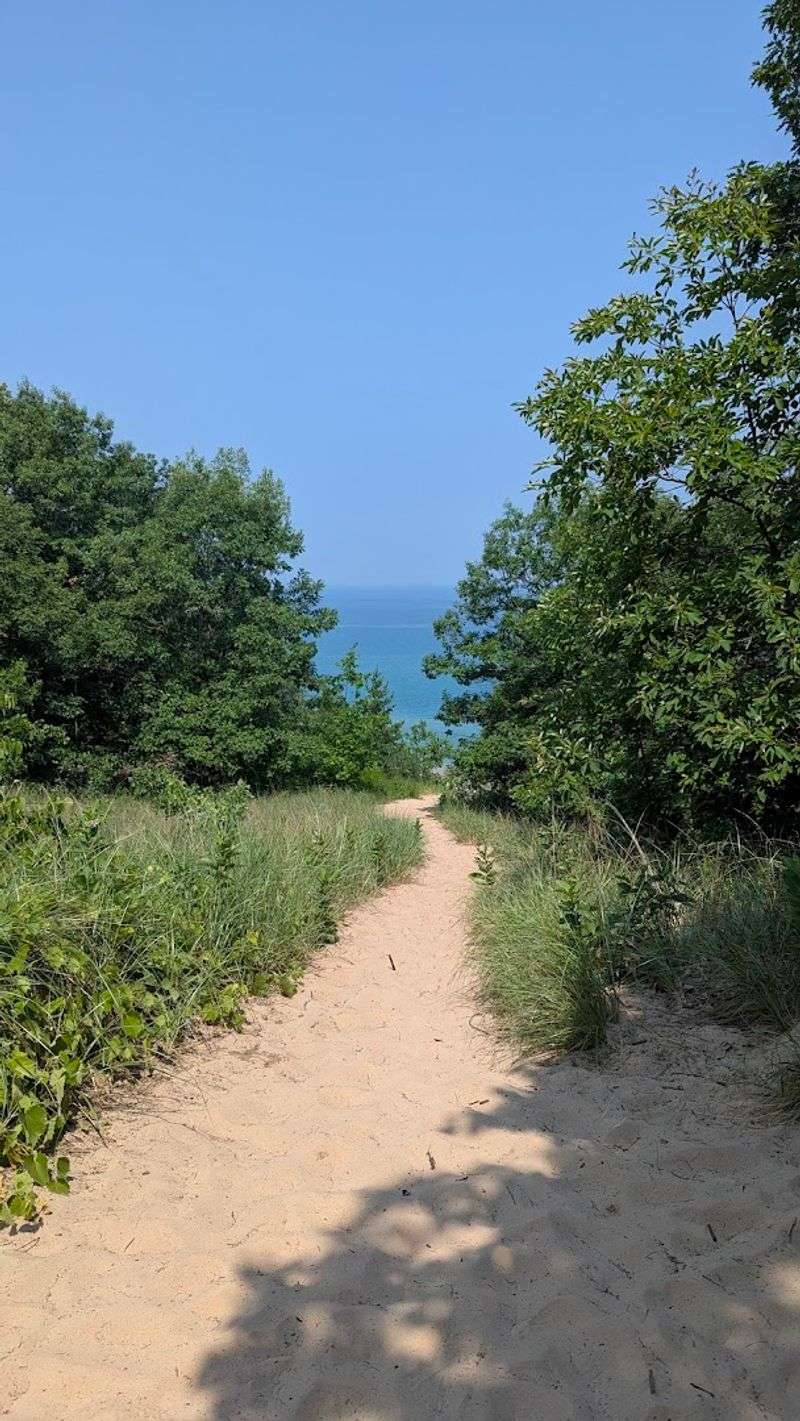
Lake Michigan stretches out in the distance, its blue-gray surface catching light in a way that looks almost too beautiful to be real.
From the summit, you can spot Michigan City landmarks on a clear day. The tree canopy spreads out below you in a wash of green, and in autumn that canopy turns into something that looks like a painter went wild with warm colors.
Other hikers on nearby trails appear as small moving figures, which gives you a genuine sense of how high you have actually climbed.
What makes this view feel different from a scenic overlook you drive to is the fact that you worked for it. Your legs carried you up shifting sand to get here.
That effort changes how you see the landscape. It is not just pretty scenery.
It feels personal.
Indiana does not have mountain peaks, but Mount Jackson proves this state does not need them. The combination of dune height, forest backdrop, and Great Lakes horizon creates a view that holds its own against anything the Midwest has to offer.
I would stand up there longer every single time if my legs were not already reminding me about the next two dunes ahead.
A History Hidden Beneath the Sand
Before 1925, Mount Jackson went by a completely different name. It was called Mount Green, named after Alanson Green, who ran a tavern and hotel in a forgotten lakeside settlement called City West.
That village no longer exists, buried by time and eventually by the shifting dunes themselves. Standing on the summit today, it is strange to think that people once lived and worked in this landscape in a very different way.
The Indiana dunes region has a layered history that most visitors never think about. Indigenous peoples used these lands long before European settlers arrived.
Later, the dunes became a subject of scientific study, drawing botanists and ecologists who recognized how rare this ecosystem truly was. The fight to preserve the dunes as public land stretched across decades and involved passionate advocates who believed this place was worth protecting at almost any cost.
Mount Jackson sits within Indiana Dunes State Park, which was established in 1925, the same year the dune was renamed. The park was created partly in response to industrial development threatening the lakeshore.
Knowing that history adds a layer of meaning to every hike here. You are walking through land that people fought hard to keep wild and open.
That backstory makes Mount Jackson more than just a physical challenge. It is a place with a past worth knowing, and the sand beneath your feet carries more history than it might first appear.
The Unique Ecosystem That Surrounds the Climb
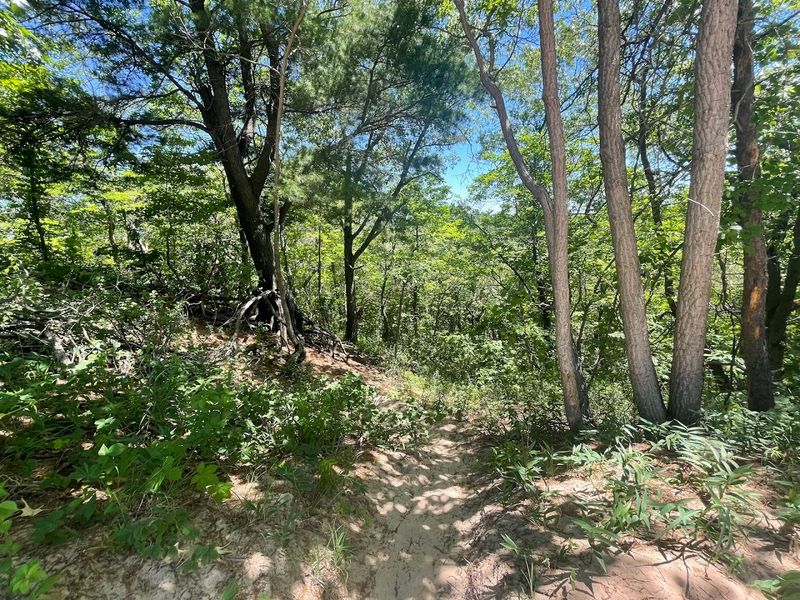
The plant life around Mount Jackson Trail is genuinely unusual. Indiana Dunes State Park sits at a crossroads of climate zones, which means species from the Arctic tundra, eastern deciduous forest, and tallgrass prairie all share the same relatively small area.
That ecological overlap creates a landscape that feels almost impossible, where prickly pear cactus and bearberry plants grow within a short walk of black oak forest.
As you climb Mount Jackson, the vegetation changes with elevation and wind exposure. Near the base, you move through shaded forest with ferns and wildflowers.
Higher up, the plant cover thins and gives way to open sandy slopes held together by marram grass and other dune specialists. These plants are doing serious work, anchoring the dune against wind and erosion.
Wildlife is active here too. Birds that call this park home include species you would not expect to find in Indiana, because the dunes act as a migratory corridor along Lake Michigan.
Watching a hawk ride a thermal above the dune crest while you catch your breath at the summit is the kind of moment that stays with you.
The ecological story of this place is one of constant change. Dunes are not static.
They move, shift, and reshape over time, and the plants and animals here have adapted to that instability in fascinating ways. Mount Jackson Trail runs straight through the middle of that living, breathing experiment.
Nearby Places That Make the Trip a Full Day Out
Mount Jackson Trail is worth building an entire day around, and the surrounding area makes that easy to do. Indiana Dunes State Park itself, located at 1600 N 25 E, Chesterton, IN 46304, offers beaches, picnic areas, and a Nature Center where you can learn about the dune ecosystem before or after your hike.
The Nature Center is also where you pick up your 3 Dune Challenge certificate if you complete all three summits.
After the hike, Octave Grill in Chesterton at 201 Broadway, Chesterton, IN 46304 is a popular local spot for a satisfying meal. The downtown Chesterton area has a comfortable small-town feel that pairs nicely with a day spent outdoors.
There are also several cafes and bakeries worth exploring within a short drive.
The Chesterton Art Center at 227 Broadway, Chesterton, IN 46304 is a creative local institution that showcases regional artists and hosts workshops throughout the year. If you have kids in tow, the Indiana Dunes Visitor Center at 1215 N Indiana 49, Porter, IN 46304 provides excellent context for the whole dunes region and is a great starting point for first-time visitors.
Making a full day of it means you leave with more than tired legs. You leave with a real sense of this corner of Indiana, which has a character all its own that feels different from anywhere else in the state.
Why Mount Jackson Trail Keeps Calling You Back
Some trails you do once and check off a list. Mount Jackson is not one of them.
There is something about the combination of physical challenge, shifting landscape, and open-sky reward that makes people want to come back in different seasons, different moods, and different company. Winter turns the dune into a snow-dusted climb that feels almost otherworldly.
Spring brings wildflowers to the base and migrating birds to the sky above.
The trail changes constantly because sand dunes are always moving. A path you walked in June will feel subtly different in September.
The contours shift. The wind reshapes the surface.
That living quality keeps the experience fresh no matter how many times you have made the climb.
There is also something deeply personal about a trail this demanding. You measure yourself against it.
First-timers often stop several times on the way up, breathing hard and laughing at how deceiving the slope looks from below. Return visitors move with more confidence, their bodies having learned what the sand requires.
That progression is its own kind of reward.
Mount Jackson Trail reminds me why Indiana has more to offer than people sometimes give it credit for. This dune is a genuine physical and sensory experience.
It is free, accessible, and honest in the way it asks something real from you. That is exactly the kind of place worth returning to, and worth telling everyone you know about.
