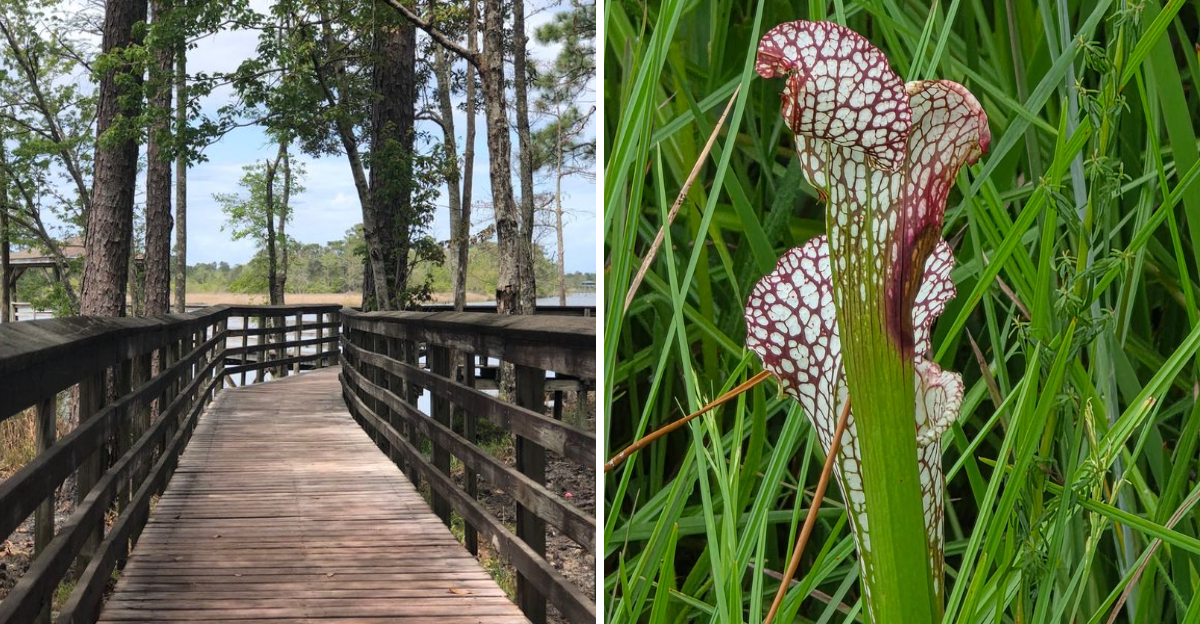
For a bug, this is a terrible place to make one bad decision. The tall green tubes look harmless enough until an insect lands inside one.
The slippery walls and strange chemistry do the rest. Humans get a much nicer experience.
A short wooden boardwalk crosses the bog, passing clusters of carnivorous pitcher plants while dragonflies flicker through the sunlight and Weeks Bay appears beyond the trees. The whole wetland sits remarkably close to the road, yet feels completely removed from it.
This Alabama stop offers the unusual combination of an easy walk, a rare ecosystem, and plants that have essentially turned the bog into an all-you-can-eat insect trap.
Meet the Plants That Eat Bugs for Breakfast
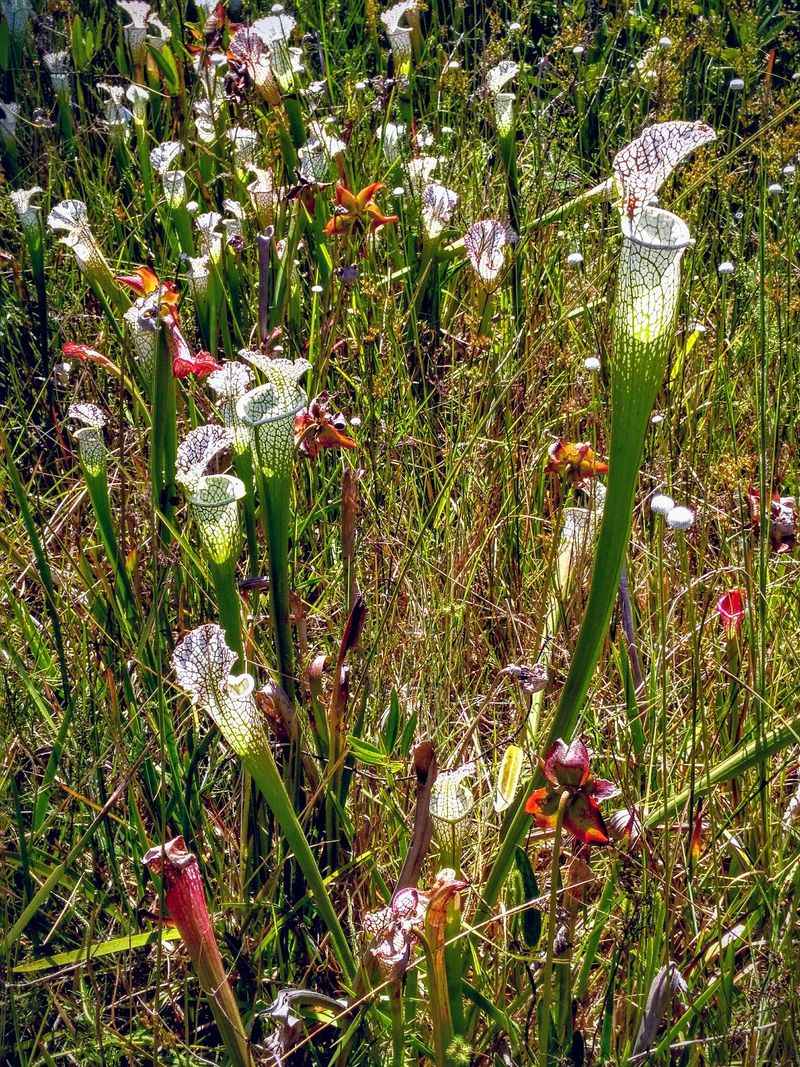
Pitcher plants look like something a set designer dreamed up. Their leaves curl into tall hollow tubes, striped with veins and topped with a flared hood, and they grow in clusters right beside the boardwalk railing.
The reason behind the strange shape comes down to hunger. Bog soil here is acidic and stripped of nutrients, so these plants developed a workaround by trapping insects instead of pulling food from the ground.
Sweet nectar along the rim draws bugs in, downward-pointing hairs inside make climbing back out nearly impossible, and a pool of rainwater and enzymes at the bottom finishes the job.
White-topped and purple pitcher plants are the two most common types visible along the trail. Look lower and closer, though, and sundews appear, tiny rosettes covered in sticky red hairs that work like natural flypaper.
Bladderworts hide in the wetter spots too.
Bring binoculars if you have them, since some of the best clusters sit a bit off the walkway. A phone camera with a zoom works nearly as well for close-up shots.
Kids tend to lose their minds over this part, and honestly, adults do too. Watching a plant quietly out-strategize an insect never stops being fascinating, and it happens right here on public Alabama land, no ticket required.
A Boardwalk Anyone Can Roll, Stroll, or Wander
The Kurt G. Wintermeyer Nature Trail does something a lot of nature trails cannot manage.
It brings visitors deep into a fragile wetland without anyone’s shoes ever touching the soil.
Summer of 2024 brought a major upgrade, with roughly 2,000 linear feet of new construction built to be wheelchair accessible. Strollers roll along without a fight, walkers and wheelchairs have room to turn, and the surface stays even from start to finish.
The full route runs about 0.8 miles out and back, which most people finish in well under an hour.
Benches show up at useful intervals. Picnic tables sit near the trailhead for anyone wanting a snack break before or after the walk.
Leashed dogs are welcome, and plenty of neighbors treat the loop as a regular morning routine with their pups in tow. Parking sits across Fish River Road on the west side, so cross carefully and note that GPS sometimes drops you slightly past the lot.
Raising the path above the ground protects the shallow root systems below, which matters more than it might seem. One misplaced footstep can undo years of slow growth in soil this delicate.
Signs along the way explain what grows where, and a few include QR codes linking to short videos.
Spring Blooms, Fall Butterflies, and Why Timing Changes Everything
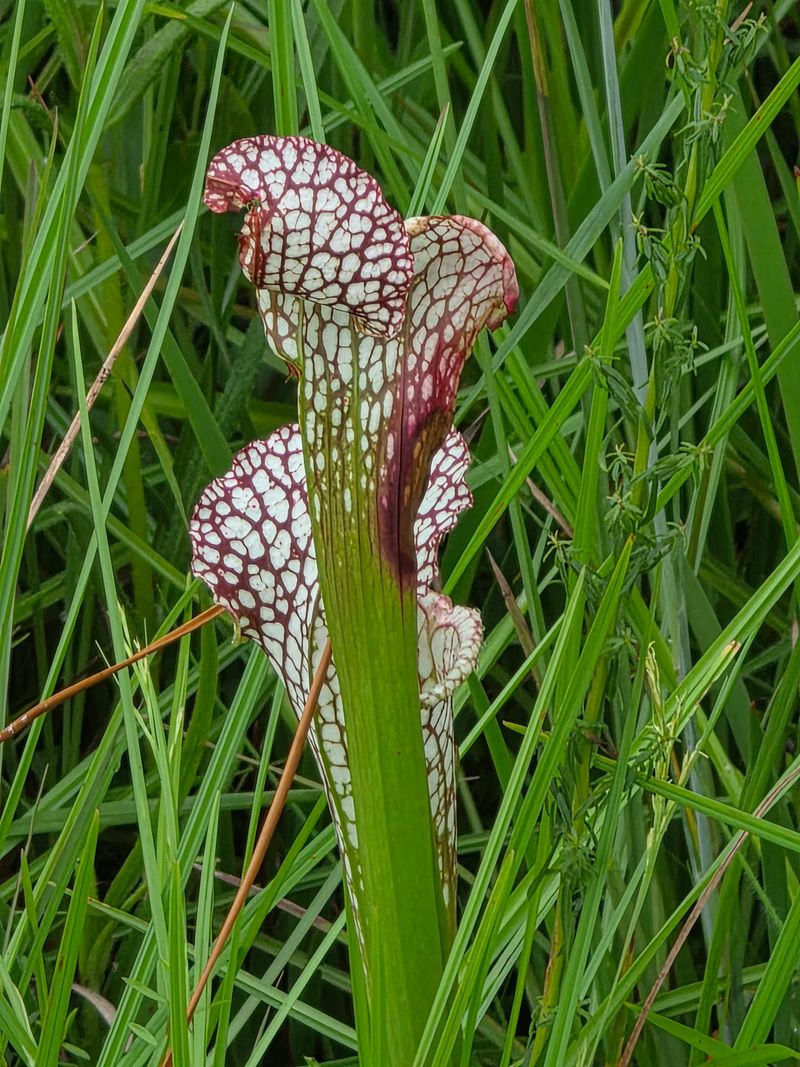
Ask anyone who visits more than once and they will tell you the bog is never the same place twice. Spring wakes everything up, with fresh pitchers pushing out of the ground and odd nodding flowers opening above them.
Wild orchids join the show around the same stretch, including pink lady’s slippers that surprise visitors who were only expecting carnivorous plants. Mid to late summer keeps the pitchers tall and colorful, and reports of strong August blooms are common.
Autumn shifts the palette entirely. Cooler air brings a second wave of wildflowers, and butterflies arrive in numbers, black swallowtails among them, drifting between blossoms while dragonflies patrol the open water.
Winter thins things out. Pitchers dry and brown, and the landscape reads more skeletal than lush, though birdwatchers often argue that is exactly when the trail gets interesting.
For peak carnivorous plant drama, aim for late spring through late summer. Morning light also flatters the bog, hitting the translucent hoods and making them glow.
Weather here can turn muggy fast, so a hat and water are smart companions. Bug spray earns its place in the bag too.
Anyone arriving off-season still gets the boardwalk, the river view, and plenty of wildlife, just with a quieter cast of characters.
One of the Last Bogs of Its Kind on the Gulf Coast
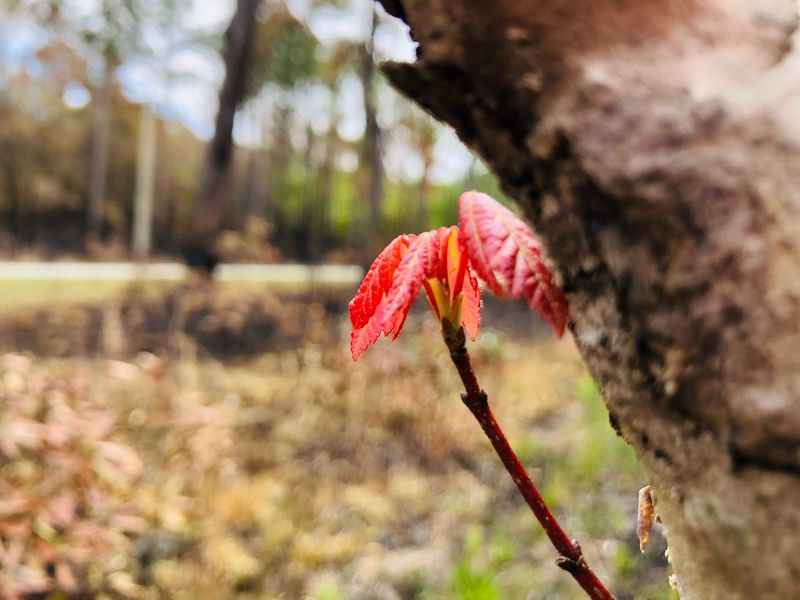
Rarity is the quiet headline of this place. Gulf Coast pitcher plant bogs once stretched across huge portions of the coastal plain, and more than ninety percent of that acreage has since been destroyed or badly damaged.
What remains here survives thanks to a very specific recipe: open sunlight, constant moisture, and soil so acidic and nutrient-poor that most plants simply refuse to grow in it. Those exact conditions are what let carnivorous species outcompete everything else.
Fire plays a starring role, which catches many visitors off guard. Controlled burns are used on purpose because without them, shrubs and small trees creep in, shade out the pitcher plants, and dry the ground until the whole system collapses.
After a burn the ground looks scorched and grim. Within weeks, green returns, and the bog comes back stronger than before.
Pitcher plants share the space with orange milkworts, bog buttons, toothache grass, yellow-eyed grass, white-topped sedges, and sundews. Several of these are uncommon elsewhere in the state.
The whole area falls under the Weeks Bay National Estuarine Research Reserve, which handles research, water-quality monitoring, and stewardship. Knowing that changes how the walk feels.
Staying on the boardwalk and packing out trash are small acts that keep a rare landscape intact.
Birds, Lizards, and the Occasional Cottonmouth
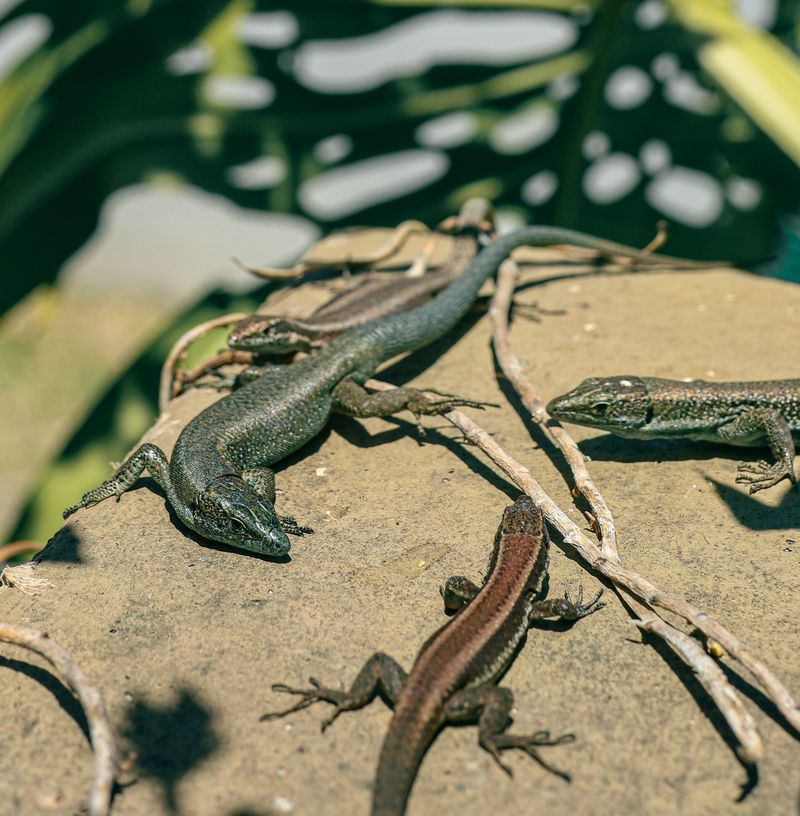
Plants get top billing, but the animal activity here holds its own. Anoles scurry along the boardwalk rails and freeze mid-stride whenever someone gets too close.
Birders do well on this trail. Woodpeckers hammer away in the pines, cardinals flash through the brush, orioles turn up during migration seasons, and wading birds work the edges near the water.
Frogs call from the wet pockets below the walkway, especially after rain. Dragonflies own the airspace over the open bog, and their wings catch light in a way that stops people mid-conversation.
Down by the river, mullet leap clear of the surface for no obvious reason, which is oddly entertaining to watch.
Now for the honest part. Signs along the trail warn about cottonmouths, and visitors have spotted them just off the path.
Staying on the boardwalk solves the problem almost entirely, which is another good reason not to wander into the grass.
Snakes here have no interest in people and will move away if left alone. Keep dogs leashed and close, and keep an eye on curious kids.
Mushroom hunters find plenty to photograph too, since the shaded wooded sections grow a surprising variety of fungi after wet stretches.
Move slowly and the wildlife count climbs fast.
Learn Something Without Feeling Like You’re in Class
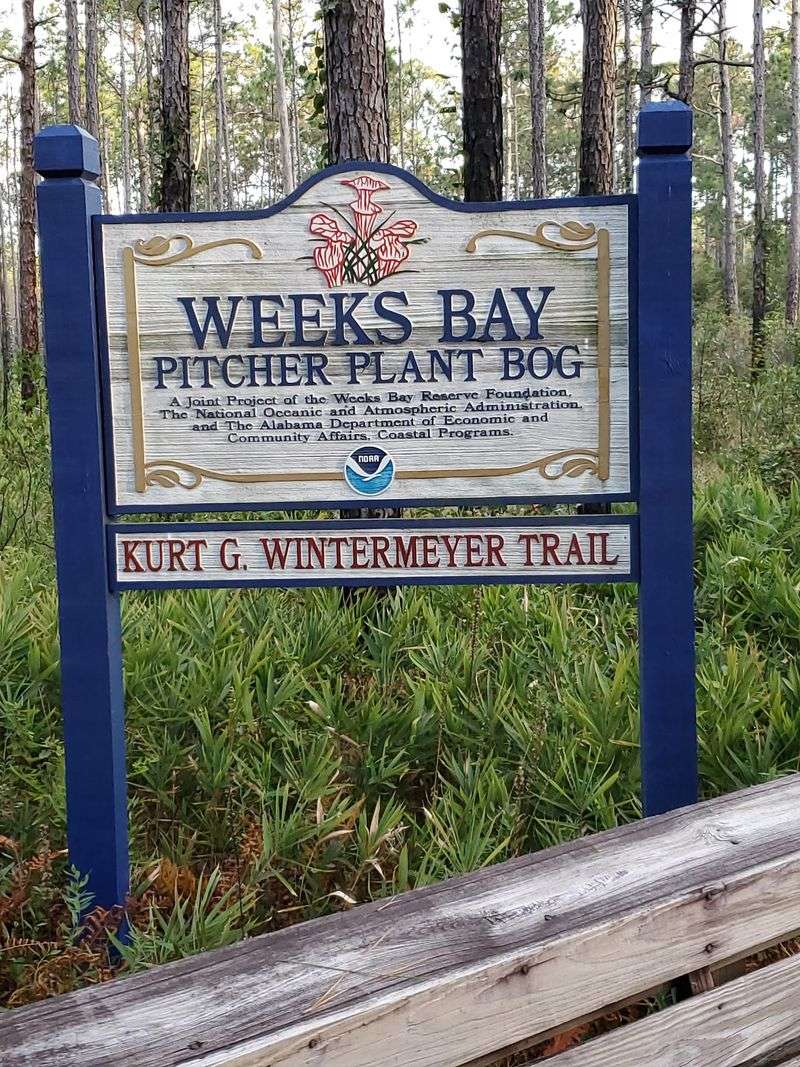
A shaded pavilion near the trailhead sets the tone before anyone takes a single step onto the boardwalk. Interpretive panels there explain how the traps work, why the soil is so poor, and what else grows in the surrounding wetland.
More signs appear along the route, several paired with QR codes that pull up short videos. Scanning one while standing beside the actual plant beats reading about it later at home.
The bog belongs to the Weeks Bay National Estuarine Research Reserve, a working research site focused on long-term study of coastal habitats, water quality, and estuary health. Real science happens here, not just sightseeing.
For anyone wanting more depth, the Weeks Bay Visitor Center sits nearby on Highway 98 between Fairhope and Foley. Exhibits inside cover regional plants and animals, live displays give kids something to look at, and additional self-guided trails wind through marsh and forest habitats.
Homeschool groups and school field trips use the area regularly for good reason. The lessons are visual, immediate, and impossible to fake.
Even casual visitors leave knowing the difference between a sundew and a bladderwort, which feels like a decent souvenir.
Combining the bog with the visitor center turns a quick stop into a solid half-day outing along the eastern shore.
The Pier at the End Where Fish River Meets the Bay
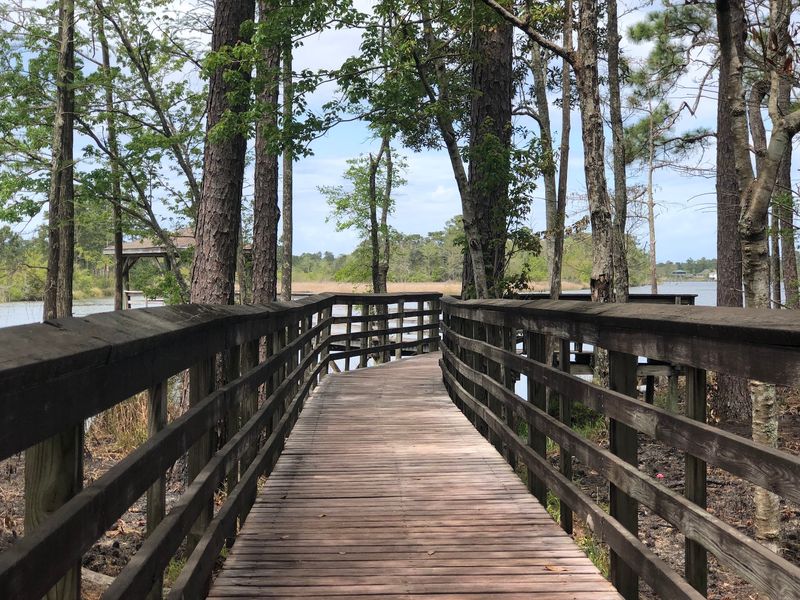
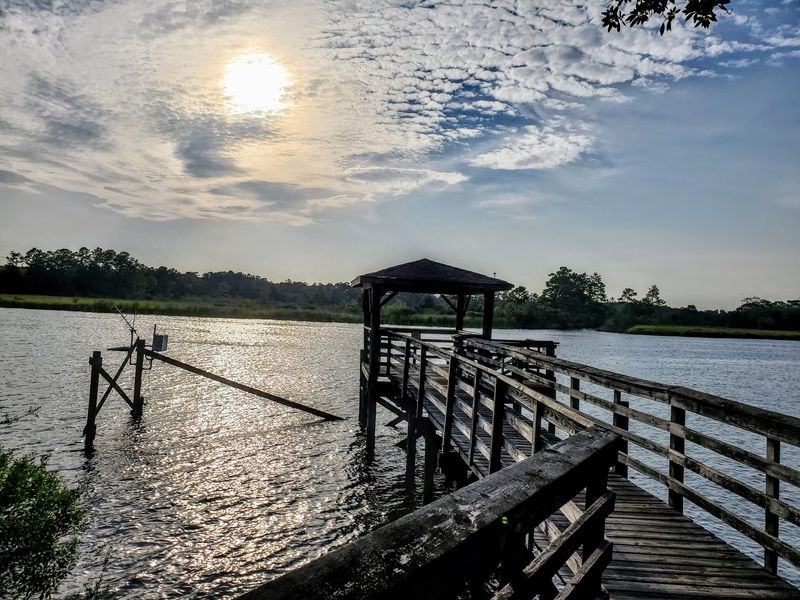
Every good trail deserves a reward at the finish, and this one delivers with water. The boardwalk ends at an observation deck and short pier looking out over Fish River where it opens into Weeks Bay.
Wind comes off the water, the temperature drops a few degrees, and the whole soundtrack changes from insect buzz to lapping current. The Weeks Bay Bridge sits in the distance, framing the view.
Benches and seating make it easy to linger. Plenty of visitors treat the deck as the actual destination and the plants as the bonus feature along the way.
Fishing is possible from the pier for those who bring gear. Others simply sit and watch boats slide past.
Late afternoon light on the water is worth planning around, though the preserve closes at 6 PM daily and opens at 6 AM, so early risers get the calmest conditions and the best bird activity.
The full round trip takes most people around forty-five minutes at an unhurried pace, longer if photography is involved.
Quiet is the norm here. Crowds rarely build, and on many mornings the boardwalk belongs to two or three people and a lot of dragonflies.
Address: 13066 Fish River Rd, Foley, AL 36535
