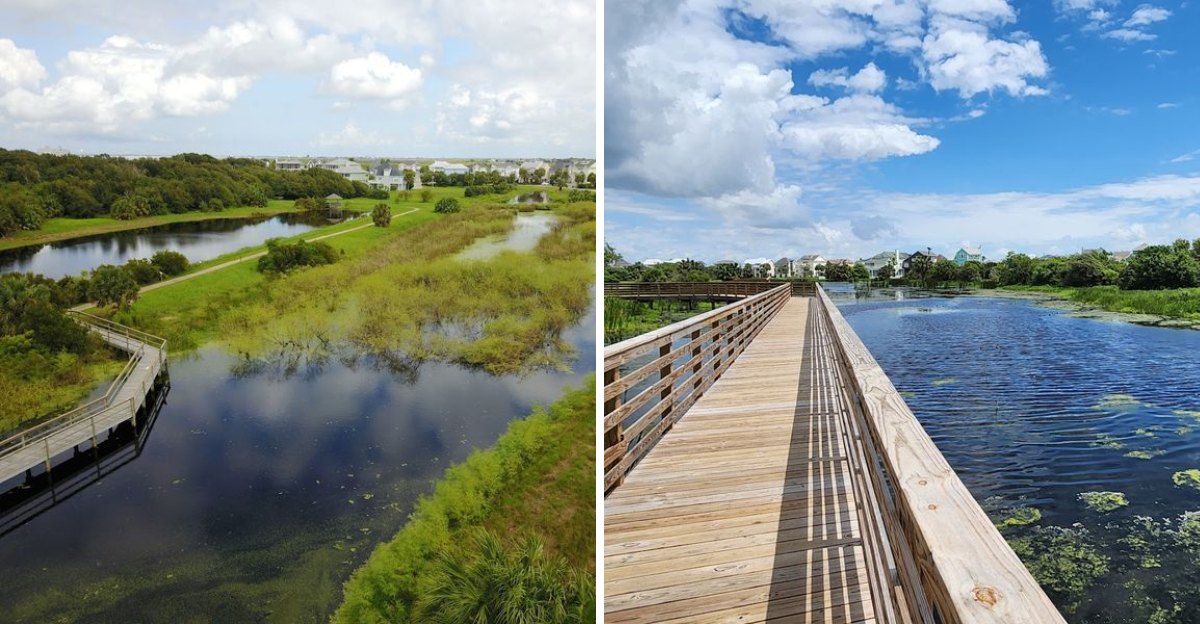
Right off a busy road, most people zoom past without a second glance. Their loss. This boardwalk trail loops through a hidden coastal marsh where the only sounds are birds and the wind.
Herons stand still as statues, egrets stalk the shallows, and the oak trees provide shade on even the hottest Texas afternoon.
The path is short, easy, and perfect for anyone who wants nature without a major hike. Families with strollers, retirees with binoculars, and anyone who just needs five minutes of quiet will find it here. No admission fee, no crowds, just a wooden boardwalk leading to a small slice of peace.
Texas has bigger nature spots with longer trails, but this one feels like a secret someone forgot to mention. Bring bug spray and a camera. The birds do not pose, but they do put on a show.
A Hidden Gem Hidden Between Neighborhood Streets
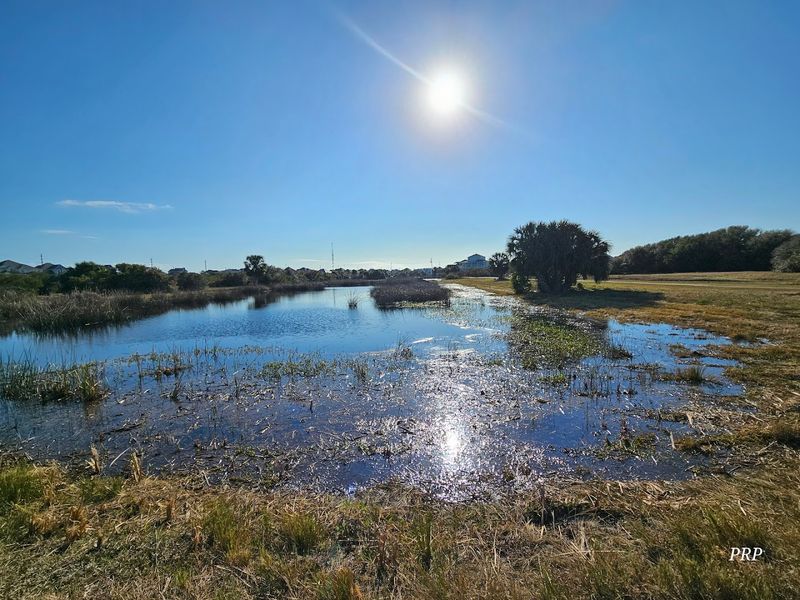
The first thing that gets you about Laffite’s Cove is how easy it is to miss. The preserve sits right inside a residential neighborhood on the west end of Galveston Island, and if you blink while driving down, you will sail right past it.
That is exactly what makes finding it feel like a small victory.
There is no grand entrance, no flashy billboard, and no long line of tourists waiting to get in. Just a modest parking area with about ten spots, a simple sign, and a path that beckons you forward.
The moment you step past the trailhead, the neighborhood noise fades and something quieter, wilder, and much more alive takes over.
The preserve was born out of a real fight to protect this land. Local conservationist Eva Egert worked hard to save a portion of the property from development after it had been owned by her father, John Egert.
That backstory gives the place a certain weight. Someone loved this land enough to protect it, and you can feel that care in every well-maintained path and every interpretive sign along the way.
Knowing that history makes the visit feel more meaningful than just a casual stroll. You are walking through land that almost became something else entirely.
For a place this small, Laffite’s Cove carries a remarkable amount of heart, and the wildlife that fills it every single day is the best possible proof that the effort to save it was absolutely worth it.
The Boardwalk That Changes Everything
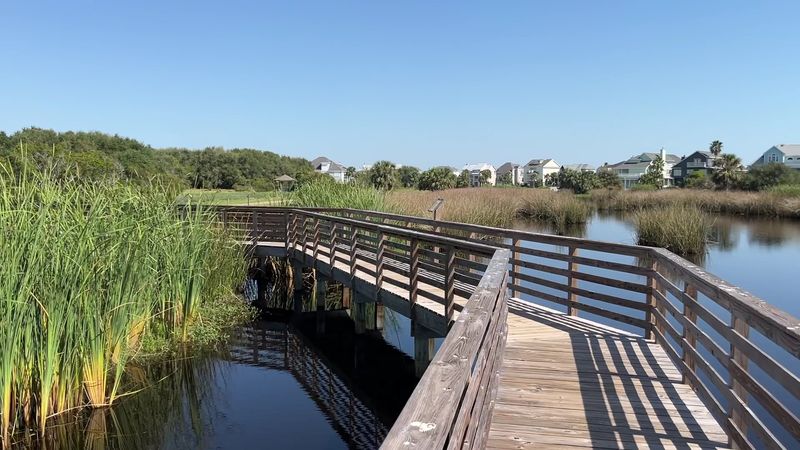
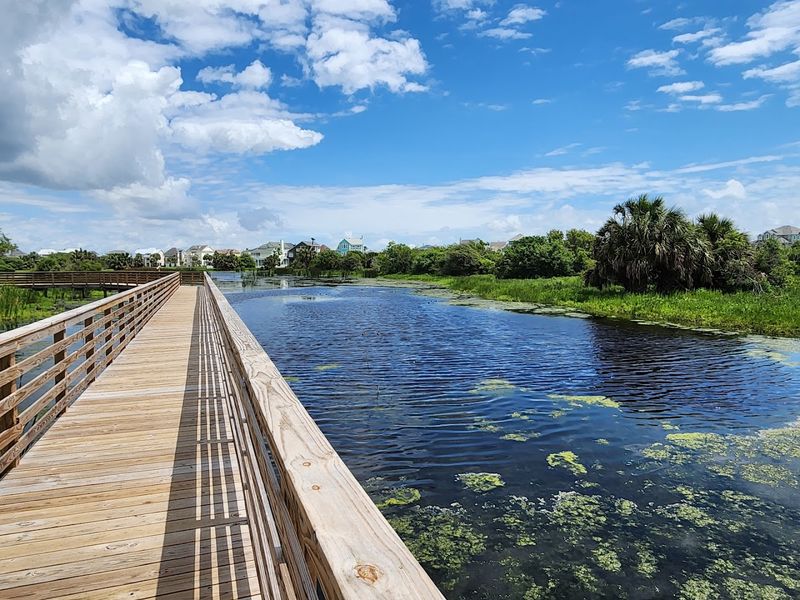
There is something about stepping onto a wooden boardwalk over marshland that immediately shifts your mood. The boards creak softly underfoot, the water glimmers below, and suddenly you are not just observing nature from a distance.
You are right in the middle of it.
The boardwalk at Laffite’s Cove is weathered and real, not polished or over-engineered. It winds through the preserve alongside concrete paths, giving you a mile-long loop that moves through woods, open fields, and wetlands.
The variety keeps things interesting at every turn, because the habitat shifts and so does the wildlife around you.
Interpretive signs are posted along the trail, sharing information about the birds, plants, and ecological systems you are walking through. These are genuinely useful, not just decorative.
I found myself stopping at several of them to read up on species I had just spotted, which made the whole experience feel more like learning than sightseeing.
The trail is also handicap accessible, which is a detail worth mentioning because not every nature trail in Texas can claim that. Benches are placed at thoughtful intervals so you can sit, breathe, and just watch.
Some of the best birding moments happen when you stop moving entirely and let the marsh settle around you. The boardwalk does not just take you through the preserve.
It actually puts you inside it, which is a completely different experience from watching wildlife through a car window or from a distant overlook.
Spring Migration and the Birds That Will Blow Your Mind
Spring migration at Laffite’s Cove is the kind of thing birders plan road trips around. During peak migration, usually from late March through May, the preserve fills up with Neotropical songbirds making their way north after wintering in Central and South America.
The sheer variety of color and sound in those weeks is genuinely hard to describe.
Baltimore Orioles flash their brilliant orange through the canopy. Indigo Buntings, electric blue and almost unreal-looking, perch on low branches near the water drips.
Tanagers in shades of red and yellow move through the understory while warblers like Hooded Warblers and Northern Parulas flit through the vegetation so quickly you have to be patient to get a good look.
Vireos add their steady, repetitive songs to the mix, and on a good migration morning the air feels almost electric with movement. These birds have traveled thousands of miles and the preserve gives them exactly what they need: fresh water, shelter, and food.
The water drips set up throughout the preserve are especially effective at pulling birds in close, making Laffite’s Cove a photographer’s dream during these weeks.
Even if you have never paid much attention to birds before, spring migration here has a way of converting people. There is something about watching a tiny warbler that weighs less than a quarter, after flying over the Gulf of Mexico overnight, land just a few feet from you.
It puts the whole world in a different perspective almost instantly.
Part of the Texas Coastal Birding Trail
Laffite’s Cove is not just a pretty walk. It carries an official designation as part of the Texas Coastal Birding Trail, listed as site UTC 068, which places it on the map alongside some of the most significant birding locations along the entire Gulf Coast.
That is a serious credential for a preserve this compact.
The Texas Coastal Birding Trail is a network of sites stretching across hundreds of miles of coastline, designed to guide birders to the best habitat along the flyway. Being included means Laffite’s Cove has been recognized as a genuinely productive spot, not just a pleasant one.
Birders who follow the trail specifically come here knowing what to expect.
For people who are new to birdwatching, this designation is actually a helpful signal. It tells you that the time you spend here is going to be rewarded with real sightings, not just a distant blur in the trees.
The preserve consistently delivers, especially during migration season when the concentration of species can be extraordinary.
The Edward and Helen Oppenheimer Bird Observatory is also connected to birding efforts on Galveston Island, adding another layer of organized observation to the area’s birdwatching culture.
Galveston sits on one of North America’s most active migratory flyways, and Laffite’s Cove is positioned perfectly to capture that traffic.
Knowing the science behind why so many birds end up here makes every sighting feel a little more incredible. This is not random.
The birds are here for a reason, and so are you.
Roseate Spoonbills, Herons, and the Year-Round Residents
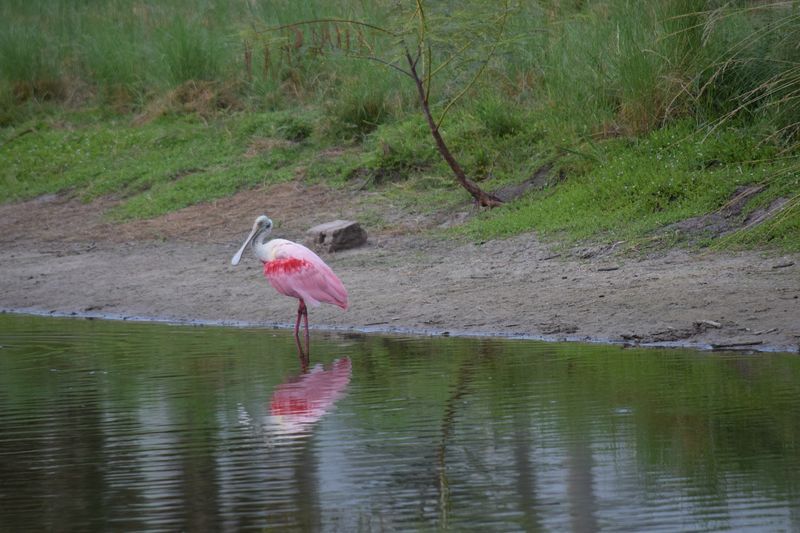
Some birds do not need a migration season to show up at Laffite’s Cove. They are simply there, dependably, throughout the year.
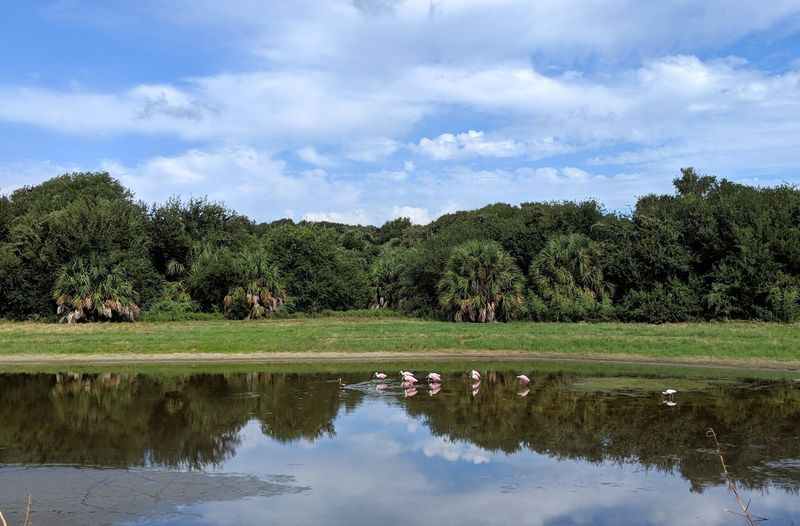
The roseate spoonbill is probably the most visually dramatic of the regulars, a large wading bird with bubblegum-pink plumage and that unmistakable spatula-shaped bill that it sweeps through the water to catch food.
Seeing one for the first time is a genuine surprise, even for people who grew up near the Gulf Coast. The color seems too vivid to be real, almost tropical.
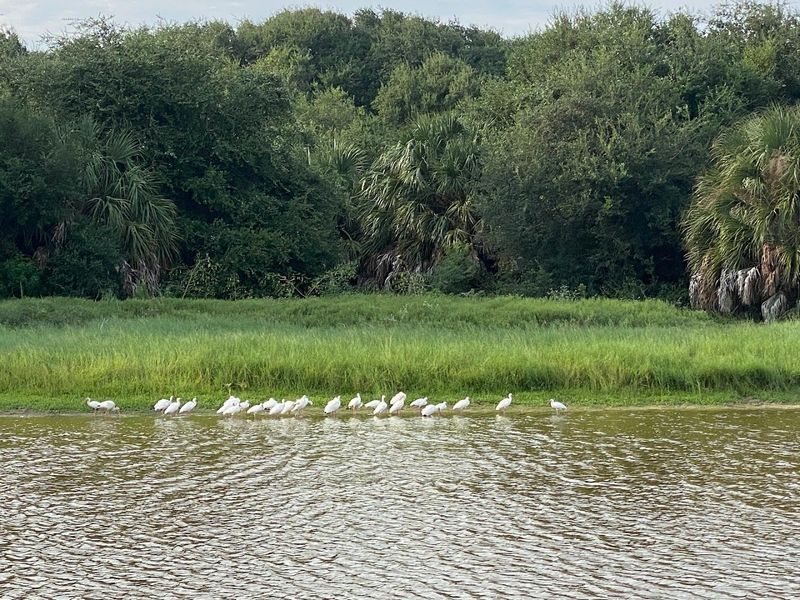
Great Blue Herons stand motionless at the water’s edge with the patience of statues, while Tricolored Herons and Little Blue Herons work the shallows more actively. White Ibis and their curved red bills are also common sights, moving in loose flocks across the marsh.
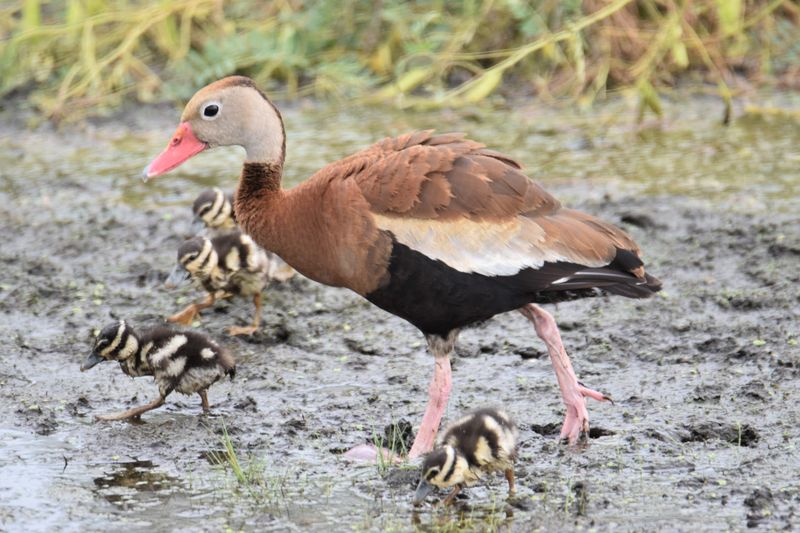
Whistling ducks, cranes, and willets round out the roster of birds you can reasonably expect on any given visit. There have even been peacock sightings reported in the area, which adds a wonderfully unexpected element to the experience.
Turtles sun themselves on logs and along the bank, adding another layer of life to the scene.
The consistency of these year-round residents is part of what makes Laffite’s Cove such a reliable destination. You do not need to time your visit perfectly or chase a rare sighting to have a memorable experience here.
The marsh is always active, always full, and always offering something worth watching. That kind of dependable wildness is genuinely rare anywhere near a major city.
Winter Visitors Worth Braving the Cold For
Not everyone thinks of winter as prime wildlife-watching season, but Laffite’s Cove flips that assumption on its head. When temperatures drop and the crowds thin out, the preserve welcomes a completely different set of feathered visitors that make the cooler months just as rewarding as spring.
Blue-winged Teal settle onto the marsh water in small groups, their iridescent wing patches catching the low winter light. American Wigeons and Buffleheads bob along the surface, while Northern Shovelers sweep their distinctive spoon-shaped bills through the shallows.
Watching them work the water is oddly meditative, the kind of thing that makes an hour disappear without you noticing.
Winter also brings more consistent access to wading birds. Sora, those secretive little rails that hide in the reeds, become slightly more visible in cooler months.
Glossy Ibis and Black-crowned Night-Herons work the edges of the marsh with quiet efficiency. The preserve feels more open in winter, less dense, which can actually make spotting certain species easier than during the lush growth of summer.
There is a particular stillness to Laffite’s Cove on a cool winter morning that I find genuinely restorative. The light is softer, the air is cleaner, and you often have stretches of the trail entirely to yourself.
Bringing a warm layer and a good pair of binoculars is all you really need. The birds do the rest of the work, and they show up reliably, season after season, making winter visits absolutely worth the effort.
Birdwatching and Photography Tips for Your Visit
Getting the most out of a visit to Laffite’s Cove takes a little preparation, but not much. The preserve opens at 6 AM daily, and that early morning window is genuinely the best time to be there.
The light is softer, the birds are most active, and the foot traffic is minimal. Arriving at or just after sunrise gives you the best chance of catching the marsh in full swing.
A good pair of binoculars makes a huge difference here. The birds at Laffite’s Cove often come surprisingly close, especially near the water drips set up throughout the preserve, but binoculars let you pick out field marks and appreciate details that you would otherwise miss.
For photography, a telephoto lens is the go-to recommendation. The birds are approachable but still wild, and a longer focal length lets you capture sharp images without disturbing them.
Moving slowly and quietly is the single most effective technique you can use. Loud footsteps on the boardwalk and sudden movements will scatter birds quickly.
Taking a seat on one of the benches and simply waiting often produces better sightings than actively walking the entire trail in one fast loop.
Downloading a bird identification app before you visit is a smart move, especially if you are newer to birding. Being able to quickly look up a species while you are still watching it makes the whole experience more satisfying.
Wear neutral or muted clothing if you want to minimize disturbance to the wildlife. The preserve rewards patience more than anything else, and that patience pays off every single time.
Practical Things to Know Before You Go
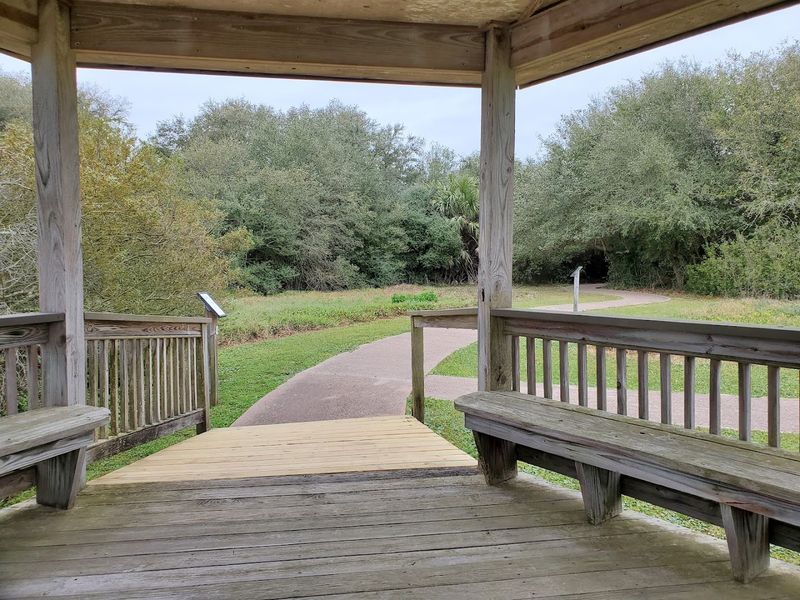
Laffite’s Cove Nature Society is open every day from 6 AM to 8 PM, which gives you a solid window of time to visit at your own pace. The parking lot near the entrance holds about ten vehicles, so arriving early on weekends is a good idea if you want to guarantee a spot.
Weekday mornings tend to be quieter and are honestly some of the best times to visit.
The trail itself is about a mile long, which makes it manageable for most fitness levels. The concrete paths and accessible boardwalk mean that visitors with mobility considerations can enjoy a meaningful portion of the preserve without difficulty.
Comfortable walking shoes are all you really need for footwear, though closed-toe shoes are always a smarter choice around marsh terrain.
There are no fees to enter the preserve, which makes it one of the most accessible nature experiences on Galveston Island. Bringing water is recommended, especially in summer when the Texas heat and humidity can be intense.
Bug spray is also a wise addition to your bag, particularly in warmer months when mosquitoes are active near the marsh.
The interpretive signs along the trail are genuinely informative and worth reading as you go. They add context to what you are seeing and help you understand the ecological relationships playing out around you.
Cell service can be inconsistent inside the preserve, so downloading an offline bird guide or map beforehand is a practical idea.
Why This Small Preserve Deserves a Spot on Your Galveston Itinerary
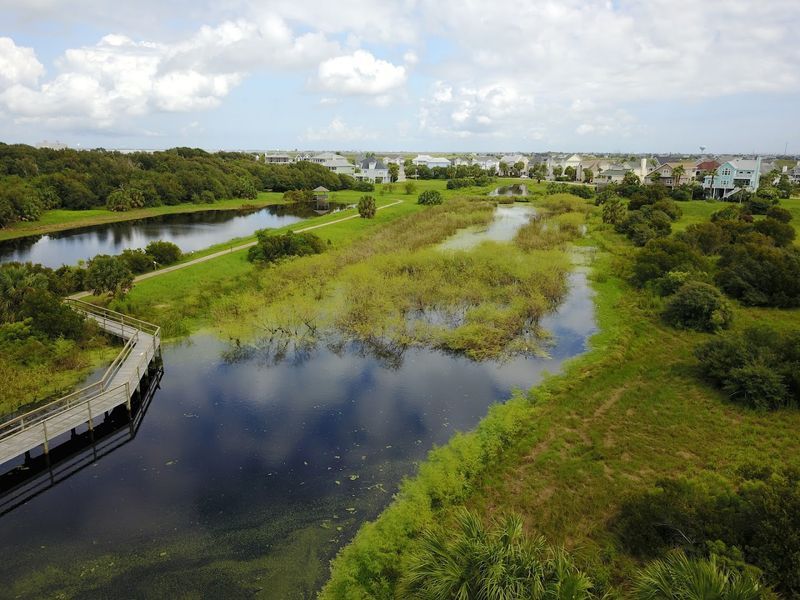
Galveston has a lot going for it: the beach, the history, the food scene, the architecture of the Strand. But most visitors move through the island on a pretty predictable circuit, and Laffite’s Cove sits well outside that circuit in the best possible way.
Adding it to a Galveston trip costs you nothing and gives you an experience that feels genuinely different from everything else the island offers.
The preserve is not trying to compete with the beach or the tourist attractions. It occupies its own quiet category, the kind of place where you slow down without being told to.
The mile-long trail takes most people between 45 minutes and an hour to complete, depending on how often you stop. That is a very reasonable investment for the kind of payoff this place delivers.
For families, the accessible trail and the abundance of visible wildlife make it a natural fit. Kids who have never been excited about birds tend to change their minds quickly when a roseate spoonbill walks past at close range or a turtle slides off a log into the water right in front of them.
The preserve has a way of sparking genuine curiosity, not just in children but in adults who thought they were done being surprised by nature.
Laffite’s Cove is proof that the most memorable parts of a trip are often the ones nobody told you to visit. It rewards the curious, the patient, and anyone willing to turn off the main road and see what is hiding just a few blocks away.
Address: 3503 Eckert Dr, Galveston, TX 77554
