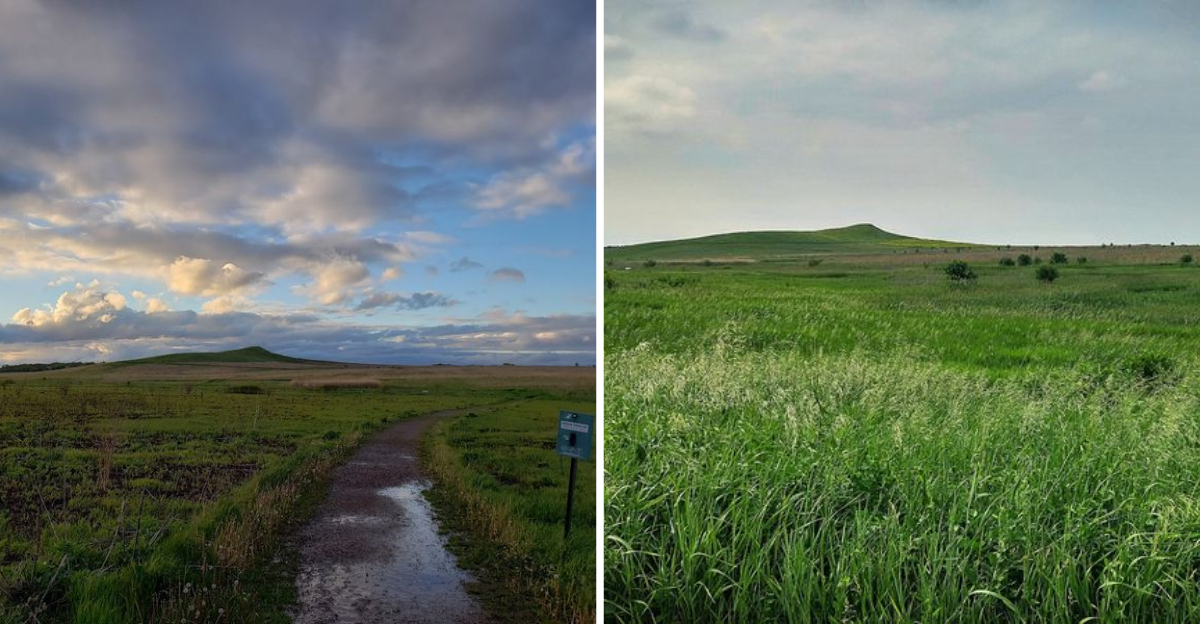
A hill rises out of the flat South Dakota prairie and has been making people stop and stare for thousands of years. It is the only significant rise for miles in every direction, with no river running through it, no lake sitting at its base, and no obvious reason for it to be there at all. Native American tribes warned their people away from it for centuries, calling it home to dangerous little spirits with large heads and sharp arrows.
Lewis and Clark made a special nine mile detour just to climb it back in eighteen hundred four. Geologists call it a roche moutonnee, a bedrock knob that simply refused to be flattened by massive glaciers. Everything around it got scraped and leveled.
This one did not.
A Hill That Defies the Flat Prairie Around It
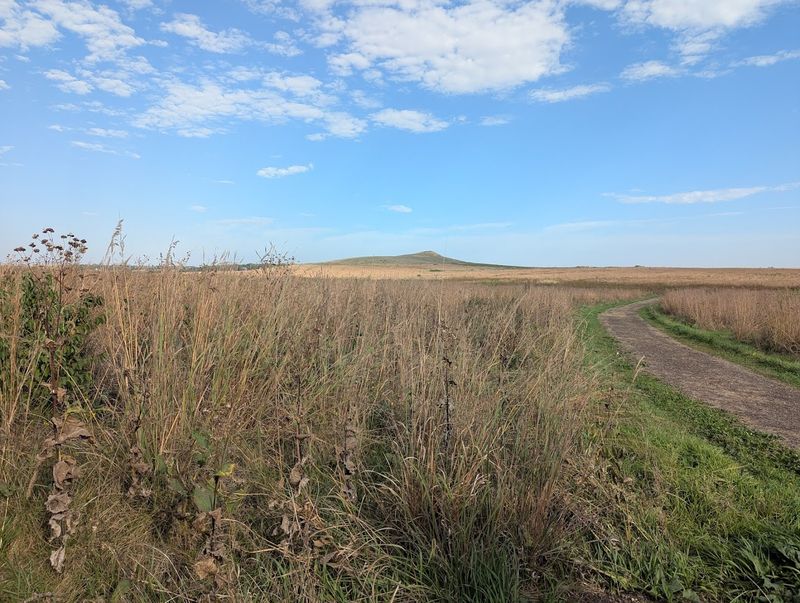
The first thing that hits you when you pull off onto State Highway 19 is just how wrong Spirit Mound looks in its surroundings. The Great Plains stretch out in every direction with barely a ripple in the earth, and then suddenly, there it is, a dome of land jutting about 70 feet above the surrounding plain like someone dropped it there on purpose.
Geologists have a name for what Spirit Mound actually is. It is called a roche moutonnee, a bedrock knob made from the lower part of the Niobrara Chalk formation that simply refused to be flattened by the massive Pleistocene glaciers that rolled through this region around 13,000 years ago.
Everything around it got scraped and leveled. Spirit Mound did not.
Its elevation sits between 1,302 and 1,309 feet, which does not sound dramatic until you realize the surrounding land offers almost no competition. That contrast is exactly what makes it so visually jarring.
From the parking area, even before you start the trail, you can feel why generations of people looked at this mound and immediately decided it must mean something. It just does not belong, and yet here it is.
No Lake, No River, No Logical Explanation on the Mound Itself
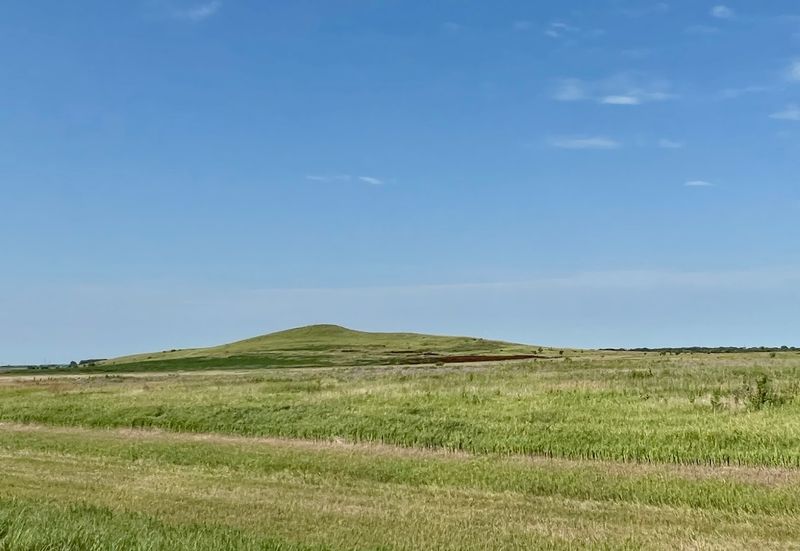
One of the most genuinely curious things about Spirit Mound is what is not there. Most unusual landforms in the American Midwest come with a story that involves water.
A river carved this canyon, a glacier left behind that lake. Spirit Mound breaks that pattern completely.
There is no lake sitting on top of it, no river cutting through it, and no obvious hydrological reason for the mound to exist in the shape it does.
The Vermillion River, which Lewis and Clark referred to as the White Stone River during their 1804 expedition, flows nearby. Spirit Mound Creek runs past the southern side of the hill.
But neither of those waterways had anything to do with creating or shaping the mound itself. The mound is purely a story of bedrock stubbornness against glacial force.
That absence of water features is part of what makes the place feel so unexplained to the casual visitor. You expect geology to follow certain rules.
Rivers shape valleys, glaciers carve lakes, erosion smooths things down. Spirit Mound simply sat there, resisting all of that, and came out the other side of the Ice Age looking exactly like it wanted to cause confusion.
It succeeds.
The Native American Legends That Kept People Away for Centuries
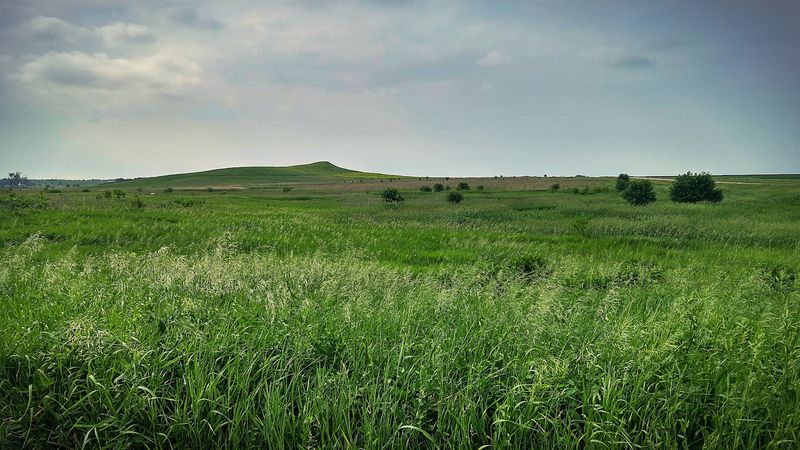
Long before any European explorer set foot in South Dakota, various Plains Indian tribes already had a very clear relationship with Spirit Mound, and that relationship was mostly one of respectful avoidance. The Yankton and Lakota Sioux, the Omaha, the Otoe, and the Mandan all carried stories about this hill, and the stories were not exactly welcoming.
Tribes described the mound as home to beings called Can O’ti na, sometimes translated as Little Tree Dwellers or little people. These beings were said to stand only about 18 inches tall but had disproportionately large heads and carried sharp arrows capable of killing from a considerable distance.
The legends were specific enough and widespread enough that many tribes simply would not go near the place.
What is remarkable is that these were not fringe stories from a single group. Multiple distinct nations, spread across a wide geographic area, all shared versions of the same warning about the same hill.
Spirit Mound is also connected to the origin of sacred objects like the Mandan Turtle Drums and the Wo’piye Can O’ti la, a medicine bundle still used by Lakota people today. The spiritual weight attached to this place is deep, layered, and very much alive.
Lewis and Clark Made a Nine-Mile Detour Just to See It
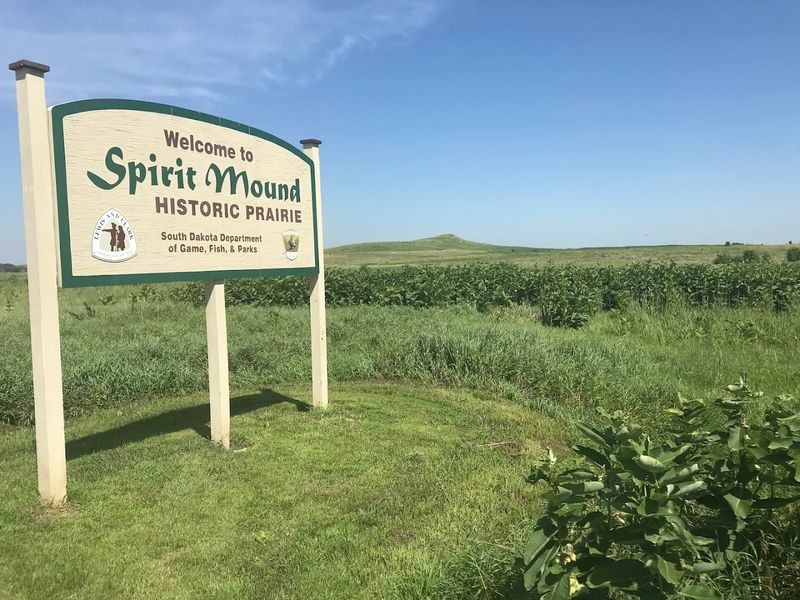
On August 25, 1804, Captains Meriwether Lewis and William Clark did something that tells you everything about how famous this hill already was. They were traveling the Missouri River on one of the most ambitious expeditions in American history, and they chose to leave their route and walk nine miles out of their way just to climb Spirit Mound and see what was up there.
They brought ten men with them. The day was brutally hot, and Lewis’s dog Seaman struggled so badly in the heat that he had to be sent back to the river early.
The group pushed on, reached the summit, and found no little people. What they did find, according to Lewis’s journal, was a most beautiful landscape, a sweeping view of the plains with enormous herds of buffalo visible in every direction.
Lewis theorized that the mound’s eerie reputation might have come from the massive swarms of swallows attracted to insects near the summit, which could have looked unsettling from a distance. Spirit Mound is one of the very few places along the entire Lewis and Clark route where historians are certain the captains physically stood, since many other expedition sites along the Missouri are now underwater due to damming.
The Geology Beneath Your Feet Is Older Than You Can Imagine
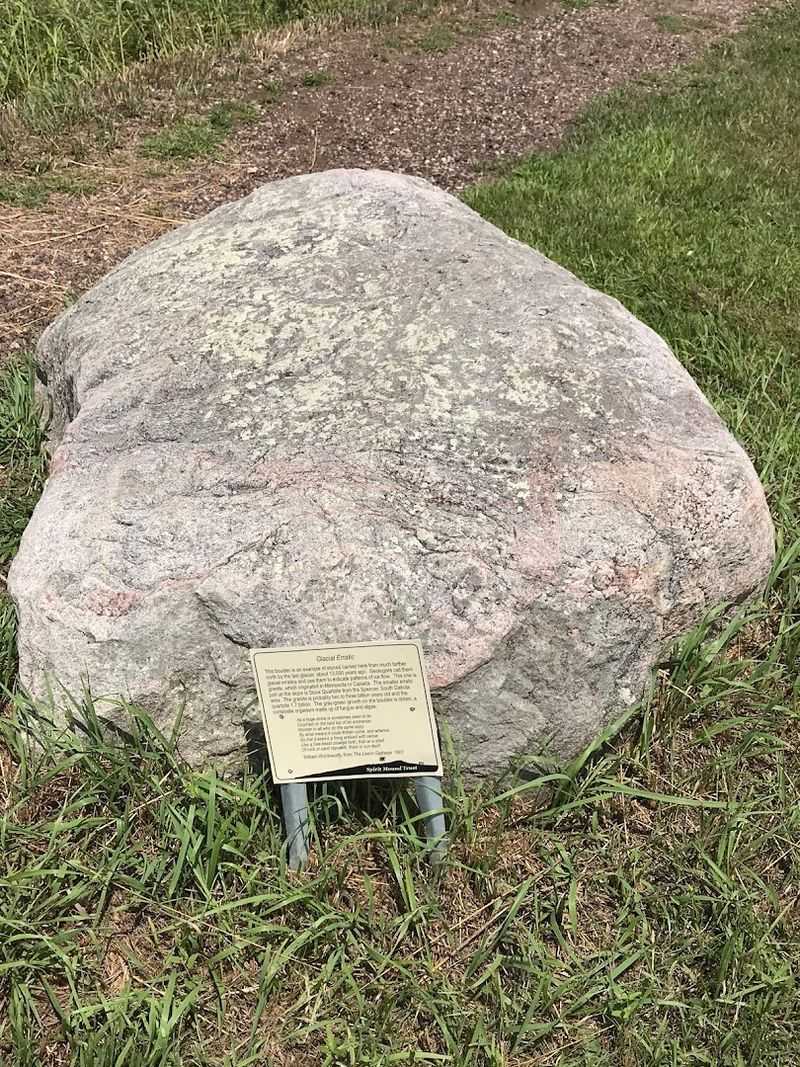
Most people who hike up Spirit Mound are thinking about the view or the history, not the rock underneath them. That is fair.
But the geology of this place is genuinely fascinating once you start to understand what you are actually climbing.
Spirit Mound is composed of Niobrara Chalk, a sedimentary rock formation that dates back to the Late Cretaceous period, when a vast inland sea covered much of North America. The chalk formed from the accumulated remains of tiny marine organisms that sank to the seafloor over millions of years.
When the glaciers of the Pleistocene epoch advanced across this region roughly 13,000 years ago, they scraped and flattened almost everything. The Niobrara Chalk at Spirit Mound was hard enough and positioned just right to resist that grinding force.
The result is a geological survivor, a piece of ancient seafloor that outlasted an ice age and now sits 70 feet above the prairie like a quiet monument to deep time. There is something almost absurd about standing on top of it, knowing you are on material that formed at the bottom of a prehistoric ocean.
The plains feel different when you think about them that way.
What the Hike Actually Feels Like Today
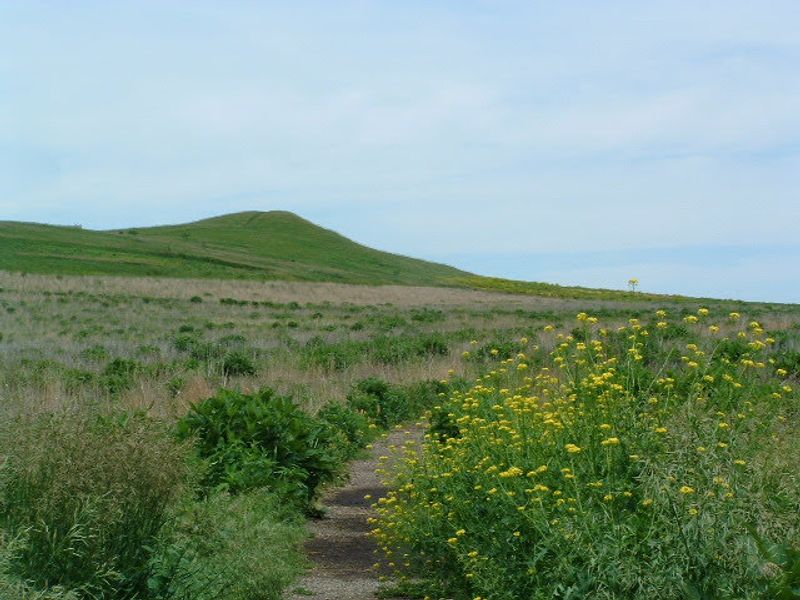
The trail to the top of Spirit Mound is short, honest, and surprisingly enjoyable. The round trip runs about 1.5 miles total, with the path made of crushed gravel that keeps things manageable for most fitness levels.
There is a modest incline as you approach the summit, but nothing that will leave you gasping.
Along the way, interpretive signs share the geological background, the Lewis and Clark visit, and the Native American history tied to the site. Benches appear at intervals, which is a nice touch for anyone who wants to stop and actually absorb what they are reading.
The trail passes through restored tallgrass prairie, and depending on the season, you might spot wildflowers, garter snakes, rabbits, red-winged blackbirds, or butterflies moving through the tall grasses.
At the very top, there is a small box where visitors can write notes and read what others have left behind. The wind at the summit can be strong enough to feel a little dizzying on smaller days, so bring a hat.
The park is open daily from 6 AM to 11 PM, which means you can time a visit for sunset or even come back after dark for stargazing. The Milky Way is visible from here on clear nights.
Why Spirit Mound Is Worth the Drive from Vermillion
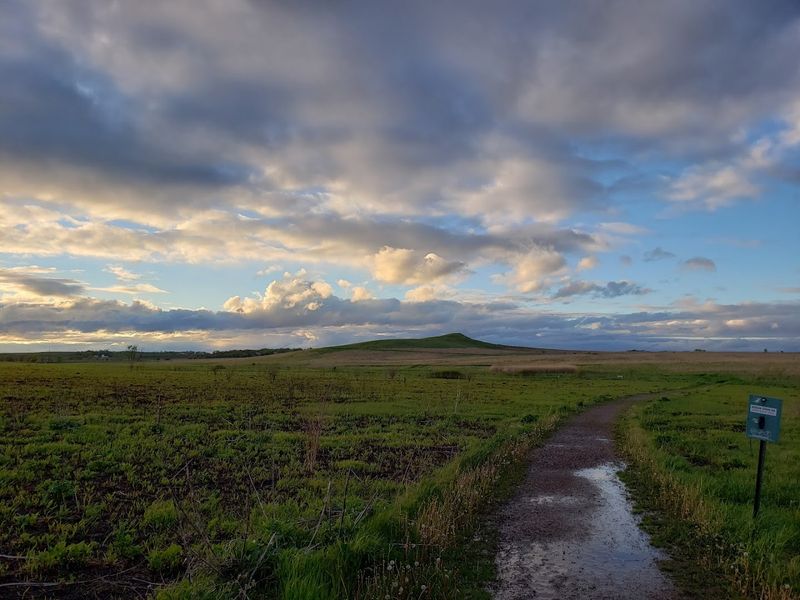
Vermillion is a small university town about 7 miles south of Spirit Mound, and the drive out on Highway 19 takes maybe fifteen minutes. It is the kind of side trip that feels almost too easy to skip, and that would be a real mistake.
Spirit Mound Historic Prairie became a South Dakota state park in 2002 after the 320-acre site was purchased in 2001, and restoration work has been ongoing ever since to bring back the tallgrass prairie that Lewis and Clark would have seen.
The park has a parking area with a circular drive, picnic tables in a shaded spot, restroom facilities, and water available, so you are not roughing it in any serious way. The trail is well maintained and the signage is genuinely informative rather than the generic placard variety.
It was added to the National Register of Historic Places back in 1974, which gives you a sense of how long people have recognized that this place matters.
Visitors come from surprisingly far away, and it is easy to understand why once you are standing at the top. The view is wide and quiet in a way that is hard to describe.
For a place with no lake, no river, and no tidy geological explanation, Spirit Mound has a way of feeling completely complete.
Address: 31148 SD-19, Vermillion, SD 57069
