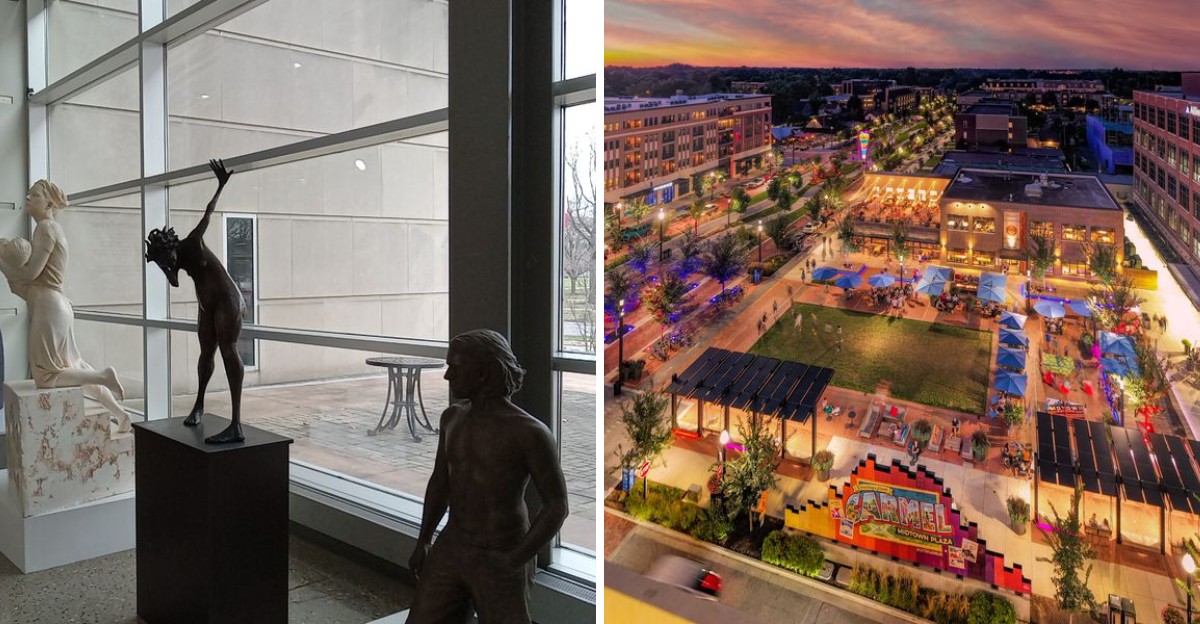
“It’s free?” That question gets asked a lot. Usually right before the plan changes.
In Indiana, there are bridges that glow over the Ohio River, art spaces where you can wander in without a ticket, and strange roadside treasures that look like somebody’s very specific hobby got out of hand. One stop hides a giant painted sphere.
Another puts ancient rock formations right where anyone can see them. There are makerspaces too.
Limestone ruins. A cartoon cat.
It sounds like a list made after several unrelated conversations. That is precisely why it works.
Nothing here requires a big budget. Just enough curiosity to stop the car.
1. Ignite Studio at Hamilton East Public Library, Fishers
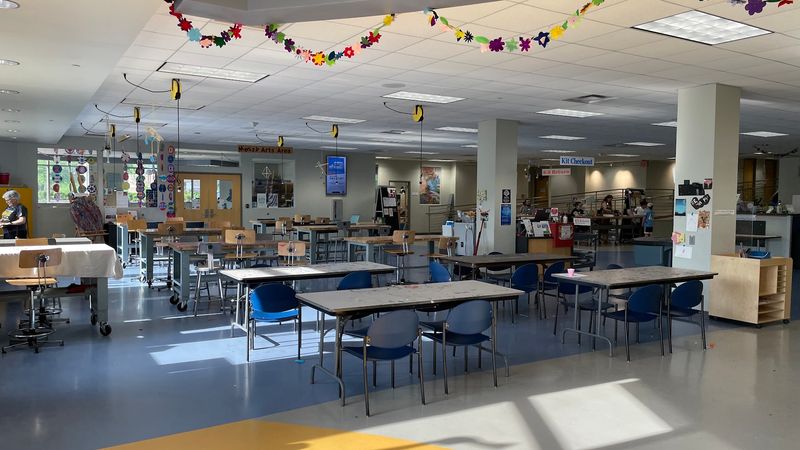
Sewing machines hum in one corner while someone sketches quietly in another, and nobody seems to mind the friendly chaos. Ignite Studio sits on the lower level of the Hamilton East Public Library at 5 Municipal Drive in Fishers, and it works far more like a workshop than a reading room.
Open tables invite visitors to spread out with whatever project they brought along. Rotating kits sit ready for anyone who showed up empty-handed.
Tools for drawing, stitching, and building stay within easy reach, so a random afternoon can turn into a first attempt at embroidery or a small wooden build. Exhibit areas along the walls give local makers a place to show finished work, which adds a gallery feel to the space.
Digital media rooms, an A.V. Studio, and fabrication gear including 3D printers and a laser engraver push things further, though a few of those require certification or a reservation ahead of time.
Plan accordingly if a laser-cut souvenir is the goal.
Most resources cost nothing at all, which makes experimenting feel low-pressure. Mess up a seam, start over, nobody keeps score.
Energy in the room stays calm but focused, with families and solo tinkerers working at their own pace. For travelers passing through Fishers, it offers a genuinely different kind of stop, one where the souvenir gets made rather than bought.
2. Herron School of Art & Design Galleries, Indianapolis
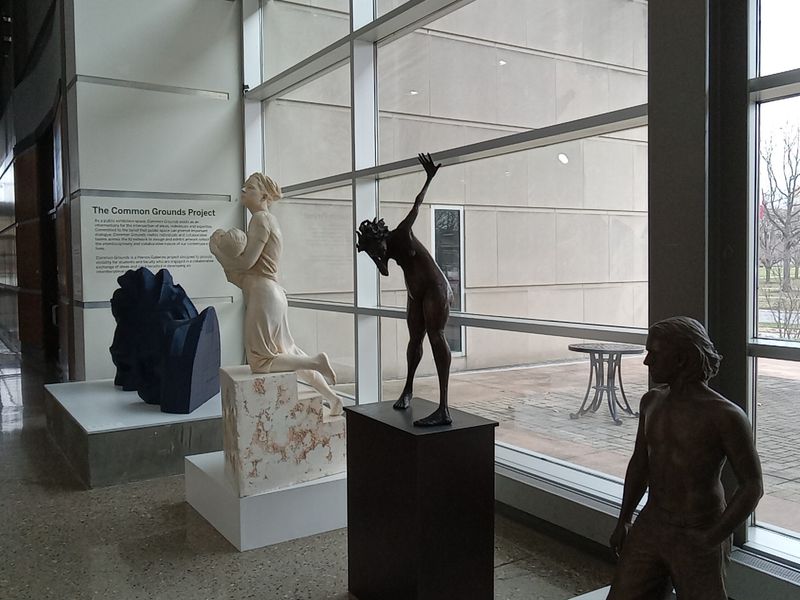
Quiet hits first, then the scale of the rooms. Tucked inside Eskenazi Hall at 735 West New York Street in Indianapolis, the Herron School of Art and Design Galleries hold more than 6,000 square feet of exhibition space spread across several distinct rooms.
Work by students, faculty, and visiting artists rotates regularly, so no two visits look alike. Contemporary pieces dominate, some bold and loud, others subtle enough to require a second look.
The Robert B. Berkshire, Eleanor Prest Reese, and Dorit and Gerald Paul Galleries anchor the main spaces, joined by the Marsh Gallery and the Frank and Katrina Basile Gallery.
High ceilings and clean walls let each installation breathe, and the layout encourages slow wandering rather than a quick loop.
Every exhibition and artist talk stays open to the public at no charge, which removes the usual hesitation about whether a gallery is worth the stop. Wheelchair access runs throughout the building.
Parking sits in nearby garages, and gallery staff handle validation, a small detail that saves a headache downtown. Ask at the desk before heading back out.
Atmosphere leans reflective and unhurried, ideal for a solo afternoon or a break from busier city attractions. Art students often move through between classes, adding a working-campus buzz that keeps the space from feeling precious or stuffy.
3. Big Four Pedestrian Bridge, Jeffersonville
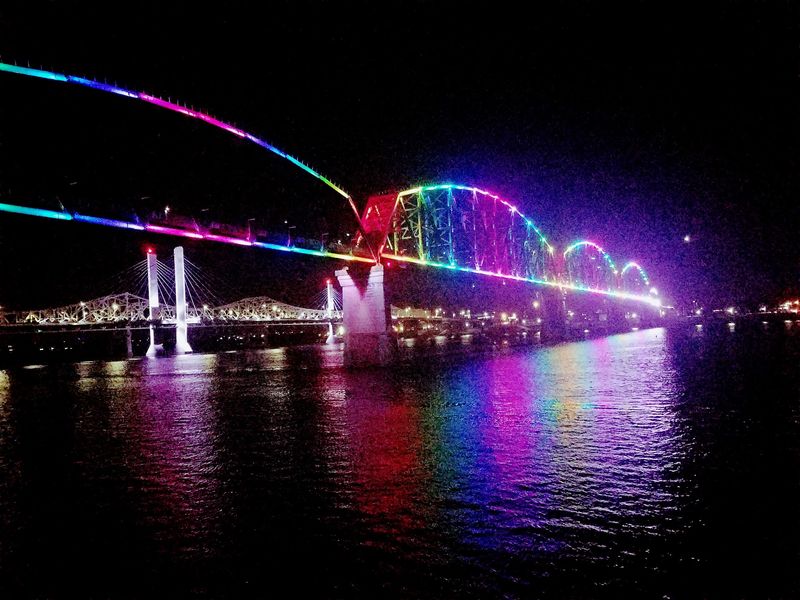
Two states in one walk, and the river rolling along far below the whole time. The Big Four Pedestrian Bridge connects Jeffersonville, Indiana with Louisville, Kentucky, carrying walkers and cyclists across water that once only saw freight trains.
Built as a railroad crossing and completed in 1895, the structure sat unused for decades before ramps on both banks brought it back to life in 2013 and 2014. The span itself runs roughly half a mile, with each ramp adding another quarter mile.
Round trip from state to state lands near two miles, enough to count as a real walk without wrecking the day. Bring comfortable shoes.
Views open wide in every direction, taking in the Ohio River, the Louisville skyline, and the tree lines along both shores. Conversations, bike bells, and footsteps create a steady background hum that makes the crossing feel social rather than solitary.
After dark, an LED system washes the iron fretwork in shifting colors, and the bridge becomes a landmark visible from both riverfronts. Evening crossings draw a good crowd for exactly that reason.
On the Indiana side, the ramp lands in Big Four Station Park near the corner of Market Street and Mulberry Street in downtown Jeffersonville, where fountains, lawns, and shaded seating give tired legs somewhere to recover before exploring the surrounding blocks.
4. Fossil Beds at the Falls of the Ohio State Park, Clarksville
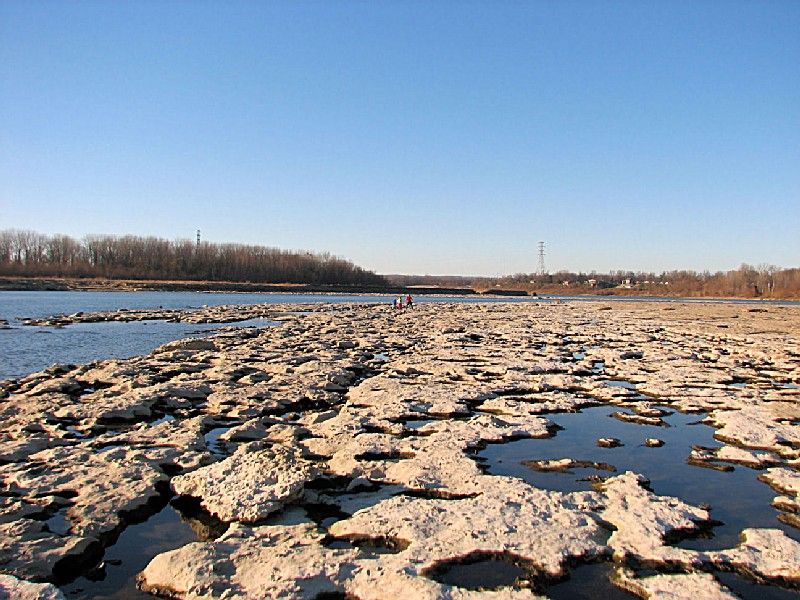
Underfoot sits a coral reef that stopped growing about 390 million years ago. The fossil beds at the Falls of the Ohio State Park in Clarksville rank among the largest naturally exposed Devonian beds anywhere on the planet, and visitors can walk straight out onto them.
Patterns in the rock turn out to be the remains of ancient marine creatures, mostly corals that once filled a shallow tropical sea covering this part of the continent. Look closely and the shapes multiply.
Honeycomb textures, spirals, and long tube-like impressions show up once the eye adjusts, and the scale of the exposure makes the whole shelf feel like an open-air museum floor. No ropes, no glass cases.
Water levels decide how much is visible, so late summer and autumn generally reveal the most rock. Spring visits often find much of the reef submerged.
Park grounds and the beds themselves cost nothing to access, though the Interpretive Center up the hill charges admission for its exhibits. The outdoor portion alone justifies the drive.
Everything sits along the Ohio River at 201 West Riverside Drive in Clarksville, with parking close to the trail down to the rock. Bring sturdy shoes, since the surface stays uneven and can be slick near the waterline, and remember that fossils stay where they are found.
5. Garfield Trail, Grant County
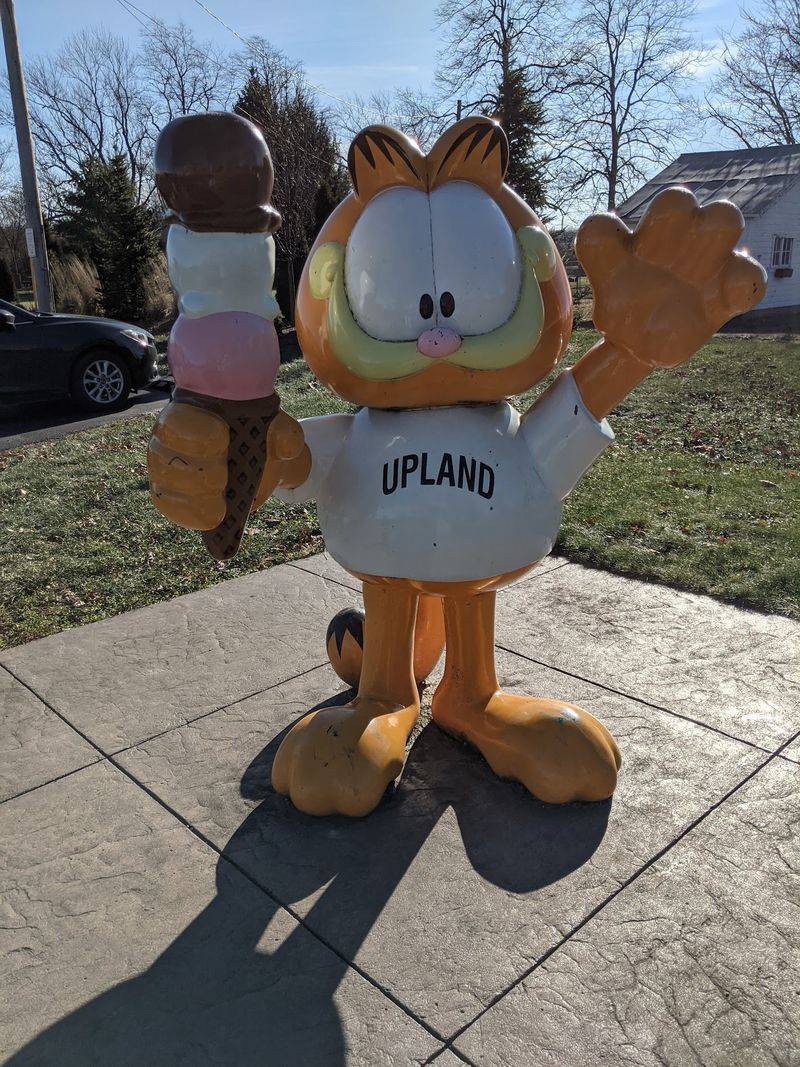
A lasagna-obsessed cartoon cat turns out to be excellent motivation for a small-town road trip. The Garfield Trail scatters 14 fiberglass statues across Grant County and into neighboring Delaware County, with stops in Fairmount, Marion, Gas City, Upland, and a handful of other communities.
Each statue stands about five feet tall and wears a costume tied to wherever it happens to live. One shoots hoops, another buries itself in books, another shows up dressed as a doctor.
Fairmount hosts a James Dean themed version, a nod to the town’s other famous native. Two icons, one sidewalk.
Driving the whole route takes a few hours depending on how long each photo stop lasts, and the roads between towns roll past farmland, grain elevators, and courthouse squares that rarely make travel lists. That in-between scenery ends up being half the fun.
Free brochures with maps and statue details are handed out at the trail’s starting point, and a cell phone tour adds commentary at each stop for anyone who wants the backstory. Handy when the costume choice seems random.
Grant County claims the trail for good reason, since Garfield creator Jim Davis grew up in the area. Kids treat the hunt like a scavenger game, and adults tend to get competitive about spotting the next one first.
6. Harmonist Labyrinth, New Harmony
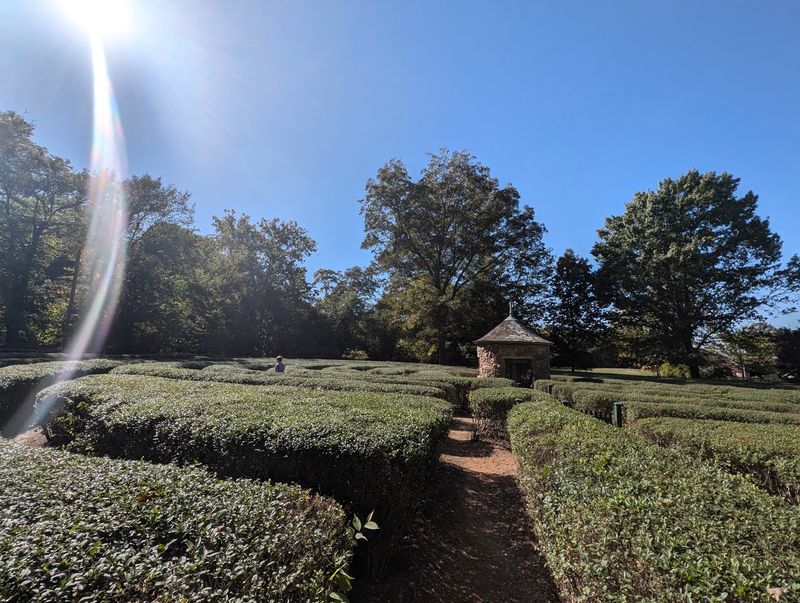
Hedges curve inward, and the only real instruction is to keep walking. The Harmonist Labyrinth at 1239 Main Street in New Harmony traces its origins to the Rappites, a German religious society that settled here in the early 1800s and built the original as a symbol of life’s twists and difficulties.
Unlike a maze, a labyrinth offers a single path with no wrong turns. That changes the whole experience from puzzle-solving to something closer to a slow, steady stroll.
Reconstructed in 2008, the current version sits right on a main street, with shrubbery guiding visitors toward a small stone Rappite temple at the heart of the design. Reaching the center takes longer than it looks from the sidewalk.
Open year-round with no gate and no fee, it suits travelers who want a pause rather than another attraction to check off. Mornings tend to be especially quiet.
New Harmony holds a second labyrinth worth adding to the walk, the Cathedral Labyrinth at 301 North Street, which copies the pattern laid into the floor of Chartres Cathedral in France. Also free, also open to anyone.
Between the two, the town’s reputation as a place built around reflection makes complete sense. The surrounding streets, lined with preserved buildings and gardens, extend that mood well past the hedges themselves.
7. Historic Walking Tour of Corydon
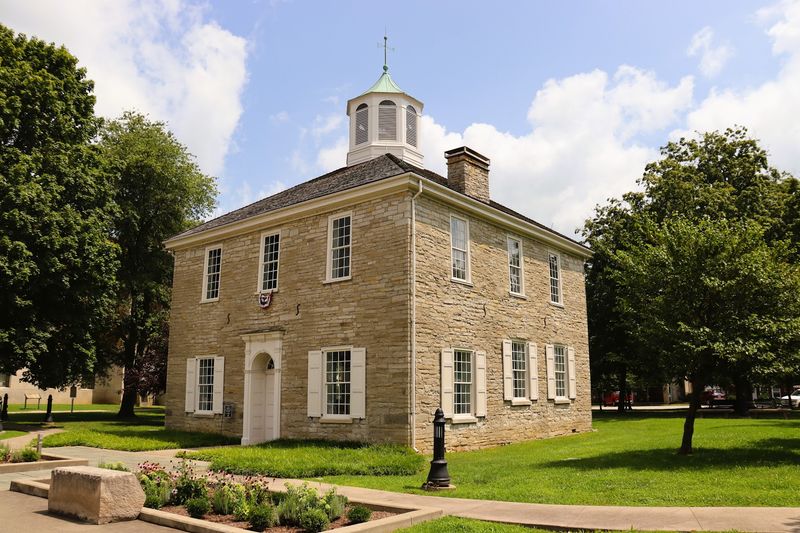
Indiana’s government started here, in a modest limestone building on a shady square. Corydon served as the state’s first capital, and a self-guided walking tour threads through downtown streets where much of that early 1800s architecture still stands.
Maps come from the Blaine H. Wiseman Visitor Center at 310 North Elm Street, which gives the route structure instead of leaving visitors to guess which buildings matter.
Grab one before setting off.
Shade trees line most of the sidewalks, so summer walks stay tolerable and autumn walks turn genuinely pretty. Distances between stops are short.
Preserved storefronts, homes, and civic buildings each carry a piece of the state’s founding story, and reading about them while standing in front of the actual doorway beats any textbook version. Details like original stonework and window shapes start jumping out once the eye knows what to look for.
Pace is entirely up to the visitor, which suits families with younger kids or anyone who wants to stop and browse along the way. No timed entries, no tour group to keep up with.
Costing nothing beyond the walk itself, the tour turns a quick highway detour into an afternoon with real depth. Southern Indiana’s rolling hills sit just outside town, making Corydon an easy anchor for a longer regional loop.
8. Holliday Park Nature Center, The Ruins, and Playground, Indianapolis
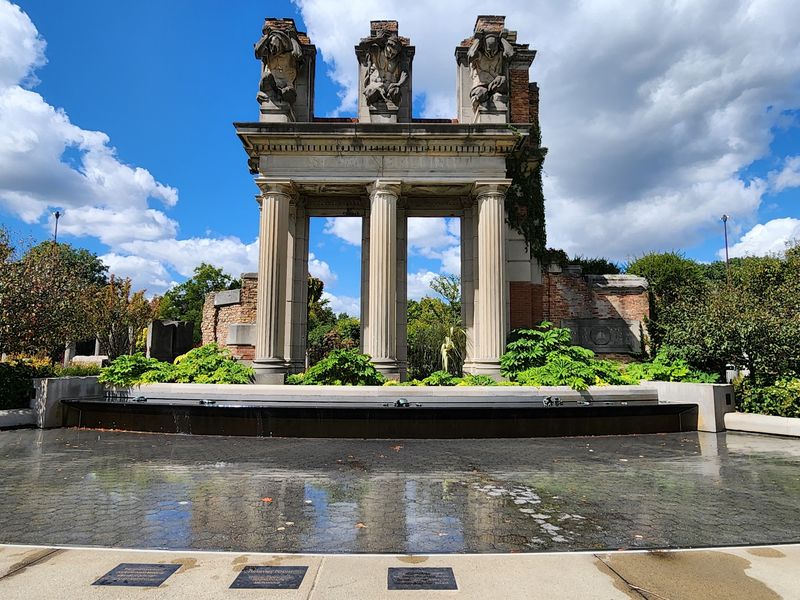
Giant limestone figures stare out over a reflecting pool in the middle of an Indianapolis park, which is not something most people expect from a neighborhood green space.
Those sculptures once decorated New York City’s St. Paul Building before being shipped west and reassembled into the installation known as The Ruins.
Holliday Park spreads across 94 acres at 6363 Spring Mill Road. There is far more here than the statues.
The Nature Center opens its doors at no charge, with hands-on exhibits and live animals that introduce Indiana’s wildlife in a way kids actually engage with.
Habitat Hall holds a miniature White River water table and an elevated viewing area built to feel like standing inside a hardwood forest canopy.
Outside, more than 3.5 miles of trails wind through wooded ravines, wetlands, and stretches along the White River. Bird watching gets good in the quieter corners.
A reimagined playground takes cues from the surrounding woods, with climbing structures and exploration zones that blend into the landscape rather than sitting on a rubber square. Kids rarely want to leave.
Everything listed stays free, from the trails to the Nature Center to The Ruins, which makes the park an easy full-afternoon stop. Late light hitting the limestone faces is worth timing a visit around.
9. World’s Largest Ball of Paint, Alexandria
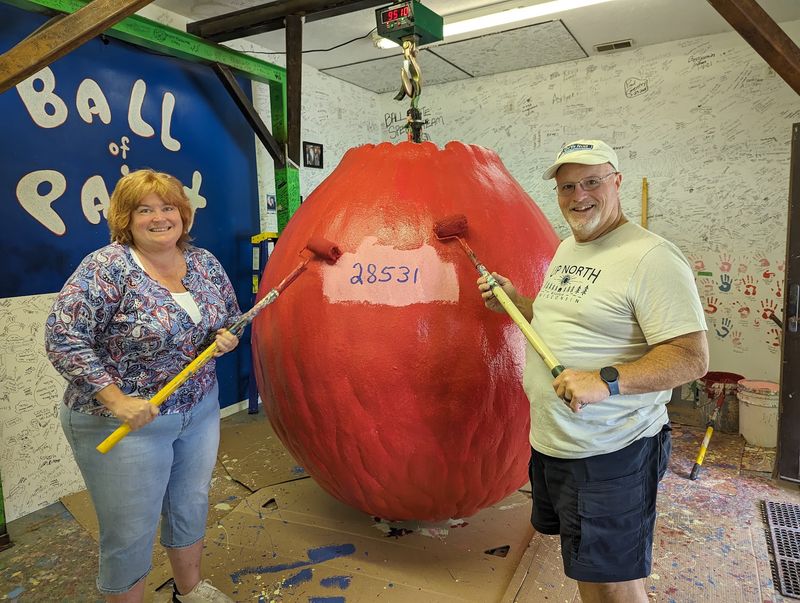
It started as an ordinary baseball in 1977. Michael Carmichael and his son brushed on the first coat, and nobody stopped adding layers after that.
Nearly five decades later, the World’s Largest Ball of Paint hangs from an industrial steel beam in a purpose-built shed beside the Carmichael home at 10696 North 200 West in Alexandria. Weight has climbed to roughly 11,000 pounds, with more than 29,500 recorded coats as of late 2024.
Visitors do not just look. Anyone who stops gets to roll on a fresh layer and become part of the record, which is easily the strangest souvenir available in the state.
An appointment is requested before showing up, so a quick call ahead keeps the visit smooth and gives the family time to have brushes ready. The setup stays intimate, more like being invited into someone’s hobby than touring an attraction.
Cross-sections displayed nearby reveal the rainbow of layers packed inside, which explains the project better than any sign could. Thousands of colors, stacked like tree rings.
Costing nothing, the stop delivers a mix of folk art, stubborn dedication, and genuine oddity that sticks in memory long after fancier destinations blur together. Roadside Indiana rarely gets weirder or more welcoming than this small shed in Madison County.
10. Midtown Plaza and Monon Boulevard Playground, Carmel
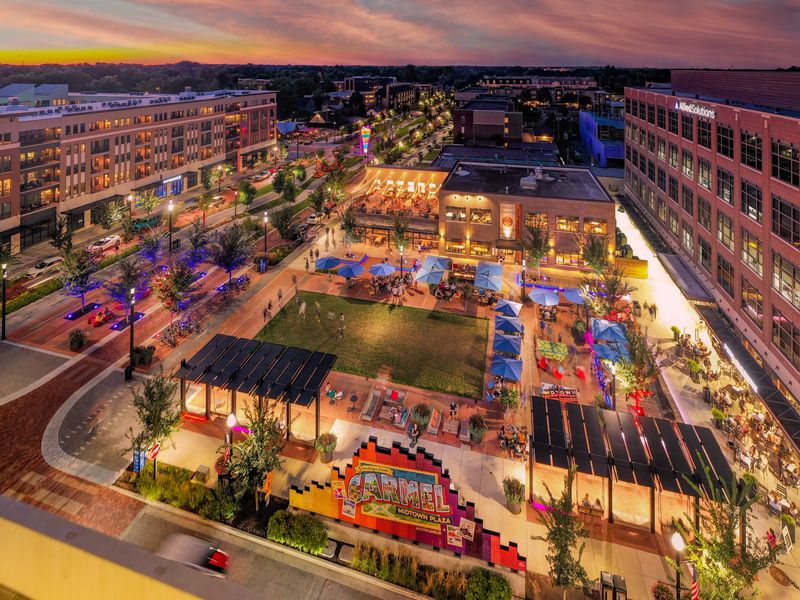
Ping-pong paddles clack, swings sway, and a paved greenway keeps a steady stream of cyclists rolling past. Midtown Plaza at 365 Monon Boulevard in Carmel functions as a gathering spot built directly into the Monon Greenway, the walking and biking path that runs through town.
Lawns, communal tables, and benches fill the open space. Swings scattered around give the whole plaza a relaxed, unhurried feel.
Games sit out for anyone to use, including a pool table, ping-pong tables, and cornhole boards, which tends to pull in a mixed crowd of kids, teens, and adults who claim they are just watching. Competition gets friendly fast.
Next door, the Monon Boulevard playground raises the bar with a 40-foot tower shaped like a metronome, plus climbing structures more ambitious than the usual neighborhood setup. Older kids finally get something worth climbing.
A large outdoor screen shows movies and live sporting events on certain evenings, and events fill the calendar throughout the week. Blankets and folding chairs show up accordingly.
Free parking waits in an adjacent garage or along nearby streets, removing the usual downtown hassle. Everything on site stays open to the public without charge.
Modern architecture surrounds the plaza, but the atmosphere stays casual rather than polished, making it a natural place to end a day of exploring central Indiana.
