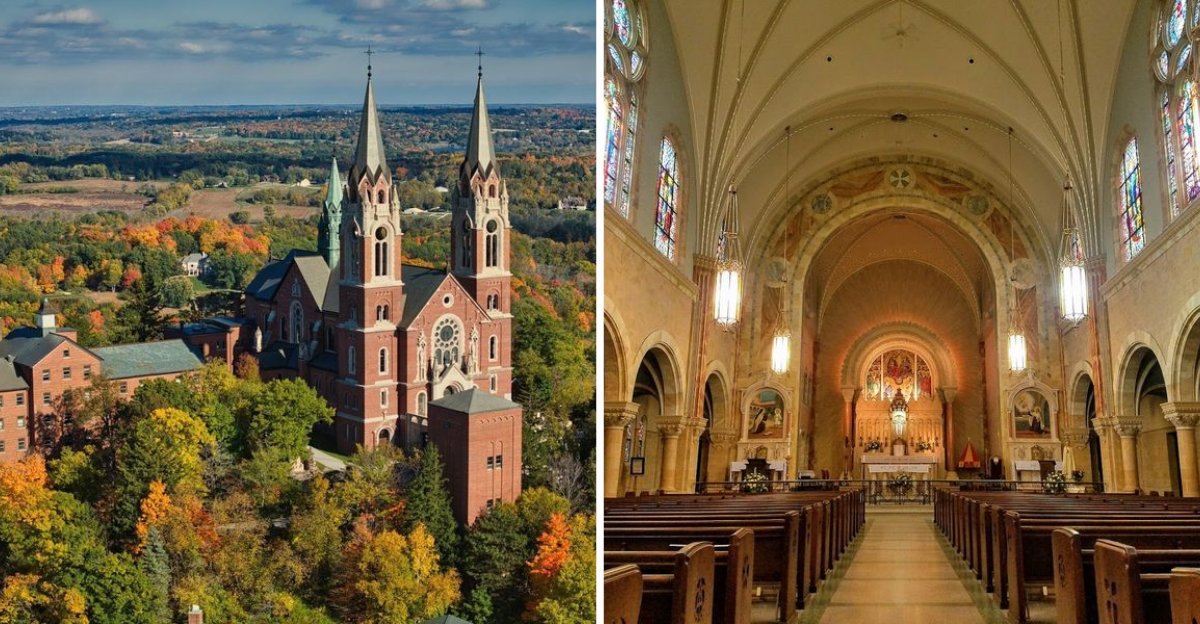
That place in Wisconsin gets under your skin the moment you arrive. The neo Romanesque towers rise above the forest like something out of a European dream, and the air up there carries a stillness that feels almost alive. People come for the faith, for the views, for the autumn colors that set the hillside on fire every October.
But some leave with something else entirely. Stories about sounds they cannot explain.
Footsteps echoing on staircases in a building that was locked, empty, and quiet as a held breath. You hear them when no one else is around. You turn expecting someone, but the hallway is empty.
Then you hear it again, closer this time, and you realize you are not alone even though you clearly are.
The Hermit Who Never Really Left
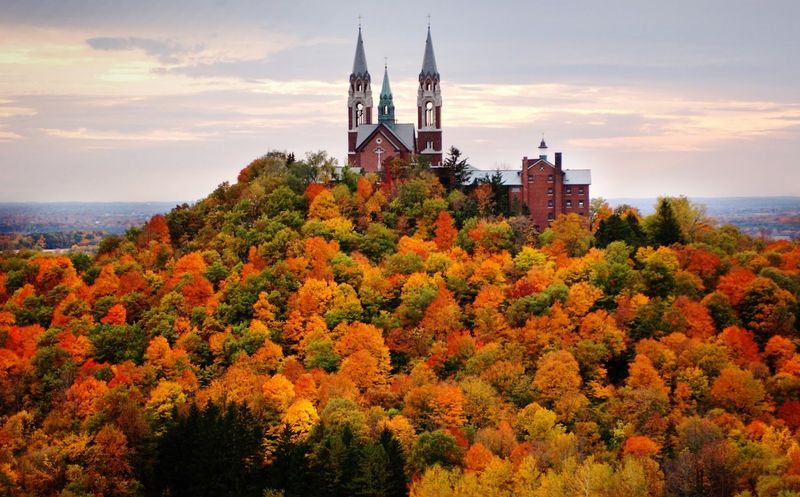
Long before the basilica’s twin towers pierced the Wisconsin skyline, a lone man named Francois Soubrio made Holy Hill his home. He was a French-Canadian hermit who settled on this forested hill in the mid-1800s, carving out a solitary life of prayer among the oaks and pines.
Locals called him the Hermit of Holy Hill, and his story never quite faded with time.
People who visit the grounds at dusk sometimes report catching a glimpse of a kneeling figure near the old wooden crosses that mark the hillside paths. The figure appears still, almost reverent, and then simply is not there anymore.
Whether that is imagination or something else is a question nobody has answered cleanly.
The Carmelite Cemetery tucked below the church adds another layer to his legend. Visitors have described a thick mist that gathers near the headstones, sometimes shaping itself into something that looks startlingly human, with a face, a beard, and hollow eyes.
It dissolves before anyone can look too closely. Soubrio may be gone, but Holy Hill seems reluctant to forget him entirely.
The mist does not rise from the ground like fog. It appears suddenly, as if forming from nothing.
Some have stood at the cemetery gate on a clear evening and watched it roll in without any breeze to carry it. The temperature drops, the silence deepens, and then the shape emerges.
It never stays long enough for a photograph. That may be by design.
Footsteps on an Empty Staircase
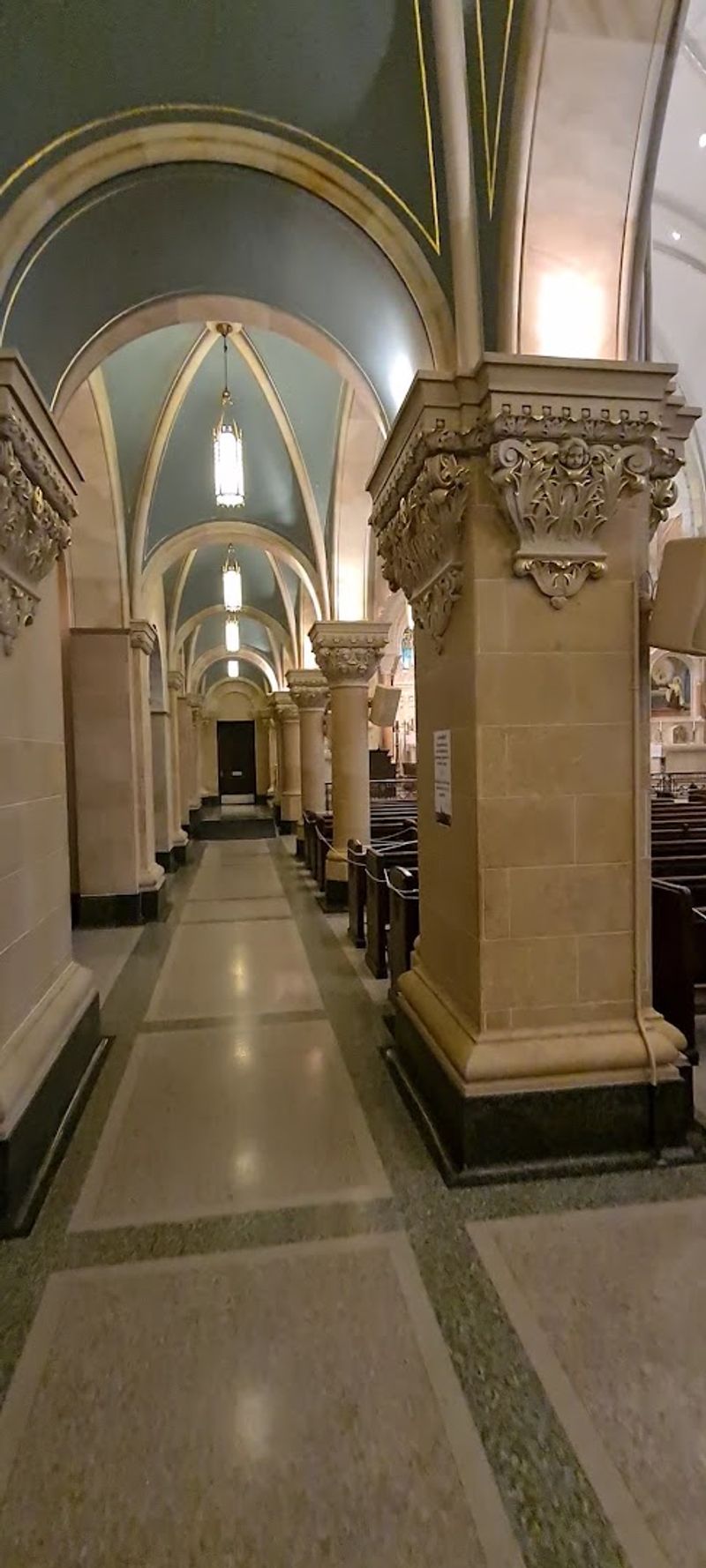
The staircase inside Holy Hill’s tower is not built for the faint of heart. It is narrow, steep, and winds upward through 178 steps before opening to a view that stretches all the way to downtown Milwaukee on a clear day.
Most people are too focused on catching their breath to notice anything unusual on the way up.
But there are accounts, passed quietly among staff and regular visitors, of sounds that do not match the building’s hours. The basilica opens at 6 AM and closes at 5 PM.
Yet some who have been near the locked structure after hours describe the distinct rhythm of footsteps climbing those interior stairs, steady and unhurried, like someone who knows exactly where they are going.
No explanation has been confirmed. The building is checked, the doors are secure, and nobody is found inside.
The sound simply stops. It is the kind of thing that makes you rethink what you assumed about old stone buildings and the histories they absorb over more than a century of prayers, pilgrimages, and quiet devotion.
The footsteps follow the same pattern each time they are reported, starting near the bottom and moving steadily upward. They never descend.
They never pause at the landings. They just climb, reach the top, and vanish into the echo of stone and silence.
No logical explanation has ever fit, and the staff has learned to stop trying to find one.
The Monk Who Vanishes Mid-Step
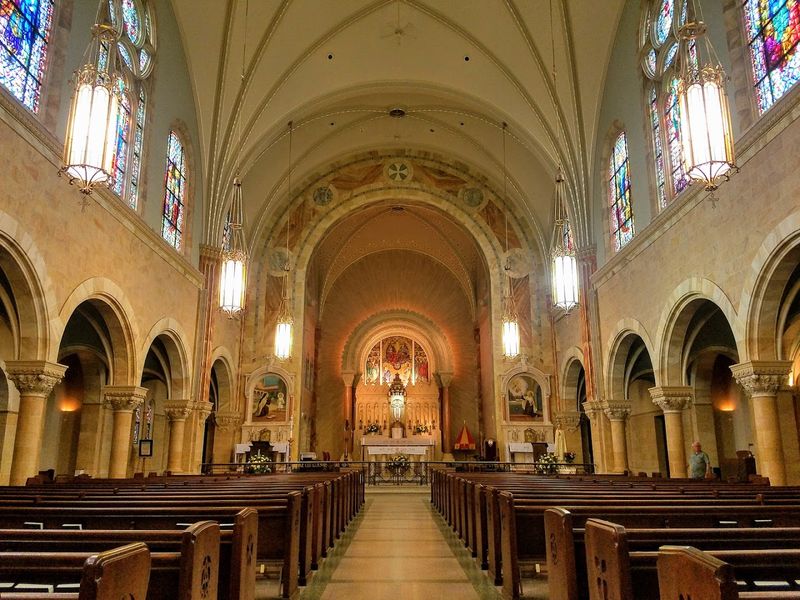
A brown-robed figure has been spotted more than once moving quietly through the basilica and along the prayer trails that wind around the property. Witnesses describe a man in the habit of the Discalced Carmelites, walking with purpose, carrying what looks like a book tucked under one arm.
He does not look up. He does not acknowledge anyone nearby.
When someone approaches to say hello or ask a question, he is simply gone. Not around the corner, not through a door.
Just gone, mid-path, mid-step. The accounts are remarkably consistent across people who had no contact with each other before sharing their stories.
Some connect this figure to a monk who reportedly disappeared from the community in the early 1900s, though no confirmed records have surfaced to pin that detail down. What makes these sightings compelling is not the drama of them but the ordinariness.
People are not expecting a ghost. They are admiring the architecture or walking a trail in the afternoon light, and then suddenly they are questioning everything they just saw.
That quiet disruption is somehow more unsettling than anything theatrical.
The figure never appears at night, always during daylight hours when the property is open and active. He moves through crowds without anyone noticing until after he has passed.
No photograph has ever captured him clearly, though plenty of people have tried. The brown robe blends too easily with the shadows of the stone walls, and by the time the camera is ready, he has already vanished.
Whispers in the Forest Paths
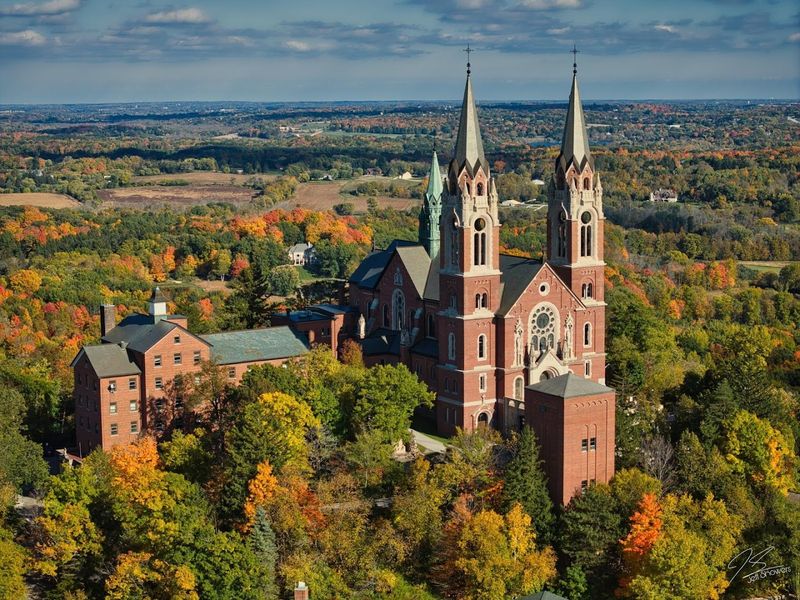
The trails leading up to Holy Hill are genuinely beautiful. Paved and well-maintained, they pass through sections of the Kettle Moraine Forest that turn spectacular shades of copper and amber each fall.
Most visitors use them to reach the Stations of the Cross or simply to enjoy the landscape before heading inside.
Some people, though, have mentioned hearing something else while walking those paths alone. Soft voices.
Not conversation exactly, more like murmuring, close enough to register but impossible to locate. You turn around and there is nobody there.
The trees do not explain it. The wind is not always blowing.
Staff at the shrine are familiar with these accounts and tend to respond with calm rather than alarm. Holy Hill has held more than a century and a half of prayers within its grounds.
Thousands of pilgrims have walked those same paths in grief, in hope, in desperation. If places absorb energy the way some people believe, this hillside has absorbed more than most.
Whether the whispers are spiritual residue or simply the acoustics of old forest land is something each visitor tends to decide for themselves after the walk is done.
Church Bells at the Wrong Hour
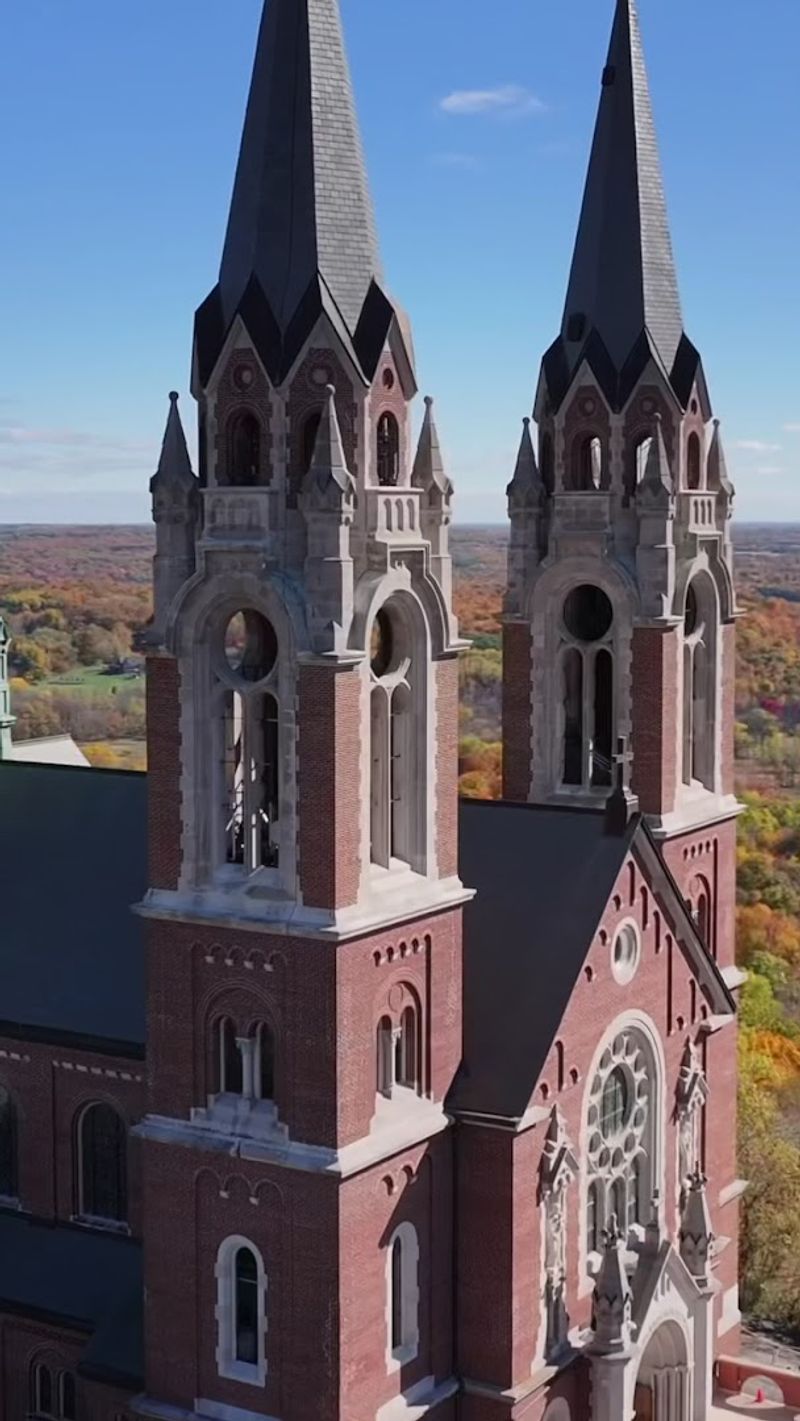
Church bells are supposed to mark the hours. At Holy Hill, the bells have reportedly sounded at times that do not match any scheduled ringing.
Late evenings, early mornings before the basilica opens, moments when the grounds are quiet and the parking lot is empty. The sound carries far across the surrounding hills, which makes it even harder to dismiss.
Nobody has caught the mechanism in the act. The bell system is checked and found normal every time.
There is no obvious mechanical explanation for the off-schedule ringing, and yet the reports come from people who have no reason to invent them. They are often pilgrims, visitors on retreats, or locals who have driven past the hill for decades and know what the bells usually sound like.
A few people describe the sound as comforting rather than frightening. One account described it as feeling like a reminder, though of what exactly, the person could not say.
Holy Hill has that quality about it. Even the unexplained things feel less sinister than they do weighted, like the hill itself is communicating something in a language just slightly out of reach.
That feeling stays with you long after the drive home.
What the Tower View Cannot Explain Away
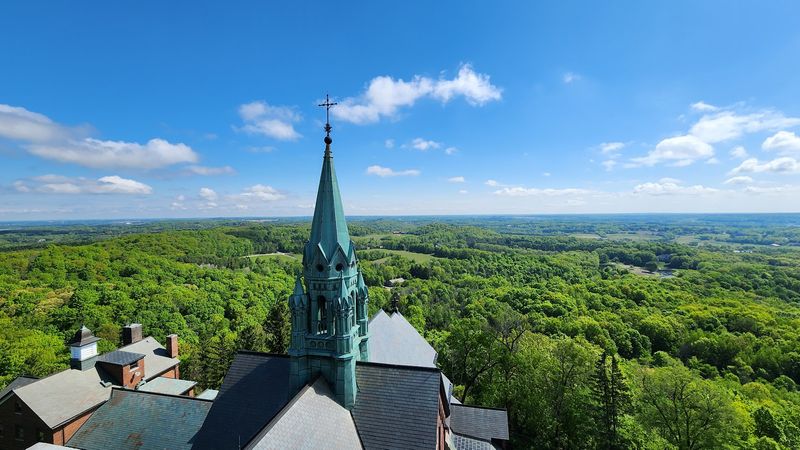
Reaching the top of the tower at Holy Hill is a physical achievement. The 178 steps are narrow and steep, and the upper levels are open to the elements, so wind and cold are real factors depending on the season.
But the view from up there makes every step feel justified. On a clear day, the Milwaukee skyline is visible in the distance, floating above a sea of treetops.
The strange thing about standing at that height is how much it changes your sense of the place below. The grounds look different from up there.
The cemetery in the forest, the winding trails, the little figures of other visitors moving slowly along the paths, it all takes on a different texture. Quiet.
Purposeful. Slightly removed from ordinary time.
That sensation might explain why Holy Hill collects so many unexplained stories. It is a place that already operates at a frequency slightly apart from everyday life.
People arrive carrying something heavy and leave feeling lighter. Others arrive feeling fine and leave with questions they did not have before.
The footsteps, the mist, the vanishing monk, none of it feels random here. It all feels like it belongs to the hill itself.
Address: 1525 Carmel Rd, Hubertus, Wisconsin
