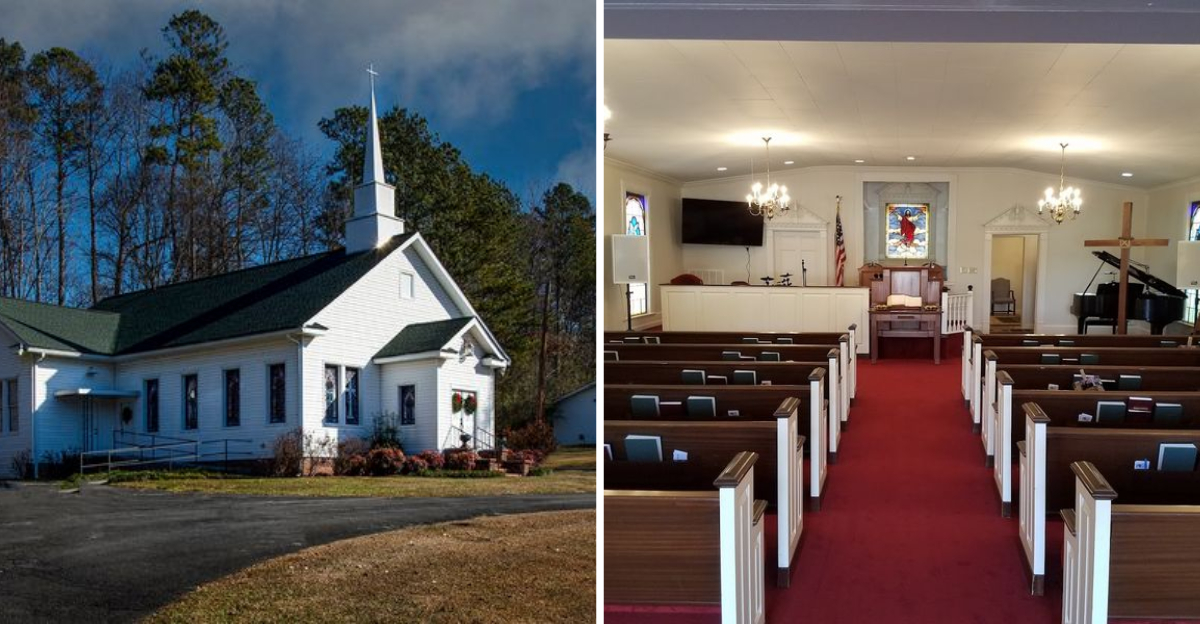
There is something about old Georgia churches that pulls you in, even when every instinct tells you to stay back. The moss draped trees, the crumbling headstones, the silence that feels almost too complete after sunset.
Some carry stories of Civil War devastation. Others are wrapped in local legends so vivid they feel almost real. The road to one narrows so much your headlights barely cut through.
Another sits on land where the Trail of Tears began, and the ground has never stopped grieving. A church built by German settlers in the seventeen hundreds still has people reporting hymns sung in a language no one speaks anymore. It doesn’t matter if you are a history lover or just someone who enjoys a good ghost story, these five Georgia churches deserve your respect and your caution after dark.
Some places are best visited with the sun still high in the sky.
1. Jerusalem Lutheran Church, Ebenezer, Effingham County, GA
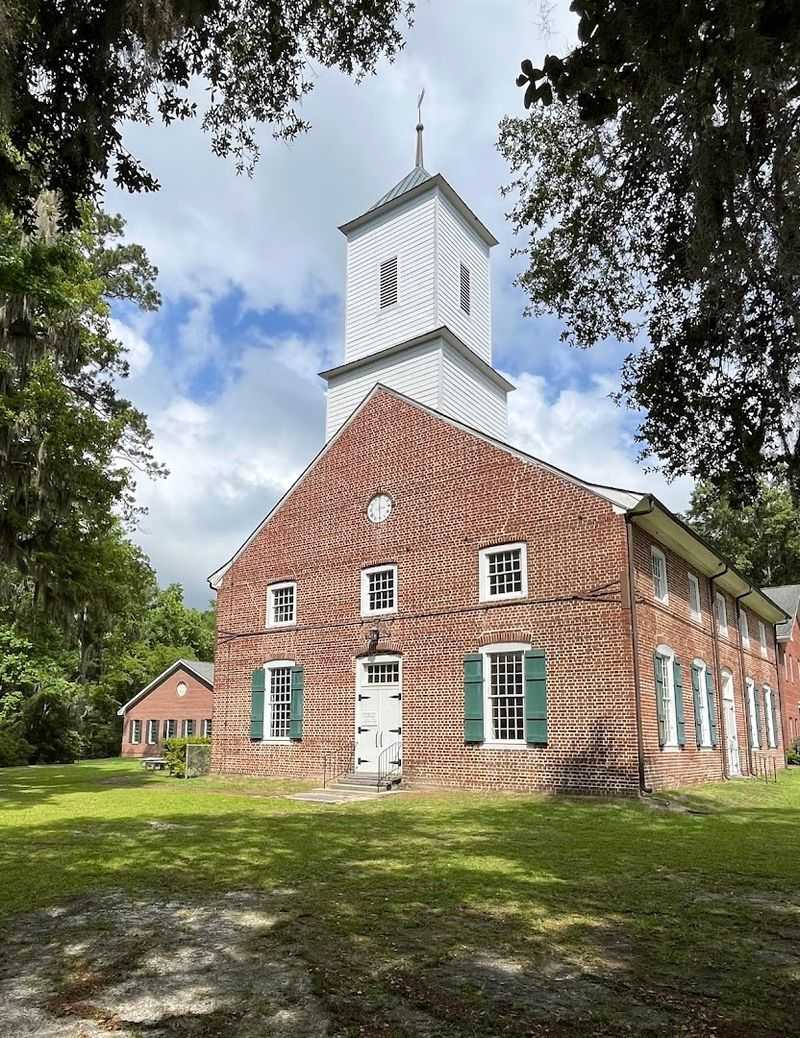
The road to Ebenezer barely feels like a road after sunset. Effingham County’s tree-lined back routes swallow your headlights, and Jerusalem Lutheran Church waits at the end of them, red brick, narrow windowed, and utterly still.
Built in 1769 by German Salzburger settlers, it holds the distinction of being one of Georgia’s oldest standing church structures.
The Salzburgers fled religious persecution in Europe, crossing the ocean for a chance to worship freely in the Georgia colony. They built this church with their own hands, brick by brick, and the craftsmanship has held for over two and a half centuries.
A cemetery crowds close on all sides, its slate markers worn smooth by nearly three hundred years of coastal weather. Some graves are marked only with field stones, names long since lost to time.
After dark, the colonial beauty curdles into something harder to name. The windows catch moonlight in ways that feel intentional.
The brick absorbs the cold and holds it. People who have visited after sunset report an overwhelming sense of being watched, not by anyone living, but by the weight of all those years pressing down at once.
The desperate longing that brought the Salzburgers here tends to linger in the walls long after the last parishioner has gone home. Some say they have seen candles flickering in the windows when the church has been locked and empty for hours.
Others have heard German hymns sung from inside, the words too old for anyone alive to recognize.
No matter if these are tricks of the mind or something real, the effect is the same. You leave with a heavy chest and the urge to look over your shoulder until the headlights find the main road again.
2. Midway Congregational Church, Midway, Liberty County, GA
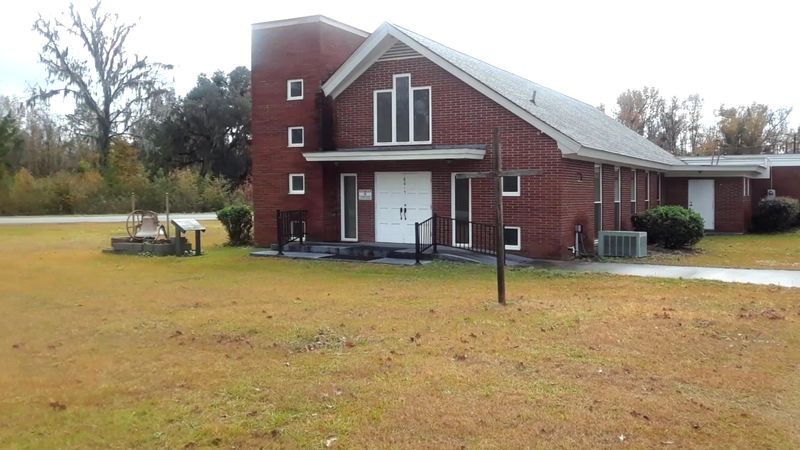
Midway Church looks peaceful enough when the sun is up, white clapboard, a raised tabby foundation, ancient oaks draped in Spanish moss that sway even when the wind seems completely still. The congregation dates to 1752, making it one of the oldest in Georgia, and the cemetery beside it holds the remains of two Revolutionary War generals.
Those men fought for a country that had barely been invented, and their graves are marked with stones that have stood for over two hundred years. The moss does not just hang from the trees.
It moves, even on nights when no breeze reaches your face. That layered history should feel impressive, something worth studying and preserving.
At night, surrounded by swaying moss and the quiet sounds of Liberty County marshland, it feels closer to suffocating than inspiring. The marsh exhales slowly, a low whisper that never quite resolves into words.
The white clapboard glows pale under moonlight, almost translucent. Nobody lingers here past dark without carrying something strange home with them afterward.
A feeling in the chest. A memory that does not belong to you.
A name you cannot place but cannot shake. Local legend says the two generals buried in the cemetery still hold council on certain nights, their voices carrying across the graves in low, serious tones.
Others claim to have seen a woman in colonial dress walking between the headstones, pausing at each one as if reading the inscriptions by moonlight alone. The marsh does not give up its secrets easily, but it does not hide them completely either.
You just have to be there at the right time. Or the wrong time, depending on how you look at it.
3. Old Antioch Baptist Church, Zebulon, Pike County, GA
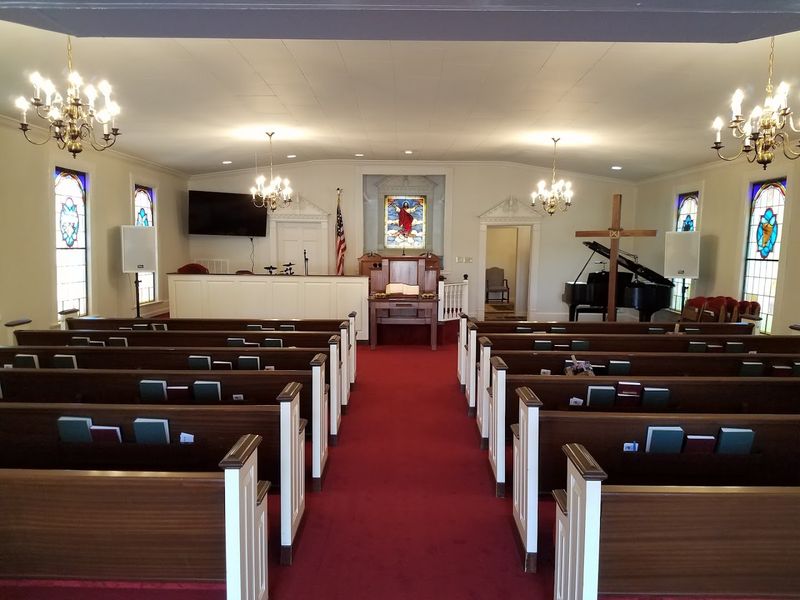
Country churches in Pike County have a way of absorbing the silence around them. Old Antioch Baptist Church in Zebulon is one of those places where that quiet feels deliberate, like it is waiting for something you cannot quite identify.
White painted wood, a tin roof that catches moonlight in strange ways, uneven graves pressing close to the foundation.
The church has not held regular services in years, but the building remains, stubborn and slowly decaying. Locals have kept this one on their mental list of places to avoid after sundown for generations.
They do not always explain why. They just say you should not go, and that is usually enough.
Stories of unexplained lights, shifting shadows between headstones, and the faint suggestion of a congregation that no longer exists have circled this church for as long as anyone can remember.
A few people have reported hearing hymns sung from inside when the building was clearly empty. Others have seen figures kneeling at graves that have not received visitors in decades.
The silence here is not empty. It is full of something that does not want to be disturbed.
One local told me about a night he drove past and saw the church windows glowing from within, warm and yellow like a service was underway.
When he stopped and walked closer, the lights went out one by one, and the door creaked open on its own. There was no one inside.
Just pews, dust, and the smell of old wood and older secrets. He does not drive that road after dark anymore.
4. New Echota Mission Church, Calhoun, Gordon County, GA
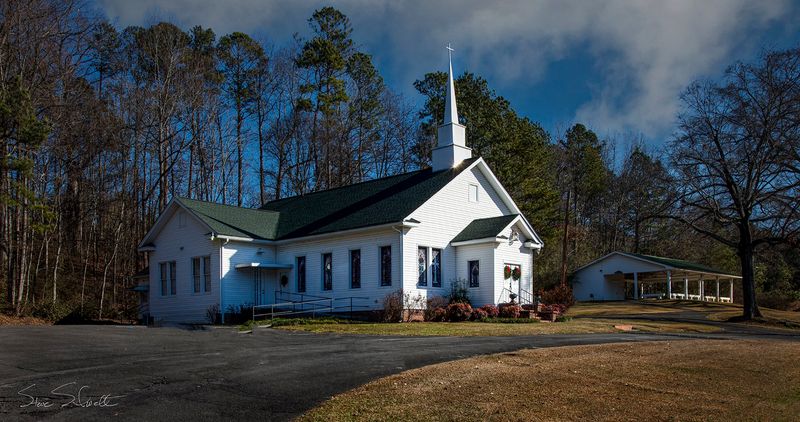
New Echota was the last capital of the Cherokee Nation before the Trail of Tears uprooted thousands of people from their Georgia homeland in 1838. The mission church that stood at the center of this once thriving community witnessed the full weight of that forced removal, and the reconstructed site in Calhoun carries that history in every plank and stone.
This is not a place where the tragedy happened long ago and faded. It is a place where the tragedy is still happening, still present, still heavy in the air.
After dusk, the cedar trees surrounding the building seem to close in rather than recede. They create walls where walls did not exist, narrowing your view until all you can see is the church and the dark between the branches.
Historians and visitors have noted a specific quality to the air here that daylight hours simply do not produce. A thickness.
A stillness. A feeling that the ground remembers what happened on top of it.
This is grief baked into geography, and it does not rest quietly after dark. The Cherokee who walked the Trail of Tears passed through places like this, leaving behind everything they had ever known.
Some of them never stopped walking. Some of them are still here.
Visitors have reported hearing the soft sound of weeping near the church walls, the shuffle of moccasins on packed earth, the murmur of voices speaking a language that has no direct translation into English. Park rangers who work at the reconstructed site often leave before dusk.
They do not need to explain why.
The few who have stayed late say the same thing. The church breathes.
Not like a building settling. Like something alive and deeply sad.
5. Cedar Grove Methodist Church, Louisville, Jefferson County, GA
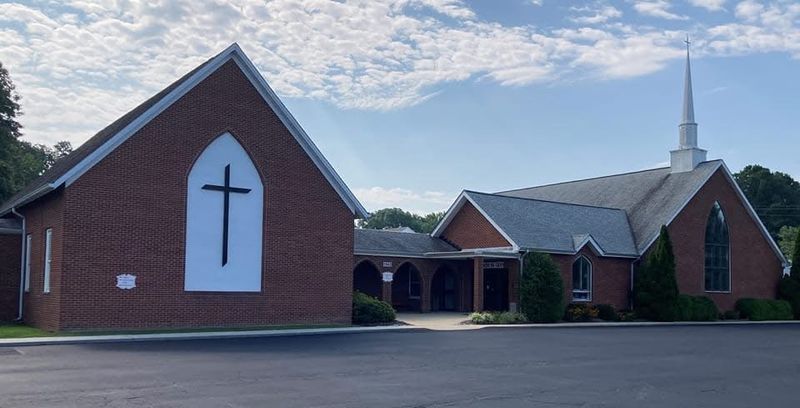
Louisville may have been Georgia’s first state capital, but Cedar Grove Methodist Church tells a quieter chapter of that history. The church sits outside town on a road that narrows as you follow it, flanked by Spanish moss draped oaks that block what little moonlight falls on an overcast night.
You cannot see the church from the main road.
You have to trust that the turn is there, that the gravel will hold, that the trees will eventually open up and reveal what they have been hiding. Jefferson County carries centuries of plantation history, and the ground around Cedar Grove holds stories that were never fully written down.
Enslaved people worshiped here, in separate sections or in the shadows outside the windows. Their descendants still live in the area, still carry the weight of what happened on this land.
Visiting at night means navigating absolute darkness with no streetlights and no neighbors close enough to hear you call out. That alone should give any curious visitor serious pause.
The moss hangs low enough to brush your face. The gravel crunches under your feet in a way that announces your arrival to anyone, or anything, listening.
Some places are best visited with respect, caution, and in the broad light of day. This is one of them.
Those who have ignored the warnings describe hearing footsteps following them on the path even when no one else was there. Others have seen shadowy figures standing near the back door of the church, watching, waiting, never moving closer.
The resting ones do not rest easy here. The living should not either.
