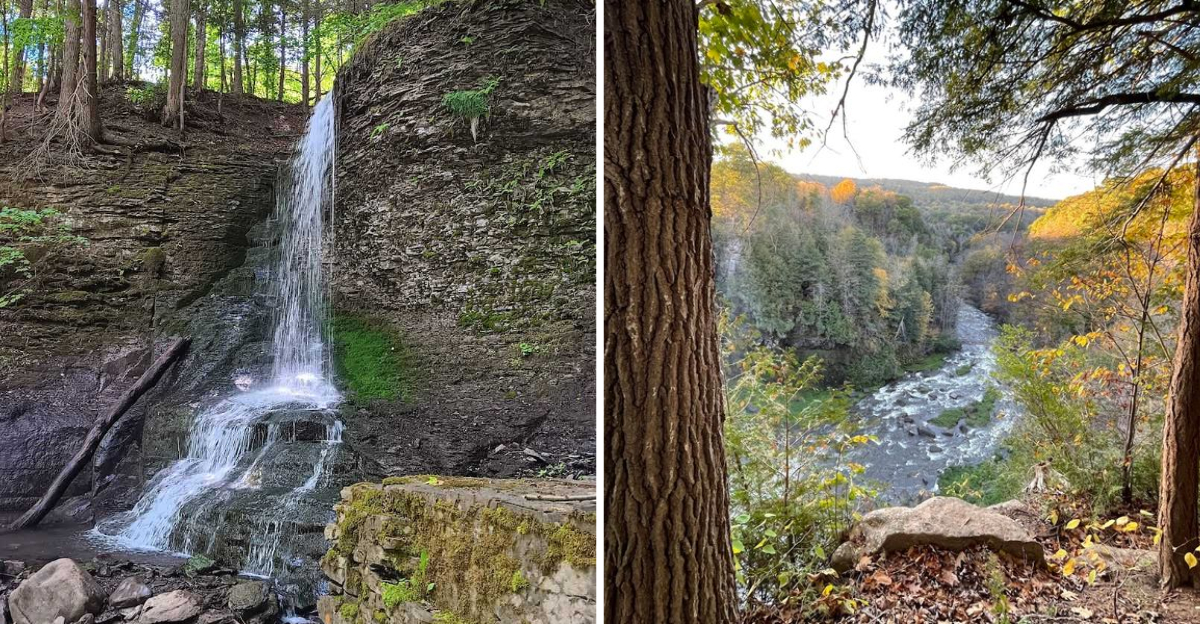
There is something almost unreal about watching a waterfall and knowing the rock it tumbles over was once the floor of a warm, shallow tropical sea. This New York state park has a one hundred sixty seven foot cascade that carries the weight of roughly four hundred million years of earth history in every drop. The bedrock here formed from compressed seafloor sediments when this part of the state was covered by water and sat near the equator.
Distinct horizontal banding in the cliff face shows each layer representing thousands of years of ocean history stacked on top of each other. The waterfall itself was carved much more recently, shaped by glacial activity around ten thousand years ago. You can hike down to a footbridge at the base where the mist reaches you even from a distance.
Old rock, young falls, and one seriously memorable view.
A 167-Foot Waterfall Pouring Over 400-Million-Year-Old Rock
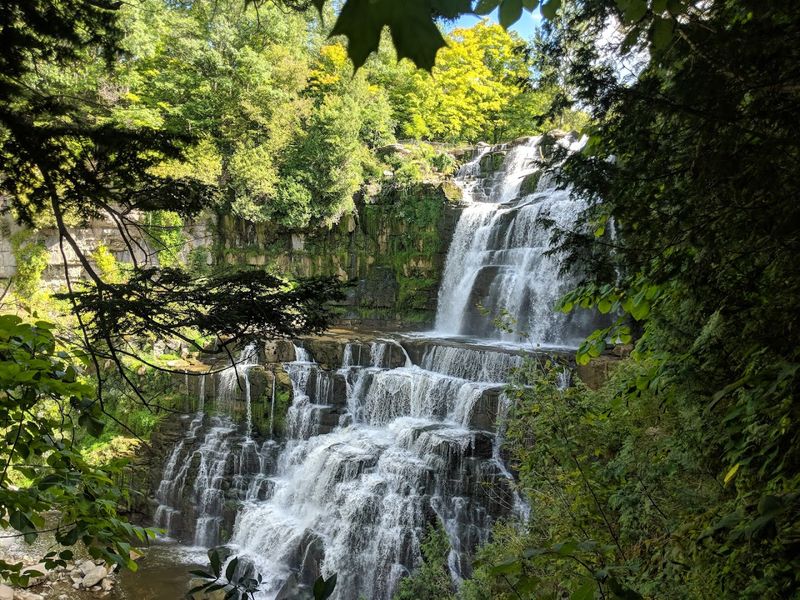
The first time you hear the falls before you see them, something shifts. There is a low, persistent roar that grows louder as you get closer to the overlook, and then suddenly the whole gorge opens up and there it is, a 167-foot ribbon of white water dropping straight down over a wall of ancient stone.
What makes this waterfall different from others in the region is what it is actually falling over. The bedrock here dates back roughly 380 to 400 million years, placing its formation in the Silurian and Devonian periods.
At that time, this part of central New York was covered by a warm, shallow inland sea teeming with marine life.
The falls plunge over the Edgecliff Member of the Onondaga Formation, a lower Middle Devonian limestone layer that formed from compressed seafloor sediments. You can see the distinct horizontal banding in the cliff face from the footbridge below.
Each layer represents thousands of years of ocean history stacked on top of each other. The waterfall itself was carved out much more recently, shaped by glacial activity around 10,000 years ago.
Old rock, young falls, and one seriously memorable view.
The Onondaga Formation and What It Tells Us About an Ancient Sea
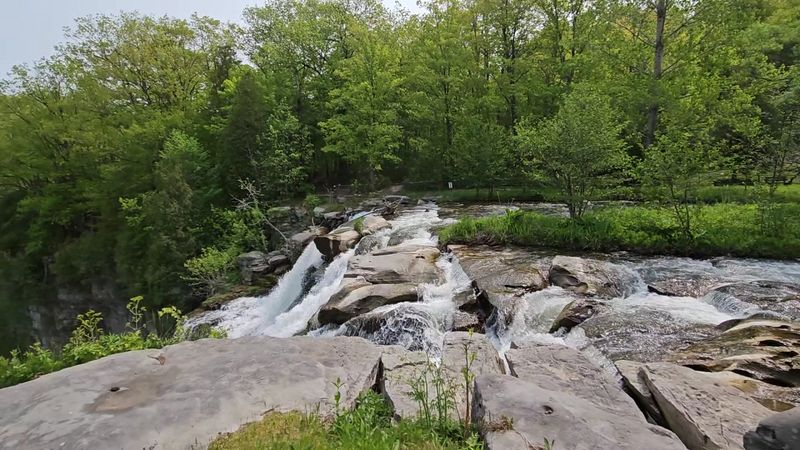
Geology can feel abstract until you are staring directly at a cliff face that used to sit at the bottom of a tropical ocean. The Edgecliff Member of the Onondaga Formation is the specific rock layer over which Chittenango Falls crashes, and geologists have studied it closely because of how well-preserved it is here in the gorge.
The Onondaga Formation dates to the lower Middle Devonian age, roughly 390 million years ago. During that era, a vast inland sea stretched across much of what is now the eastern United States.
Central New York sat near the equator at the time, submerged under warm, nutrient-rich water. Sediment, shell fragments, and marine organism remains accumulated on the seafloor over millions of years, slowly compressing into the limestone and shale we see today.
At the base of the cliff, you can also spot the dolomitic Cobleskill Formation and Chrysler dolostones, which represent even older layers from the Silurian period. The distinct banding in the gorge walls is not just visually striking, it is a timeline you can actually read with your eyes.
Each stripe of rock is a chapter from a world that existed long before humans, dinosaurs, or even most land plants came along.
Fossils Hidden in the Gorge Walls: Corals, Sponges, and Sea Scorpions
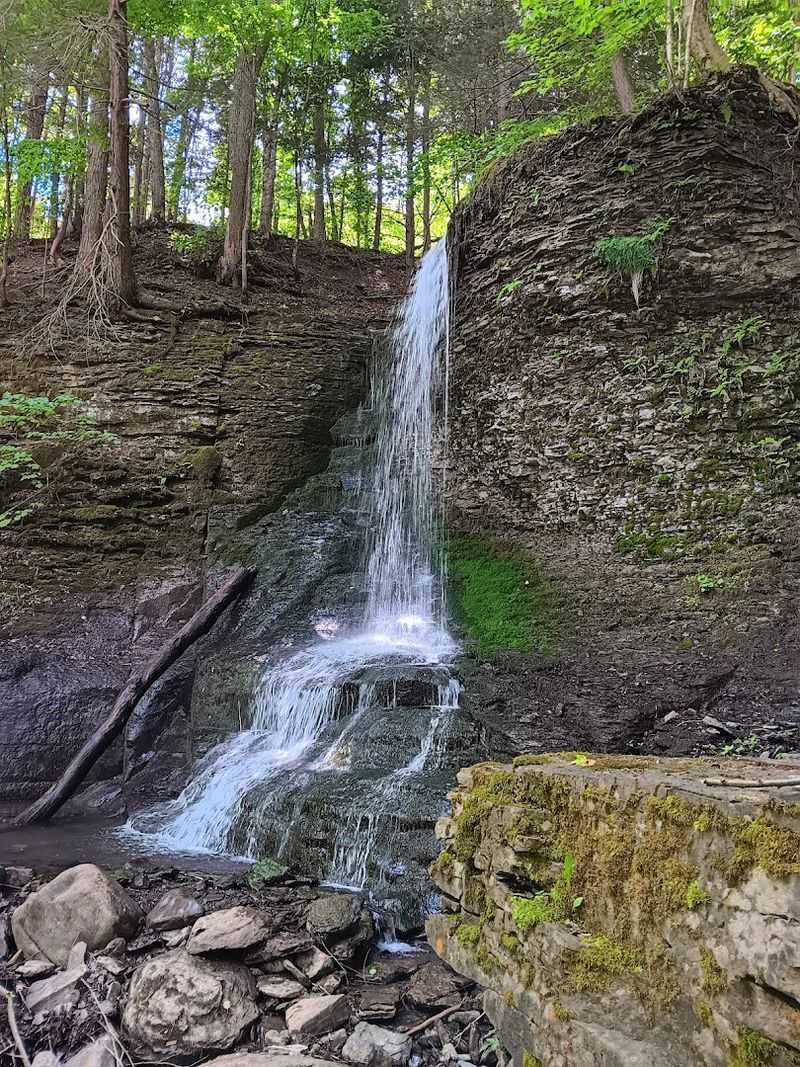
Not many state parks quietly hide sea scorpion fossils in their walls. Chittenango Falls is one of them.
The rock formations here are packed with evidence of the marine world that once existed in this exact spot, and it turns the gorge into something closer to an open-air natural history museum.
Fossils found in the park include early marine algae, stromatoporoids (an ancient type of sponge), corals, mollusks, brachiopods, and ostracods. These were creatures living on and around the seafloor of that Devonian inland sea, and their remains got locked into the sediment as layers built up over time.
The Cobleskill and Chrysler formations have also yielded fragmentary remains of eurypterids, which are the prehistoric sea scorpions that once patrolled ancient coastal waters.
Mudcracks preserved in the Phelps Waterlime hint at past algal mudflats, meaning some areas occasionally dried out, creating a dynamic coastal environment rather than a static deep-sea floor. You will not necessarily spot fossils on a casual walk, but knowing they are there changes how you look at the stone walls around you.
The gorge stops being just scenery and starts feeling like something you are reading rather than simply passing through.
How Glaciers Carved the Gorge Just 10,000 Years Ago
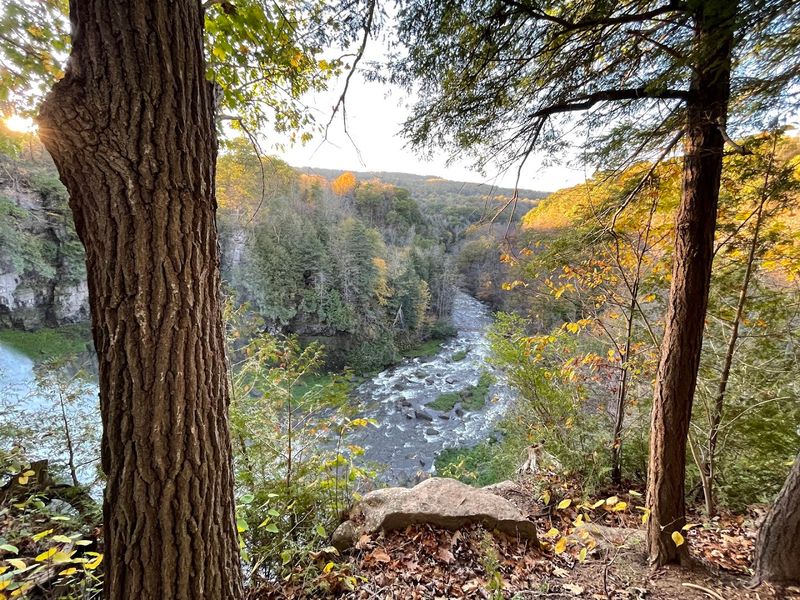
Here is a fun contrast to sit with: the rock at Chittenango Falls is nearly 400 million years old, but the gorge itself is only about 10,000 years young. That gap is one of the most interesting details about this park, and it says a lot about how dramatically the last ice age reshaped this region.
During the last glacial period, massive sheets of ice covered much of North America, including central New York. When those glaciers retreated around 10,000 years ago, meltwater carved aggressively through the ancient bedrock, cutting the deep gorge we see today.
Chittenango Creek found its path through the landscape and began eroding the Onondaga limestone and underlying formations, eventually creating the dramatic drop that forms the falls.
The result is a geological layering effect that feels almost theatrical. You are looking at ancient seafloor that survived hundreds of millions of years relatively intact, then got rapidly sculpted by ice-age forces in what amounts to a geological blink of an eye.
The steep gorge walls, the plunge pool at the base, and the narrow creek corridor all bear the signature of that glacial sculpting. It is one of the cleaner examples in New York State of how recent glaciation left such a visible mark on much older rock.
The Gorge Trail: Getting Down to the Base of the Falls
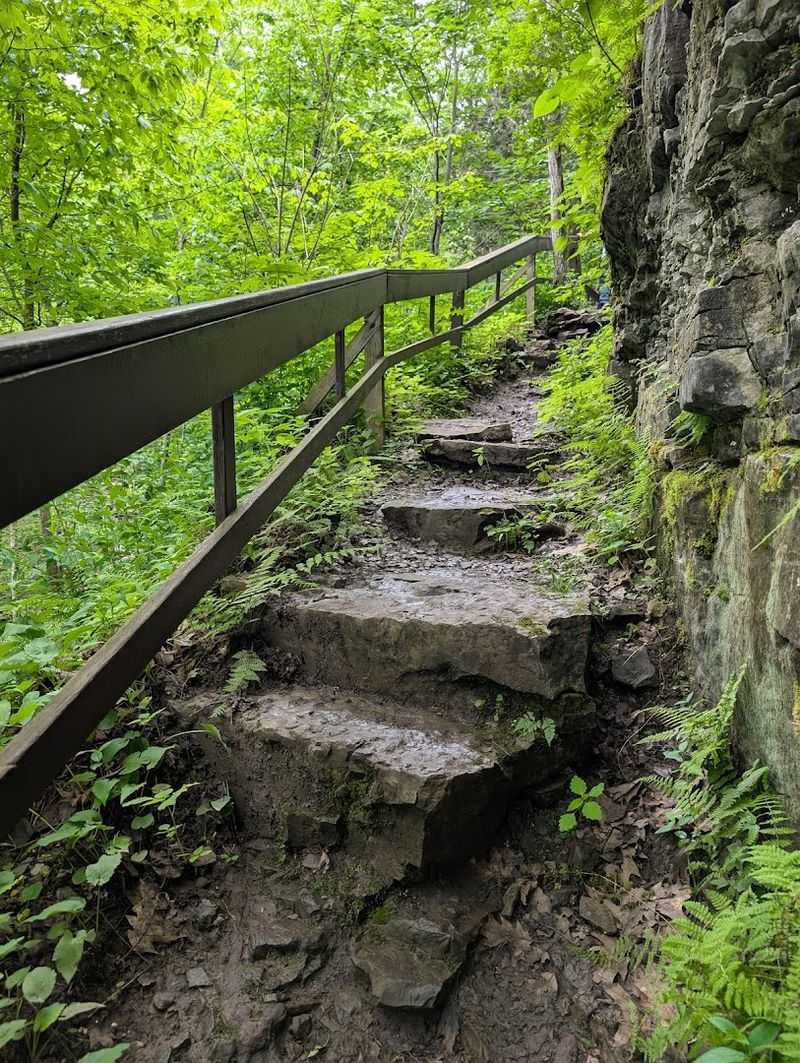
Getting to the bottom of the falls is not a stroll, but it is absolutely worth the effort. The Gorge Trail is roughly half a mile as a loop, and the descent involves a series of stone steps, some of them steep and uneven, especially on the east side of the creek.
Solid footwear is not optional here.
The west side trail is more manageable, with constructed steps, handrails, and a gentler overall incline for most of the descent. That side works well for visitors who want the view without the scramble.
Once you reach the footbridge at the base, the perspective completely changes. From up top, the falls look tall.
From the bridge, they look enormous, with water crashing into the pool below and mist drifting across the stone walls.
The east side of the trail is rougher and more rugged, with natural rock surfaces and a climb that feels more like actual hiking. Both sides meet at the bridge, so you can mix and match based on your comfort level.
The trail signage does a solid job of preparing visitors for what to expect. Going down early in the morning means fewer people on the narrow paths, which makes the whole experience feel more personal and a lot quieter.
The Footbridge View: Where the Park Truly Comes Alive
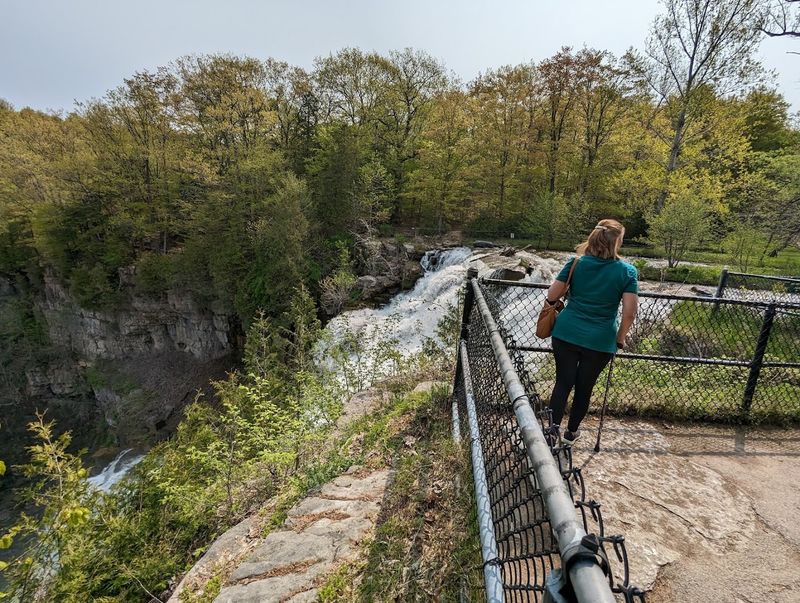
There is a pedestrian bridge at the base of the gorge that was built specifically to frame the waterfall, and it delivers on that promise completely. From the bridge, the falls fill your entire field of view, dropping 167 feet straight down with a sound that you feel as much as hear.
The mist reaches you even from a distance.
The bridge is the payoff for making the descent. It sits at the perfect angle to capture the full height of the falls, which is why so many photos from this park look like they belong on a nature calendar.
Early afternoon light can make the gorge interior a bit shadowy, so morning visits tend to produce better photos and a more vibrant visual experience overall.
Even if photography is not your thing, just standing on the bridge and absorbing the scale of what surrounds you is genuinely moving. The gorge walls rise sharply on both sides, covered in moss and ferns that cling to the ancient limestone.
The creek moves quickly beneath your feet, cold and clear. It is one of those spots where you stop thinking about anything else for a few minutes, which is rarer than it sounds.
The bridge is the heart of the park, and most visitors agree it is the moment the whole trip clicks into place.
Planning Your Visit: Trails, Picnic Areas, and What to Expect
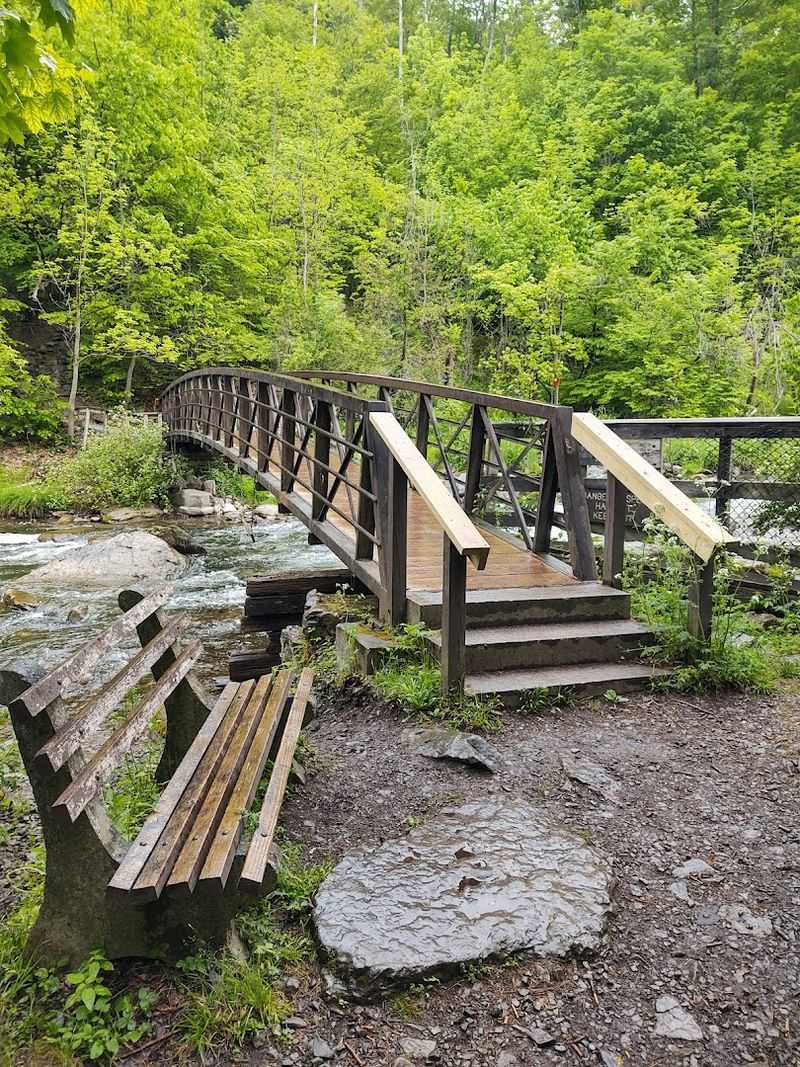
Chittenango Falls State Park is compact, which is actually one of its strengths. You can genuinely see the whole park within an hour or two, making it an easy half-day stop or a quick detour if you are passing through central New York.
The park sits just outside Cazenovia, which is itself worth a look if you have extra time.
The parking lot is small but manageable, and a modest fee is collected at a self-service machine near the entrance. Restrooms are on-site and well maintained, according to just about everyone who visits.
The upper park area includes a playground, picnic tables, charcoal grills, and a large covered shelter, making it genuinely family-friendly beyond just the waterfall itself.
There are two main trail options: the accessible Creekside path along the top, and the steeper Gorge Trail that descends to the bridge. If anyone in your group has mobility concerns, the upper overlook still provides a solid side view of the falls without requiring any significant climbing.
Dogs are welcome on leash. The park is open year-round, and winter visits have their own appeal, with ice formations along the gorge walls and a frozen creek that still rumbles beneath the surface.
Come prepared for the season and you will not be disappointed.
Address: 5241 Gorge Rd #13, Cazenovia, NY 13035
